Concept
Origin of Life and Biology
Origin of Life and Biology Hub, Biology and Christianity, Biology and Design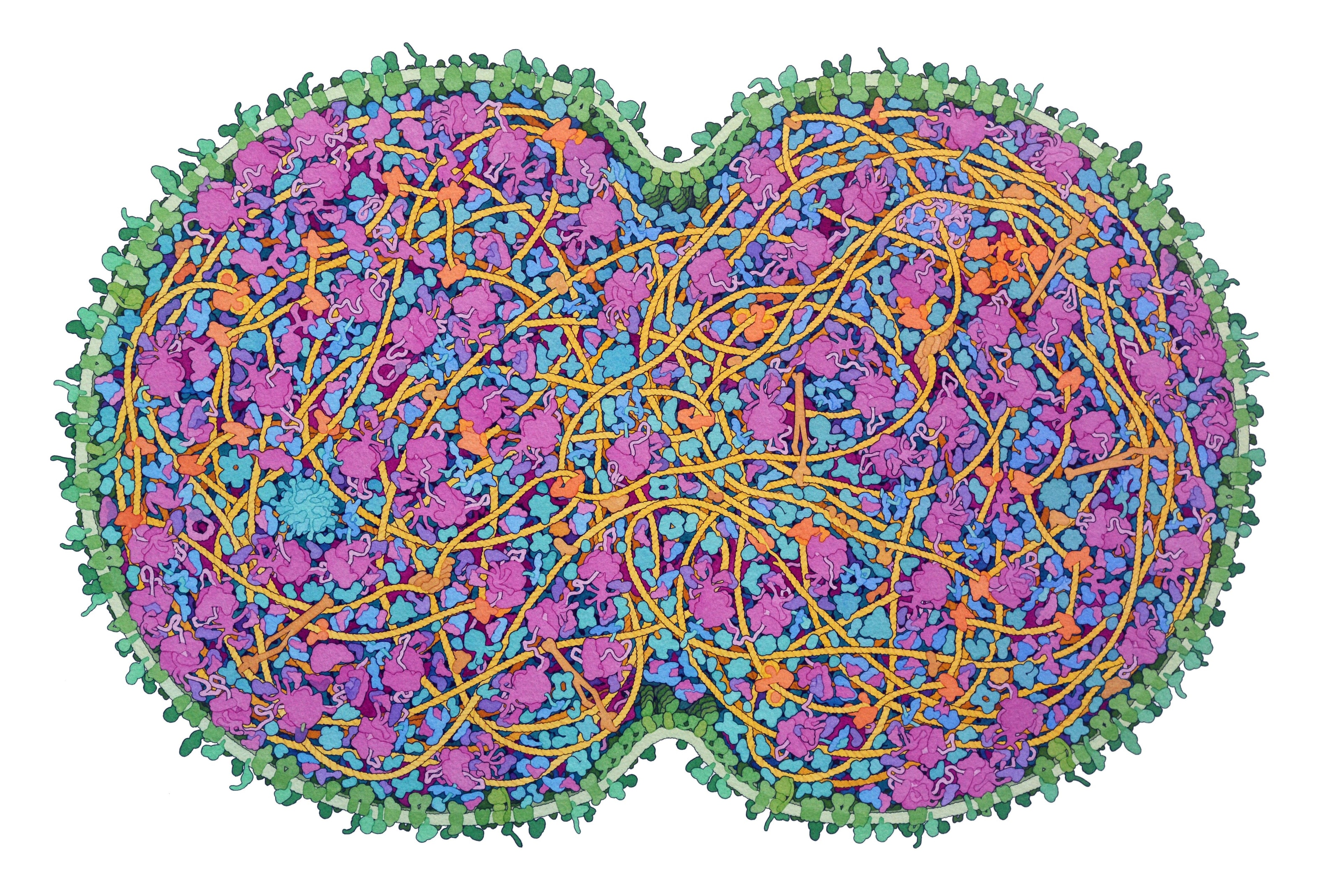
The minimal cell JCVI-syn3A, painted molecule by molecule as it divides. Even the simplest free-living cell scientists have built is crowded with machinery and coded information. Illustration: David S. Goodsell, CC BY 4.0, via Wikimedia Commons, resized.
Intro
Where did life come from? Every living thing we have ever watched come into being came from another living thing. Yet many textbooks teach that the very first cell assembled itself from non-living chemicals, with no guidance at all. How that could happen is one of the biggest open questions in science.
The question gets harder the closer you look. Even the simplest cell runs on DNA, a written code with an alphabet, words and a translation table. It is packed with tiny machines that need each other to work. And once life exists, there is a second question: how much can random mutation and natural selection actually build?
This page is the codex's home for the origin of life and for biology. It gathers the chemistry of life's beginning, the information in DNA, the limits of mutation, the debate over common descent, and two showcases of living design, one of animals and one of the human body. Start with the learning path, or jump to the section you need.
The 30-second version:
All observed life comes from life, and no one has shown how the first cell could assemble itself from chemicals. Even the simplest cell depends on coded information in DNA and on molecular machines that need one another to function. In every case where we know the source of a code, the source is a mind. Christians debate how much evolution explains after life began, but on the origin of life and the origin of biological information, design is the best explanation on offer.
See this page's graph and discover linked topics
In full
Folder hub for the biology sub-area of Origins and Science. It covers four connected questions: abiogenesis (the chemical origin of the first cell and the status of the leading naturalistic models), biological information (the genetic code, specified complexity and the design inference from it), the reach of mutation and selection (waiting times, protein rarity, mutational load and the sudden appearance of animal body plans), and common ancestry (the inference from shared anatomy and shared genetic markers, and the common-design reading of the same data). The folder also holds two design showcases with their own sub-folders: Animals That Defy Evolution (fifty animals in five categories) and 50 Amazing Facts About the Human Body (fifty features of human anatomy and physiology in eight systems).
The codex presents the in-house Christian spread fairly. Young Earth Creationism, Old Earth Creationism, Intelligent Design and Theistic Evolution all have defenders, and the disagreement among them is mainly about common descent and the age of life, not about whether God is Creator. On the origin of life itself, the positions converge: no undirected chemical pathway to a living cell has been demonstrated, and the Information Argument for Design holds that coded information is best explained by a mind.
The concept pages here state the science, the strongest naturalist position, and the design-side reply. The structured premise-conclusion versions live in the Origins argument category and in Teleological Arguments.
Learning path
- The rule all observation supports. Law of Biogenesis, then Abiogenesis.
- The famous experiment and the leading model. Miller-Urey Experiment and RNA World.
- How simple can life be? Minimal Cell and LUCA.
- The code. DNA, Genetic Code, then Specified Complexity.
- Parts that need each other. Irreducible Complexity and Complex Functional Order.
- What mutation can and cannot do. Edge of Evolution, Waiting Time Problem, Genetic Entropy.
- The fossil and genetic record. Cambrian Explosion, Orphan Genes, Common Descent vs Common Design.
- See design up close. Animals That Defy Evolution and 50 Amazing Facts About the Human Body.
The origin of life
- Law of Biogenesis: all observed life comes from life, from Pasteur's experiments to the present.
- Abiogenesis: the claim that the first cell assembled itself from non-living chemicals, and why it remains unsolved.
- Miller-Urey Experiment: the 1953 spark-discharge experiment, what it produced, and what it did not show.
- RNA World: the leading naturalistic model for life's first information carrier, and its problems.
- Minimal Cell: the smallest set of genes and parts that can sustain independent life, and how large that set is.
- LUCA: the proposed last universal common ancestor and the complexity it already carries.
- Water and Life: the anomalous properties of water that every living cell depends on.
Information and design in the cell
- DNA: the four-letter instruction manual in every cell, and why it is evidence for design.
- Genetic Code: the translation table from codons to amino acids, and its error-minimizing structure.
- Specified Complexity: Dembski's criterion for telling designed patterns from chance and necessity.
- Complex Functional Order: many parts arranged so that the whole does something, and why that signals a mind.
- Irreducible Complexity: Behe's case that some systems fail if any core part is removed.
The reach of mutation and selection
- Edge of Evolution: Behe's estimate, from malaria and drug resistance, of what random mutation can achieve.
- Waiting Time Problem: how long a population must wait for coordinated mutations (Durrett and Schmidt 2008, Sanford et al. 2015).
- Genetic Entropy: Sanford's argument that harmful mutations accumulate faster than selection can remove them.
- Orphan Genes: genes with no detectable counterpart in other lineages, and what they imply for common descent.
- Cambrian Explosion: the geologically sudden appearance of most animal body plans about 538 million years ago.
The common descent debate
- Evolution: the three different claims packed into the word "evolution," and where Christians agree and differ.
- Common Descent Critique: the Christian and intelligent-design case against universal common ancestry.
- Common Descent vs Common Design: whether shared anatomy and shared DNA point to a common ancestor or a common designer.
- Human Chromosome 2 Fusion: the fusion evidence offered for human-ape ancestry, and the design-side replies.
- Endogenous Retroviruses: shared viral insertions offered as evidence for common descent, and the replies to that reading.
- Theistic Evolution: the Christian position that God created the diversity of life through evolutionary processes.
- Adam and Eve Historicity: whether Adam and Eve were real people, and how the genetics bears on the question.
Design showcases
- Animals That Defy Evolution: fifty animals whose features press hard on unguided evolution, from the bombardier beetle to the woodpecker.
- 50 Amazing Facts About the Human Body: fifty features of human anatomy and physiology, from the ribosome to the human eye, organized by body system.
Arguments built on biology
Origin of life:
- Argument from Origin of Life: the design inference from the origin of the first cell.
- Biogenesis Argument: all observed life comes from life, so the first life points beyond chemistry.
- Chirality Argument: why life's use of only one mirror form of its building blocks is hard to explain by chance.
- Miller-Urey Reframe Argument: why the famous experiment does not show life can arise unguided.
- RNA World Failure Argument: the case against the leading naturalistic origin-of-life model.
- Lab-vs-Wild Defeater for Origin-of-Life Demonstrations: why carefully guided laboratory chemistry does not show what unguided nature can do.
Information and design:
- Signature in the Cell Argument: Meyer's case that the information in DNA is best explained by intelligence.
- Information Argument for Design: specified information, wherever its source is known, comes from a mind.
- Information Argument: DNA is a real code, and codes come from minds.
- Argument from the Genetic Code: the optimized, near-universal codon table as a design signal.
- Specified Complexity Argument: Dembski's explanatory filter set out as an argument.
- Universal Probability Bound: the threshold below which chance explanations fail.
- Protein Sequence Space Argument: how rare functional protein folds are among possible sequences.
- Irreducible Complexity Argument: Behe's case from systems such as the bacterial flagellum.
- Interdependency Argument: systems whose parts depend on one another cannot arise one part at a time.
- Molecular Machines Argument: the cell's rotary motors, assembly lines and transport systems as evidence of engineering.
- Intelligent Design: the modern design movement, its claims and its critics.
- Inference to the Best Explanation in Bio Origins Argument: why design inference is legitimate historical science.
- Methodological Naturalism Critique: the case against ruling design out of science in advance.
Mutation, fossils and common descent:
- Edge of Evolution Argument: the empirical limits of random mutation set out as an argument.
- Genetic Entropy Argument: mutational load as an argument against deep-time genome building.
- Cambrian Explosion Argument: the sudden origin of animal body plans as an information problem.
- Orphan Genes Argument: lineage-specific genes against the predictions of common descent.
- Phylogenetic Incongruence Argument: why different genes give conflicting trees of life.
- Common Design vs Common Descent Argument: homology read as shared design rather than shared ancestry.
- Convergent Evolution as Design Signal Argument: the same complex solutions appearing in unrelated lineages.
- Hominin Foot and Big Toe Transition Argument: the engineering gap between a grasping foot and a walking foot.
- Top 25 Reasons We Do Not Share a Common Ancestor With Apes: the case against human-ape common ancestry in one place.
- Vestigial Organs and Anatomy Objection Defeater: answering the claim that the body carries useless leftover parts.
- 100 Questions for Evolutionists: probing questions for the claim that unguided processes built all of life.
Human origins:
- Population Genetics for Historical Adam Argument: population-genetic models compatible with a single first couple.
- Mitochondrial Eve Argument: what the maternal genetic line implies about human origins.
Further reading in the codex
- Hard Questions for Abiogenic Life: the questions materialist accounts of life's origin still have to answer.
- Abiogenesis Under the Microscope: ris3n's scientific and philosophical critique of abiogenesis, with the full paper.
- The Riddle of Consciousness: the hard problem of consciousness, and why the mind resists a purely chemical account.
- Methodological Naturalism: the difference between a working method in science and a worldview.
Apologetic deployment
Start with the first cell. The origin of life is where the naturalistic story is weakest, and mainstream researchers say so themselves. Ask how the first self-replicating cell, with its code and its machinery, came about without guidance.
Then follow the information. DNA is a code in the full technical sense. Every code whose origin we know came from a mind. That is an argument from what we know, not from what we do not know.
Keep the common descent debate in proportion. Christians disagree about common ancestry. The design inference from the origin of life and from biological information holds whichever view of common descent turns out right.
Also in this section
50 Amazing Facts About the Human Body
- Acid-Base Balance: Blood pH is regulated within roughly 7.35 to 7.45 by an integrated three-tier system.
- Antibody Diversity: Your body can manufacture an antibody shaped to grip almost any molecule it will ever meet, including molecules that have never existed in nature...
- ATP Synthase: ATP synthase is a two-part rotary machine embedded in the inner membrane of mitochondria, and in the membranes of chloroplasts and bacteria.
- Bipedal Balance and Gait: Habitual upright bipedalism is a coordinated engineering package, not a single trait.
- Blood Sugar Control: Blood glucose is regulated by opposing hormones from the islets of Langerhans in the pancreas.
- Bone: Bone is not the dry, dead scaffolding it looks like in a museum.
- Capillary Exchange: Capillaries are the exchange tier of the circulation, vessels roughly a single red blood cell wide with walls only one endothelial cell thick, so the diffusion...
- DNA Data Storage: The human genome stores roughly 3.2 billion base pairs in each nucleus, and because each base position carries one of four possibilities it encodes two bits...
- DNA Proofreading and Repair: DNA replication in humans starts with an intrinsic error rate around one wrong base in 100,000, far too sloppy to sustain a large genome.
- From One Cell to Trillions: Human development runs a staged, self-executing program.
- Hemoglobin: Hemoglobin is a protein built from four folded subunits, two alpha and two beta chains in the adult form, each cradling an iron-containing heme group...
- Immunological Memory: After a primary infection, the responding B and T cell populations expand enormously, clear the pathogen, and then contract as most effector cells undergo...
- Innate Defenses and Inflammation: Innate immunity is the body's fast, general-purpose defense, and it works in layers.
- Memory: Human memory is not one thing but a set of coordinated processes.
- Muscle: Skeletal muscle contracts by the sliding-filament mechanism.
- Nerve Signal Speed: A nerve signal is the action potential, a self-propagating wave of voltage produced when voltage-gated sodium channels open, sodium rushes in and depolarizes...
- Neuroplasticity: Neuroplasticity operates on several scales at once.
- Protein Folding and Chaperones: Levinthal's paradox frames the problem: a modest protein of 100 amino acids, with even a few possible orientations per bond, could in principle adopt something...
- Red Blood Cells: A red blood cell (erythrocyte) is a specialized oxygen-transport container.
- Self vs Non-Self Recognition: Nearly every nucleated cell presents fragments of its internal proteins on MHC class I molecules, and specialized antigen-presenting cells display engulfed...
- Sleep and the Glymphatic System: The glymphatic system, described by Maiken Nedergaard's group in 2012 and 2013, is a brain-wide clearance pathway.
- Taste: Taste begins in taste buds, clusters of about 50 to 100 receptor cells housed in the papillae of the tongue and palate.
- The Birth Transition: Fetal circulation is engineered around the fact that the fetus gets oxygen from the placenta, not the lungs, so blood is deliberately routed to bypass...
- The Blood Clotting Cascade: Blood coagulation is a cascade: an enzyme activates the next enzyme, which activates the next, so a small initiating signal is amplified into a decisive...
- The Blood-Brain Barrier: The blood-brain barrier is formed chiefly by the endothelial cells lining the brain's capillaries, which differ from ordinary capillary endothelium in three...
- The Cell Membrane and Its Gates: The cell membrane is a phospholipid bilayer: molecules with water-loving heads and water-fearing tails that spontaneously arrange into a two-layer sheet...
- The Circadian Clock: The circadian clock is a molecular oscillator built on a transcription-translation feedback loop.
- The Cochlea: The cochlea is a coiled, fluid-filled tube of about two and a half turns.
- The Complement System: Complement is a cascade of roughly thirty plasma and membrane proteins that activate one another in sequence.
- The Design of Human Milk: Human milk is an adaptive, multifunctional secretion whose composition changes over the course of lactation and even within a single feeding.
- The Genetic Code: The genetic code maps the 64 possible three-letter codons, drawn from a four-letter alphabet read in triplets, onto the 20 standard amino acids plus start...
- The Genetic Program of Development: Animal development is governed by developmental gene regulatory networks, dGRNs, hierarchical circuits of regulatory genes and the DNA switches they bind.
- The Gut Microbiome: The human gut hosts a microbial community numbering in the trillions, dominated by bacteria but including archaea, fungi, and viruses, collectively carrying far...
- The Human Connectome: The adult human brain contains on the order of 86 billion neurons and a comparable number of glial cells, with each neuron forming an average of several...
- The Human Eye: The eye is a matched optical and electrochemical system.
- The Human Hand: The human hand has 27 bones: 8 carpals in the wrist, 5 metacarpals in the palm, and 14 phalanges in the fingers and thumb.
- The Human Heart: The human heart is a muscular double pump: the right side receives oxygen-poor blood and sends it to the lungs, the left side receives oxygen-rich blood...
- The Kidney: The functional unit of the kidney is the nephron, and each kidney holds roughly one million of them.
- The Liver: The liver weighs about 1.5 kilograms and processes roughly 1.4 liters of blood every minute through a dual blood supply: oxygen-rich blood from the hepatic...
- The Placenta: The placenta is a transient fetal-maternal organ, mostly built from fetal tissue, that interfaces two separate circulatory systems.
- The Ribosome: The ribosome is a two-subunit molecular machine of roughly 2.5 megadaltons in humans, built from several ribosomal RNA molecules and about 80 proteins.
- The Sense of Smell: Humans carry roughly 400 functional types of olfactory receptor, each the product of its own gene; these make up the largest gene family in the genome, though...
- The Spine: The human vertebral column is a stack of 33 vertebrae: 7 cervical in the neck, 12 thoracic anchoring the ribs, 5 lumbar in the lower back, 5 fused...
- The Vascular Network: The vascular network is a closed, branching transport system with three tiers: arteries carry blood away from the heart under high pressure, veins return...
- The Vestibular System: Aircraft and spacecraft carry an inertial guidance unit, a package of gyroscopes and accelerometers that lets the vehicle know how it is turning and tilting...
- Thermoregulation: Core body temperature is regulated around a set-point near 37 degrees Celsius by the preoptic area of the anterior hypothalamus, which integrates signals...
- Touch and Proprioception: Touch is not one sense but several, each with its own specialized receptor.
- Vision Processing: Vision begins in the retina, itself a piece of neural tissue where photoreceptors transduce light and layers of bipolar, horizontal, amacrine, and ganglion...
- Wound Healing: Wound healing proceeds through four overlapping, tightly ordered phases.
Animals That Defy Evolution
- Abalone: Abalone (Haliotis) shell is built in two layers: an outer calcite layer and an inner nacre of aragonite, a crystalline form of calcium carbonate.
- Acacia Ant: Swollen-thorn acacias (such as Vachellia cornigera, the bullhorn acacia) and their obligate ant guards (Pseudomyrmex ferrugineus and relatives) form a defensive...
- Antarctic Icefish: Notothenioid icefish of the family Channichthyidae, along with related Antarctic notothenioids, produce antifreeze glycoproteins (AFGPs): repeating chains...
- Archerfish: Toxotes species shoot prey from overhanging vegetation with a jet of water formed inside the mouth.
- Arctic Tern: Sterna paradisaea performs the longest known annual migration of any animal.
- Axolotl: The axolotl, Ambystoma mexicanum, performs epimorphic regeneration.
- Bar-Tailed Godwit: Limosa lapponica, especially the baueri and menzbieri populations, performs the longest documented nonstop migratory flights of any bird.
- Bat: Echolocating bats emit ultrasonic pulses, typically 20 to over 100 kilohertz, through the mouth or nose and reconstruct their surroundings from the returning...
- Bobtail Squid: The sepiolid squid Euprymna scolopes houses the bioluminescent bacterium Aliivibrio fischeri (formerly Vibrio fischeri) in a dedicated bilobed light organ...
- Bombardier Beetle: Brachinus and related genera combine stored hydroquinones and hydrogen peroxide with the enzymes catalase and peroxidase in a thick-walled reaction chamber.
- Butterfly Metamorphosis: Complete metamorphosis in butterflies runs through egg, larva, pupa, and adult.
- Chameleon: Chameleons combine two integrated systems.
- Cleaner Wrasse: Cleaner wrasses of the genus Labroides maintain stationary cleaning stations on coral reefs where "client" fish, including large piscivores, queue...
- Clownfish and Sea Anemone: Anemonefish (about thirty species in Amphiprion and Premnas) live among the tentacles of host sea anemones whose nematocysts (stinging cells) are deadly to most...
- Coral and Zooxanthellae: Reef corals (order Scleractinia) host symbiotic dinoflagellate algae of the genus Symbiodinium and its relatives, the zooxanthellae, inside membrane-bound...
- Cuttlefish: Cuttlefish skin contains chromatophores, pigment-filled organs each surrounded by radial muscles under direct neural control; expanding or relaxing the muscles...
- Diving Bell Spider: Argyroneta aquatica, the only spider that spends its entire life underwater, constructs a dome-shaped web (the diving bell) anchored to aquatic vegetation...
- Dung Beetle: Dung beetles (notably Scarabaeus species) roll balls of dung along straight-line escape paths, and experiments by Marie Dacke and colleagues showed that they...
- Electric Eel: Electrophorus electricus generates its discharge from electrocytes, flattened cells derived from muscle tissue, arranged in long series-wired columns within...
- European Eel: Anguilla anguilla is a catadromous fish with a famously cryptic life cycle, only recently confirmed by satellite tracking of spawning-bound adults.
- Fig Wasp and Fig: Figs (Ficus, around 750 species) and their pollinating fig wasps (family Agaonidae, such as Blastophaga) form a strict, often one-to-one obligate mutualism...
- Firefly: Firefly bioluminescence is produced in a specialized abdominal organ where the substrate luciferin is oxidized by the enzyme luciferase in the presence of ATP...
- Gecko: Gecko adhesion is a dry, structural system, not a chemical glue or a suction cup.
- Giraffe: The giraffe (Giraffa) solves a hydrostatic problem no other land animal faces.
- Glowworm: Arachnocampa glowworms produce light by bioluminescence: an enzyme acts on a luciferin substrate in the presence of oxygen and ATP, emitting a blue-green glow...
- Goby and Pistol Shrimp: Many species of alpheid snapping shrimp (the "pistol" shrimp) form obligate or near-obligate partnerships with gobiid fishes (watchman or shrimp gobies).
- Honeyguide: The greater honeyguide (Indicator indicator) of sub-Saharan Africa leads human honey-hunters to wild bee colonies in a genuine interspecies mutualism.
- Hummingbird: Hummingbirds (family Trochilidae) achieve sustained hovering through a specialized wing and flight stroke: the wing moves in a horizontal figure-eight...
- Leafcutter Ant: Leafcutter ants (Atta and Acromyrmex) practice obligate fungiculture: foragers harvest fresh vegetation not as food but as substrate for a cultivated...
- Mantis Shrimp: Smashing stomatopods strike with a raptorial appendage powered by elastic energy storage rather than direct muscle contraction.
- Monarch Butterfly: The eastern population of Danaus plexippus completes a multi-generational migration of up to roughly 3,000 miles to overwintering sites in the oyamel fir...
- Morpho Butterfly: The blue of Morpho wings is structural color, not pigmentary.
- Mussel: Marine mussels such as Mytilus edulis anchor by the byssus, a bundle of byssal threads tipped with adhesive plaques secreted by the foot.
- Octopus: The octopus combines several integrated systems.
- Oxpecker: Oxpeckers (Buphagus africanus, the yellow-billed, and Buphagus erythrorynchus, the red-billed) are African starling relatives that live almost entirely...
- Peacock: The peacock train shows structural color, not pigmentary color.
- Pistol Shrimp: Snapping shrimp of the family Alpheidae possess one greatly enlarged chela with a specialized plunger ("dactyl") and socket.
- Pit Viper: Crotaline snakes, the pit vipers (rattlesnakes, copperheads, lanceheads, and relatives), possess paired loreal pit organs, one on each side of the head between...
- Platypus: The platypus (Ornithorhynchus anatinus) is a monotreme that combines traits typically segregated across vertebrate classes.
- Salmon: Anadromous salmon (Oncorhynchus and Salmo species) hatch in freshwater, migrate to the sea, and return years later to spawn, displaying natal homing...
- Sea Turtle: Sea turtles, including loggerheads (Caretta caretta) and green turtles (Chelonia mydas), display natal homing: females return to nest near their own hatching...
- Shark: Sharks and other elasmobranchs possess the ampullae of Lorenzini, an electroreceptive system of subdermal sensory organs concentrated around the snout and head.
- Spider: Spider silk is a protein fiber spun from spidroins, large repetitive proteins stored as a concentrated liquid crystalline dope in the silk glands.
- Star-Nosed Mole: The star-nosed mole (Condylura cristata) bears a nasal appendage of 22 mobile, fleshy rays studded with roughly 25,000 to 27,000 Eimer's organs, mechanosensory...
- Tardigrade: Tardigrades enter cryptobiosis, specifically anhydrobiosis (life without water), by forming a tun in which they lose up to roughly 95 to 99 percent...
- Termite and Gut Microbes: Lower termites cannot metabolize the cellulose in their woody diet on their own; digestion is carried out by an obligate community of symbionts housed...
- Trap-Jaw Ant: Trap-jaw ants (notably Odontomachus and Anochetus) use a spring-latch power-amplified mandible strike.
- Wood Frog: Lithobates sylvaticus (formerly Rana sylvatica) tolerates the freezing of up to about 65 to 70 percent of its total body water as extracellular ice.
- Woodpecker: Woodpeckers (family Picidae) excavate wood by rapid pecking, with impact decelerations on the order of hundreds of g.
- Yucca Moth and Yucca Plant: The yucca and its pollinating moths (Tegeticula and Parategeticula) form one of biology's clearest obligate mutualisms.
See also
- Origins and Science, the parent hub
- Cosmology and Physics, the sister hub for the beginning and fine-tuning of the universe
- Origins, the argument category for biological design and origins
- Teleological Arguments, the argument category for design
- Evolution, the three meanings of "evolution" and the Christian positions on each
- Intelligent Design, the modern design movement
- Young Earth Creationism, the young-earth reading of biological history
- Adam and Eve Historicity, the question of the first human couple
Common questions this page answers
Q: How did life begin, according to science?
Science has no settled answer. The leading naturalistic proposals, such as the RNA World, remain hypotheses with serious unsolved problems, and every observed living thing comes from another living thing (Law of Biogenesis). Abiogenesis sets out where the research stands.
Q: Did the Miller-Urey experiment show that life can form by itself?
No. The 1953 experiment produced some amino acids, which are building blocks, from a gas mixture chosen by the experimenters. It produced no proteins, no DNA and no cell, and the gas mixture it used is now widely doubted as a model of the early Earth. See Miller-Urey Experiment and Lab-vs-Wild Defeater for Origin-of-Life Demonstrations.
Q: Is DNA evidence for God?
DNA stores information in a four-letter code that is read and translated by cellular machinery. In every case where the source of a code is known, it is a mind, so the Information Argument for Design and the Signature in the Cell Argument infer an intelligent source for the information in life. See DNA and Genetic Code.
Q: What is irreducible complexity?
Irreducible Complexity is Michael Behe's term for a system that needs several matched parts all present before it works at all, like a mousetrap. Such systems are hard to build one small useful step at a time, which is what unguided evolution requires.
Q: Do Christians have to reject evolution?
Christians hold several positions. Young-earth and old-earth creationists reject universal common descent, theistic evolutionists accept it, and intelligent-design advocates differ among themselves. All agree that God is the Creator. Evolution separates the three meanings of the word, and Common Descent vs Common Design lays out the debate over shared ancestry.
Q: What is the Cambrian explosion?
The Cambrian Explosion is the appearance of most major animal body plans in the fossil record within a geologically short window around 538 million years ago. Stephen Meyer argues that the burst of new biological information it requires is best explained by design (Cambrian Explosion Argument).