Concept
Star-Nosed Mole
Intro
The star-nosed mole wears its most important organ on the end of its face. Ringing its nostrils are twenty-two pink fleshy rays arranged in a star, and that star is not for smelling. It is a touch organ, packed with more than twenty-five thousand tiny sensory bumps wired to a huge share of the animal's brain. The mole is nearly blind and lives in dark, wet tunnels, so it reads the world by touch at blinding speed. The star sweeps across the ground, the mole detects a worm, decides it is food, and eats it in well under a second, faster than any other mammal can find and seize a meal. The star, the dense receptors, the dedicated brain map, and the high-speed nerve wiring all have to be present and connected for any of it to work. An organ that only functions when sensor, wiring, and brain map are built and matched together carries the fingerprint of design.
In full
The star-nosed mole (Condylura cristata) bears a nasal appendage of 22 mobile, fleshy rays studded with roughly 25,000 to 27,000 Eimer's organs, mechanosensory structures densely innervated by tens of thousands of nerve fibers. The star is a high-resolution active-touch organ, not olfactory; the mole sweeps it across the substrate and performs serial "tactile fixations," with the small eleventh ray pair acting as a tactile fovea fixated on candidate prey. Detection-to-ingestion times can fall below 230 milliseconds, the fastest documented foraging in any mammal, and the system supports underwater "sniffing" by exhaling and re-inhaling air bubbles to carry scent. Each component is interdependent: the patterned rays, the dense Eimer's-organ array, the dedicated high-bandwidth nerves, the enlarged and precisely mapped somatosensory cortex, and the rapid motor-sensory loop are jointly required for the high-speed touch system to function. This is an Irreducible Complexity case: a star with no cortical map, or a cortical map with no receptors, yields no fast tactile foraging, and a partial array delivers no usable high-resolution sense for selection to favor.
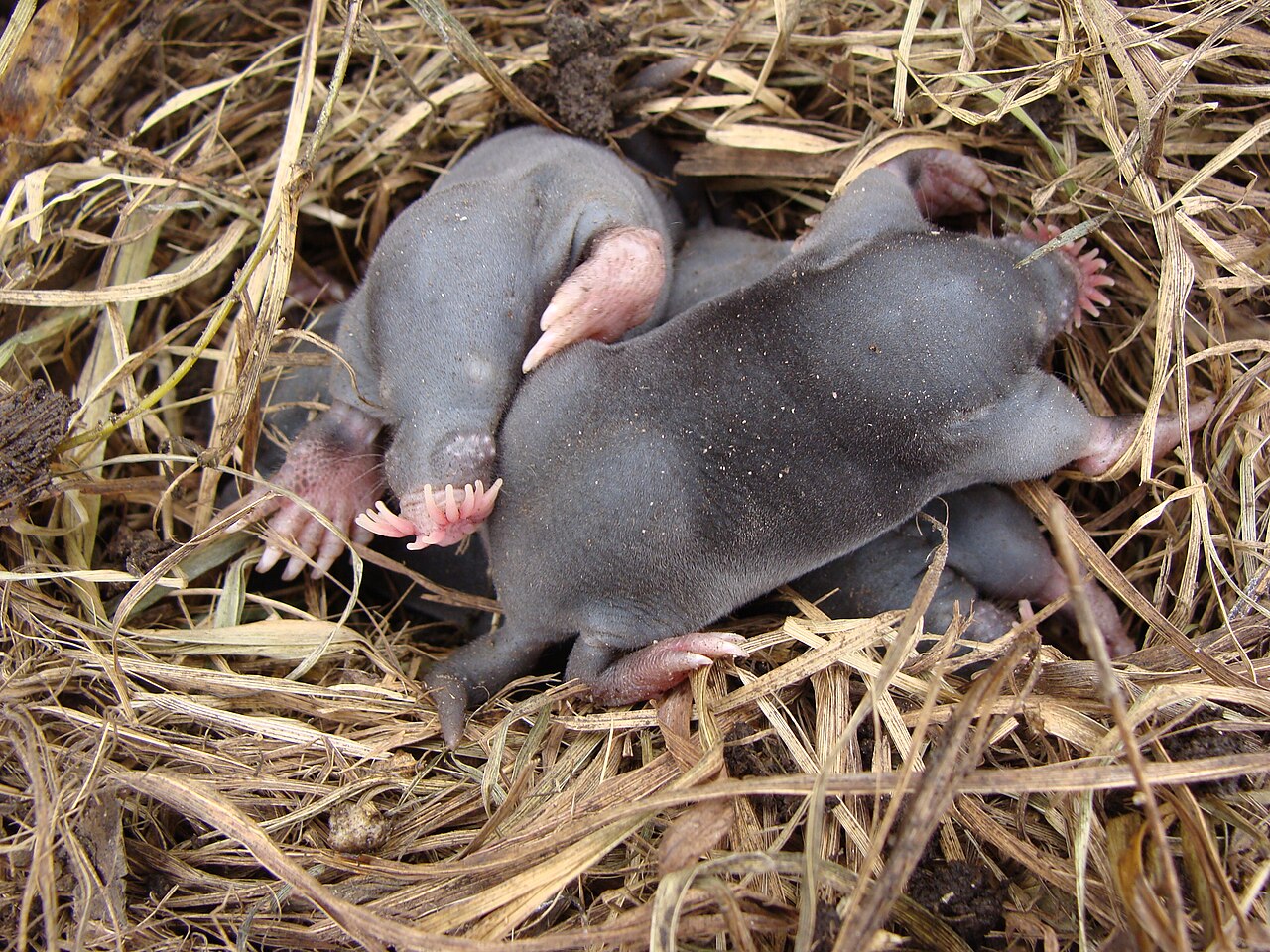
Young star-nosed moles, showing the pink star of fleshy touch rays around the snout. Image: public domain, via Wikimedia Commons.
The mechanism
- The star. Twenty-two fleshy rays ring the nostrils in a fixed, symmetric pattern, each ray mobile and constantly in motion as the mole forages.
- The receptors. The rays carry more than twenty-five thousand Eimer's organs, microscopic touch sensors, giving the star extremely fine spatial resolution.
- The tactile fovea. One small ray pair works like the center of vision: when a sensor detects something promising, the mole swings that ray pair onto it for a high-resolution look by touch.
- The wiring. Tens of thousands of nerve fibers carry the touch data at high speed to an enlarged, precisely mapped region of the brain devoted to the star.
- The speed. Detection, identification, and ingestion can finish in under a quarter of a second, the fastest foraging measured in any mammal, with underwater scent-sniffing by re-breathing exhaled air bubbles.
Why this points to design
A working high-speed touch sense requires every part present and matched at once: a patterned array of rays, a dense field of receptors on them, high-bandwidth nerves to carry the signal, and an enlarged brain region mapped point-for-point to the star to interpret it. Receptors with no cortical map send signals nowhere useful. A brain map with no receptors has nothing to read. Rays with no dedicated wiring cannot deliver data fast enough to beat a quarter second. None of these halves gives the mole a faster meal, so there is no series of separately advantageous steps building toward the finished system. An organ whose function appears only when sensor, wiring, and matched brain map are assembled and calibrated together is exactly what intelligent agents produce and what blind, incremental processes are not equipped to build. See Irreducible Complexity and Specified Complexity.
The evolutionary account, and why it falls short
The standard reply is gradual elaboration: moles already have touch-sensitive snouts and Eimer's organs, so selection could slowly multiply the receptors, fold the snout into rays, and expand the matching brain area step by step, each small gain in touch sensitivity paying its own way until the full star and its cortical map emerged.
The reply names ordinary touch tissue but never delivers the integrated instrument. The star-nosed mole is not remarkable because it has a sensitive nose; it is remarkable because it runs a 22-ray, twenty-five-thousand-sensor array with a tactile fovea, wired at high bandwidth to a precisely mapped brain region, fast enough to find and eat prey in under a quarter second. A more sensitive plain snout is a different system from a foveated, brain-mapped star, and the transition requires the receptor array, the dedicated wiring, and the matching cortical map arriving together, the part the story skips. Noting that moles can feel no more explains a foveated touch organ wired to its own brain map than noting that skin senses pressure explains an eye. A narrative that connects an ordinary snout to a finished high-speed touch system is not the same as demonstrating the selectable intermediates and the genetic and developmental changes that built the sensor, the wiring, and the brain map as one working unit. That gap between a sensitive nose and a calibrated, brain-mapped star is precisely what points to design.
See also
- Animals That Defy Evolution, the hub this spoke belongs to
- Irreducible Complexity, the core pattern behind the star and its brain map
- Edge of Evolution, the empirical reach of random mutation
- Information Argument for Design, the wiring and brain map as functional information
- The platypus, another animal in this hub that hunts with a specialized sensory organ on its snout
Common questions this page answers
Q: Why is the star-nosed mole a problem for evolution?
Its high-speed touch sense needs several matched parts at once: the patterned ring of rays, the dense field of more than twenty-five thousand receptors on them, the high-bandwidth nerves, and an enlarged brain region mapped point-for-point to the star. Receptors with no brain map send signals nowhere, and a brain map with no receptors has nothing to read, so there is no ladder of separately useful halfway stages, which is the Irreducible Complexity pattern. No stepwise account has shown how unguided processes assemble the sensor, the wiring, and the matching brain map together.
Q: How does the star-nosed mole's nose work?
The star is a touch organ, not a smell organ. Twenty-two fleshy rays carry over twenty-five thousand microscopic touch sensors and sweep across the ground while the mole forages. One small ray pair acts like the center of vision, swinging onto promising objects for a fine-resolution feel, and the data races over dedicated nerves to a brain region devoted entirely to the star.
Q: How fast can the star-nosed mole eat?
It can detect, identify, and swallow prey in under a quarter of a second, around 230 milliseconds, which is the fastest foraging measured in any mammal. It can even smell underwater by blowing out air bubbles and re-inhaling them to carry scent back to its nose.
Q: Couldn't the star have evolved gradually from an ordinary sensitive snout?
A more sensitive plain snout and a foveated, brain-mapped star are different systems, and the jump between them needs the dense receptor array, the dedicated high-speed wiring, and the matching cortical map all present together. A partly built version has receptors with nowhere to send signals or a brain map with nothing to read, so there is nothing advantageous for selection to keep along the way, and that integrated leap is exactly what gradual stories assume but never demonstrate.