Concept
Coral and Zooxanthellae
Intro
A reef-building coral looks like a rock, but it is a colony of soft animals that quietly farms light. Inside the living tissue of each tiny coral polyp live millions of single-celled algae called zooxanthellae. The algae sit in the sun the coral cannot leave, run photosynthesis, and hand most of the sugar they make straight to their animal host. In return the coral gives the algae a protected home, a steady supply of carbon dioxide, and the nitrogen-rich waste they need as fertilizer. Strip the algae out and the coral starves; pull the algae loose and they lose the sheltered, nutrient-fed berth that lets them flourish. Two completely different kingdoms of life, an animal and a photosynthetic microbe, are wired together into one working organism, each supplying exactly what the other lacks. That kind of matched, two-sided dependence is the fingerprint of design.
In full
Reef corals (order Scleractinia) host symbiotic dinoflagellate algae of the genus Symbiodinium and its relatives, the zooxanthellae, inside membrane-bound vacuoles within the coral's own gastrodermal cells. The algae perform photosynthesis and translocate up to about ninety percent of their fixed carbon (as glucose, glycerol, amino acids, and lipids) to the host, supplying the energy budget that lets corals build massive calcium-carbonate skeletons and raise reefs in the clear, nutrient-poor tropical waters where little else thrives. The coral reciprocates with a sheltered, high-light position, inorganic carbon for photosynthesis, and nitrogen and phosphorus recycled from its metabolic waste, scarce nutrients the algae could not easily obtain in open water. The partnership is obligate for reef-builders: a coral that loses its zooxanthellae bleaches and, if the algae do not return, dies, and the free-living algae forgo the protected, fertilized niche that makes them productive. This is a case of obligate interdependence reaching across the boundary between two kingdoms, an integrated metabolic loop in which host cell, symbiont, nutrient exchange, and recognition chemistry must all be present together for either partner to gain. A half-built version, an animal that engulfs algae but cannot house or feed them, or algae that enter a host but are digested rather than farmed, benefits neither side and gives selection nothing to keep.
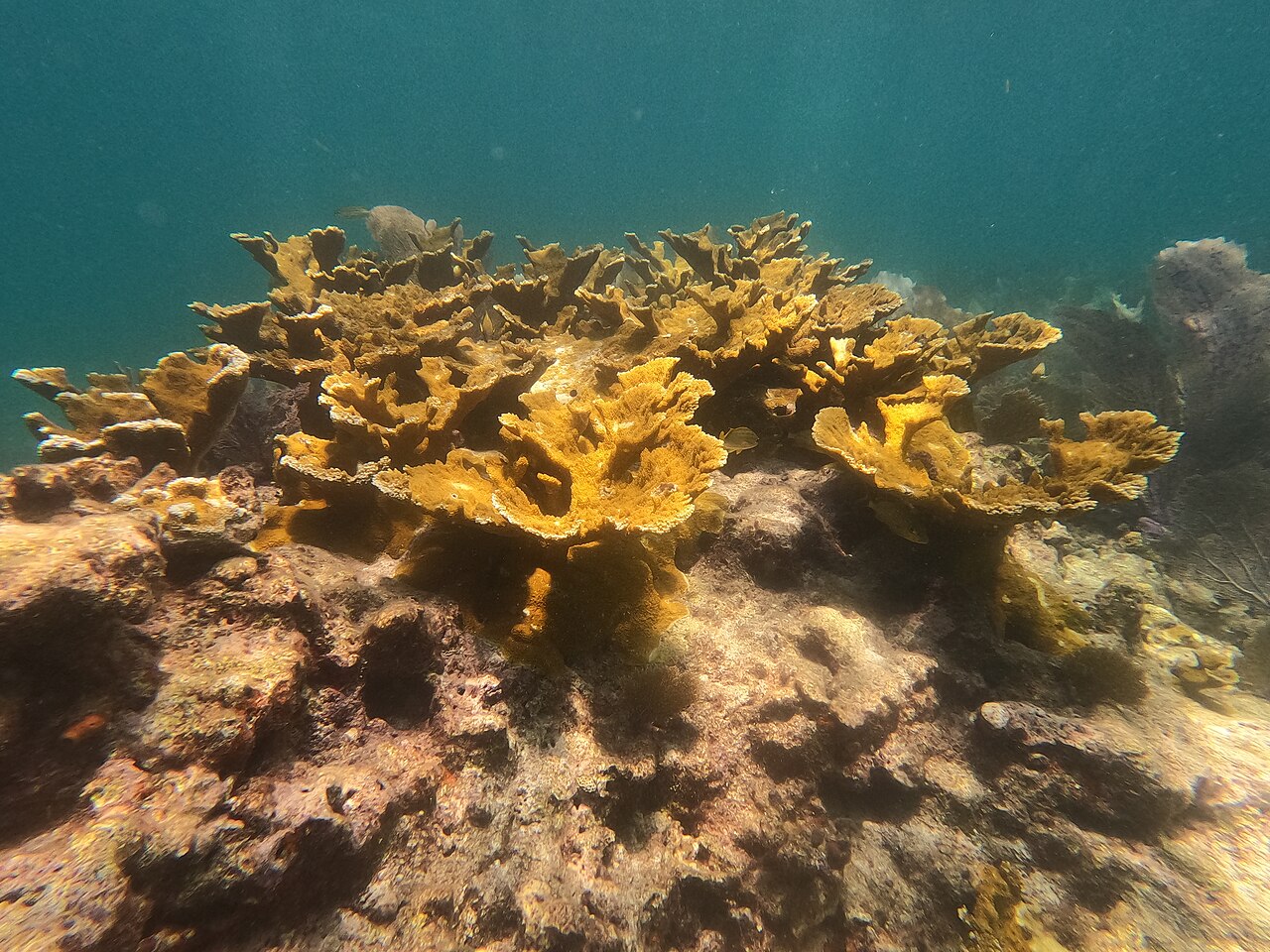
Elkhorn coral (Acropora palmata) on a reef; its color comes from the zooxanthellae living inside the polyps. Image: CC0, via Wikimedia Commons.
The mechanism
- Algae inside the animal. Each coral polyp holds millions of zooxanthellae packaged inside its own cells, positioned in the light like a field of solar panels the animal cannot grow on its own.
- Sugar handed over. The algae photosynthesize and pass the large majority of the sugars and other carbon compounds they make directly to the coral, fueling its growth and skeleton-building.
- Fertilizer returned. The coral feeds the algae carbon dioxide for photosynthesis plus nitrogen and phosphorus recycled from its waste, the exact nutrients that are scarce in clear tropical water.
- Recognition and uptake. The coral selectively takes up the right algae from the water and houses them rather than digesting them as food, a controlled internal sorting that ordinary feeding does not perform.
- One organism, two genomes. The result functions as a single light-driven creature: the reef exists because an animal and a microbe run a shared metabolism neither could run alone.
Why this points to design
The whole reef-building way of life depends on a closed loop between two organisms from different kingdoms: the coral supplies shelter, carbon dioxide, and fertilizer, and the algae supply the energy. Break the loop at any point and it collapses. A coral that engulfs algae but cannot house them, feed them, or stop digesting them gains nothing; algae that drift into a host that treats them as a meal gain nothing. The benefit appears only when the housing, the nutrient hand-off, the recognition chemistry, and the algae's productivity are all aligned at once, which is not how a series of separately advantageous steps proceeds. An animal and a photosynthetic microbe fitted to each other so precisely that each one provides exactly the resource the other cannot make, and neither thrives apart, is the kind of prearranged, cross-kingdom match that points to a designer. See Intelligent Design and the symbiosis discussion in Animals That Defy Evolution.
The evolutionary account, and why it falls short
The standard reply is that the partnership began loosely: a coral that happened to digest some engulfed algae slowly, or leak it a little sunlight, gained a small energy bonus, and selection then refined the housing and the nutrient exchange step by step until the two became inseparable. Free-living dinoflagellates are common, the story runs, so the raw partners were available to be drawn together over time.
The reply names the ingredients and skips the integration. The point that needs explaining is not that algae and animals exist near each other; it is the controlled internal farming, an animal that takes up specific algae, shelters them inside its own cells without digesting them, supplies them carbon dioxide and recycled nitrogen, and harvests the sugar they export. That coordinated exchange is what builds reefs, and pointing to free-floating algae no more explains it than pointing to loose solar cells explains a power grid. Naming a path from "facultative" to "obligate" is not the same as exhibiting the intermediate coral that could capture, house, and farm algae with a half-formed recognition and transport system, or the genetic changes in both partners that wired the loop together. The integrated, two-genome metabolism, with each kingdom supplying precisely what the other lacks, is exactly what the gradual account cannot deliver and what design accounts for directly.
See also
- Animals That Defy Evolution, the hub this spoke belongs to
- Intelligent Design, the positive design program
- Irreducible Complexity, the pattern of jointly-required, individually-useless parts
- Edge of Evolution, the empirical reach of random mutation
- The clownfish and sea anemone, another marine partnership in this hub where each organism is set up in advance for the other
Common questions this page answers
Q: Why is the coral and zooxanthellae partnership a problem for evolution?
Reef corals depend on photosynthetic algae living inside their own cells, and the algae depend on the sheltered, fertilized home the coral provides. The benefit only appears when the coral can house specific algae without digesting them, feed them carbon dioxide and recycled nitrogen, and harvest their sugar, all at once. Because a half-built version helps neither partner, there is no ladder of separately advantageous steps for selection to climb, and the integrated, cross-kingdom system looks engineered.
Q: How does coral get its energy from algae?
The algae, called zooxanthellae, live inside the coral's tissue and run photosynthesis using sunlight. They pass the large majority of the sugars and other carbon compounds they make straight to the coral, which uses that energy to grow and build its calcium-carbonate skeleton. In exchange the coral supplies carbon dioxide plus nitrogen and phosphorus recycled from its waste.
Q: What happens to coral without its zooxanthellae?
When a coral loses its algae it turns white, which is called bleaching, because the algae provide most of its color and nearly all of its food. If the algae do not return, the coral starves and dies. That total dependence is part of why the partnership resists a gradual, step-by-step origin: the coral cannot live the reef-building life without the symbiont already in place.
Q: Couldn't corals and algae have teamed up gradually over time?
The usual story says the bond started loose and tightened, but that skips the hard part: the coral must selectively take up the right algae, shelter them inside its cells instead of digesting them, and run a two-way nutrient exchange before the arrangement pays off. Pointing to free-floating algae supplies the parts, not the integrated farming system, and the intermediate coral and the genetic changes in both partners have never been demonstrated. That prearranged, cross-kingdom fit is what points to design.