Concept
Gecko
Intro
A gecko can run straight up a pane of glass and hang from the ceiling by one toe, then let go and sprint away without a trace of glue. It does this with dry feet. Each toe is covered in millions of microscopic hairs, and each hair splits into hundreds of even tinier tips, so that a single foot makes contact with a surface at a billion points at once. At that scale a faint molecular attraction, the same weak force that acts between any two surfaces pressed close, adds up into a grip that holds many times the animal's weight. The genius is the off switch: by changing the angle of its toes, the gecko peels each foot loose in milliseconds, so it can stick and unstick at full running speed. Billions of nanoscale tips, a force that only works at that size, and a built-in release: none of them is any use without the others. A clinging system that only works when all of its parts are present at once is the fingerprint of design.
In full
Gecko adhesion is a dry, structural system, not a chemical glue or a suction cup. The underside of each toe carries rows of flexible flaps (lamellae) bearing millions of hair-like setae, and each seta branches into hundreds of nanometer-scale tips (spatulae). The enormous number of close contacts lets van der Waals forces, weak intermolecular attractions effective only at very short range, sum into substantial adhesion, which is why a gecko clings even to smooth glass and even in a vacuum, conditions that rule out suction and capillary effects. The system is directional and switchable: the setae engage only when loaded along a particular axis, and the gecko detaches by hyperextending its toes to peel the array off at an angle, releasing each foot in milliseconds. The setae are also self-cleaning, shedding dirt that would foul the contacts. This is Irreducible Complexity expressed in precise nanoscale geometry: the hierarchical splitting of the contacts, the force that only becomes useful at that scale, and the load-and-peel control are jointly required. Coarse hairs give negligible dry adhesion, an array with no controlled release glues the animal in place, and the peeling motion governs nothing if the contacts never grip. The functional information sits in the exact branching architecture, a signature of Specified Complexity.
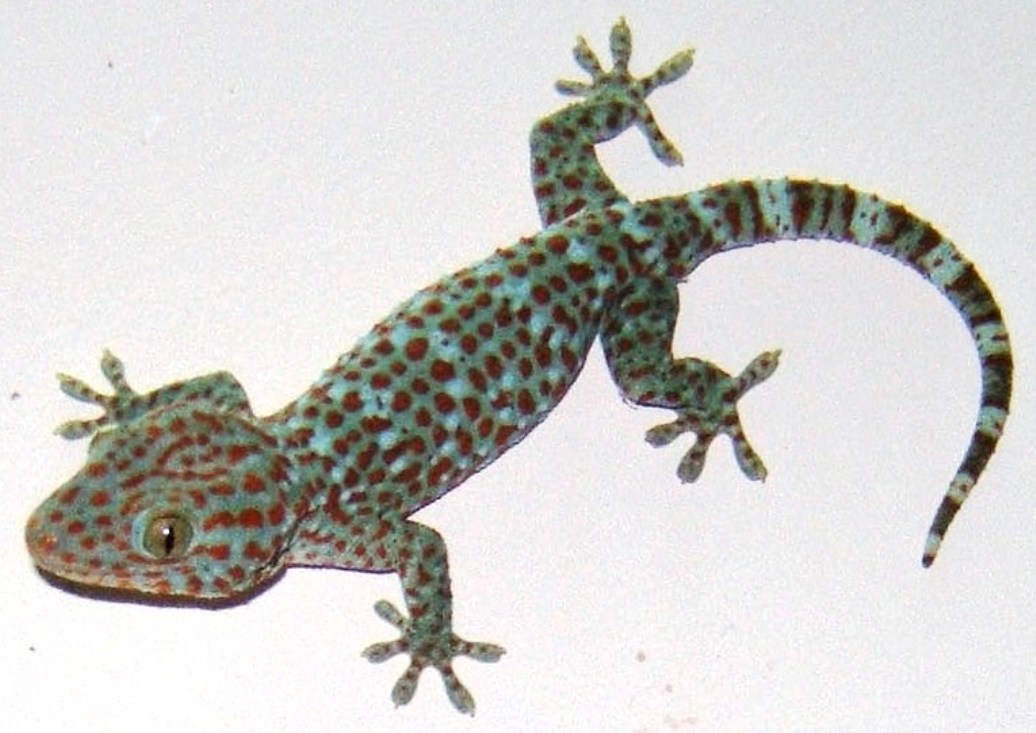
A Tokay gecko, its broad adhesive toe pads splayed against the surface. Image: public domain, via Wikimedia Commons.
The mechanism
- A branching hierarchy. Each toe carries flaps lined with millions of fine setae, and every seta divides into hundreds of nanometer-wide tips, multiplying the points of contact into the billions.
- A scale-dependent force. Spreading contact across so many tiny tips lets van der Waals attraction, useful only at very short range, sum into a grip that supports many times the gecko's weight.
- No glue, no suction. The system works on smooth glass and even in a vacuum, which shows it is dry structural adhesion, not wet chemistry or air pressure.
- A directional switch. The setae grip only when pulled along one axis, so the foot holds when loaded the right way and is primed to release the other way.
- Instant peeling release. The gecko curls and hyperextends its toes to peel the array off at an angle, detaching each foot in milliseconds so it can climb at speed.
Why this points to design
A useful foot needs the whole arrangement at once. A handful of coarse hairs produces almost no dry adhesion, because the molecular force only adds up to something when the contact is split into billions of nanometer tips. An array that grips with no controlled release is a trap: the animal sticks fast and starves on the wall. The peeling motion is wasted if the contacts never engage in the first place. Remove any single feature and you get a foot that will not hold, or one that will not let go. There is no gradual climb through advantageous halfway states, because partway between an ordinary foot and a switchable nanoscale adhesive lies a foot that either does not stick or cannot release, a cost with no payoff for selection to keep. A device whose function appears only when a precisely branched structure, a scale-specific force, and a release mechanism are matched and assembled together is exactly what intelligent agents produce and what unguided, step-by-step processes are unequipped to build. See Irreducible Complexity and Information Argument for Design.
The evolutionary account, and why it falls short
The standard reply is gradual elaboration: ancestral lizards with slightly textured toe surfaces are supposed to have gained a small grip advantage, after which selection multiplied and finer-branched the hairs over many generations until the toes became the dense, switchable adhesive seen today.
The reply names hairs but never delivers the tunable adhesive system that needs explaining. The gecko is not impressive because its toes are rough; it is impressive because it splits contact into billions of nanoscale tips so a short-range molecular force becomes load-bearing, and because it engages and peels that grip directionally in milliseconds. Pointing to a textured foot no more explains that system than pointing to a strip of felt explains a switchable nanostructured adhesive. A story that connects coarse toe scales to a finished, self-cleaning, peel-to-release clinging system is not the same as showing the road exists: the selectable advantage of each intermediate, the half-branched foot that supposedly gripped or released usefully, and the genetic and developmental changes that produced the exact spatular geometry, have never been demonstrated. The gap between a textured foot and a switchable, billion-point molecular adhesive is exactly the gap that points to design.
See also
- Animals That Defy Evolution, the hub this spoke belongs to
- Irreducible Complexity, the core pattern behind the gecko's foot
- Information Argument for Design, the functional information in the nanoscale geometry
- Specified Complexity, the precise branching architecture as a design signature
- The spider, another animal that grips with van der Waals forces through fine foot hairs
Common questions this page answers
Q: Why is the gecko a problem for evolution?
Its clinging depends on three things at once: contact split into billions of nanoscale tips, a molecular force that only becomes useful at that tiny scale, and a directional peeling release so the foot can let go in milliseconds. Each is useless without the others, which is the Irreducible Complexity pattern, so there is no path of small advantageous steps. A foot that sticks but cannot release is a trap, and coarse hairs give almost no grip, which is why a gradual account does not explain the integrated, switchable adhesive.
Q: How do gecko feet stick to walls and glass?
Each toe is covered in millions of tiny hairs called setae, and each hair branches into hundreds of nanometer-scale tips, so one foot touches the surface at a billion points. At that scale a weak short-range attraction called van der Waals force adds up into a grip strong enough to hold many times the gecko's weight. It is dry adhesion, not glue or suction, which is why a gecko sticks even to smooth glass and even in a vacuum.
Q: How does a gecko unstick its feet so quickly?
The grip is directional. The hairs hold only when loaded along one axis, and to release, the gecko curls and hyperextends its toes to peel the array off at an angle, detaching each foot in milliseconds. That instant on-off control is what lets it run up a wall at speed instead of being glued in place, and it has to be present for the adhesive to be usable at all.
Q: Couldn't gecko toe hairs have evolved gradually from rougher feet?
A textured foot is a different thing from the gecko's system, which needs contact split into billions of nanoscale tips, a force that only works at that size, and a directional release. A few coarse hairs produce almost no dry adhesion, and an array with no controlled release would trap the animal, so the in-between stages give selection nothing to reward. The selectable intermediates and the changes that built the exact nanoscale geometry have never been shown.