Concept
Mantis Shrimp
mantis shrimp, mantis shrimp evolution, mantis shrimp design, stomatopod, mantis shrimp club, mantis shrimp eyesIntro
The mantis shrimp throws the fastest punch in the animal world. A smashing species swings a club-shaped limb so quickly that the water in front of it boils into vapor, and the collapse of those bubbles delivers a second hit a heartbeat after the first. The strike lands with enough force to shatter crab shells, snail armor, and the glass of an aquarium. Muscle alone cannot move that fast, so the limb is not powered like an arm at all; it is a spring-loaded catapult, with an elastic saddle that the animal slowly winds up, a latch that holds the energy, and a click that fires it all in a couple of thousandths of a second. The club itself is built from a special layered material so the blow does not destroy the weapon. The spring, the latch, the slow-loading muscle, and the crack-proof club are useless apart and lethal together. A weapon that only works when all of its parts are present at once is the fingerprint of design.
See this page's graph and discover linked topics
In full
Smashing stomatopods strike with a raptorial appendage powered by elastic energy storage rather than direct muscle contraction. A saddle-shaped segment of mineralized cuticle, a natural spring, is slowly compressed by muscle and held by a latch of small sclerites. When the latch releases, the stored energy unloads at once, accelerating the club at over ten thousand times gravity to roughly twenty meters per second, completing the strike in a few thousandths of a second. The speed drops the local water pressure enough to cause cavitation, and the collapsing vapor bubbles deliver a second impulse along with a flash of light and heat, so the prey is struck twice from one motion. The club survives its own violence because it is built as a graded composite: a hard hydroxyapatite-rich impact face over a helically stacked (Bouligand) fiber architecture that arrests cracks. The strike is a textbook case of Irreducible Complexity in a power-amplification system: the spring stores nothing without the latch, the latch releases nothing without the spring, the slow-loading muscle is pointless without both, and a club that moves this fast without the crack-arresting structure destroys itself on first use. The animal also carries among the most complex visual systems known, with up to sixteen photoreceptor classes and the ability to detect polarized light, a separate layer of engineering in the same body.
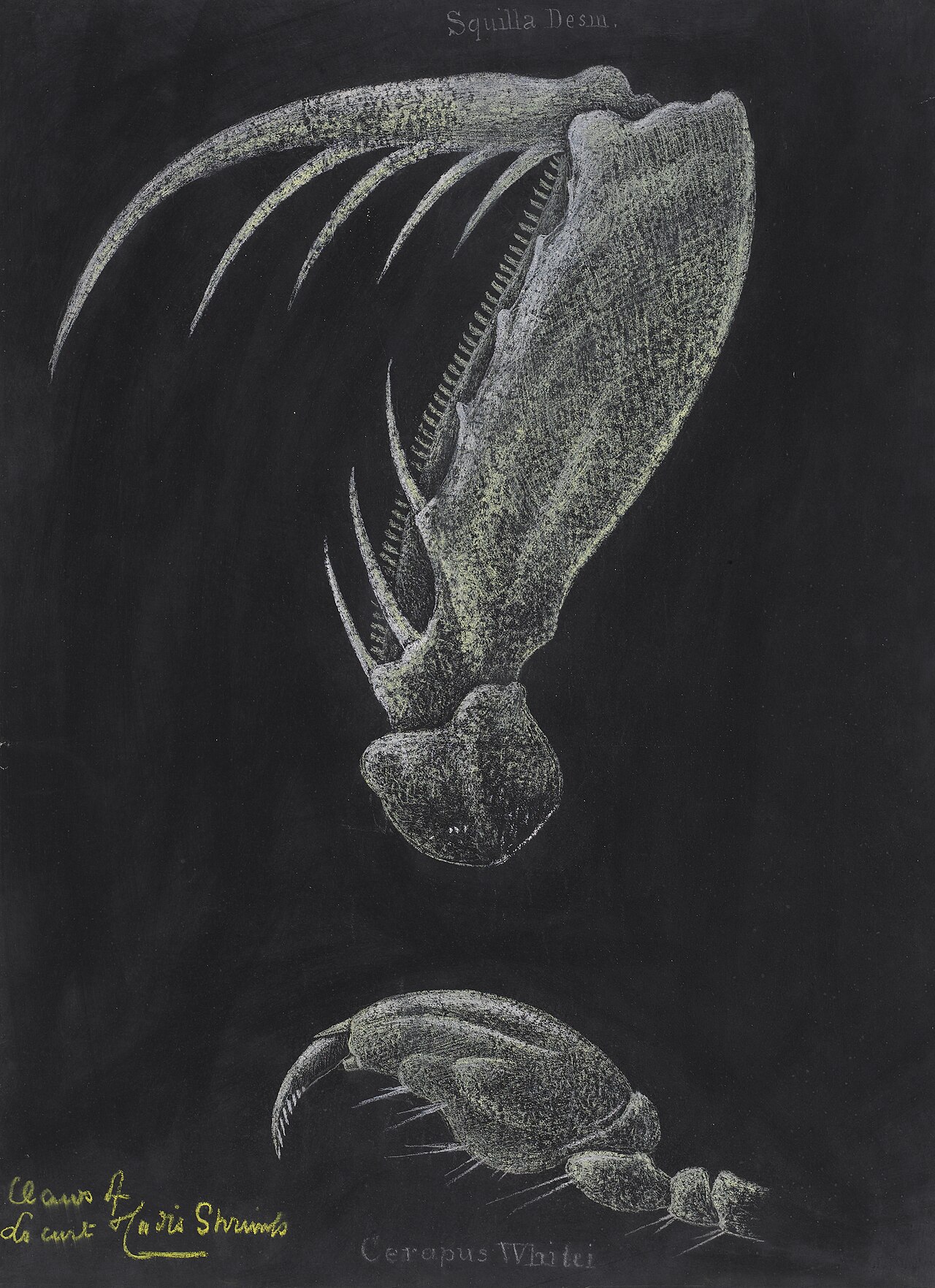
The raptorial limb of a mantis shrimp, from a nineteenth-century natural-history illustration. Image: public domain, via Wikimedia Commons.
The mechanism
- An elastic spring. A saddle-shaped piece of mineralized cuticle acts as a spring, storing energy when the animal compresses it, far more energy than muscle could release directly.
- A latch and slow load. Small locking sclerites hold the loaded spring while muscle winds it up over time, the same principle as drawing a crossbow before the shot.
- The release. When the latch lets go, the stored energy unloads in a couple of thousandths of a second, hurling the club at over ten thousand g and roughly twenty meters per second.
- A second strike from cavitation. The club moves so fast that it vaporizes the water ahead of it, and the collapsing bubbles deliver a second blow, with a flash of light and heat, so one swing hits twice.
- A self-protecting club. The weapon is a layered composite with a hard impact face over a helically stacked fiber structure that stops cracks, so it can land thousands of these blows without breaking.
Why this points to design
A functioning strike needs the whole catapult at once. The spring with no latch cannot hold energy to release. The latch with no spring has nothing to fire. Either one without the slow-loading muscle never gets wound up. And the fastest limb in the sea, built from ordinary cuticle, would crack and ruin itself on the first impact without the crack-arresting architecture. Remove any single component and you do not get a weaker punch, you get a limb that cannot store, cannot fire, or cannot survive its own blow. There is no gradual climb through advantageous halfway states, because a spring that cannot latch, or a club that shatters itself, is a cost with no payoff for selection to keep. A mechanism whose function appears only when a spring, a latch, a loading system, and a fracture-resistant material are matched and assembled together is exactly what intelligent agents produce and what unguided, step-by-step processes are unequipped to build. See Irreducible Complexity and Specified Complexity.
The evolutionary account, and why it falls short
The standard reply is incremental strengthening: a grasping raptorial limb is supposed to have stiffened and quickened in small steps, with parts of the existing exoskeleton gradually recruited into a spring and a latch, until the appendage crossed over into stored-energy striking.
The reply names body parts but never delivers the integrated catapult that needs explaining. The mantis shrimp is not impressive because it has a limb; it is impressive because it stores elastic energy in a saddle spring, holds it with a latch, loads it slowly with muscle, fires it in milliseconds, and absorbs the recoil with a layered, crack-proof club. Pointing to a grasping appendage no more explains that system than pointing to a stiff stick explains a crossbow with a trigger and a hardened tip. A story that connects an ordinary limb to a finished, self-protecting power-amplification weapon is not the same as showing the road exists: the selectable advantage of each intermediate, the half-formed spring or unlatched club that supposedly helped its owner, and the genetic and developmental changes that tuned the spring, the latch, and the composite material together, have never been demonstrated. The gap between a grasping limb and a latched, spring-loaded, self-protecting hammer is exactly the gap that points to design.
See also
- Animals That Defy Evolution, the hub this spoke belongs to
- Irreducible Complexity, the core pattern behind the spring-latch strike
- Specified Complexity, functional information as a design signature
- Edge of Evolution, the empirical reach of random mutation
- The trap-jaw ant, another animal in this hub that fires a latched, spring-loaded mechanism
Common questions this page answers
Q: Why is the mantis shrimp a problem for evolution?
Its strike is not powered by muscle but by a spring-and-latch catapult: an elastic saddle stores energy, a latch holds it, muscle slowly loads it, and a crack-proof club survives the blow. Each part is useless or destructive without the others, which is the Irreducible Complexity pattern, so there is no ladder of small advantageous steps. A spring that cannot latch, or a club that shatters itself, is a cost with no benefit, which is why a gradual account does not explain the integrated weapon.
Q: How does the mantis shrimp punch so fast?
It does not swing with muscle directly. It slowly compresses a saddle-shaped spring made of mineralized cuticle and holds it with a latch, like drawing a crossbow. When the latch releases, the stored energy unloads in a couple of thousandths of a second, throwing the club at over ten thousand times gravity and about twenty meters per second, fast enough to vaporize the water in front of it and strike a second time as the bubbles collapse.
Q: How does the mantis shrimp's club not break when it hits so hard?
The club is a layered composite. A hard, mineral-rich face takes the impact, and beneath it the fibers are stacked in a rotating, helical pattern that stops cracks from spreading. That architecture lets the animal land thousands of violent blows without destroying its own weapon, and it has to be present from the start, since an ordinary limb moving that fast would crack on the first strike.
Q: Couldn't the mantis shrimp's strike have evolved gradually from a normal limb?
A grasping limb is a different thing from a stored-energy catapult. The strike requires a spring, a latch, a slow-loading muscle, and a crack-resistant club working together, and any one of them alone accomplishes nothing. A half-formed spring that cannot latch, or a fast club that shatters itself, gives selection nothing to reward, and the selectable intermediates and coordinated changes that would tune all the parts together have never been shown.