Concept
Octopus
Intro
The octopus is a soft-bodied animal that behaves like several engineered systems bundled into one. Its skin changes color and texture in an instant, vanishing against rock, coral, or sand even though the animal, like its cuttlefish relatives, is color-blind. It moves by jet propulsion, drawing water into its body and firing it out through a steerable funnel. And it thinks with a brain unlike any other: most of its neurons are not in its head but distributed down its eight arms, so each arm can taste, feel, and act with a measure of independence while the central brain coordinates the whole. Instant camouflage, jet drive, and a distributed nervous system are three complete technologies, each demanding its own matched parts, all integrated into one creature. That kind of layered, working integration is the mark of design.
In full
The octopus combines several integrated systems. Its skin carries millions of neurally controlled chromatophores over reflecting iridophores and leucophores, producing rapid color and pattern change for camouflage and signaling, achieved despite monochromatic vision. Locomotion is by jet propulsion: the mantle draws in water and expels it through a muscular, directable siphon, giving rapid escape thrust in a hydrostatic body with no skeleton. Its nervous system is decentralized, with roughly two-thirds of its neurons located in the arms; each arm contains its own neural circuitry capable of local sensorimotor control, sucker-by-sucker chemotactile sensing, and reflexive action, coordinated with a large central brain that supports learning, problem-solving, and tool use. Camouflage hardware, a jet-propulsion drive, and a distributed control architecture are each independently complex and jointly expressed in one organism. The arrangement embodies Specified Complexity: precise functional information instantiated in matched, jointly required parts across multiple integrated systems.
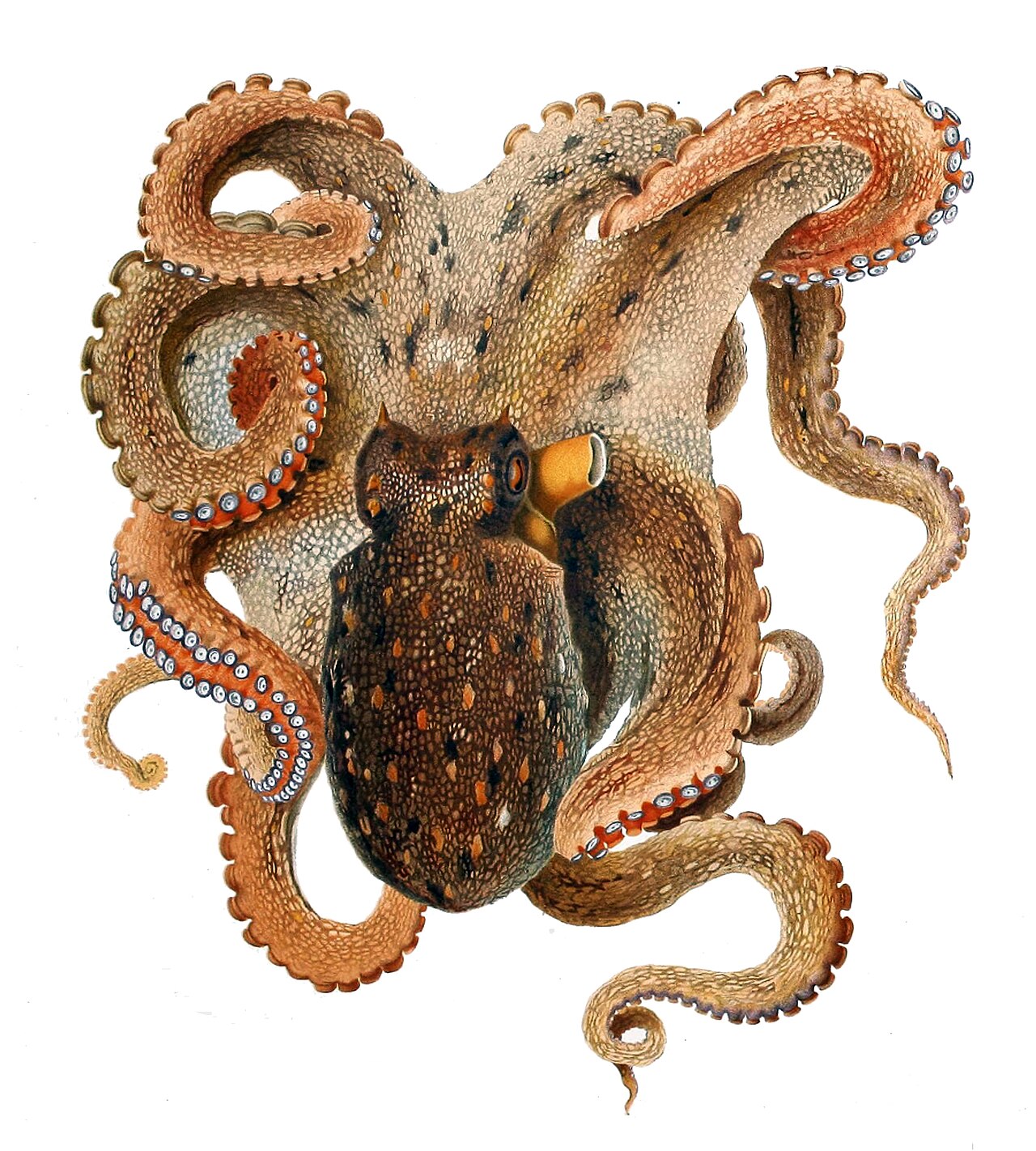
A common octopus (Octopus vulgaris), shown in an illustration; the suckered arms hold most of the animal's neurons. Image: public domain, via Wikimedia Commons.
The mechanism
- Instant camouflage. Millions of muscle-driven color cells, layered over structural reflectors, repaint the skin in milliseconds; muscles also raise papillae to match texture, not just color.
- Color-blind matching. Like the cuttlefish, the octopus has a single visual pigment, yet it matches its background, relying on extra built-in cues rather than ordinary color vision.
- Jet propulsion. The mantle fills with water and fires it through a muscular siphon the animal aims, producing fast, directable escape thrust without any rigid skeleton.
- A boneless, shape-shifting body. Muscular hydrostatic tissue lets the octopus stiffen, fold, and squeeze through gaps barely larger than its eye, then resume full strength.
- A distributed brain. Roughly two-thirds of its neurons sit in the arms, so each arm senses and acts with local autonomy while the central brain coordinates the whole.
- Chemotactile arms. Each sucker tastes what it touches, feeding the arm's own circuitry, so the octopus can explore and grip without watching what its arms are doing.
Why this points to design
Each of the octopus's systems needs its full set of matched parts before it does anything useful. Camouflage requires the color cells, the reflectors, the texture muscles, and the neural control all wired together; remove the wiring and the pigment is dead paint. Jet propulsion requires a sealing mantle, the muscle to pressurize it, and a steerable siphon to aim the thrust; any one alone moves nothing. A distributed nervous system requires arm circuitry, sucker sensors, and central coordination together, or the arms are limbs with no local control. None of the half-built versions confers the benefit that the finished system does, so there is no smooth ladder of advantageous intermediates to climb. Stacking three integrated technologies into one soft-bodied animal multiplies the problem rather than easing it. This is the Specified Complexity and Irreducible Complexity pattern at the level of whole systems: precise, jointly required parts producing working function only when assembled. See also Information Argument for Design.
The evolutionary account, and why it falls short
The standard reply is incremental assembly of each system in turn. Simpler mollusks have pigment cells, a mantle cavity used for breathing, and a basic nerve net, so the account holds that color cells multiplied and got wired, the mantle was co-opted for thrust, and the nervous system expanded and decentralized, each step favored by better escape, concealment, or foraging.
The reply lists raw materials but never delivers the working machines. A breathing cavity is not a jet drive until the muscle, the seal, and the steerable siphon are matched together; a nerve net is not a distributed brain until arm circuitry, sucker sensing, and central coordination are integrated; and slow pigment cells are not instant camouflage until millions of them are individually wired and run by a brain that matches scenes it cannot see in color. Pointing to a mantle used for respiration no more explains directional jet propulsion than pointing to a balloon explains a rocket nozzle. The selectable advantage of each intermediate, and the genetic and developmental changes that built and integrated three complex systems in one animal, have never been demonstrated. The distance between simple mollusk parts and an integrated camouflage, jet-drive, and distributed-brain animal is exactly the gap that points to design.
See also
- Animals That Defy Evolution, the hub this spoke belongs to
- Specified Complexity, functional information as a design signature
- Irreducible Complexity, the matched-parts pattern across the octopus's systems
- Information Argument for Design, integrated control systems as evidence of an intelligent source
- The cuttlefish, a close relative in this hub with the same instant skin-based camouflage
Common questions this page answers
Q: Why is the octopus a problem for evolution?
It bundles three complete systems into one animal: instant skin camouflage, jet propulsion, and a brain with most of its neurons spread through the arms. Each system needs all of its matched parts before it works, and the half-built versions give no advantage for selection to keep, which is the Specified Complexity pattern. Integrating three engineered technologies in one soft body looks designed, and no stepwise account has shown how unguided processes could assemble it.
Q: How does an octopus change color and texture so fast?
Its skin holds millions of muscle-driven color cells layered over reflecting cells, all wired directly to the nervous system, so it repaints itself in milliseconds. Skin muscles also raise bumps called papillae to match the roughness of rock or coral, not just the color. The brain selects the pattern and drives the whole display almost instantly, even though the animal is effectively color-blind.
Q: Why do people say the octopus has a brain in its arms?
About two-thirds of an octopus's neurons are located in its eight arms rather than its central brain, so each arm has its own circuitry and can sense and act with local independence. The suckers taste what they touch and feed that information to the arm, while the central brain coordinates the whole animal. This distributed design lets the octopus explore and grip without watching its arms.
Q: Could the octopus's abilities have evolved one small step at a time?
Simpler mollusks have pigment cells, a breathing cavity, and a nerve net, but those are raw materials, not the finished machines. A breathing cavity is not a steerable jet drive, a nerve net is not a distributed brain, and slow pigment cells are not instant camouflage until each system's matched parts are integrated and controlled together. The selectable intermediates and the genetic changes that would build and combine all three systems have never been demonstrated.