Concept
Antarctic Icefish
Intro
The Antarctic icefish lives in seawater cold enough to freeze it, and does not freeze. The water around it sits below the normal freezing point of its body fluids, full of tiny ice crystals that should seed freezing inside the fish and kill it. Instead the icefish carries a special set of antifreeze proteins in its blood that hunt down ice crystals as they start to grow, latch onto their surfaces, and stop them cold before they can spread. The crystals are pinned in place, unable to enlarge, and the fish stays liquid in water that would turn any ordinary fish to ice. A molecule shaped to recognize the surface of an ice crystal and halt its growth is a precision tool, and precision tools matched to a job point to design.
In full
Notothenioid icefish of the family Channichthyidae, along with related Antarctic notothenioids, produce antifreeze glycoproteins (AFGPs): repeating chains of a three-amino-acid unit (alanine-alanine-threonine) with a sugar group attached to each threonine. These molecules bind directly to the surface of nascent ice crystals through a structural match, lowering the temperature at which ice can grow without changing the melting point, a non-colligative effect known as thermal hysteresis. By covering the crystal faces, the proteins prevent the small ice already present in the fish's tissues and gut from enlarging, so the animal remains unfrozen in waters near minus 1.9 degrees Celsius. The design inference rests on the fit and the integration: the protein's repeating structure is shaped to the geometry of an ice lattice, it is secreted into blood and tissues in the right amounts, and it works alongside the fish's reduced internal ice load and its other cold adaptations as a coordinated system (Specified Complexity, Information Argument for Design). A generic protein does nothing against ice; only a sequence specified to the crystal surface holds the line.
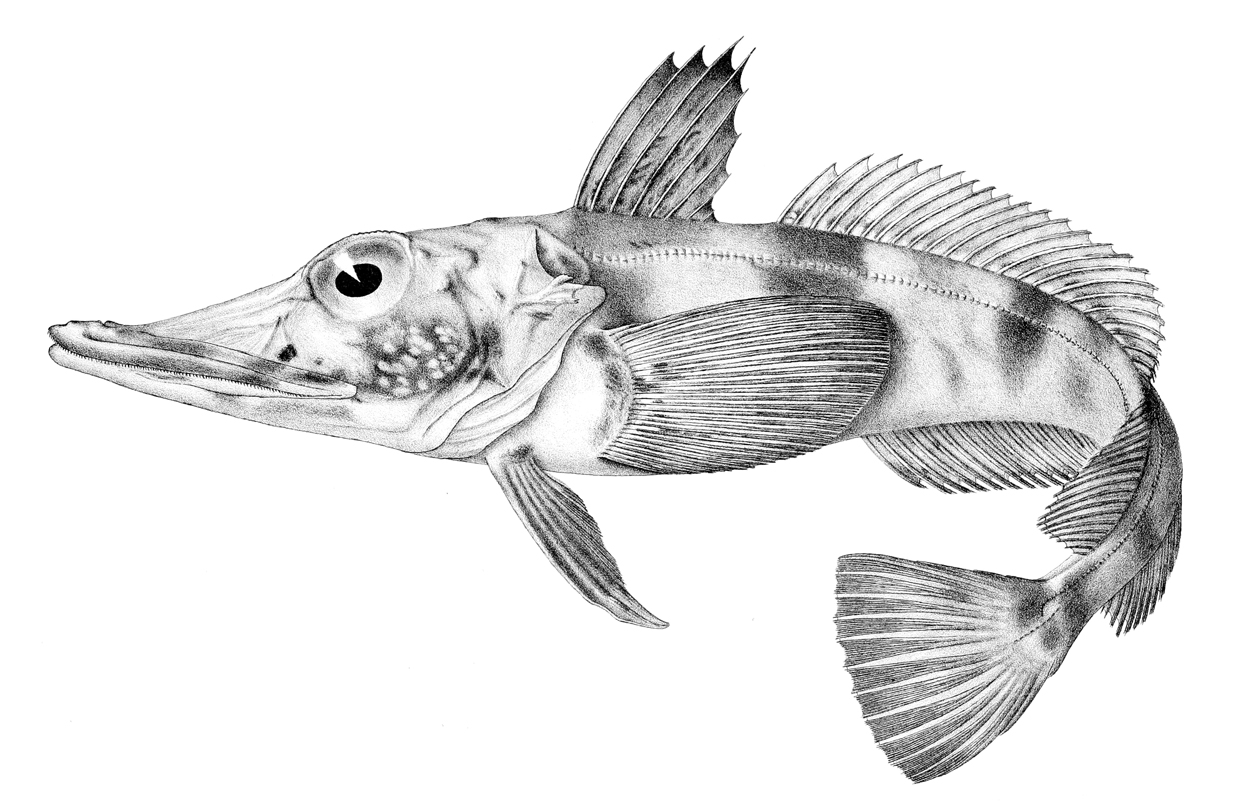
A scientific illustration of the blackfin icefish (Chaenocephalus aceratus), an Antarctic icefish. Image: public domain, via Wikimedia Commons.
The mechanism
- Antifreeze proteins. The fish builds antifreeze glycoproteins, repeating alanine-alanine-threonine units carrying sugar groups, and pours them into its blood and body fluids.
- Surface binding. Each protein recognizes and locks onto the faces of a growing ice crystal, matching the crystal's geometry rather than dissolving like ordinary salt or sugar.
- Growth arrest. With the crystal faces covered, ice cannot add new water molecules and stops enlarging, so the small crystals already inside the fish never spread.
- Thermal hysteresis. This drops the temperature at which ice can grow well below the melting point, a gap no simple dissolved solute can produce.
- System fit. The antifreeze works together with a low internal ice load and the fish's broader cold physiology, including, in the white-blooded icefishes, blood that carries oxygen dissolved in the cold-rich water without red cells.
Why this points to design
Salt or sugar can lower a freezing point a little, but only by brute concentration, and the amounts needed to survive Antarctic water would poison the fish. The icefish instead uses a protein precisely shaped to grip the surface of an ice crystal and stop its growth, a targeted lock-and-key action, not a bulk effect. That shape is the whole point: a random protein has no purchase on ice, and only a sequence specified to the crystal lattice does the job. The protein also has to be made in the right tissues, in the right quantity, and deployed alongside the fish's other cold systems, or it protects nothing. A molecule whose function depends on a structural match to a target, produced and delivered as part of an integrated survival package, is the kind of specified, information-rich solution that intelligent agents engineer and that undirected chemistry has no path toward. See Specified Complexity and Information Argument for Design.
The evolutionary account, and why it falls short
The standard reply points to a striking finding: the icefish antifreeze gene appears to have arisen near a digestive enzyme gene, with a small repeated segment expanded into the long repetitive antifreeze chain, so the story is that an existing sequence was copied, repeated, and recruited for a new job under selection in cooling seas.
The reply describes where a raw sequence may have come from, not how the working antifreeze system was built. A repeat of three amino acids is not an antifreeze protein in any useful sense until that repeat folds and presents a surface that actually binds the geometry of ice and arrests its growth, until it is glycosylated correctly, secreted in protective amounts, and integrated with the fish's reduced ice load and cold physiology. Showing a candidate source for the letters is not the same as showing that the specified, ice-gripping function and its delivery system assembled through a chain of selectable intermediates, each one a real survival advantage in real water. The hard part, a molecule whose precise shape recognizes and stops ice, deployed as a coordinated whole, is exactly what the co-option story names but does not deliver, and that is where the design inference stands.
See also
- Animals That Defy Evolution, the hub this spoke belongs to
- Specified Complexity, functional information as a design signature
- Information Argument for Design, the information case behind the antifreeze proteins
- Edge of Evolution, the empirical reach of random mutation
- The wood frog, another animal in this hub that survives sub-freezing conditions with its own cryoprotectants
Common questions this page answers
Q: Why is the Antarctic icefish a problem for evolution?
Its survival depends on antifreeze proteins whose precise shape grips the surface of growing ice crystals and stops them, a targeted lock-and-key action that a random protein cannot perform. The protein also has to be made in the right tissues, in the right amount, and integrated with the fish's other cold systems, or it protects nothing. That specified, information-rich fit between molecule and ice crystal looks engineered, and a chain of generic precursors cannot supply it.
Q: How do antifreeze proteins keep the icefish from freezing?
The proteins recognize and bind directly to the faces of tiny ice crystals already present in the fish, covering them so they cannot add more water and grow. This lowers the temperature at which ice can spread well below the normal melting point, an effect called thermal hysteresis that ordinary dissolved salt or sugar cannot produce. The crystals are pinned in place and the fish stays liquid in seawater near minus 1.9 degrees Celsius.
Q: Why can't the icefish just use salt or sugar like antifreeze in a car?
Salt and sugar only lower a freezing point by sheer concentration, and the amounts needed to survive Antarctic water would poison the fish. The antifreeze protein works by a completely different mechanism, physically gripping the ice crystal's surface to stop its growth, so a small amount does what a toxic load of simple solute could not. That targeted action depends on the protein's specific shape.
Q: Didn't scientists show the antifreeze gene evolved from a digestive enzyme?
They proposed a possible source for the raw sequence, a repeated segment near a digestive enzyme gene, but that only addresses where the letters came from, not how the working system was built. A short repeat is not antifreeze until it folds to bind the geometry of ice, is sugar-tagged correctly, secreted in protective amounts, and integrated with the fish's cold physiology. The selectable intermediates that would assemble that specified, ice-gripping function have never been demonstrated.