Concept
Peacock
Intro
The peacock's train is one of the most extravagant displays in nature: a fan of up to two hundred feathers, each tipped with a shimmering eyespot that shifts from blue to green to bronze as the bird turns. The colors are not pigment. They come from light itself, bouncing off microscopic lattices built into the feather barbs with the precision of a crystal. The bird raises the whole train, rattles it, and the eyespots seem to glow and move. Building that effect takes feathers grown to exact lengths, barbs studded with nanometer-scale structures tuned to specific wavelengths, and an instinct to spread and shake them on cue. Color manufactured from structure, arranged in a coordinated display, is the mark of design.
In full
The peacock train shows structural color, not pigmentary color. Within each feather barbule lie two-dimensional photonic crystals, ordered lattices of melanin rods spaced at intervals close to the wavelength of visible light, embedded in keratin. These lattices reflect specific wavelengths by thin-film interference and coherent scattering, and small changes in rod spacing and lattice geometry across the eyespot produce the blue, green, and bronze zones in their exact pattern. The result is iridescence that brightens and shifts with viewing angle. The display is a system: the photonic nanostructure, the developmental program that grows each barb to the right length and curvature, the bilateral arrangement of eyespots into a coherent fan, and the courtship behavior that erects and vibrates the train at the right moment. This is Specified Complexity expressed in optics and growth, functional information specified down to the nanometer and integrated with anatomy and instinct. Darwin admitted the train troubled him, and the difficulty stands: a structure precisely tuned to manipulate light, and coordinated with the behavior that shows it off, is the kind of matched, information-rich design that blind steps do not assemble.
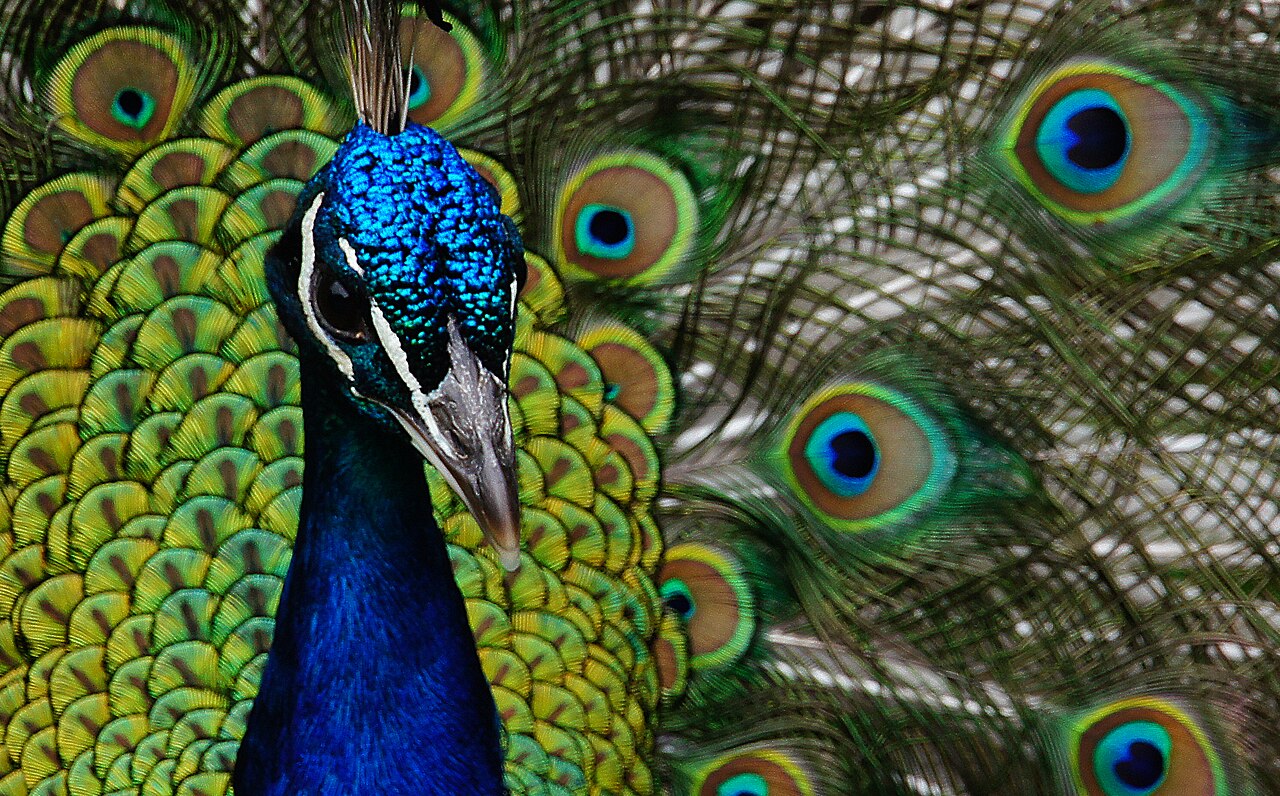
A peacock displaying its iridescent train, the colors produced by light bouncing off photonic nanostructures in the feathers. Image: CC0, via Wikimedia Commons.
The mechanism
- Color from structure. Each eyespot's color is made by ordered lattices of melanin rods in the feather barbules, spaced near the wavelength of light, which reflect chosen colors by interference rather than by any blue or green pigment.
- Tuned zones. Slightly different rod spacings and lattice angles across the eyespot yield the distinct blue center, green ring, and bronze edge, each tuned to its own wavelength.
- Iridescence. Because the color depends on geometry, it brightens and shifts as the viewing angle changes, giving the eyespots their living, glinting quality.
- Grown to spec. A developmental program lays down each barb to a set length and curve and places the eyespots in a balanced, repeating pattern across the whole fan.
- The display. The male raises the train into a wide fan and vibrates it, a built-in courtship routine that sets the eyespots shimmering at the moment it matters.
Why this points to design
The peacock's train is a finished optical instrument wired to a behavior. The colors require nanostructures whose spacing matches particular wavelengths of light, an error of a few nanometers and the hue is wrong. Those structures have to be grown in the right place, in feathers of the right length, arranged into a symmetric pattern of eyespots, and then deployed by an instinct to fan and shake the train. A pile of melanin and keratin does nothing. The effect appears only when the lattice geometry, the feather development, the bilateral layout, and the display behavior are all present and matched. That is functional information specified to a fine tolerance and integrated across optics, anatomy, and instinct, the pattern of Specified Complexity and Information Argument for Design. Precision tuning of light by built structure, joined to the behavior that uses it, is what designing minds produce. See Intelligent Design.
The evolutionary account, and why it falls short
The standard reply is sexual selection: peahens are said to prefer brighter, more elaborate eyespots, so over generations runaway preference drove the train toward ever finer iridescence, with the nanostructures emerging gradually as small reflective tweaks accumulated.
The reply may describe a pressure that could favor an existing display, but it does not build the optical machinery or the genetic program behind it. A preference for shiny feathers does not explain how to grow a two-dimensional photonic crystal with melanin rods spaced to the wavelength of blue light, nor how to vary that spacing across one feather to paint a tuned blue-green-bronze eyespot, nor how to repeat the pattern in symmetry across two hundred feathers, nor how to wire the instinct that fans and rattles them. Saying females liked it names a possible filter, not the origin of the nanostructure, the developmental control, or the coordinated behavior. And a half-tuned lattice that reflects no clean color gives the filter nothing to favor. The distance from raw feather material to a precision light-manipulating display, integrated with growth and instinct, is the gap that points to design.
See also
- Animals That Defy Evolution, the hub this spoke belongs to
- Specified Complexity, functional information tuned to a fine tolerance
- Information Argument for Design, coded structure as a design signature
- Intelligent Design, the inference from integrated optical systems
- The Morpho butterfly, another animal in this hub whose color comes from photonic structure, not pigment
Common questions this page answers
Q: Why is the peacock's tail a problem for evolution?
The train's colors come from photonic nanostructures tuned to the wavelength of light, grown in feathers of exact length, arranged into a symmetric pattern of eyespots, and deployed by an instinct to fan and shake the display. Each part is useless without the others, a lattice that reflects no clean color, or a perfect color with no behavior to show it, gives selection nothing to favor. That integration of optics, growth, and instinct is functional information of the kind found in Specified Complexity, which points to design.
Q: How does the peacock get its colors if not from pigment?
The blue, green, and bronze are structural colors. Inside each feather barbule are ordered lattices of melanin rods spaced close to the wavelength of visible light, and these reflect specific colors by interference, the way a thin oil film shimmers. Because the color depends on the geometry, it shifts and brightens as the bird turns, producing the iridescence.
Q: Did the peacock's train really bother Darwin?
Yes. Darwin wrote that the sight of a peacock feather made him feel sick, because its extravagance seemed to defy survival-based natural selection. He proposed sexual selection to account for it, but that idea describes a possible pressure on an existing display, not the origin of the nanostructures and developmental program that build it.
Q: Couldn't sexual selection have built the eyespots step by step?
A preference for showier feathers might favor a display that already works, but it does not explain how to grow a photonic crystal tuned to blue light, vary its spacing to paint a tuned eyespot, repeat the pattern in symmetry across hundreds of feathers, and wire the courtship instinct that fans and rattles the train. A half-tuned lattice reflecting no clean color gives the preference nothing to act on, so the leap to a precision optical display points to design.
Q: What makes the eyespot change color as the peacock moves?
The eyespot's color is produced by the angle at which light strikes its ordered melanin lattices, so as the viewing angle changes the reflected wavelength shifts, moving through blue, green, and bronze. Slightly different lattice spacings across the eyespot create the distinct concentric zones, and the bird's vibrating display keeps them shimmering.