Concept
Termite and Gut Microbes
Intro
Termites are famous for eating wood, but a termite cannot actually digest wood. It has the jaws to chew it and the appetite to swallow it, yet it lacks the chemistry to break down cellulose, the tough fiber that makes wood wood. The work is done by a private zoo living inside the termite's hindgut: a dense community of specialized single-celled protists and bacteria that ferment the cellulose and turn it into compounds the insect can absorb. Without these microbes the termite starves on a full stomach. And the microbes return the favor with their lives, because many of them live nowhere else on Earth; they are sealed inside termite guts, fed a steady stream of wood, and kept in the exact warm, oxygen-free conditions they require. An animal that swallows the fuel but cannot burn it, paired with microbes that can burn it but cannot gather it, each one helpless without the other, is not a loose convenience. It is a single feeding system split across two organisms, and that matched, mutual dependence is what design looks like.
In full
Lower termites cannot metabolize the cellulose in their woody diet on their own; digestion is carried out by an obligate community of symbionts housed in the enlarged hindgut. In the wood-feeding lower termites this includes specialized anaerobic flagellate protists (parabasalids and oxymonads) found nowhere outside termite and woodroach guts, which engulf wood particles and ferment cellulose, together with prokaryotic partners. The system is layered: many of the gut protists themselves harbor endosymbiotic and surface bacteria that fix nitrogen (wood is nitrogen-poor) and assist the breakdown, so the partnership is nested microbe-within-microbe-within-insect. The interdependence is mutual and obligate. Defaunated termites, stripped of their gut protists, continue to eat wood but starve, while the protists are anaerobes adapted to the gut's specific chemistry and do not survive in the open environment. The colony perpetuates the partnership behaviorally: because the gut community is shed at each molt and is absent in newly hatched young, termites reinoculate one another by proctodeal trophallaxis, the transfer of hindgut fluid between individuals, so the symbionts are deliberately passed down the generations. This is obligate interdependence in its strongest form, an animal that supplies the food, shelter, anaerobic chamber, and a built-in re-seeding behavior, and microbes that supply the digestive and nitrogen-fixing chemistry the animal wholly lacks. A half-built version, a termite that eats wood it cannot process, or gut microbes with no host to feed and house them, benefits neither side, so a step-by-step process has no advantageous intermediate to build on.
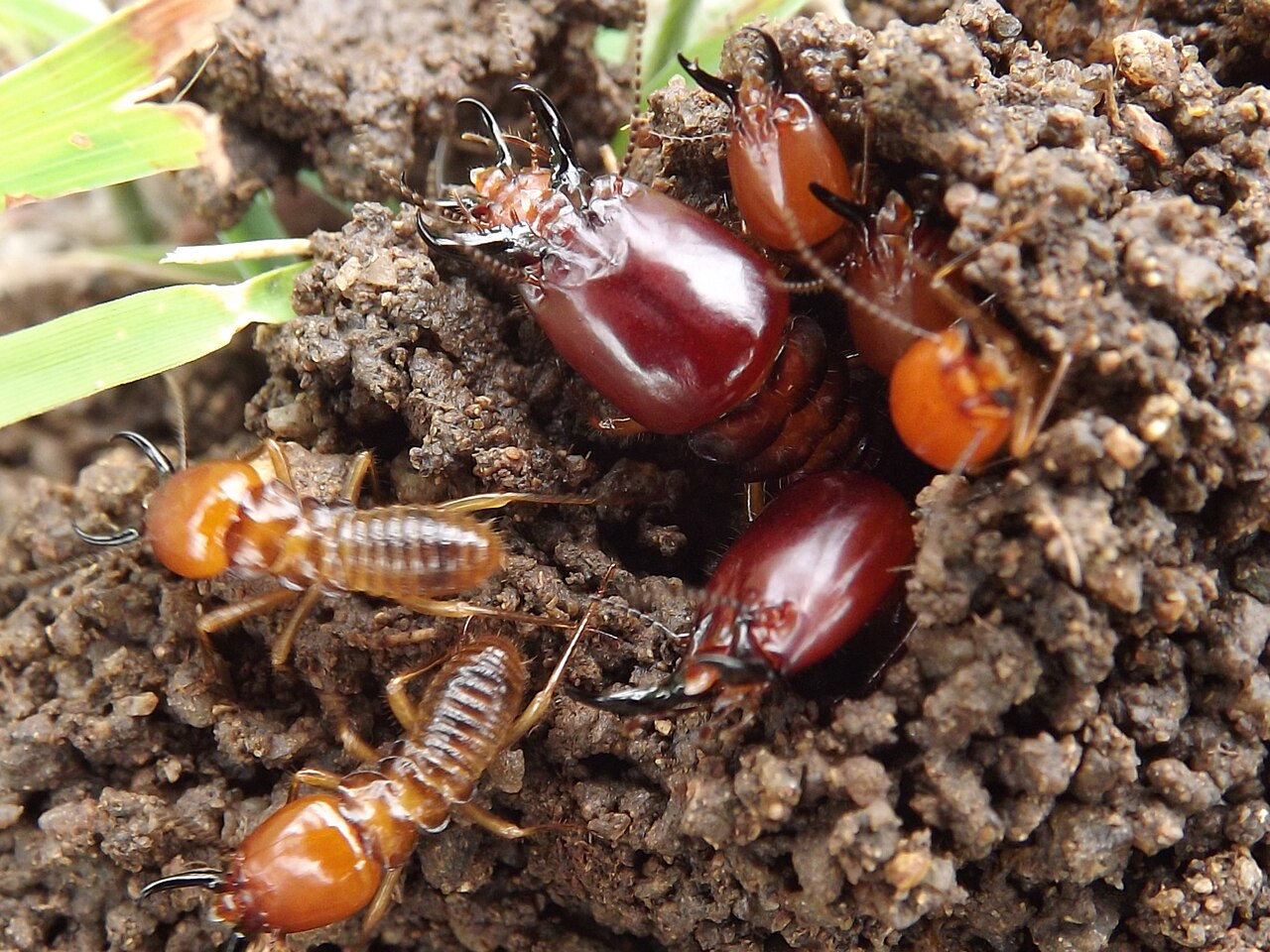
Termite workers and soldiers (Macrotermes michaelseni); the workers gather wood that gut microbes digest for the colony. Image: CC0, via Wikimedia Commons.
The mechanism
- The termite gathers the fuel. Its jaws chew and swallow wood, and its enlarged hindgut provides a warm, oxygen-free chamber, but the insect's own enzymes cannot break down cellulose.
- Microbes do the digesting. A dense community of specialized protists engulfs the wood particles and ferments the cellulose into compounds the termite can absorb, doing the chemistry the host cannot.
- A nested partnership. Many of those protists carry their own bacteria, including nitrogen-fixers that supplement the nitrogen-poor wood diet, so the system runs microbe inside microbe inside insect.
- Found nowhere else. The gut protists are anaerobes adapted to the termite hindgut and do not survive outside it; the host is their entire world.
- Passed on deliberately. Because the gut community is lost at each molt and absent in hatchlings, termites re-seed one another by transferring hindgut fluid, ensuring the symbionts are handed to the next generation.
Why this points to design
Wood-eating only works when two things are present together: an animal that can gather, chew, and house the fuel in an anaerobic chamber, and microbes that can chemically break it down and fix the missing nitrogen. Remove either and the whole system fails. A termite without the microbes eats wood and starves; the microbes without the termite have no fuel, no shelter, and no survivable home. The benefit appears only when the host's anatomy, the microbes' chemistry, and the behavior that passes the microbes on are all aligned at once, which is not how a chain of separately advantageous steps proceeds. Layer on the nested design, bacteria living inside the protists living inside the insect, and a built-in re-seeding behavior to keep the partnership from being lost at every molt, and you have a single digestive system deliberately divided across organisms that cannot live without each other. That kind of matched, prearranged interdependence points to a designer. See Intelligent Design and Irreducible Complexity.
The evolutionary account, and why it falls short
The standard reply is that the partnership assembled gradually: ancestral wood-roaches already carried some gut microbes, an insect that swallowed cellulose-fermenting microbes got a little extra nutrition from its diet, selection favored a larger hindgut and tighter retention of the helpful microbes, and the transfer behavior arose because colonies that re-seeded their young kept the benefit. The microbes, for their part, specialized to the rich, steady niche inside the gut.
The reply names the pieces and never delivers the integrated system. What needs explaining is not that an insect can house a microbe; it is the complete, obligate division of labor, an animal built to gather and chamber wood it cannot digest, microbes that exist nowhere but that gut and supply both cellulose breakdown and nitrogen fixation, and a deliberate fluid-transfer behavior without which the partnership is lost at the very next molt. Pointing to a roach with incidental gut flora no more explains that arrangement than pointing to loose yeast explains a brewery. Naming a path from "facultative" to "obligate" is not the same as exhibiting the intermediate termite that thrived on wood with a half-formed microbe community and no way to pass it on, or the genetic and behavioral changes that locked the re-seeding into the colony's life cycle. The matched, mutually helpless fit, a host that cannot digest and microbes that cannot forage, joined by a behavior that perpetuates them both, is what the gradual story cannot deliver and what design accounts for directly.
See also
- Animals That Defy Evolution, the hub this spoke belongs to
- Intelligent Design, the positive design program
- Irreducible Complexity, the pattern of jointly-required, individually-useless parts
- Edge of Evolution, the empirical reach of random mutation
- The clownfish and sea anemone, another obligate partnership in this hub where each organism is set up in advance for the other
Common questions this page answers
Q: Why is the termite and its gut microbes a problem for evolution?
A termite gathers and chews wood but cannot digest the cellulose; specialized gut microbes do that for it, and many of those microbes live nowhere else and depend entirely on the termite. The feeding system only works when the host's wood-gathering and anaerobic gut, the microbes' digestive and nitrogen-fixing chemistry, and the behavior that passes the microbes on are all present together. Because a half-built version helps neither partner, there is no ladder of separately advantageous steps for selection to climb, and the split digestive system looks engineered.
Q: How do termites digest wood?
They do not digest it themselves. Termites chew and swallow wood, but the actual breakdown of cellulose is done by a dense community of specialized protists and bacteria in their hindgut, which ferment the wood into compounds the insect can absorb. Some of those microbes also fix nitrogen to supplement the nitrogen-poor wood diet, so the gut community supplies chemistry the termite completely lacks.
Q: What happens to a termite without its gut microbes?
It starves, even while eating. Termites stripped of their gut protists keep chewing and swallowing wood but cannot extract nourishment from it and die. That total dependence is part of why the partnership resists a gradual origin: the termite cannot live its wood-eating life unless the microbes are already in place.
Q: Couldn't the termite-microbe partnership have evolved gradually?
The usual story says ancestral roaches carried some gut microbes and the bond tightened over time, but that skips the hard part: the system needs a host that chambers wood it cannot digest, microbes that exist only in that gut and supply both digestion and nitrogen fixation, and a deliberate fluid-transfer behavior, or the whole community is lost at the next molt. Pointing to incidental gut flora supplies a starting microbe, not the integrated, obligate system, and the intermediate termite and the genetic and behavioral changes have never been demonstrated. That prearranged, mutual fit is what points to design.