Concept
Goby and Pistol Shrimp
goby and pistol shrimp, goby shrimp symbiosis, watchman goby, snapping shrimp goby, goby pistol shrimp mutualism, goby shrimp evolution, goby shrimp designIntro
On a tropical sand flat, a near-blind pistol shrimp and a sharp-eyed goby fish run a shared household. The shrimp is a tireless digger; it excavates and constantly maintains a burrow that shelters both animals. The fish cannot dig, but it can see, so it stands guard at the burrow mouth while the shrimp works. The catch is that the shrimp has very poor eyesight and would be helpless to a passing predator on its own. So the two stay in constant touch: the shrimp keeps one antenna resting on the goby's tail, and the moment the goby senses danger it flicks its tail, and the shrimp dives for cover before it ever sees the threat. A blind laborer and a watchman with no shovel, locked together by a private touch signal that means "danger," is not a loose convenience. Each animal supplies exactly what the other lacks, and the pairing only works once both halves and the signal between them are already in place. That matched, prearranged fit is what design looks like.
See this page's graph and discover linked topics
In full
Many species of alpheid snapping shrimp (the "pistol" shrimp) form obligate or near-obligate partnerships with gobiid fishes (watchman or shrimp gobies). The shrimp digs and continually maintains a sandy burrow that both partners occupy; the goby, which cannot excavate, uses the burrow as refuge and nesting site. Because alpheid shrimp have extremely poor vision, the goby serves as a sentinel: while the shrimp works at or just outside the entrance it keeps one or both antennae in continuous contact with the goby's body, and the fish communicates threat by characteristic tail flicks that trigger the shrimp's retreat. The signaling is specific and bidirectional, with distinct tail movements correlated to the shrimp's behavior, and partners recognize and re-pair with each other. The arrangement is a tightly fitted division of labor: digging ability in one partner, vision and an alarm signal in the other, coupled by a learned, mutually understood tactile code. The interdependence resists gradual assembly because the components are jointly required. A digging shrimp with no warning system is exposed every time it surfaces; a watching goby with no burrow has no shelter to offer or share; and a sentinel relationship is worthless unless the warning is both sent and correctly read. None of the parts pays off until the burrow, the constant antenna contact, the tail-flick alarm, and the matched response are all present at once, which gives a step-by-step process no advantageous foothold to build on.
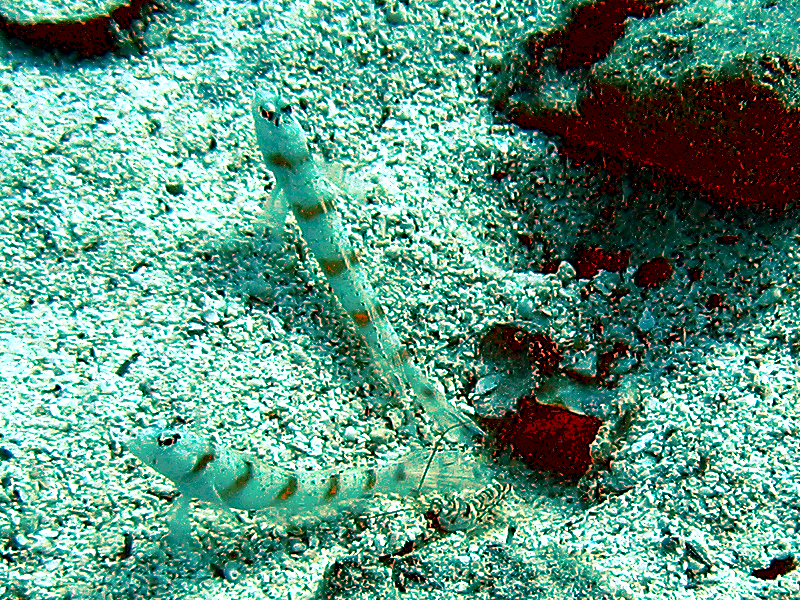
A watchman goby and its partner pistol shrimp at their shared burrow. Image: public domain, via Wikimedia Commons.
The mechanism
- The shrimp digs. The pistol shrimp excavates and endlessly repairs a burrow in loose sand, hauling out debris; this shelter is the home both animals depend on.
- The goby watches. The fish, far better-sighted than the shrimp, stations itself at the burrow entrance and scans for predators while the shrimp labors.
- Constant contact. As the shrimp works near the opening it keeps an antenna pressed against the goby's tail, maintaining an unbroken physical link to its lookout.
- The alarm signal. When the goby detects a threat it flicks its tail in a specific way; the shrimp reads the movement instantly and retreats into the burrow before it can see the danger itself.
- A shared, defended household. Both animals shelter and often breed in the burrow, and partners recognize one another and re-establish the pairing.
Why this points to design
The partnership only functions when four things are present together: the burrow the shrimp builds, the vision the goby supplies, the continuous antenna contact, and a tail-flick alarm that the shrimp both receives and obeys. Remove any one and the system fails. A digging shrimp with no lookout is caught in the open; a goby with no burrow has nothing to guard or gain; an alarm that is sent but not understood, or understood but never sent, saves no one. There is no slow climb through separately advantageous stages, because a half-built partnership protects neither animal and gives selection nothing to preserve. Two unrelated species fitted together so that one provides the labor and shelter the other cannot, while the other provides the eyes and warning the first lacks, joined by a private signal both already understand, is exactly the kind of prearranged match that points to a designer. See Intelligent Design and Irreducible Complexity.
The evolutionary account, and why it falls short
The standard reply is that the association began casually and tightened over time: a shrimp that happened to dig near a goby gained some incidental warning when the fish bolted from predators, the shrimp learned to respond, and selection gradually refined the burrow-sharing, the contact, and the signaling into the close bond seen today.
The reply describes a destination without showing the road. What needs explaining is not that two animals can live near each other; it is the integrated sentinel system, an effectively blind digger that surfaces only while tethered by antenna to a lookout, plus a specific tail-flick code that means "danger" and a partner trained to dive the instant it feels it. Pointing to a fish that sometimes flees no more explains that arrangement than pointing to a moving shadow explains a working alarm. Naming a path from "casual" to "obligate" is not the same as exhibiting the intermediate pair that gained real protection from a half-formed signal neither side reliably sent or read, or the behavioral and developmental changes that locked the tactile code into place. The matched, two-sided fit, with each animal supplying precisely the capability the other lacks and a shared signal binding them, is what the gradual story cannot deliver and what design accounts for directly.
See also
- Animals That Defy Evolution, the hub this spoke belongs to
- Intelligent Design, the positive design program
- Irreducible Complexity, the pattern of jointly-required, individually-useless parts
- Edge of Evolution, the empirical reach of random mutation
- The clownfish and sea anemone, another marine partnership in this hub where each organism is set up in advance for the other
Common questions this page answers
Q: Why is the goby and pistol shrimp partnership a problem for evolution?
The blind shrimp digs and maintains a shared burrow, while the sharp-eyed goby stands guard and warns the shrimp of danger with a tail signal. The system only protects either animal when the burrow, the constant antenna contact, the specific alarm flick, and the shrimp's trained response are all in place at once. Because a half-built version helps neither partner, there is no ladder of separately advantageous steps for selection to climb, and the fitted division of labor looks engineered.
Q: How do the goby and pistol shrimp communicate?
The shrimp keeps one antenna resting on the goby's tail whenever it works near the burrow entrance, maintaining a continuous physical link. When the goby spots a predator it flicks its tail in a particular way, and the shrimp reads that movement instantly and retreats into the burrow before it can even see the threat. The signaling is specific and learned, with distinct tail motions tied to the shrimp's behavior.
Q: What does each partner get from the relationship?
The shrimp gets eyes and an early-warning system it badly needs, because its own vision is very poor. The goby gets a ready-made, constantly maintained burrow for shelter and nesting that it could never dig itself. Each animal supplies exactly the capability the other lacks, which is the heart of the design inference here.
Q: Couldn't the goby-shrimp partnership have evolved gradually?
The usual story says it began as a casual association and tightened over time, but that skips the hard part: a real sentinel system needs a specific alarm signal that the shrimp both receives and obeys, plus the burrow-sharing and constant contact, before it protects anyone. Pointing to a fish that sometimes flees supplies a behavior, not the integrated code, and the intermediate pair and the genetic and behavioral changes have never been demonstrated. That prearranged, two-sided fit is what points to design.