Concept
Shark
shark, shark electroreception, ampullae of Lorenzini, shark evolution, shark design, how sharks find hidden preyIntro
A shark can find a fish buried in the sand, in the dark, with its eyes shut, by feeling the faint electric field every living body leaks into the water. The snout of a shark is studded with hundreds of tiny pores, each opening into a jelly-filled canal that runs to a cluster of sensory cells. These ampullae of Lorenzini detect electric fields as weak as a few billionths of a volt across a centimeter, the steady leakage from a hidden animal's muscles and nerves. Humans have no sense remotely like it; we cannot feel electric fields at all. The system works because the jelly is an extraordinary conductor, the canals are precisely arranged, and the receptor cells and the brain together read the direction and strength of a field a hidden prey cannot help broadcasting. A sense with no human analog, delivered complete and working the first time a young shark hunts, is the kind of purpose-built equipment that points to design.
See this page's graph and discover linked topics
In full
Sharks and other elasmobranchs possess the ampullae of Lorenzini, an electroreceptive system of subdermal sensory organs concentrated around the snout and head. Each ampulla is a bundle of receptor cells at the base of a canal filled with a glycoprotein gel of remarkably high proton conductivity; the canal opens to the surface through a pore. The system functions as an array of sensitive voltmeters, detecting bioelectric fields on the order of nanovolts per centimeter, the DC and low-frequency potentials produced by the muscle and nerve activity of nearby animals. The gel transmits voltage differences between the pore and the ampulla to electrosensory hair cells, which signal to the brain; the spatial distribution of pores across the head lets the shark compute the direction and distance of the source, and the same array also registers temperature, salinity, and the induced fields used in geomagnetic orientation. The conductive gel, the canal geometry, the specialized receptor cells, and the neural mapping are obligately interdependent, and the apparatus must function correctly the first time the animal forages. Specifying that electrosensory array and its processing in advance is a feat of built-in information (Information Argument for Design, Specified Complexity).
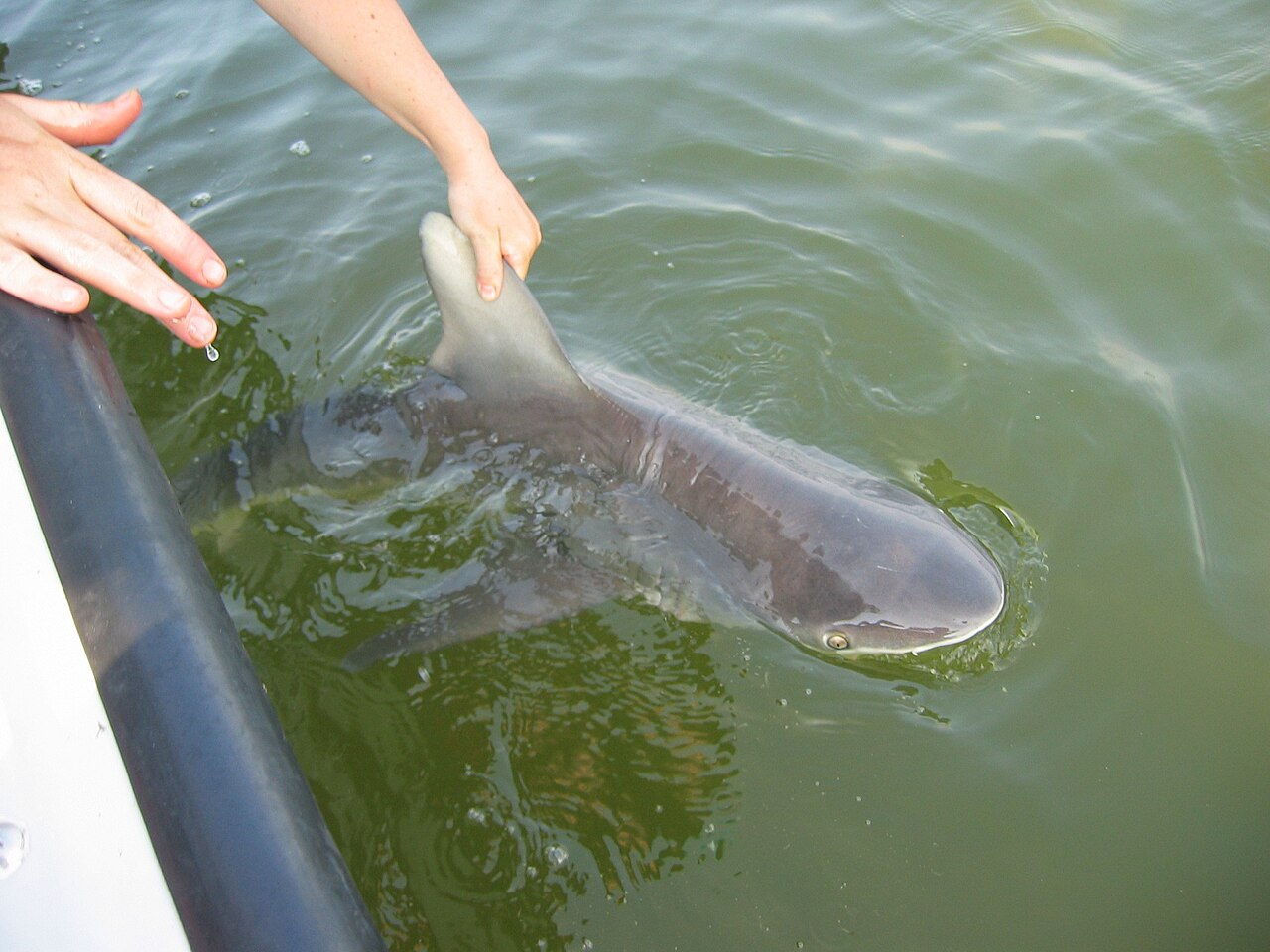
A juvenile shark at the surface, the electroreceptive pores concentrated on the snout. Image: public domain, via Wikimedia Commons.
The mechanism
- Pore array. Hundreds of pores dot the snout and head, each the entrance to a gel-filled canal, spread in a pattern that lets the shark triangulate a field's direction.
- Super-conductive gel. The canals are filled with a glycoprotein jelly that conducts voltage from the pore to the sensory cells with exceptional efficiency, one of the best proton conductors known in biology.
- Nanovolt sensitivity. The receptor cells respond to electric fields as faint as a few billionths of a volt per centimeter, fine enough to register the steady bioelectric leakage of a hidden animal.
- Direction and distance. Comparing signals across the spread of pores, the brain computes where the source lies, letting the shark home in on prey it cannot see, smell, or hear.
- Multi-purpose array. The same organs also read temperature and salinity gradients and the weak fields induced as the shark swims through Earth's magnetic field, aiding orientation on open ocean.
Why this points to design
Electroreception is worthless unless every part is present together. Pores without the conductive gel carry no signal; gel without the nanovolt-sensitive receptor cells transduces nothing; sensitive cells with no spread-out array of pores cannot tell which way the source lies; and a directional electric signal is meaningless until the brain has the wiring to map it and steer the hunt. Each component is useless until all are matched, and a shark gets no incremental practice detecting prey, the sense either works on the first forage or it does not. There is no climb through individually advantageous halfway stages, because a half-built electroreceptor returns no usable field-map and a partly wired brain cannot localize what it cannot interpret. A sense for which humans have no analog at all, appearing only when conductive gel, canal array, receptor cells, and dedicated neural processing are assembled together, is what engineering produces, not what unguided step-by-step processes build. See Information Argument for Design and Irreducible Complexity.
The evolutionary account, and why it falls short
The standard reply is gradual refinement: ordinary mechanosensory lateral-line organs, which fish use to feel water movement, share an embryonic origin with electroreceptors, so a few cells that became weakly sensitive to voltage could give a faint electric sense, and selection then deepened the canals, improved the gel, and sharpened the array over time. Electroreception, it is noted, appears in several fish lineages.
The reply names a related organ and assumes the rest assembles. The hard problem is not that fish have sensory hair cells; it is that a high-conductance glycoprotein gel, a precisely arranged array of canals and pores, receptor cells tuned to nanovolt fields, and a brain that maps the array to compute a source's direction and distance form one coordinated detection system that must already work for the shark to find buried prey. A canal is no advantage until it is filled with the conductive gel and capped with cells that can read billionths of a volt; a faint electric signal arriving at the brain is noise until dedicated circuitry localizes it. Pointing to lateral-line cells no more explains that array than pointing to a wire explains a working voltmeter network. The selectable intermediate stages, and the genetic and developmental changes that would build the gel, the canal geometry, and the neural mapping together, have never been demonstrated. The gap between a vague water-motion sense and a calibrated, direction-finding electroreceptor with no human counterpart is exactly what points to design.
See also
- Animals That Defy Evolution, the hub this spoke belongs to
- Information Argument for Design, the information case behind an exotic inherited sense
- Irreducible Complexity, the integrated-organ pattern behind the ampullae
- Specified Complexity, functional information as a design signature
- The pit viper, another animal in this hub built around a sense humans do not share
Common questions this page answers
Q: Why is the shark a problem for evolution?
Its electric sense, the ampullae of Lorenzini, is an integrated system: surface pores, a super-conductive gel, receptor cells tuned to a few billionths of a volt, and brain wiring that maps the array to find a source's direction. Each part is useless without the others, so there is no ladder of individually useful halfway stages, and the sense has to work the first time a young shark forages. That points to engineered information rather than lucky accumulation.
Q: How does a shark detect electric fields with the ampullae of Lorenzini?
Hundreds of pores on the snout open into jelly-filled canals that run to clusters of sensory cells. The jelly conducts the tiny voltage from a hidden animal's muscle and nerve activity to those cells, which fire at fields as faint as nanovolts per centimeter, and the brain compares signals across the spread of pores to compute where the prey lies, even buried in sand or in the dark.
Q: Can sharks really find prey they cannot see?
Yes. A shark can locate a fish hidden under sand or in darkness by sensing the steady electric field the prey's body leaks into the water, a sense so acute it works when sight, smell, and hearing give nothing.
Q: Couldn't shark electroreception have evolved gradually from the lateral line?
The lateral line shares an embryonic origin with electroreceptors, but a few weakly voltage-sensitive cells give no usable field-map. A canal is no help until it holds the conductive gel and receptor cells that read billionths of a volt, the pores are arrayed to give direction, and the brain is wired to localize the signal. Those parts are only beneficial together, so there are no separately advantageous intermediate steps, and the genetic pathway to the finished array has never been demonstrated.