Concept
Yucca Moth and Yucca Plant
Intro
Most flowers bribe insects with nectar and let pollination happen by accident. The yucca runs no such lottery. Its only pollinator is a small white moth that does the job on purpose. The female moth visits a yucca flower, scrapes pollen into a sticky ball, holds it under her chin with a pair of tentacle-like mouthparts no other moth has, flies to a second flower, drills into its ovary to lay her eggs, then climbs to the top of the pistil and deliberately packs the pollen onto the stigma. Her grubs will eat some of the developing seeds; the rest become the next generation of yuccas. Neither species can reproduce without the other. A plant that breeds through one specific insect, and an insect built with special tools and a fixed routine to breed that one plant, is two halves of a single design.
In full
The yucca and its pollinating moths (Tegeticula and Parategeticula) form one of biology's clearest obligate mutualisms. The yucca is pollinated by no other agent, and the moth larvae develop on no other food. The female moth possesses unique prehensile maxillary tentacles found in no related lineage, used to gather pollen into a packed ball and carry it under her head. She actively oviposits into the flower's ovary with a specialized ovipositor, then climbs the style and deliberately applies pollen to the stigma, an intentional pollinating act rather than incidental transfer. The plant absorbs a controlled cost, the larvae consume a fraction of the seeds, and in turn limits exploitation: yuccas selectively abort flowers that are overloaded with eggs, policing moths that take too much. The interdependence is total and the toolkit is matched in advance: the moth's pollen-handling tentacles, its egg-laying-then-pollinating behavioral sequence, and the plant's reliance on exactly that behavior plus its abortion-based sanction must all be present together. A moth without the tentacles and the routine starves the plant and its own offspring; a plant pollinated only this way cannot set seed without the finished partner.
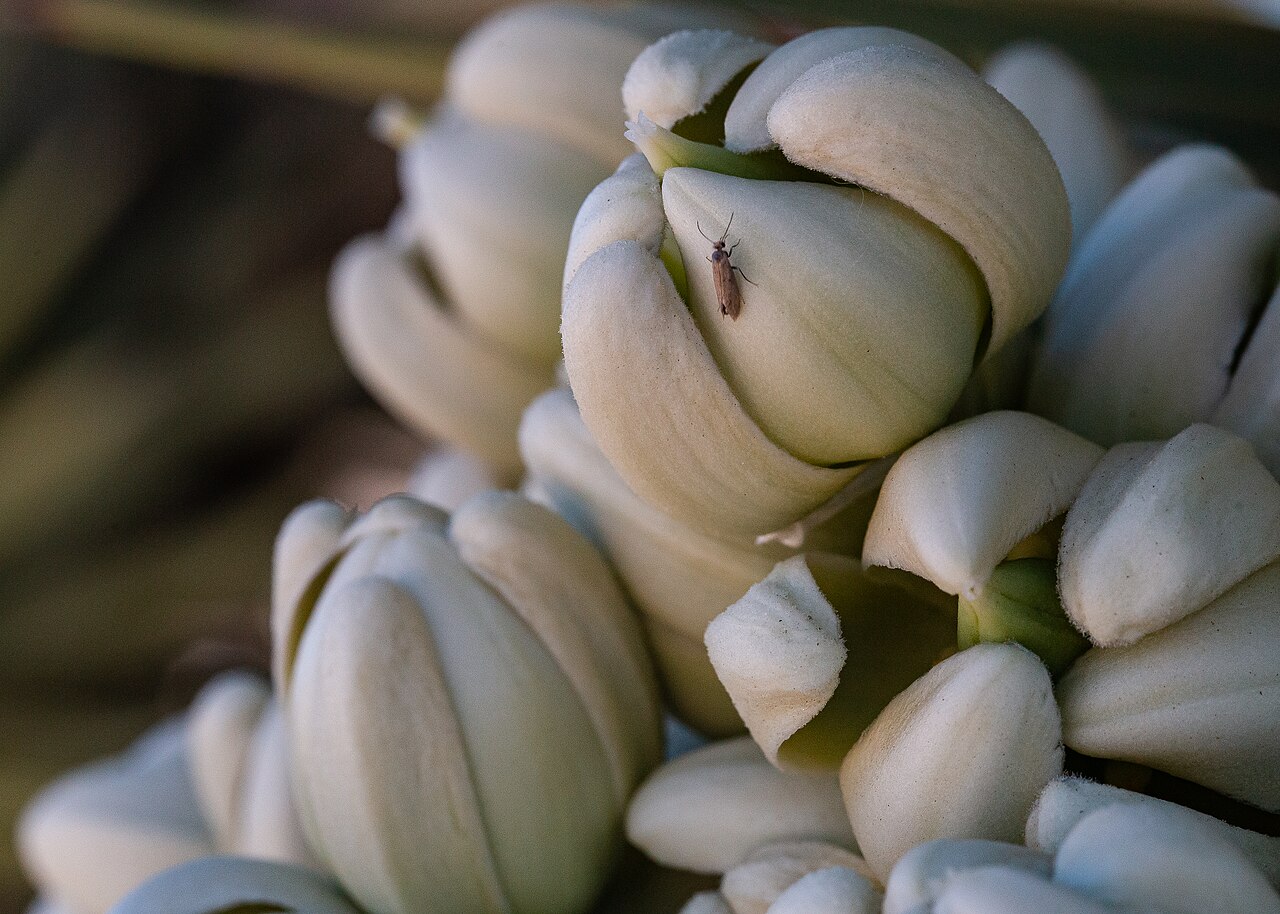
A yucca moth on the flowers of its host yucca. Image: public domain, via Wikimedia Commons.
The mechanism
- Specialized pollen tools. The female moth carries prehensile maxillary tentacles, found in no other moths, dedicated to gathering and holding a ball of yucca pollen.
- Deliberate collection. She scrapes pollen from the anthers and packs it under her chin before flying to another flower, carrying it on purpose rather than by accident.
- Egg-laying inside the ovary. Using a specialized ovipositor, she drills into the flower's ovary and lays eggs among the developing seeds her larvae will eat.
- Intentional pollination. She then climbs the pistil and actively presses the pollen ball onto the stigma, ensuring the seeds her young need actually form.
- A policed bargain. The plant tolerates the loss of some seeds but selectively aborts flowers loaded with too many eggs, so moths that overexploit lose their brood.
Why this points to design
The partnership pays off only when the whole set is present together: the moth's one-of-a-kind pollen-handling tentacles, the precise sequence of collecting pollen, laying eggs, then climbing to pollinate, and the plant's matching reliance on exactly that act along with its sanction against cheats. Remove any piece and the system yields nothing. A moth with the tentacles but not the pollinating routine lays eggs into flowers that never set seed, starving its own larvae; a plant that depends on this moth and no other agent simply fails to reproduce if the finished partner is absent; the special tentacles serve no purpose except in this exact procedure. There is no slow climb through separately useful stages, because a half-built routine breeds neither the moth nor the plant. Two organisms fitted to each other in advance, each carrying tools and instincts that are pointless without the other, is the prearranged match that points to a designer. See Intelligent Design and Irreducible Complexity.
The evolutionary account, and why it falls short
The standard reply is that the bond began loose and one-sided and tightened over time: ancestral moths fed or laid eggs on yuccas while pollinating them incidentally, like ordinary flower visitors, and selection gradually refined the behavior and the mouthparts until both species became wholly dependent.
The reply gestures at a starting point but never produces the thing that needs explaining, the active, deliberate pollination performed by an insect with organs built for nothing else. Incidental pollen transfer by a casual visitor is a different phenomenon from a moth that gathers a pollen ball with dedicated tentacles, carries it under her chin, and then climbs the pistil to pack it onto the stigma after laying her eggs. Naming a path from "occasional visitor" to "obligate pollinator" is not the same as exhibiting the intermediate moth with half-formed tentacles and a half-formed routine that nonetheless reproduced, or the plant that survived the transition while depending on a partner not yet finished, or the genetic changes that built the novel mouthparts and the instinct to use them in sequence. The mutual, all-or-nothing dependence and the purpose-built toolkit are precisely what the gradual account cannot deliver and what design accounts for directly.
See also
- Animals That Defy Evolution, the hub this spoke belongs to
- Intelligent Design, the positive design program
- Irreducible Complexity, the matched-parts pattern behind the partnership
- Edge of Evolution, the empirical reach of random mutation
- The fig wasp and fig, another obligate plant-and-insect breeding lock in this hub
Common questions this page answers
Q: Why is the yucca moth a problem for evolution?
The yucca and its moth depend on each other completely: the plant is pollinated by no other agent, and the moth's larvae eat nothing else. The benefit appears only when the moth's unique pollen-handling tentacles, its egg-laying-then-pollinating routine, and the plant's reliance on exactly that behavior are all present together, and a half-built version reproduces neither partner. That all-or-nothing, purpose-built fit looks engineered rather than assembled by gradual, separately useful steps.
Q: How does yucca moth pollination actually work?
The female moth scrapes pollen from a yucca flower and packs it into a ball held under her chin with special tentacle-like mouthparts no other moth has. She flies to a second flower, drills into its ovary to lay her eggs among the future seeds, then deliberately climbs the pistil and presses the pollen onto the stigma so the seeds her larvae need will form.
Q: Why can't the yucca and the moth survive without each other?
The yucca has no other pollinator, so without the moth's deliberate pollination it sets no seed. The moth's larvae develop only on yucca seeds, so without the plant they have no food, and the moth's pollen-gathering tentacles are useless anywhere else. Each carries tools and instincts that pay off only in this exact partnership, which is the heart of the design inference here.
Q: Doesn't the moth damage the plant by laying eggs in it?
The larvae do eat a fraction of the developing seeds, but the plant absorbs that controlled cost and still comes out ahead because the moth guarantees pollination. The yucca also polices the deal by selectively aborting flowers overloaded with eggs, so moths that take too much lose their brood. The cost is regulated on both sides, which keeps the prearranged exchange stable.