Concept
Arctic Tern
Intro
The Arctic tern flies farther than any other animal on Earth. Each year it travels from its breeding grounds in the high Arctic all the way to the pack ice of Antarctica and back, a winding round trip that can run more than 40,000 miles. It chases summer to both ends of the planet, so it lives in more daylight than any creature alive. A young tern makes this journey for the first time with no map, no parent flying ahead the whole way, and no chance to practice. It launches from the far north and finds the far south across open ocean. A bird that completes a pole-to-pole crossing correctly on its first attempt has to carry the route, the timing, and the destination inside it from the start. Instructions that work the first time point to an author.
In full
Sterna paradisaea performs the longest known annual migration of any animal. Geolocator studies tracking individual birds have logged round-trip distances of roughly 44,000 to 56,000 miles when the meandering, wind-following route is measured rather than the straight-line distance. The tern breeds in the Arctic during the northern summer, then flies south down the Atlantic (often in an S-shaped path that exploits prevailing wind systems) to the Southern Ocean and the edge of Antarctic ice, where it arrives for the southern summer. Birds may live thirty years and rack up more than a million migratory miles in a lifetime. Orientation draws on a suite of inherited compasses: a sun compass, a star compass, and a magnetic sense, integrated with an inborn sense of direction, distance, and seasonal timing. A first-year tern completes the crossing without having been taught it, so the full navigational program and its destination must be encoded in advance and run correctly on the first attempt. Packing a precise, multi-cue intercontinental navigation algorithm and a target into a genome is a feat of built-in information (Information Argument for Design, Specified Complexity).
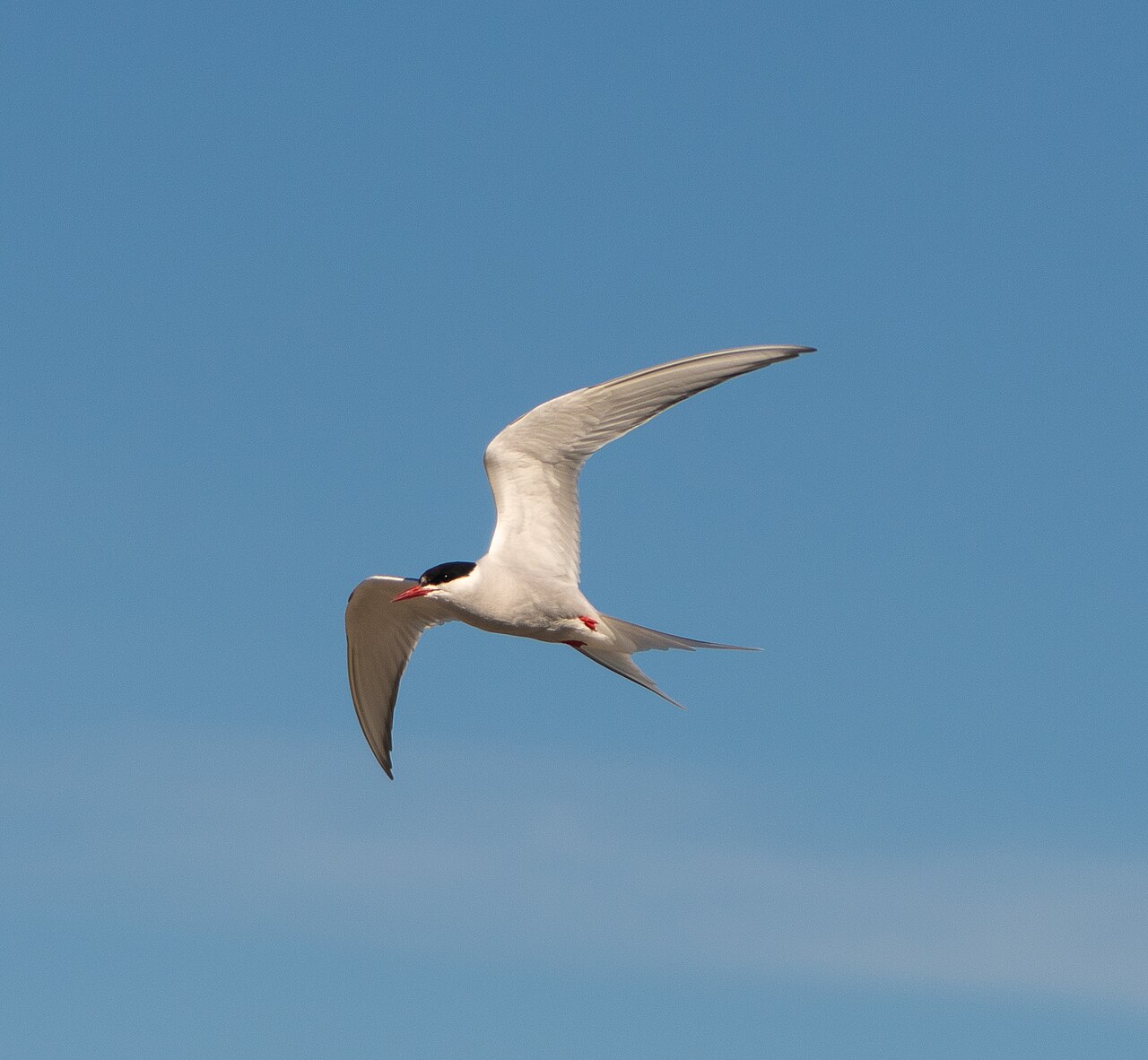
An Arctic tern in flight. Image: public domain, via Wikimedia Commons.
The mechanism
- Pole-to-pole route. The tern breeds in the Arctic, then crosses the entire globe to the Antarctic pack ice and returns, timing each leg to land in summer at both ends.
- Wind-aware path. Rather than flying a straight line, it follows looping, S-shaped tracks that ride prevailing wind belts, adding miles but saving energy.
- Multiple compasses. It reads direction from the sun's arc, from star patterns at night, and from Earth's magnetic field, with the cues cross-checking one another.
- Inborn schedule. An internal sense of season and distance tells it when to leave, how far to go, and when to turn around, without any prior experience of the trip.
- First-time success. A juvenile makes the crossing without a lifelong guide, arriving at wintering grounds it has never seen.
Why this points to design
An Arctic tern does not get to rehearse a 40,000-mile crossing. It gets one attempt, and it succeeds. That means the navigation program, the sun compass, the star compass, the magnetic sense, and the built-in sense of direction, distance, and timing, must all be in place and working correctly before the journey begins. Information that is present before it is ever tested, and that specifies a precise multi-step procedure together with a destination on the far side of the planet, is not the kind of thing random mutations accumulate by lucky degrees. It is the kind of thing minds write. The young tern carries a complete, functioning instruction set for a journey it has never taken, which is the signature of design. See Information Argument for Design and Specified Complexity.
The evolutionary account, and why it falls short
The standard reply is that the individual cues are widespread among birds (sun-compass and star-compass orientation and magnetoreception are common) and that the route lengthened gradually as breeding and wintering ranges drifted apart over time, with selection favoring slightly better orientation and slightly longer flights generation after generation.
The reply names the ingredients and assumes they assembled themselves into a working system. The hard problem is not that terns sense the sun or the magnetic field; it is that a sun compass, a star compass, a magnetic compass, and an inherited heading, distance, and stopping rule are integrated into one program that delivers a never-been-there bird from the Arctic to Antarctica on its first try. A gradually lengthening route still has to keep that program coherent at every stage, and a half-wired navigation system does not carry a bird partway to the other pole, it strands it over open ocean. Pointing to common components and a plausible historical trend is not the same as exhibiting the genetic encoding of the integrated, first-time-correct algorithm or the selectable advantage of each intermediate. A complete, working instruction set that must be present before its first and only use is exactly what points to a designer.
See also
- Animals That Defy Evolution, the hub this spoke belongs to
- Information Argument for Design, the information case behind inherited navigation
- Specified Complexity, functional information as a design signature
- Edge of Evolution, the empirical reach of random mutation
- The bar-tailed godwit, another bird in this hub built for an extreme migration
Common questions this page answers
Q: Why is the Arctic tern a problem for evolution?
Its pole-to-pole navigation program has to work correctly the first time, with no chance to learn or refine it across the trip. That means a precise, multi-cue algorithm plus an inherited destination must be encoded in advance, and a half-wired version does not carry the bird partway, it loses it over the ocean. Information that specifies a complete intercontinental procedure and target before it is ever used is the kind of thing minds produce, not the kind of thing lucky mutations accumulate piece by piece.
Q: How does the Arctic tern navigate such a long migration?
It uses several inherited compasses at once: a sun compass that reads the sun's position by time of day, a star compass for night flying, and a magnetic sense that reads Earth's field. These are integrated with a built-in sense of direction, distance, and seasonal timing, so the tern holds its heading and times each leg to reach summer at both ends of the planet.
Q: How far does the Arctic tern actually fly each year?
Tracking studies that follow individual birds along their real, wind-following routes log round trips of roughly 44,000 to 56,000 miles, far more than the straight-line distance between the poles. Over a lifespan of about thirty years a single tern can cover more than a million migratory miles.
Q: How does a young Arctic tern know where to go on its first migration?
It is not taught the route. A first-year tern completes the crossing to wintering grounds it has never seen, which means the heading, the distance, the timing, and the destination are inherited rather than learned. A working navigation program that must be present and correct before the bird's first and only attempt is a striking case of built-in biological information.