Concept
Platypus
Intro
The platypus looks like several animals stitched together, and that is exactly what makes it hard to explain. It is a mammal that lays eggs and nurses its young with milk. It hunts with a soft, rubbery bill that detects the faint electrical fields of prey, eyes shut, in muddy water where sight is useless. The males carry venomous spurs on their hind legs. Its genome mixes features usually kept apart in mammals, birds, and reptiles. Each of these systems is a complete working unit in its own right: electroreception needs sensors, nerves, and a brain to read them; egg-laying with milk needs both an egg-laying tract and functioning mammary tissue; the venom needs glands, spurs, and a delivery system. The platypus is not a smooth blend of halfway features. It is a mosaic of finished, integrated systems that resist being lined up on any single gradual track. A mosaic of complete, coordinated systems is the mark of design, not of a tidy chain of small steps.
In full
The platypus (Ornithorhynchus anatinus) is a monotreme that combines traits typically segregated across vertebrate classes. It lays eggs yet lactates (lacking nipples, secreting milk through skin patches), and reproduction involves a functional egg-laying tract together with mammary function. Its bill is an electrosensory and mechanosensory organ: tens of thousands of electroreceptors and push-rod mechanoreceptors let it localize prey by the weak electric fields of muscle activity, foraging with eyes, ears, and nostrils closed, and integrating electrical and mechanical timing cues in a dedicated, enlarged cortical region. Males bear a hind-limb spur delivering a defensin-like venom. Its genome carries a mosaic of mammalian, avian, and reptilian-like genes and an unusual multi-chromosome sex-determination system. Each subsystem, electroreception, egg-laying-plus-lactation, and the venom apparatus, is independently integrated and individually irreducibly complex: electroreception requires receptors, fast nerves, and the cortical map together; venom requires glands, spurs, and delivery together. A receptor array with no brain map, or a spur with no venom gland, confers no advantage, so there is no graded path of separately useful intermediates for selection to climb, and the mosaic as a whole resists any tidy ancestral series.
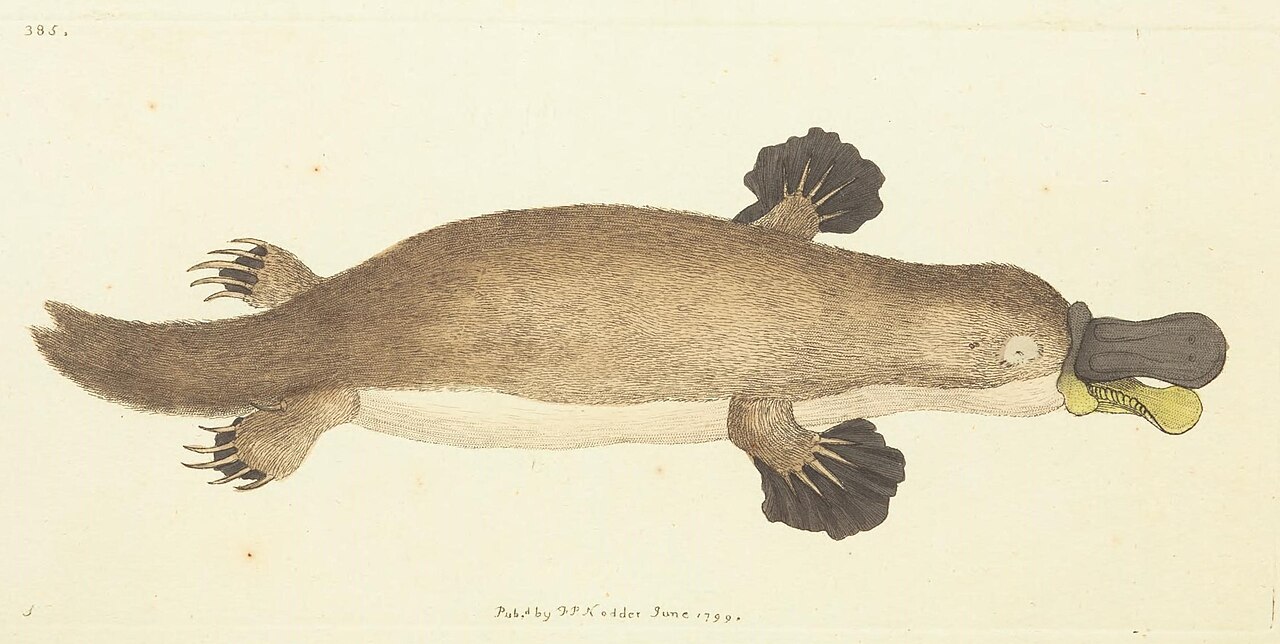
An 1799 illustration of the platypus, showing the bill, webbed clawed feet, and broad tail. Image: CC0, via Wikimedia Commons.
The mechanism
- Electroreception. The bill carries tens of thousands of electroreceptors that sense the weak electric fields of muscle movement, letting the platypus pinpoint prey with eyes, ears, and nose sealed shut underwater.
- Sensor fusion. Push-rod mechanoreceptors in the same bill detect water disturbance; the brain combines the timing of electrical and mechanical signals to locate prey by distance, all mapped in a dedicated, enlarged brain region.
- Egg-laying mammal. It lays leathery eggs like a reptile or bird, yet nourishes the hatchlings on milk secreted through skin patches rather than nipples.
- Venom system. Males carry a spur on each hind leg connected to a venom gland, delivering a painful, defensin-based venom, a full gland-and-delivery apparatus.
- Mosaic genome. Its DNA blends genes and features usually found separately in mammals, birds, and reptiles, with an unusual multi-chromosome sex system.
Why this points to design
Each platypus subsystem is a finished, interdependent unit. Electroreception needs the receptor field, fast nerves, and a brain region mapped to read and fuse the signals; receptors with no cortical map detect nothing useful, and a map with no receptors has nothing to read. The venom needs glands, spurs, and a delivery channel together; a spur with no venom gland is just a spike. Egg-laying paired with lactation needs both a working reproductive tract and functioning milk tissue at once. None of these systems offers a benefit in half-built form, so there is no series of separately advantageous steps assembling any one of them, and stacking three such integrated systems plus a mixed genome into one animal compounds the problem rather than easing it. A mosaic of complete, coordinated systems, each functional only when its matched parts are all present, is exactly what intelligent agents produce and what blind, incremental processes are not equipped to build. See Irreducible Complexity and Specified Complexity.
The evolutionary account, and why it falls short
The standard reply is that the platypus is an ancient lineage retaining old traits while acquiring new ones, with electroreception, lactation, and the rest assembled gradually over deep time, the "mosaic" simply reflecting an early branch that kept reptile-like features while evolving mammalian ones.
The reply relabels the puzzle without solving it. Calling the animal a mosaic of ancestral and derived traits names the pattern but does not supply the selectable intermediates or the genetic pathways for any one of its integrated systems. The platypus is not striking because it is old; it is striking because it runs a working electrosensory bill with a dedicated brain map, a venom gland wired to a delivery spur, and egg-laying combined with milk, each a complete unit useless in half-built form. A partial electroreceptor field with no cortical map locates no prey, and there is no record of the graded, advantage-bearing stages that would build it. A story that connects an early mammal branch to a finished electrosensory, venomous, egg-laying mosaic is not the same as demonstrating the intermediates and the mutations that produced each integrated system. That gap between a deep-time label and the actual assembly of three interdependent systems in one animal is precisely what points to design.
See also
- Animals That Defy Evolution, the hub this spoke belongs to
- Irreducible Complexity, the core pattern behind each platypus subsystem
- Edge of Evolution, the empirical reach of random mutation
- Information Argument for Design, the electrosensory wiring and brain map as functional information
- The star-nosed mole, another animal in this hub that hunts with a specialized sensory organ on its snout
Common questions this page answers
Q: Why is the platypus a problem for evolution?
It stacks several complete, interdependent systems into one animal: an electrosensory bill with a dedicated brain map, a venom gland wired to a delivery spur, and egg-laying combined with milk. Each system is useless in half-built form, receptors with no brain map detect nothing and a spur with no venom gland is just a spike, which is the Irreducible Complexity pattern, so there is no ladder of separately useful stages for any one of them. Combining three such systems plus a mixed genome compounds the difficulty, and no stepwise account has shown how unguided processes assemble them.
Q: How does the platypus find prey with its eyes closed?
Its bill is an electrosensory organ. Tens of thousands of electroreceptors detect the weak electric fields made by the muscle movements of prey, while push-rod sensors in the same bill detect water disturbance. The platypus forages with eyes, ears, and nostrils shut underwater, and its brain fuses the timing of the electrical and mechanical signals, mapped in a dedicated region, to pinpoint where the prey is.
Q: Is the platypus really a mammal that lays eggs?
Yes. It is a monotreme that lays leathery eggs like a reptile or bird, yet it nurses its young on milk like a mammal, secreting the milk through skin patches rather than nipples. Pairing a working egg-laying tract with functioning milk tissue is itself an integrated system, not a halfway trait.
Q: Couldn't the platypus just be an ancient lineage that kept old traits?
Calling it an old mosaic names the pattern but does not supply the selectable intermediates or genetic pathways for its electrosensory bill, its venom apparatus, or its egg-laying-plus-lactation. Each of those is a complete unit that gives no advantage half-built, so the deep-time label leaves the actual assembly of three interdependent systems unexplained, which is exactly the gap that points to design.