Concept
Acacia Ant
Intro
Some acacia trees keep a standing army, and they pay it. The bullhorn acacia grows large hollow thorns that the ants hollow out and live inside, ready-made barracks. At the tips of its leaves it grows little protein-and-fat packets, Beltian bodies, that exist for no purpose except to feed the ants, and at the leaf bases it secretes nectar to water them. In return the ants are a living defense force: they swarm and bite any animal that touches the tree, and they prune away vines and seedlings that crowd it, even clearing the ground around the trunk. The tree feeds and houses; the ants patrol and defend. The catch is that the acacia's food bodies and hollow thorns are wasted on a tree with no ants, and a half-built shelter with no food draws no garrison. A tree that grows custom housing and custom rations for a partner, and a partner that supplies exactly the defense the tree cannot, is two halves of one design.
In full
Swollen-thorn acacias (such as Vachellia cornigera, the bullhorn acacia) and their obligate ant guards (Pseudomyrmex ferrugineus and relatives) form a defensive mutualism in which the plant supplies housing and food and the ants supply protection. The tree produces enlarged, hollow stipular thorns that the ants excavate and inhabit, Beltian bodies (lipid- and protein-rich nodules) at the leaflet tips that serve as the ants' food and have no known function except ant nutrition, and extrafloral nectaries that provide carbohydrate. The resident ants aggressively attack herbivores from insects to large mammals, and they clear competing vegetation, biting and killing encroaching seedlings and severing vines, reducing competition and pathogen load for the host. In the obligate ant-acacias the dependence runs both ways: the tree's defenses are reduced and it relies on the ants for protection, while the specialized ants depend on the acacia for shelter and food and live nowhere else. The system requires a matched set present together: the hollow domatia, the purpose-built food bodies and nectar, and ant behavior tuned to occupy, feed from, and defend that specific host. A tree that grows housing and rations with no ants pays a cost for nothing; ants with the defensive behavior but no host have nowhere to live and nothing to eat; food bodies that exist solely to feed ants are dead weight without the partner that consumes them.
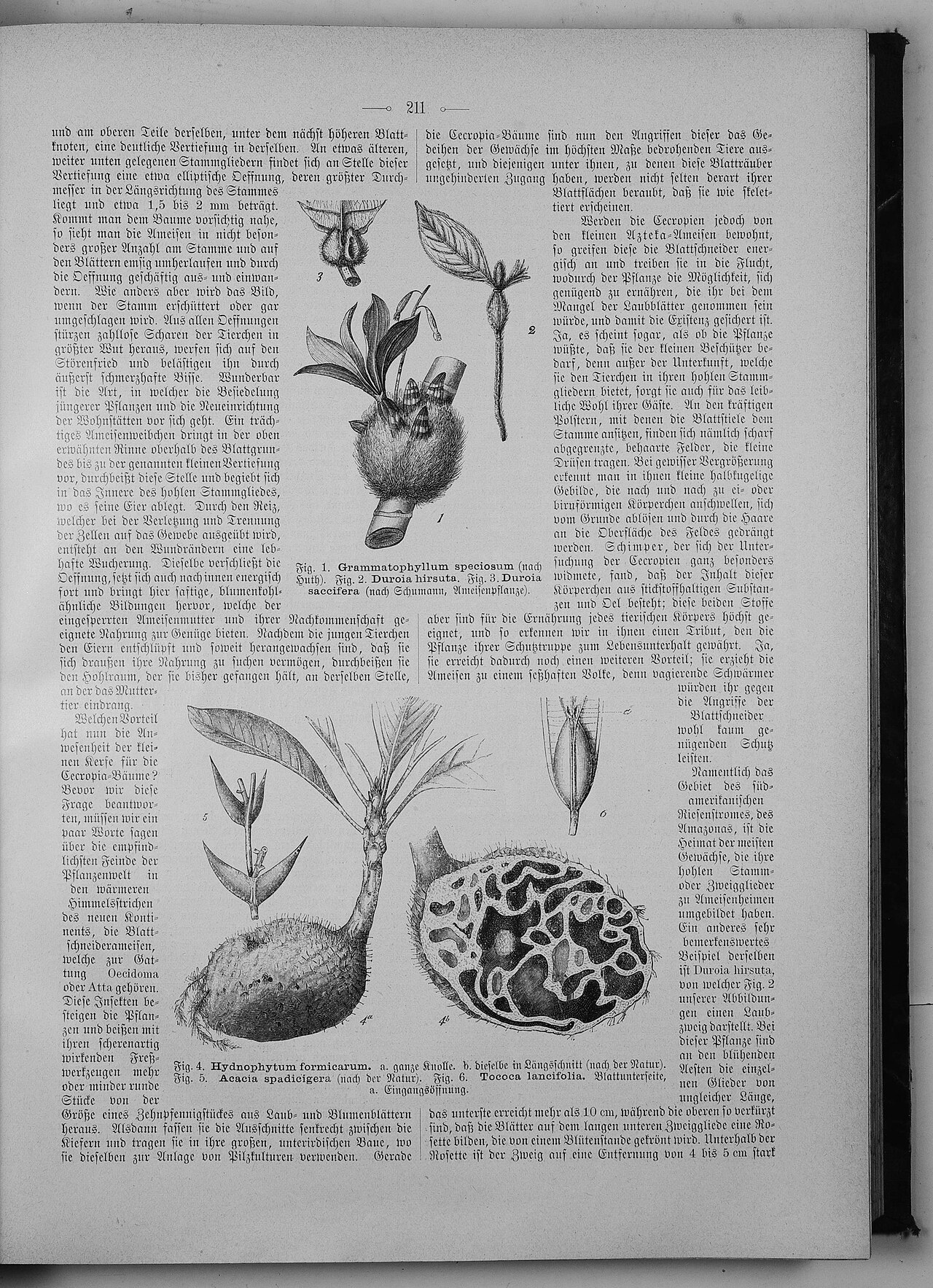
A historical illustration of ant-plants, including a swollen-thorn acacia (Fig. 5), whose hollow structures house defending ant colonies. Image: public domain, via Wikimedia Commons.
The mechanism
- Built-in barracks. The acacia grows enlarged hollow thorns that the ants chew open and live inside, custom housing the tree produces and the ants occupy.
- Custom rations. At its leaf tips the tree grows Beltian bodies, packets rich in protein and fat that feed the ants and serve no other known purpose.
- A nectar supply. Glands at the leaf bases secrete sugary nectar, giving the ant colony a steady carbohydrate source on the tree itself.
- A standing defense. The ants swarm and bite anything that disturbs the tree, driving off insects and even large browsing mammals before they can feed.
- Groundskeeping. The ants prune away vines and kill seedlings that crowd the acacia, clearing space and cutting competition and disease around their host.
Why this points to design
The arrangement pays off only when the full set is present together: the hollow thorns for housing, the food bodies and nectar that feed the garrison, and ant behavior tuned to occupy, feed from, and defend that one kind of tree. Take away any piece and the investment is wasted. A tree that grows custom barracks and custom rations but has no ants pays the metabolic cost of housing and feeding a partner that is not there; ants with the defensive instinct but no acacia have nowhere to nest and nothing to eat; Beltian bodies that exist for nothing but ant food are pure expense on a tree without ants. In the obligate pairings the tree has even reduced its own chemical defenses and leans on the ants, so a half-built version leaves it both undefended and out of pocket. There is no gradual ramp of separately advantageous steps, because growing housing and food before the defender arrives is cost with no return, and a defender with no housing and food never arrives. A tree fitted in advance to feed and shelter a specific partner, paired with an insect fitted to defend exactly that host, is the prearranged match that points to a designer. See Intelligent Design and Irreducible Complexity.
The evolutionary account, and why it falls short
The standard reply is gradual mutual reinforcement: ants visited acacias for incidental nectar and happened to deter some herbivores, trees that offered a little more nectar or slightly roomier thorns drew more ants, and over time the food bodies, the hollow domatia, and the obligate dependence accumulated step by step.
The reply names a casual starting interaction but never delivers the integrated system that needs explaining. Opportunistic nectar-feeding is not a tree that grows hollow barracks, manufactures protein-fat food bodies whose only role is ant nutrition, and reduces its own defenses to rely on a resident army, matched by ants that nest in those thorns, harvest those food bodies, and patrol that host and no other. Naming a path from "occasional visitor" to "obligate guard" is not the same as exhibiting the intermediate tree that profited while paying for housing and rations before a dependable garrison existed, or the ant lineage that committed to a host not yet supplying shelter and food, or the genetic and developmental changes that built the domatia, the Beltian bodies, and the extrafloral nectaries in concert with ant behavior tuned to use them. The matched, mutually dependent housing-food-and-defense system is precisely what the gradual story cannot stage and what design accounts for directly.
See also
- Animals That Defy Evolution, the hub this spoke belongs to
- Intelligent Design, the positive design program
- Irreducible Complexity, the matched-parts pattern behind the partnership
- Edge of Evolution, the empirical reach of random mutation
- The leafcutter ant, another insect in this hub bound to a partner it cannot live without
Common questions this page answers
Q: Why is the acacia ant a problem for evolution?
The partnership pays off only when several matched parts are present at once: the tree's hollow thorns for housing, its food bodies and nectar that feed the ants, and ant behavior tuned to occupy and defend that specific tree. Growing barracks and rations before a defender arrives is cost with no return, and a defender with no housing and food never arrives, so there is no ladder of separately advantageous steps. The fitted, two-sided system looks engineered rather than gradually negotiated.
Q: How does the acacia ant and acacia tree relationship work?
The bullhorn acacia grows large hollow thorns that the ants live inside, protein-and-fat food bodies at its leaf tips that feed them, and nectar glands that supply sugar. In return the ants swarm and bite any animal that touches the tree and prune away vines and seedlings that crowd it, acting as a live defense and groundskeeping crew for their host.
Q: What are Beltian bodies and why do they matter?
Beltian bodies are small nodules rich in protein and fat that the acacia grows at the tips of its leaflets, and they have no known purpose except to feed the ants. Because they cost the tree energy and benefit only the ant partner, they are dead weight on a tree without ants, which is exactly why the food source and the defender have to be matched in advance rather than built one slow step at a time.
Q: Why can't the obligate acacia ants and their tree live apart?
In the obligate pairings the specialized ants nest only in the acacia's hollow thorns and feed on its food bodies and nectar, so they live nowhere else. The tree, in turn, has reduced its own defenses and depends on the ant garrison to fend off herbivores and competitors. Each is built to need the other, which is the heart of the design inference here.