Concept
Leafcutter Ant
Intro
Leafcutter ants are farmers. They do not eat the leaves they cut and carry home in long marching columns; they cannot digest them. Instead they feed the chewed leaf paste to a fungus they grow in underground gardens, and they eat the fungus. The ants cannot live without the crop, and the crop, bred for the job over a vast span, no longer survives without the ants. Then there is a third partner. The ants carry a specific antibiotic-producing bacterium on their bodies, housed in special pits with glands that feed it, and they use it to suppress a parasitic mold that would otherwise wipe out the fungus garden. So the system is a three-way lock: ants that farm, a crop that depends on its farmers, and a live pesticide cultured on the farmers' own skin. A colony built to grow a food it cannot make and to defend that food with a cultured drug it carries from birth is an integrated agricultural system, and integrated systems point to design.
In full
Leafcutter ants (Atta and Acromyrmex) practice obligate fungiculture: foragers harvest fresh vegetation not as food but as substrate for a cultivated basidiomycete fungus (Leucoagaricus and relatives) grown in climate-managed subterranean gardens, and the ants subsist largely on specialized fungal structures (gongylidia). The fungal cultivar is propagated clonally across colony generations, with founding queens carrying a pellet of the fungus on the nuptial flight to start a new garden, and the cultivar has become dependent on ant tending. The mutualism is at minimum three-way: a specialized parasitic fungus (Escovopsis) attacks the gardens, and the ants carry antibiotic-producing actinobacteria (notably Pseudonocardia) in cuticular crypts served by dedicated exocrine glands, deploying these microbes as a living antifungal that suppresses the parasite. The integrated system requires a matched set present together: the leaf-harvesting and processing castes and behavior, a cultivar that depends on that tending, vertical transmission of the crop by founding queens, and the maintained bacterial partner with the host structures that house and feed it. No single element stands alone. Ants that gather leaves they cannot digest, with no cultivated fungus, starve; a cultivar that cannot survive without tending dies if the farming behavior is absent; a garden with no antibiotic partner is overrun by Escovopsis; and a queen who failed to carry the crop founds nothing.
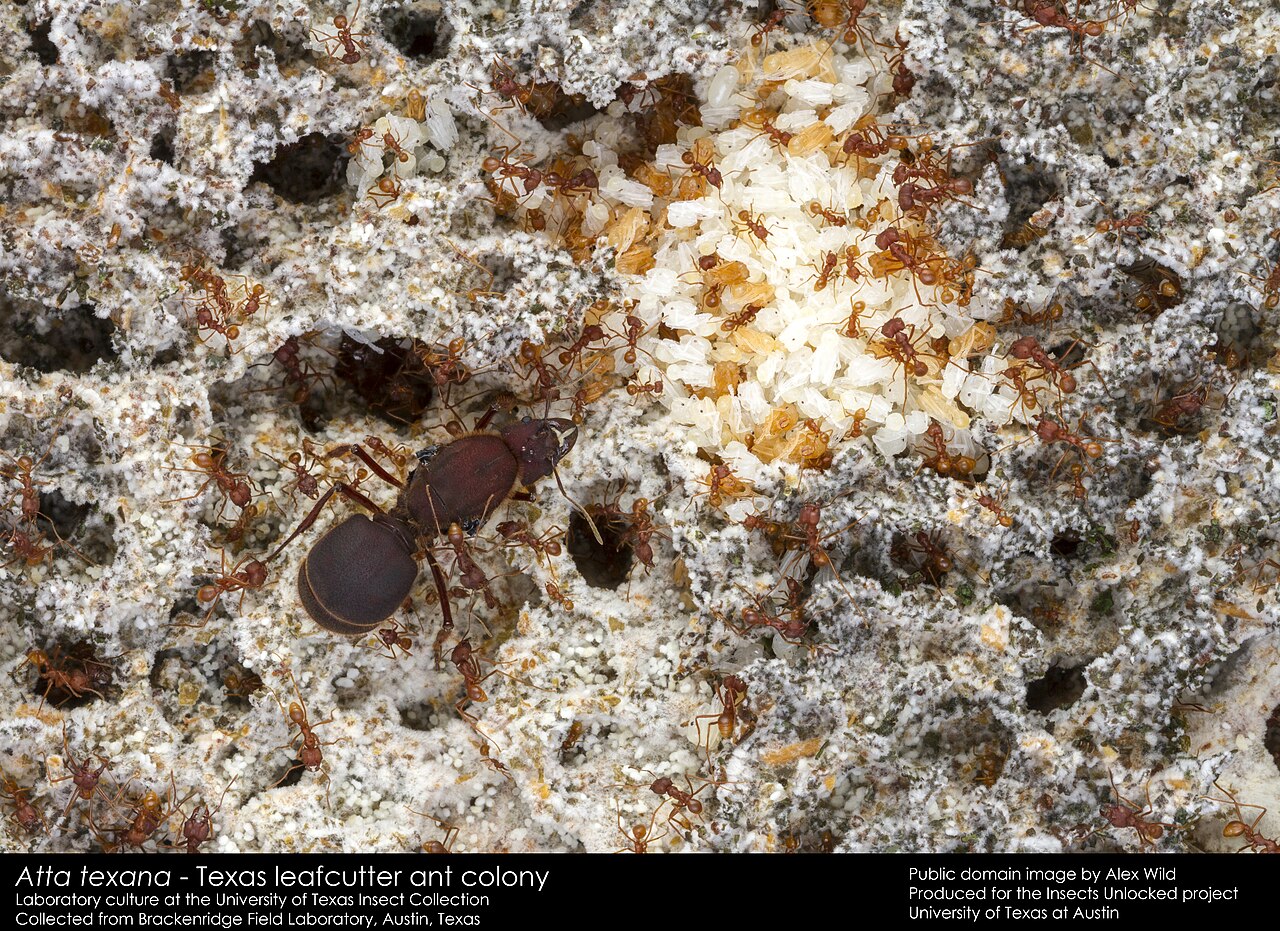
Leafcutter ants (Atta texana) tending their cultivated fungus garden. Image: CC0, via Wikimedia Commons.
The mechanism
- Harvesting, not eating. Foragers cut and carry leaf fragments in long columns, though they cannot digest the leaves themselves; the leaves are raw material for the farm.
- The fungus crop. Workers chew the leaves into a paste and feed it to a cultivated fungus grown in underground gardens; the ants live on the nutrient-rich structures the fungus produces.
- A crop that needs its farmers. The fungus has been propagated clonally for so long that it depends on ant tending and no longer thrives on its own.
- Vertical transmission. A founding queen carries a pellet of the fungus on her mating flight to seed the garden of a brand-new colony, passing the crop down the generations.
- A cultured pesticide. The ants carry antibiotic-producing bacteria in special body pits fed by dedicated glands and use them to suppress a parasitic mold that would otherwise destroy the garden.
Why this points to design
The colony eats only when the whole agricultural system is in place together: harvesting castes and behavior, a fungus crop that depends on that tending, the inheritance route that carries the crop to each new colony, and the maintained bacterial partner with the body structures built to house and feed it. Remove any one and the system fails. Ants gathering leaves they cannot digest, with no cultivated fungus to convert them, starve; a crop bred to need its farmers dies without the farming; a garden lacking the antibiotic partner is overrun by its specialized mold parasite; a queen who carried no fungus pellet founds a colony with nothing to farm. There is no gradual climb through separately advantageous steps, because half a farm, leaf-cutting with no crop, or a crop with no defense, feeds no one and survives nothing. An insect society fitted in advance to grow a food it cannot make, with a co-dependent crop and a cultured drug carried on its own body to protect that crop, is the kind of integrated, multi-partner design that points to a designer. See Intelligent Design and Irreducible Complexity.
The evolutionary account, and why it falls short
The standard reply is gradual recruitment: ancestral ants scavenged on fungus growing on plant debris, an incidental association deepened as the ants began tending and propagating it, and over long spans the crop, the farming behavior, and later the antibiotic bacteria were added step by step into the modern system.
The reply names a possible entry point but never produces the integrated farm that needs explaining. Scavenging wild fungus is not clonal cultivation of a crop that can no longer live without tending, propagated by queens that carry it on the nuptial flight, defended by antibiotic microbes housed in purpose-built skin crypts with their own glands. Naming a path from "casual fungus-eater" to "obligate three-way farmer" is not the same as exhibiting the intermediate colony whose half-formed farming, with a crop not yet dependent and no antibiotic partner, nonetheless survived its specialized mold parasite, or the genetic and behavioral changes that wired harvesting, cultivation, vertical transmission, and microbial defense into one working agriculture. The matched, mutually dependent, multi-partner farming system is precisely what the gradual account cannot stage and what design accounts for directly.
See also
- Animals That Defy Evolution, the hub this spoke belongs to
- Intelligent Design, the positive design program
- Irreducible Complexity, the matched-parts pattern behind the farm
- Specified Complexity, functional information as a design signature
- The acacia ant and its acacia tree, another insect partnership in this hub built on housing and defense
Common questions this page answers
Q: Why is the leafcutter ant a problem for evolution?
The colony survives only when a whole farm is present at once: harvesting ants, a fungus crop that depends on their tending, the route by which queens carry the crop to new colonies, and antibiotic bacteria carried on the ants' bodies to defend the garden. Each part is useless without the others, and half a farm feeds no one, so there is no ladder of separately advantageous steps. The integrated, multi-partner agricultural system looks engineered rather than gradually assembled.
Q: How does leafcutter ant fungus farming actually work?
Foragers cut and carry leaf fragments home, but they cannot digest leaves, so they chew them into a paste and feed it to a fungus grown in underground gardens. The ants then eat nutrient-rich structures the fungus produces, and they protect the garden from a parasitic mold using antibiotic-making bacteria carried in special pits on their bodies.
Q: Why can't the ants and the fungus live without each other?
The ants cannot digest the leaves they gather and depend on the fungus to turn them into food. The fungus has been farmed clonally for so long that it depends on ant tending and no longer thrives on its own, and a founding queen must carry a pellet of it to start each new colony. Each is built to need the other, which is the heart of the design inference here.
Q: What is the third partner in the leafcutter ant system?
Besides the ants and their fungus crop, a parasitic mold called Escovopsis attacks the gardens, and the ants carry antibiotic-producing bacteria in body crypts fed by dedicated glands to suppress it. This makes the relationship at least three-way: farmers, crop, and a living pesticide cultured on the farmers' own skin, all required together for the system to work.