Concept
Pit Viper
pit viper, pit viper infrared, pit viper evolution, pit viper design, how snakes see heat, rattlesnake heat sensingIntro
A rattlesnake can strike a mouse in pitch darkness with its eyes covered. Between each eye and nostril it carries a small pit lined with a thin membrane packed with heat-sensing nerves so sensitive they register a change of a small fraction of a degree. That membrane lets the snake detect the body heat radiating off a warm animal and judge where the prey is, how far away, and which direction it is moving, building a thermal image of a target it cannot see with its eyes. The brain then fuses this heat-picture with the ordinary visual image, so the snake effectively sees in two kinds of light at once and aims a strike with no visible light at all. A separate organ that delivers a working thermal sense, wired into the same brain region that handles vision and calibrated to fire on the first hunt, is the kind of integrated equipment that points to design.
See this page's graph and discover linked topics
In full
Crotaline snakes, the pit vipers (rattlesnakes, copperheads, lanceheads, and relatives), possess paired loreal pit organs, one on each side of the head between eye and nostril. Each pit is a hollow chamber spanned by a suspended membrane roughly 15 micrometers thick, densely innervated by terminals of the trigeminal nerve. These terminals are packed with mitochondria and express the heat-gated ion channel TRPA1, which opens in response to infrared radiation warming the membrane; the suspended, air-backed design thermally isolates the membrane so it responds to minute radiant heat differences, on the order of thousandths of a degree Celsius. The pit acts as a crude pinhole imager, giving directional information. Critically, the infrared signal travels the trigeminal pathway to the optic tectum, the same midbrain structure that processes the eyes' visual input, where the thermal and visual maps are registered in spatial alignment and fused. The organ is an obligately integrated system: the insulated membrane, the specialized heat-transducing nerve endings, the pinhole geometry, and the neural fusion circuitry are jointly required, and the apparatus must work correctly the first time the young snake strikes. Specifying that thermal-imaging algorithm and its cross-wiring into the visual brain in advance is a feat of built-in information (Information Argument for Design, Specified Complexity).
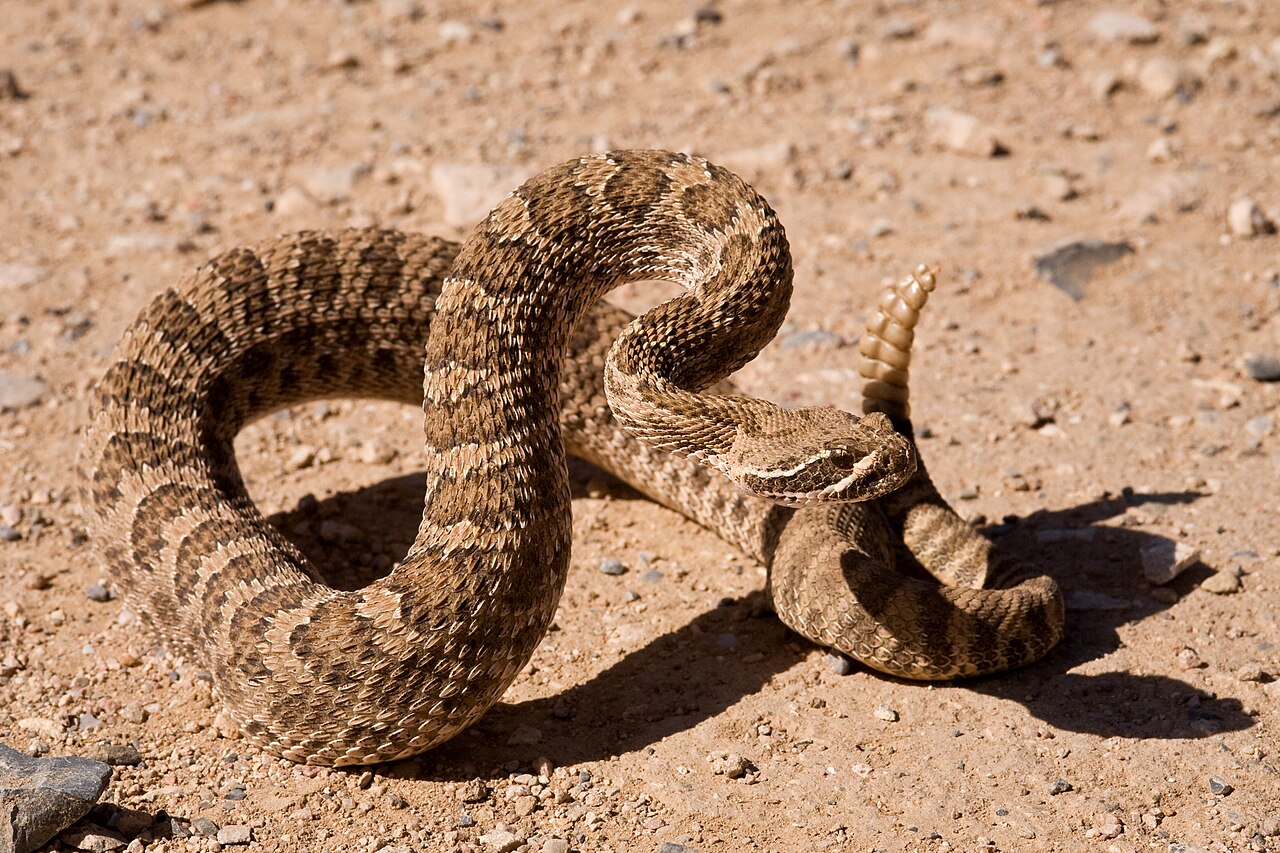
A prairie rattlesnake coiled to strike, with the loreal pit visible between eye and nostril. Image: CC0, via Wikimedia Commons.
The mechanism
- The insulated membrane. A paper-thin membrane is suspended across an air-backed chamber, thermally isolated so it heats up from a target's radiant warmth instead of from the surrounding air.
- Heat-gated transduction. The membrane is saturated with nerve endings rich in mitochondria and the TRPA1 channel, which opens when infrared warms it, converting radiant heat into a nerve signal sensitive to thousandths of a degree.
- Directional pinhole. The pit's opening works like a crude pinhole camera, casting a rough thermal image onto the membrane so the snake reads the prey's direction and distance.
- Two organs, stereo range. Paired pits, one per side, give overlapping thermal fields that sharpen the snake's fix on where a target sits in space.
- Fusion with vision. The heat signal is routed to the optic tectum, the same midbrain region that maps the eyes' image, and the two maps are merged so the snake aims a strike on a combined thermal-and-visual picture.
Why this points to design
The pit organ is worthless in pieces. A membrane that is not thermally insulated heats with the air and reads nothing; insulation without the heat-gated nerve endings transduces no signal; a sensitive membrane with no pinhole geometry gives a warm blur with no direction; and a directional thermal signal is meaningless until the brain has circuitry to register it against the visual map and act on it. Each component is useless until all are present and matched, and the system has to deliver a correct strike the first time, because a snake that misses in the dark does not get incremental practice. There is no path of separately advantageous halfway stages, since a half-formed pit returns no usable heat-image and a half-wired tectum cannot fuse what it receives. An integrated sense organ whose function appears only when membrane, transducer, optics, and dedicated brain wiring are assembled together is what engineering produces, not what unguided step-by-step processes build. See Information Argument for Design and Irreducible Complexity.
The evolutionary account, and why it falls short
The standard reply is gradual co-option: a shallow facial depression lined with ordinary warmth-sensitive nerves could give a faint heat-sense, and over time the pit deepened, the membrane thinned, the TRPA1 channels concentrated, and the neural connections to the visual midbrain were recruited and refined, each small improvement selected for better prey detection. Heat-sensitive channels, it is noted, are common in animal tissue.
The reply names precursors and assumes the rest assembles. The difficulty is not that nerves can feel warmth; it is that an air-insulated suspended membrane, heat-gated terminals tuned to thousandths of a degree, pinhole optics, and the cross-wiring that fuses an infrared map with the visual map in the optic tectum form one coordinated imaging system that must already work for the snake to strike blind. A deeper pit is no advantage until the membrane is insulated and innervated to exploit it; a thermal signal arriving at the brain is noise until dedicated circuitry registers it against the visual field. Pointing to generic heat-sensitive channels no more explains that organ than pointing to a light-sensitive cell explains an eye fused to a working image-processor. The selectable intermediate stages, and the genetic and developmental changes that would build the insulated membrane together with its visual-brain integration, have never been demonstrated. The gap between a vague warmth-sense and a calibrated, vision-fused thermal imager is exactly what points to design.
See also
- Animals That Defy Evolution, the hub this spoke belongs to
- Information Argument for Design, the information case behind an inherited exotic sense
- Irreducible Complexity, the integrated-organ pattern behind the pit
- Specified Complexity, functional information as a design signature
- The shark, another animal in this hub built around a sense humans do not share
Common questions this page answers
Q: Why is the pit viper a problem for evolution?
Its heat-sensing pit is an integrated thermal-imaging organ: an air-insulated membrane, heat-gated nerve endings sensitive to thousandths of a degree, pinhole optics for direction, and brain wiring that fuses the infrared image with vision. Each part is useless without the others, so there is no ladder of individually useful halfway stages, and the snake has to strike accurately in the dark on its first hunt. That integration points to engineered information rather than lucky accumulation.
Q: How does a pit viper sense heat or "see" in the dark?
A thin, thermally insulated membrane inside each facial pit is warmed by the infrared radiation coming off a warm-bodied animal. Nerve endings packed with the heat-gated TRPA1 channel turn that tiny temperature change into a signal, the pit's pinhole shape gives direction, and the brain merges this thermal map with the eyes' image so the snake aims a strike using body heat alone.
Q: Can pit vipers really strike prey in total darkness?
Yes. With their eyes covered they can still locate and accurately strike a warm-bodied animal, because the pit organs detect the prey's radiant body heat and the brain builds a thermal picture of where it is and how it is moving.
Q: Couldn't the heat-sensing pit have evolved gradually from an ordinary dimple?
A shallow dimple gives no usable heat-image, and a deeper pit is no help until the membrane is insulated and packed with heat-gated nerve endings, the optics give direction, and the brain is wired to fuse the signal with vision. Those parts are only beneficial together, so there are no separately advantageous intermediate steps, and the genetic pathway to the integrated, vision-fused imager has never been demonstrated.