Concept
Bar-Tailed Godwit
Intro
The bar-tailed godwit holds the record for the longest nonstop flight of any animal. One tracked bird flew from Alaska to Tasmania across the open Pacific without landing, eating, or drinking once, covering more than 8,000 miles in about eleven days of continuous flapping. There is no island to rest on for most of that route, so the godwit cannot stop. Before it leaves, the bird does something stranger than the flight itself. It gorges until it nearly doubles its weight in fat, then shrinks its own stomach, liver, kidneys, and gut to make room for fuel and to cut the dead weight it has to carry. It reads the weather, waits for a favorable wind system, and launches on a precise heading toward a destination it has never seen. A bird that re-engineers its own body for a one-shot ocean crossing, then navigates it correctly the first time, is running a program that had to be written in advance. Instructions like that point to an author.
In full
Limosa lapponica, especially the baueri and menzbieri populations, performs the longest documented nonstop migratory flights of any bird. Satellite-tagged individuals have flown from western Alaska across the Pacific to New Zealand and Australia, with one juvenile logged at roughly 8,400 miles in about eleven days of unbroken flight over water. To fuel this, the godwit undergoes extreme pre-migratory hyperphagia, laying down fat until it approaches twice its lean weight, and atrophies its digestive organs (stomach, intestine, liver, kidneys) to reduce mass that will be useless in flight, then regrows them on arrival. It departs on weather windows, launching with tailwinds from frontal systems and holding a heading across thousands of miles of featureless ocean using inherited compass senses. Juveniles make the southbound crossing without adult guidance, so the timing of the body's transformation, the fueling, the launch decision, and the navigational route must all be inherited and run correctly on the first attempt. Coordinating a reversible organ remodeling with a one-shot, no-landfall navigation program is a feat of built-in, integrated information (Information Argument for Design, Specified Complexity).
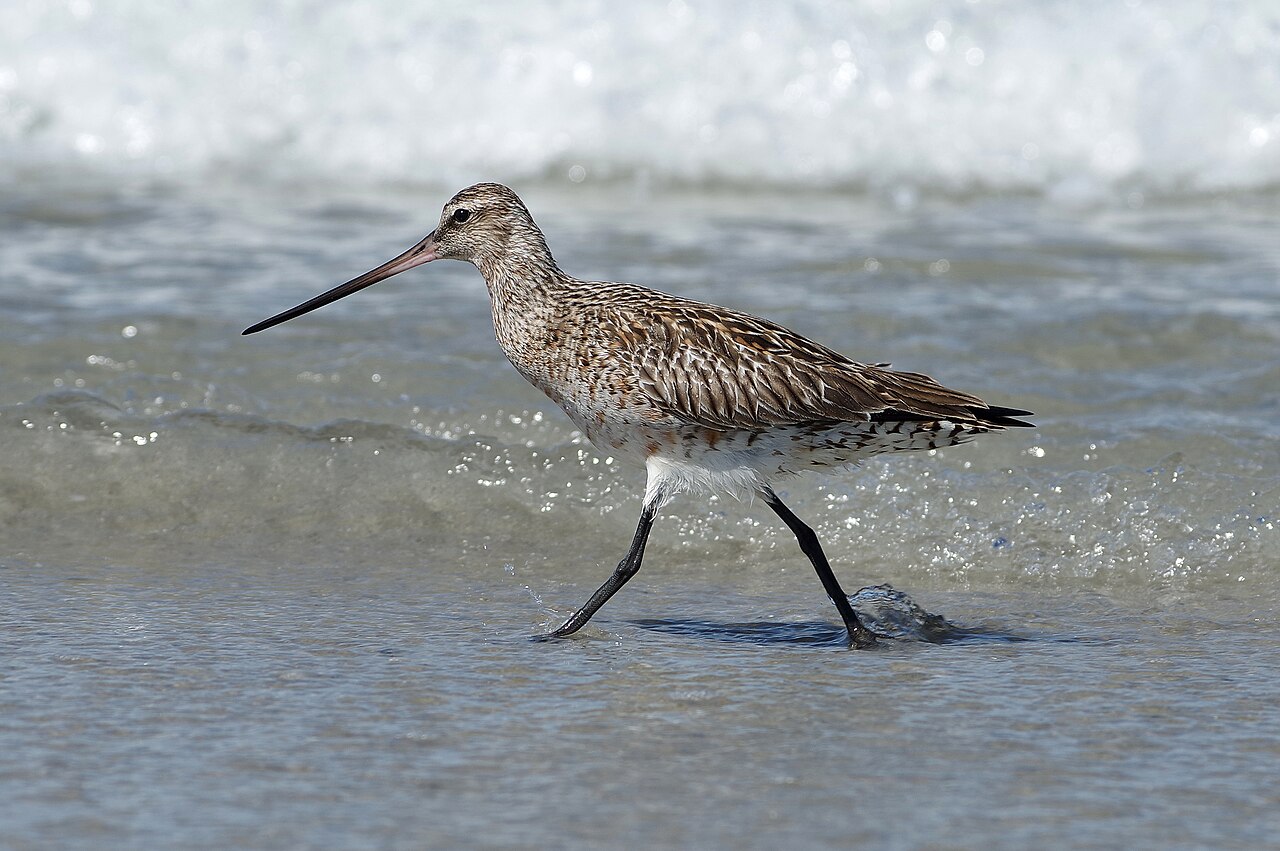
A bar-tailed godwit foraging at the shoreline. Image: CC0, via Wikimedia Commons.
The mechanism
- Record nonstop flight. Tracked godwits cross the open Pacific from Alaska to Australasia in a single unbroken flight of more than 8,000 miles, with no food, water, or rest for over a week.
- Doubling up on fuel. Before departure the bird feeds intensely and stores fat until it nears twice its normal weight, packing the energy the flight will burn.
- Shrinking the organs. It atrophies its stomach, gut, liver, and kidneys to shed weight it does not need aloft, then rebuilds them after landing.
- Reading the weather. The godwit waits for favorable frontal winds and launches on a tailwind, using the weather system as a free push.
- Open-ocean navigation. Across a route with almost no landmarks it holds a precise heading using inherited compass senses, arriving at a destination it has never visited.
Why this points to design
The godwit's crossing has no margin for trial and error. There is no place to land, so a bird that mis-times the fueling, fails to remodel its organs, launches into the wrong wind, or drifts off heading does not get a second attempt. That means the whole package, the appetite switch, the fat loading, the organ shrinkage and later regrowth, the weather-reading launch, and the navigation program with its destination, has to be coordinated in advance and execute correctly on the first run. A set of separately useless steps that only pays off when all of them fire together, in the right order, is not something random variation builds by lucky increments. It is the kind of integrated, forward-looking instruction set that minds produce. The godwit carries a working plan for a journey and a body-transformation it has never rehearsed, which is the fingerprint of design. See Information Argument for Design and Specified Complexity.
The evolutionary account, and why it falls short
The standard reply is that each piece is a tuned-up version of something ordinary: many migratory birds fatten before flights and adjust organ size, weather-dependent departure is common, and compass orientation is widespread, so selection is said to have stretched these capacities gradually as the route across the Pacific lengthened.
The reply lists familiar parts and assumes they combine into a working whole. The hard problem is not that birds store fat or sense direction; it is that an appetite-and-fattening switch, a reversible shrink-and-regrow of the digestive organs, a weather-reading launch decision, and an open-ocean navigation program with an inherited destination are integrated into one coordinated routine that delivers a never-been-there bird across 8,000 miles of empty water on its first try. A partly assembled version fails completely: fat without the organ remodeling carries dead weight, navigation without the fuel falls short, and a half-wired heading strands the bird at sea. Naming common capacities and a plausible trend is not the same as exhibiting the genetic encoding of the integrated, first-time-correct system or the selectable advantage of each intermediate. A complete, working, life-or-death program that must be present before its first and only use is exactly what points to a designer.
See also
- Animals That Defy Evolution, the hub this spoke belongs to
- Information Argument for Design, the information case behind inherited navigation
- Specified Complexity, functional information as a design signature
- Irreducible Complexity, why all the parts must fire together
- The Arctic tern, another bird in this hub built for an extreme migration
Common questions this page answers
Q: Why is the bar-tailed godwit a problem for evolution?
Its ocean crossing has no place to stop, so the whole routine has to work the first time: the fat loading, the shrinking of its own organs, the weather-timed launch, and the navigation to a destination it has never seen. Each step is useless without the others, and a half-built version strands the bird at sea, so there is no gradual path of advantageous halfway stages. A coordinated, life-or-death program that must be complete before its first use is the kind of thing minds design.
Q: How does the bar-tailed godwit fly so far without stopping?
Before departure it nearly doubles its weight in stored fat for fuel, then atrophies its stomach, gut, liver, and kidneys to cut the weight it does not need in flight, regrowing them after landing. It launches on a favorable tailwind from a weather front and holds a precise heading across the open Pacific using inherited compass senses, then refuels and rebuilds its organs at the other end.
Q: How far is the longest nonstop bird flight?
A satellite-tracked juvenile bar-tailed godwit flew about 8,400 miles from Alaska to Tasmania in roughly eleven days of continuous flight, with no food, water, or rest the entire way. This is the longest documented nonstop flight of any animal.
Q: How does a young godwit know to shrink its organs and fly the route?
Juveniles make the southbound crossing without adult guidance, so the timing of the body transformation, the fueling, the launch decision, and the route are inherited rather than learned. A working, integrated program that must be present and correct before the bird's first and only attempt is a striking case of built-in biological information.