Concept
Morpho Butterfly
Intro
The morpho butterfly is one of the most intense blues in nature, and it contains no blue pigment at all. If you ground up a morpho wing you would get brown dust, because the color is not a dye. It is built from shape. Each scale on the wing is covered with rows of microscopic ridges, layered like tiny shelves spaced just far enough apart to cancel most colors of light and reflect a brilliant, shimmering blue back to your eye. The blue you see is light itself, sorted by a structure measured in billionths of a meter. To make that color, the butterfly has to grow architecture at the scale of light's own wavelength, with the spacing tuned precisely or the effect collapses to drab. Color produced by nanometer-exact engineering, encoded in the genome and assembled the first time without a trial run, is the fingerprint of design.
In full
The blue of Morpho wings is structural color, not pigmentary. The wing scales bear ridges whose cross-section forms multilayered, tree-like lamellae spaced on the order of 200 nanometers; this periodic nanostructure produces constructive interference for blue wavelengths and destructive interference for others, yielding an intense, angle-dependent iridescence with no blue chemical present. The geometry is precise: the layer spacing and refractive contrast must fall within tight tolerances to reflect blue rather than another color or none at all. The result is a specified optical outcome achieved by built form, the same principle human engineers exploit in dielectric mirrors and photonic structures, here grown by the developing scale cell according to genetic instructions. This is functional, sequence-specified information expressed as nanoscale architecture, a case of Specified Complexity: a precise structure producing a precise result, with the parts and dimensions jointly required for the function to appear.
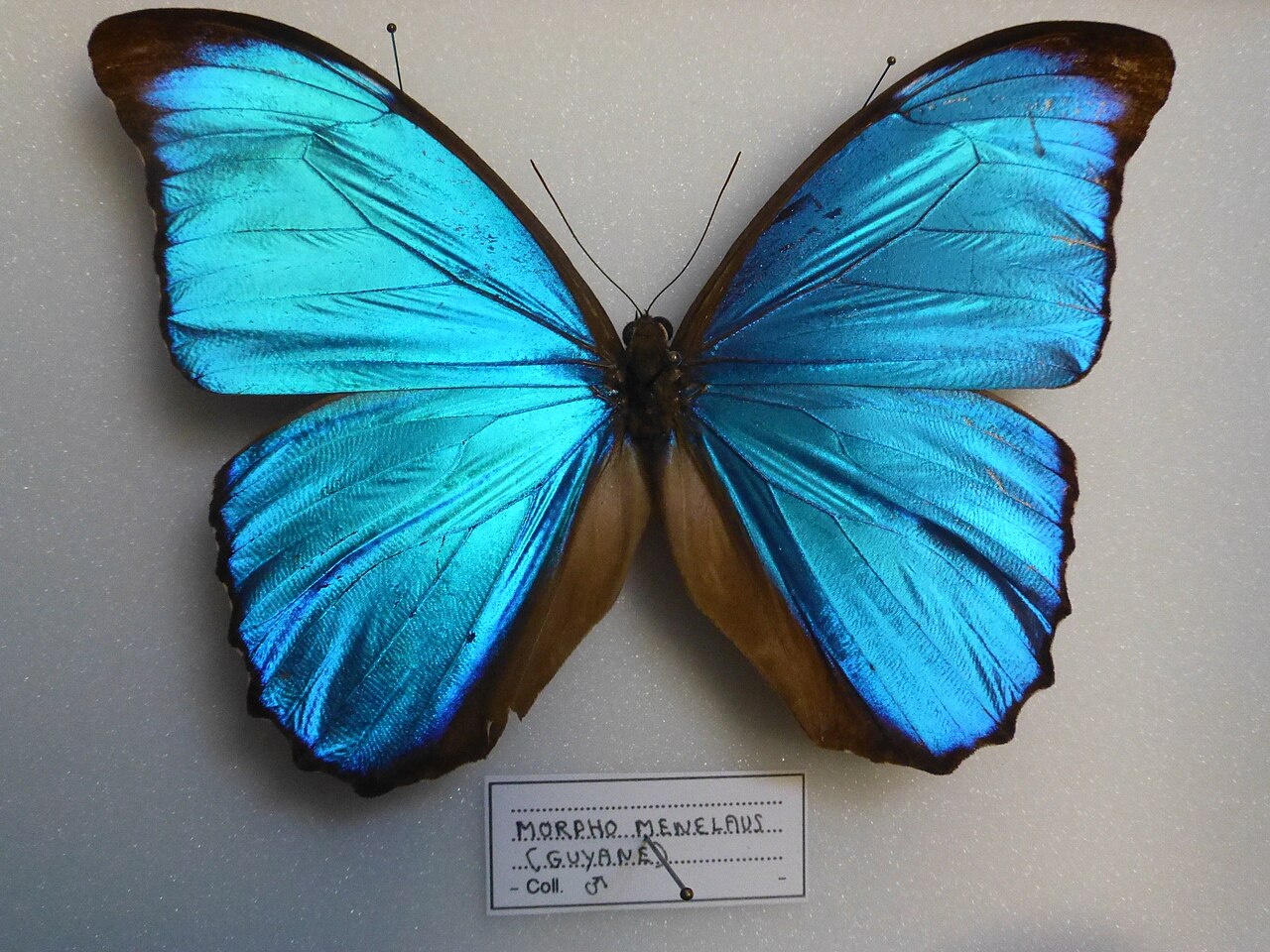
A Morpho menelaus, shown as a mounted specimen; the blue comes from wing-scale nanostructure, not pigment. Image: CC0, via Wikimedia Commons.
The mechanism
- No blue dye. The wing has no blue pigment; crushed, the scales look brown. The color exists only while the structure is intact.
- Layered ridges. Each scale carries rows of ridges whose cross-section is a stack of thin shelves, like a microscopic tree, repeating across the surface.
- Wavelength-scale spacing. The shelves are spaced around 200 nanometers apart, close to the wavelength of blue light, which is what lets them sort colors.
- Interference, not absorption. The spacing makes blue light waves reinforce each other while other colors cancel, so blue is reflected strongly and the rest is suppressed.
- Iridescence. Because the effect depends on the angle of light, the blue shifts and shimmers as the wing tilts, a hallmark of structural color.
- Grown to spec. The developing scale cell builds this architecture from genetic instructions, hitting the required dimensions the first time the wing forms.
Why this points to design
Structural blue exists only when the nanostructure is right. The ridges must be present, layered, and spaced within a narrow tolerance close to the wavelength of light; outside that window the interference fails and the wing is dull brown. A partly built structure does not produce a dimmer blue that selection could improve toward brilliance, it produces no blue at all, because the optical effect is a threshold phenomenon that depends on hitting the geometry. The information needed to specify that geometry, the spacing, the layer count, the refractive contrast, has to be in place before the color appears, and it has to be expressed correctly the first time the scale develops, with no chance to test-fly a half-tuned mirror. That is first-time-right, dimension-specific information embodied in form, the signature of Specified Complexity and of Information Argument for Design. Nanometer-precise optical engineering is what intelligent designers produce, in dielectric mirrors and photonic devices, and it is what we find pre-built on the wing.
The evolutionary account, and why it falls short
The standard reply is gradual refinement of scale structure. Butterfly scales have ridges for other reasons, and slight nanoscale variation can shift reflectance, so the account holds that selection for mate signaling or thermoregulation nudged the ridge spacing step by step until it landed on the dimensions that reflect brilliant blue.
The reply notes that scales vary but never explains the working optic. Structural blue is not the endpoint of a smooth slope of ever-bluer wings; it is a threshold effect that appears only when the layer spacing and contrast fall inside a tight window, and outside that window there is no blue for selection to favor. Pointing to ordinary ridges no more explains a tuned photonic structure than pointing to a rough surface explains a precision mirror. The account assumes the genome can specify and reliably build a nanometer-exact architecture, which is the very thing in question, and the selectable advantage of each off-target intermediate, along with the actual genetic changes that hit the optical tolerance, has never been demonstrated. The gap between a generic scale and a wavelength-tuned interference mirror grown right the first time is precisely the gap that points to design.
See also
- Animals That Defy Evolution, the hub this spoke belongs to
- Specified Complexity, precise structure producing a precise result
- Information Argument for Design, dimension-specific information as evidence of an intelligent source
- Irreducible Complexity, the threshold, all-or-nothing pattern behind the color
- The cuttlefish, another animal in this hub that uses structural reflectors to make color without pigment
Common questions this page answers
Q: Why is the morpho butterfly a problem for evolution?
Its brilliant blue is not pigment but a nanostructure tuned to the wavelength of light, and the color only appears when the layer spacing and contrast fall inside a tight window. A partly built structure makes no dimmer blue to improve, it makes no blue at all, so there is no smooth slope of advantageous intermediates, which is the Specified Complexity pattern. The dimension-exact optical architecture has to be specified and built correctly the first time, and that looks engineered.
Q: How does the morpho butterfly make blue without blue pigment?
Its wing scales carry rows of microscopic ridges whose cross-section forms stacked shelves spaced about 200 nanometers apart, close to the wavelength of blue light. That spacing makes blue light waves reinforce each other while other colors cancel out, so blue is reflected back intensely. The color comes from the structure sorting light, which is why a crushed wing looks brown.
Q: What is structural color?
Structural color is color produced by microscopic shape rather than by dye or pigment. Tiny layered or ridged structures, spaced near the wavelength of light, make some colors reinforce and others cancel, so the surface reflects a specific hue. Human engineers use the same principle in dielectric mirrors and photonic devices, which is why the morpho's precisely tuned wing looks like deliberate optical engineering.
Q: Couldn't the morpho's blue have evolved by small changes in scale shape?
Butterfly scales do vary, but structural blue is a threshold effect that appears only when the spacing and contrast hit a narrow target, and outside that window there is no blue to select for. Ordinary ridges no more explain a tuned photonic mirror than a rough surface explains a precision optic. The selectable advantage of each off-target intermediate and the genetic changes that would reliably hit the nanometer tolerance have never been demonstrated.