Concept
Firefly
Intro
The firefly makes light inside its own body and wastes almost none of it as heat. A household bulb throws off most of its energy as warmth and only a sliver as light; the firefly runs the opposite way, turning chemical energy into a cold glow with an efficiency that human engineers have never matched. It does this with a precise recipe: a fuel molecule, a custom enzyme, oxygen delivered on cue, and a control system that switches the flashes on and off in a timed code other fireflies can read. The light is not random shimmer. It is a signal, blinked in patterns that say which species this is and whether it is looking for a mate. A coded, near-perfect light system that only works when fuel, catalyst, oxygen gate, and timing circuit are all present at once is the signature of design.
In full
Firefly bioluminescence is produced in a specialized abdominal organ where the substrate luciferin is oxidized by the enzyme luciferase in the presence of ATP, magnesium ions, and molecular oxygen, yielding oxyluciferin and a photon. The reaction is close to 100 percent quantum-efficient: nearly every reacting molecule emits light rather than heat, which is why the glow is cold. The flash is gated by oxygen supply to the photocytes, regulated through the tracheal system and nitric oxide signaling, so the insect can pulse its light in species-specific temporal codes used for mate recognition. This is functional, sequence-specified information expressed in hardware: a matched substrate and enzyme, an ATP energy tie-in, an oxygen-delivery valve, and a neural timing controller that encodes a readable message. The system is a case of Specified Complexity, where the parts are jointly required and the output is a precise, information-bearing signal rather than a mere byproduct.
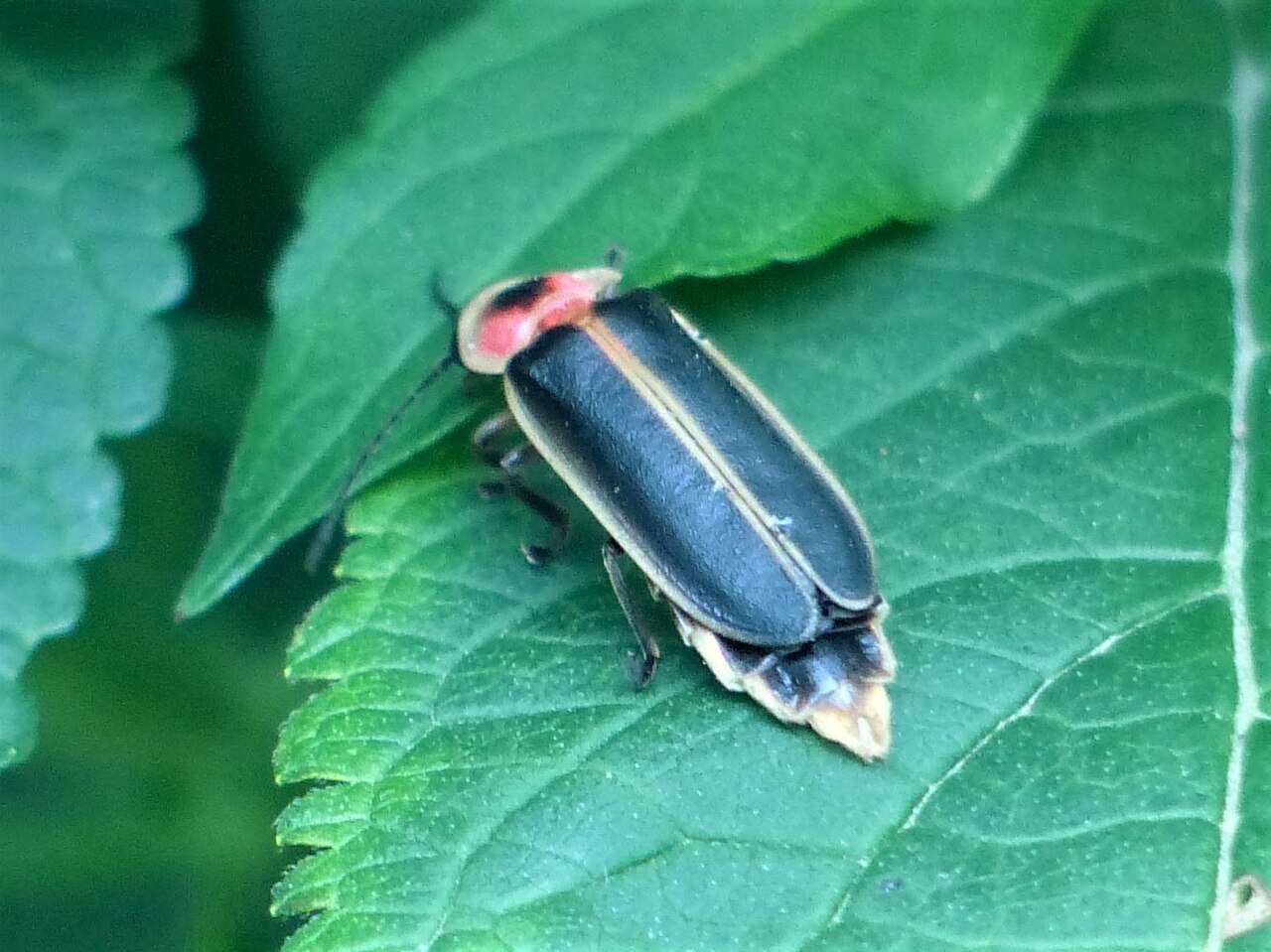
A common eastern firefly (Photinus pyralis); the pale segments at the abdomen tip are the light organ. Image: CC0, via Wikimedia Commons.
The mechanism
- The fuel. A small molecule, luciferin, is the substrate that gets oxidized to release light. It is held ready in the light organ.
- The custom enzyme. Luciferase binds luciferin, ATP, and oxygen and catalyzes the exact reaction that emits a photon. No other enzyme does this job.
- The energy tie-in. ATP and magnesium ions activate the luciferin so the oxidation can proceed, linking the light to the cell's own energy currency.
- The oxygen gate. The insect controls the flash by metering oxygen to the photocytes through its tracheal system, using nitric oxide as the switch. Light on, light off.
- The code. A neural controller times the pulses into species-specific flash patterns, so the glow carries a readable message about identity and mating intent.
- Cold output. Because the chemistry is almost fully efficient, virtually no energy is lost as heat, protecting the delicate tissue that produces the light.
Why this points to design
A working firefly lantern needs every component present together. Luciferin without luciferase is inert fuel with no engine. Luciferase without the precise substrate has nothing to burn. Either one without the ATP activation and the oxygen gate produces no controlled flash, and a flash with no timing circuit carries no message and attracts no mate. None of the halfway states does anything an unguided process could select for: a glow that cannot be switched, coded, or aimed at a mate confers no reproductive advantage and may simply advertise the insect to predators. The pattern points to Specified Complexity and to Irreducible Complexity: a set of matched parts that produces a precise, information-rich output only when assembled and tuned together. Coded light is not the kind of thing that accumulates one useless increment at a time; it is the kind of thing that gets engineered. See also Information Argument for Design.
The evolutionary account, and why it falls short
The standard reply is incremental recruitment. Luciferin resembles compounds involved in antioxidant chemistry, luciferase belongs to a known enzyme family, and a faint, uncontrolled glow from a leaky oxidation reaction, the story goes, could have been refined step by step into a bright, gated, coded signal as natural selection favored ever more useful flashes.
The reply names enzyme relatives and a possible spark, but it never delivers the working lantern. A dim, unregulated glimmer is not a courtship signal; it becomes one only when the oxygen gate, the timing controller, and the species-specific code are in place, and those are exactly the parts the gradualist story assumes rather than builds. Pointing to an enzyme family explains where a catalyst might come from, not how substrate, catalyst, energy tie-in, oxygen valve, and neural code were matched into a system that emits a readable message at near-perfect efficiency. The selectable advantage of each intermediate, and the actual genetic and developmental changes that produced the integrated, information-bearing flash, have never been demonstrated. The distance between loose oxidation chemistry and a coded, cold-light communication system is precisely the gap that points to design.
See also
- Animals That Defy Evolution, the hub this spoke belongs to
- Specified Complexity, functional information as a design signature
- Information Argument for Design, coded signals as evidence of an intelligent source
- Irreducible Complexity, the matched-parts pattern behind the lantern
- The cuttlefish, another animal in this hub that runs a precise, coded light-and-color system
Common questions this page answers
Q: Why is the firefly a problem for evolution?
Its light depends on several matched parts at once: a fuel molecule, a custom enzyme, an ATP energy link, an oxygen gate, and a neural timing circuit that flashes a species-specific code. Each part is useless without the others, and a glow that cannot be switched or coded gives no mating advantage for selection to keep, which is the Specified Complexity pattern. The integrated, near-perfectly efficient, information-bearing system looks engineered, and no stepwise account has shown how unguided processes could assemble it.
Q: How does a firefly produce light?
In a special abdominal organ the firefly oxidizes a molecule called luciferin using the enzyme luciferase, along with ATP, magnesium, and oxygen, releasing a photon for almost every reaction. Because the chemistry is close to fully efficient, the glow is cold and wastes virtually no energy as heat. The insect switches the flash on and off by metering oxygen to the light cells, timing the pulses into coded patterns.
Q: Why is firefly light called the most efficient light in nature?
Nearly every reacting molecule emits a photon rather than heat, giving a quantum efficiency close to 100 percent, far beyond any human-made bulb. That cold-light chemistry protects the firefly's tissue and lets it run a bright signal on very little energy. Matching a fuel, an enzyme, and an oxygen control system to hit that efficiency is an engineering feat, not an accident.
Q: Could a faint glow have slowly evolved into the firefly's coded flash?
A dim, uncontrolled glimmer is not a courtship signal and offers no clear advantage; it may even attract predators. The flash only becomes useful once the oxygen gate, the timing controller, and the species-specific code are all present, and those integrated parts are what the gradual story assumes rather than demonstrates. The selectable intermediates and the genetic changes that would build a coded, switchable, cold-light system have never been shown.