Concept
Cleaner Wrasse
Intro
On a coral reef there are barbershops, and the barbers are tiny fish. A cleaner wrasse sets up a fixed station, and big predators line up to be serviced. The wrasse swims into a grouper's open mouth, picks parasites off its gums, works between the gill rakers, and comes back out alive. A fish that size is an easy meal, yet the predator holds its jaws open and lets it go. The wrasse advertises with a dance and a bold stripe; the client signals back by posing still and flaring its gills. Two animals that should be eater and eaten instead run a calm, repeated exchange built on matched signals and matched restraint. A working truce between predator and prey, with both sides equipped in advance to read it, is what design looks like.
In full
Cleaner wrasses of the genus Labroides maintain stationary cleaning stations on coral reefs where "client" fish, including large piscivores, queue for the removal of ectoparasites, dead tissue, and mucus. The interaction runs on a coordinated signaling system: the cleaner performs a recognizable bobbing display and wears a high-contrast lateral stripe, while the client adopts a stationary posing posture, darkens or pales its color, and opens mouth and gill covers to grant access to the most vulnerable surfaces. The client suppresses its feeding response toward a bite-sized fish moving inside its own mouth, and the cleaner restrains itself from biting healthy tissue, although it sometimes "cheats" on mucus, which clients police by withholding return visits. The arrangement is an obligate-grade behavioral mutualism whose benefit appears only when the full package is present: the client's recognition of the cleaner and its inverted feeding instinct, the cleaner's species-specific signals and stationkeeping, and the trust-and-policing loop that keeps both honest. A half-built version, a predator that recognizes no truce, or a cleaner with no signal and no safe-conduct, yields a snack, not a partnership.
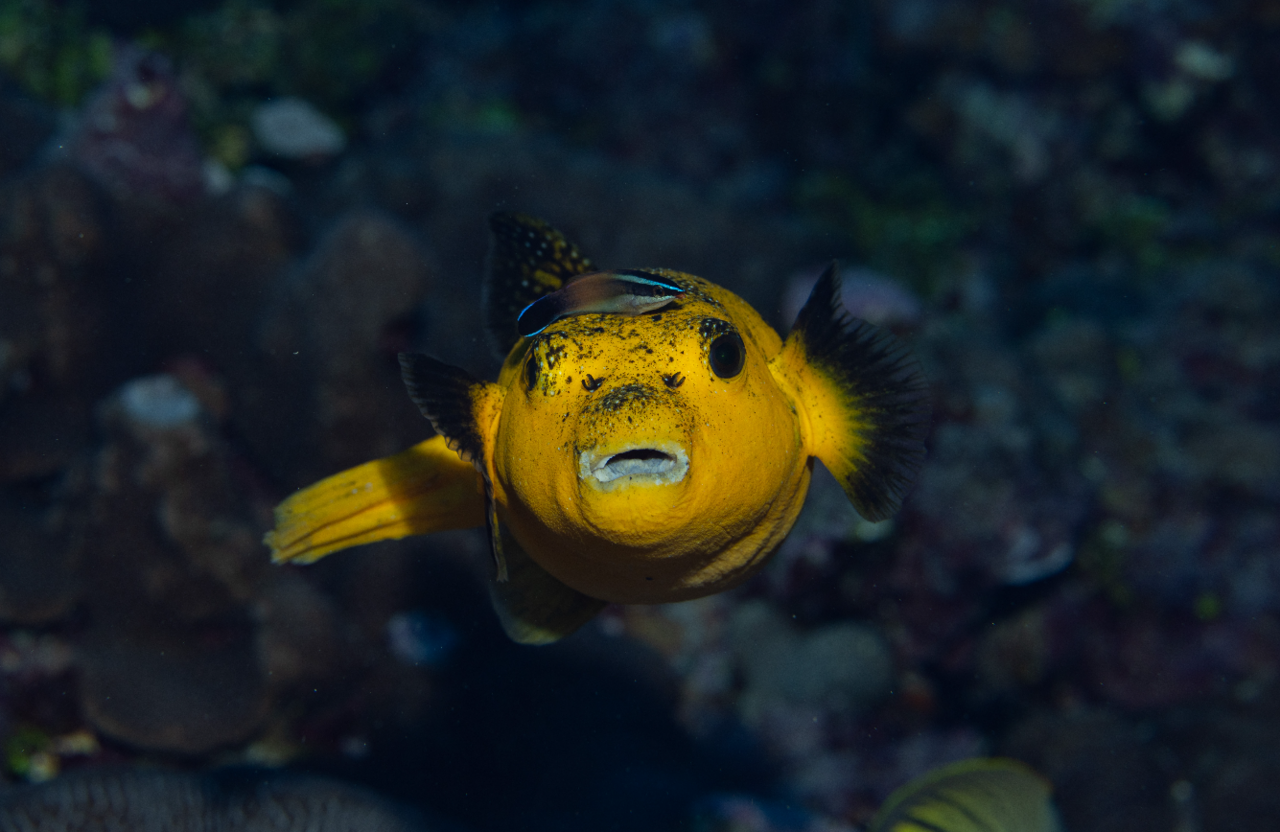
A cleaner wrasse grooming a pufferfish client at a reef cleaning station. Image: public domain, via Wikimedia Commons.
The mechanism
- A fixed station. The wrasse stays put at a known reef site so clients can find it and return, the way customers return to a known shop.
- Mutual advertising. The cleaner performs a bobbing dance and displays a bright lateral stripe that clients recognize as "cleaner, not prey"; the client poses motionless to signal "open for service."
- Access to lethal zones. The client holds its mouth and gill covers open and lets the wrasse work inside, the single most dangerous place a small fish can be.
- Suppressed predation. The predator overrides the reflex to snap at a small moving fish for the duration of the cleaning, then releases the wrasse unharmed.
- Honesty enforcement. Cleaners that bite healthy mucus instead of parasites lose clients, who remember and avoid cheats, so the system rewards reliable service on both sides.
Why this points to design
The benefit is real only when several matched parts are present at once: the client must recognize the cleaner and reverse its feeding instinct toward it, the cleaner must carry the species-specific signal and hold a fixed station, and both must run the trust-and-policing loop that keeps the exchange honest. Strip out any one and the interaction collapses into predation. A predator that does not recognize the truce simply eats the small fish; a wrasse with no recognized signal gets no safe-conduct and no clients; a system with no policing invites cheating that ends the relationship. There is no ladder of separately advantageous steps here, because the first fish to swim into a predator's mouth without an established truce is lunch, not a pioneer. Two species fitted to each other in advance, one carrying the exact signals that earn passage into the other's jaws, is the kind of prearranged match that points to a designer. See Intelligent Design and Irreducible Complexity.
The evolutionary account, and why it falls short
The standard reply is that cleaning began as casual opportunism and tightened gradually: a small fish that nibbled parasites off a tolerant host gained food, hosts that allowed it lost their parasite load, and selection slowly refined the signals, the stationkeeping, and the restraint until the modern arrangement emerged.
The reply names a plausible payoff but never delivers the part that needs explaining, the safe passage into a predator's mouth. Tolerating a parasite-picker on your flank is one thing; suspending the strike reflex while a bite-sized fish works between your gills is another, and that suppression has to be in place before the wrasse can safely enter, not after. Naming "casual" to "obligate" is not the same as exhibiting the intermediate predator that overrode its feeding instinct toward an unsignaled fish, or the cleaner with a half-formed signal that nonetheless earned protection, or the genetic and neural changes that wired the recognition and restraint on both sides at once. The coordinated, mutually recognized, self-policing truce between animals built to be enemies is precisely what the gradual story cannot stage and what design accounts for directly.
See also
- Animals That Defy Evolution, the hub this spoke belongs to
- Intelligent Design, the positive design program
- Irreducible Complexity, the matched-parts pattern behind the truce
- Edge of Evolution, the empirical reach of random mutation
- The clownfish and sea anemone, another marine partnership in this hub built on a defused defense
Common questions this page answers
Q: Why is the cleaner wrasse a problem for evolution?
Cleaning depends on several matched parts at once: a predator that recognizes the wrasse and suppresses its strike reflex, a wrasse that carries the right signals and holds a fixed station, and a trust-and-policing loop that keeps both honest. Each piece is useless or fatal without the others, so there is no ladder of separately advantageous steps, because the first small fish to enter a predator's mouth without an established truce is simply eaten. The coordinated truce between animals built to be enemies looks engineered rather than negotiated by chance.
Q: How does a cleaner wrasse cleaning station actually work?
The wrasse holds a fixed reef location and advertises with a bobbing dance and a bright lateral stripe that clients recognize as a cleaner rather than prey. Client fish line up and pose motionless, opening their mouths and gill covers so the wrasse can pick off parasites, dead tissue, and debris from the most vulnerable surfaces, then release it unharmed.
Q: Why doesn't the big fish just eat the cleaner wrasse?
The client recognizes the cleaner's signal and overrides its instinct to snap at a small moving fish for the duration of the cleaning. That suppression has to be in place before the wrasse can safely enter the mouth, which is exactly why a half-formed version offers no foothold: a predator without the truce eats the cleaner, and a cleaner without the recognized signal gets no safe passage.
Q: What does each animal get out of the relationship?
The cleaner wrasse gets a reliable food supply of parasites and dead tissue without hunting. The client gets parasite removal and wound care that improves its health. Because each is equipped to read the other's signals and the system polices cheats by withholding return visits, both are fitted in advance to keep the exchange honest, which is the heart of the design inference here.