Concept
Axolotl
Intro
Cut off an axolotl's leg and it grows the leg back, complete with bone, muscle, nerves, blood vessels, and skin, joined in the right order and the right shape, with no scar. This Mexican salamander does the same for a lost jaw, a crushed section of spinal cord, parts of its heart, and even portions of its brain, and it can do it again and again across its whole life. At the wound, mature cells step back to a flexible state, form a growth bud, and rebuild exactly what was missing, no more and no less. Knowing how long the limb should be, where the joints go, and when to stop is not damage control; it is a stored construction plan executing on demand. Perfect, repeatable rebuilding to spec is the fingerprint of design.
In full
The axolotl, Ambystoma mexicanum, performs epimorphic regeneration. After amputation, the wound is quickly covered by a wound epidermis that thickens into an apical signaling cap. Beneath it, differentiated cells dedifferentiate into a blastema, a pool of progenitor cells that proliferate and then redifferentiate into the correct tissues in the correct positions. Regeneration is faithful to scale and pattern: the new limb stops at the right length, places its joints correctly, and restores bone, muscle, nerve, vasculature, and skin, without the fibrotic scarring that blocks regeneration in mammals. Positional information retained in the cells tells the blastema which structures lie distal to the cut, so only the missing part is rebuilt. The capacity extends to jaw, spinal cord, ocular and cardiac tissue, and brain regions. This is Specified Complexity in a control system: a coordinated program of wound signaling, controlled dedifferentiation, patterned regrowth, and a stop rule, all carrying detailed information about the body's three-dimensional layout. The parts are jointly required, a blastema with no positional code would grow a formless mass, and positional code with no blastema would grow nothing, so there is no graded path of useful intermediates for blind processes to build.
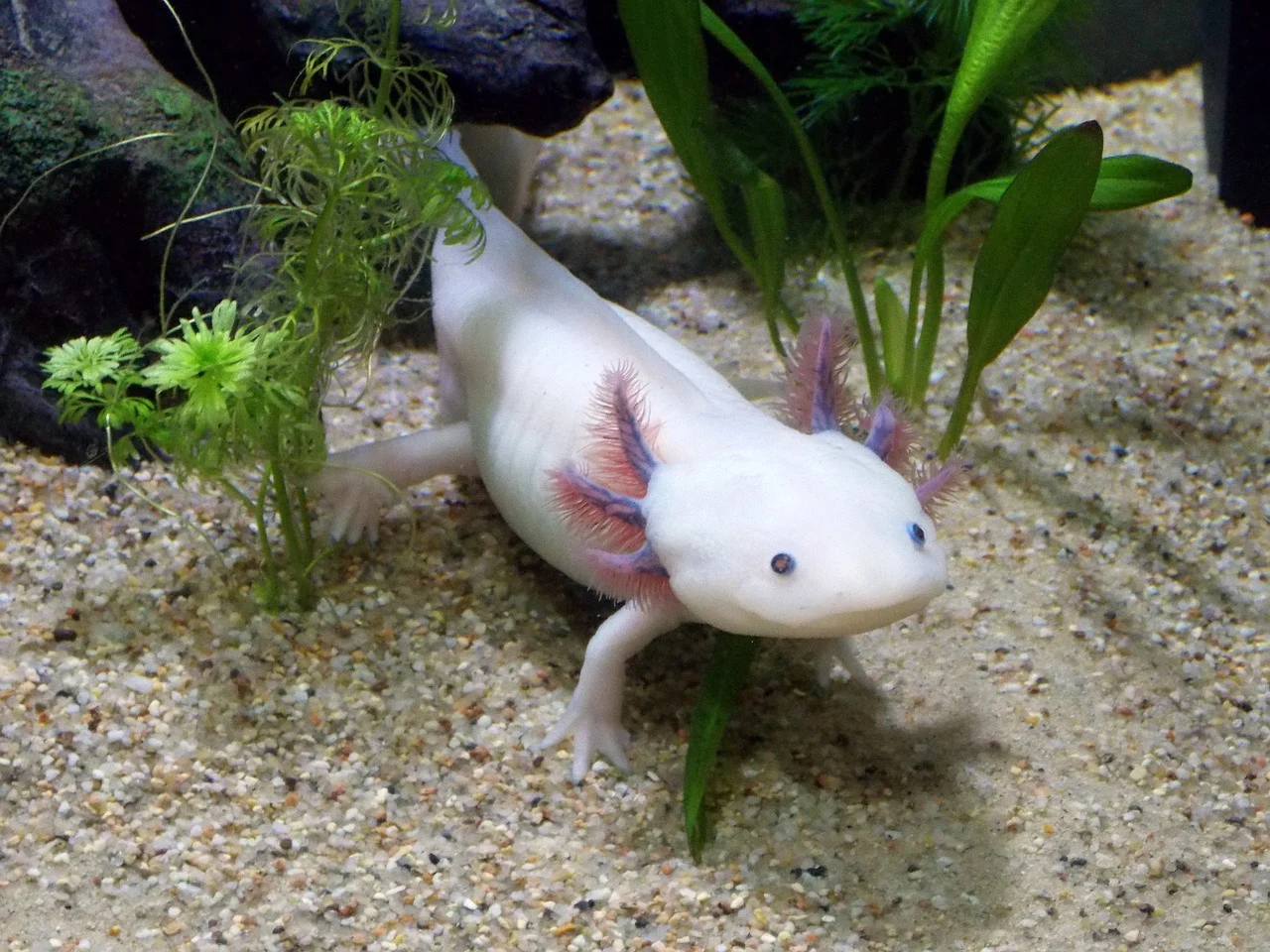
An axolotl, a salamander that perfectly regrows lost limbs, jaw, spinal cord, and parts of its heart and brain throughout life. Image: CC0, via Wikimedia Commons.
The mechanism
- Wound signaling cap. Within hours a special wound epidermis seals the cut and thickens into a signaling center that directs everything below it.
- Dedifferentiation. Mature cells near the wound revert to a flexible, stem-like state, supplying a fresh pool of building cells called a blastema.
- Patterned regrowth. The blastema multiplies, then redifferentiates into bone, muscle, nerve, blood vessel, and skin, each in the correct place and order.
- Positional memory. The cells carry coordinates of the body's layout, so the bud rebuilds only the structures that lay beyond the cut, in the right orientation.
- A stop rule. Growth halts when the limb reaches the right length and pattern, restoring the original shape with no scar and no excess.
Why this points to design
Faithful regeneration is a tightly integrated control system, not a single trick. The axolotl needs a wound cap that signals, mature cells that can safely revert, a blastema that multiplies, a positional code that says exactly what was lost and where, a redifferentiation program that turns the bud into the right tissues in the right order, and a stop rule that ends growth at the correct shape. Remove the positional information and the bud grows a shapeless lump. Remove the stop rule and growth never resolves. Remove the controlled dedifferentiation and there are no cells to build with. The function appears only when all of these run together, carrying detailed three-dimensional information about the body. That is the matched, information-rich pattern of Specified Complexity and Information Argument for Design. A system that rebuilds a complex limb perfectly, repeatedly, and to spec is the kind of programmed, integrated control that designing minds produce, not something blind step-by-step processes assemble. See Intelligent Design.
The evolutionary account, and why it falls short
The standard reply is that regeneration is an extension of ordinary wound healing and tissue turnover: animals already repair small injuries and replace cells, so selection could have stretched those routine repair pathways into full limb regrowth, with the blastema arising as an enhanced version of normal healing.
The reply points to healing but never delivers the rebuild. Wound closure and cell turnover patch a surface; they do not regenerate an entire limb with its bones, joints, muscles, nerves, and vessels arranged in the correct three-dimensional pattern and stopped at the correct length. The thing that needs explaining is the information and the coordination: a positional code that records the body's layout, controlled dedifferentiation that does not turn cancerous, patterned redifferentiation, and a precise stop rule, all working as one. Ordinary healing supplies none of that integrated program, and a blastema without the positional code grows a useless mass rather than a limb, giving selection nothing better to keep. Calling regeneration scaled-up healing names a starting tissue, not the origin of the layout information and the coordinated control. That gap between routine repair and perfect, patterned rebuilding is exactly what points to design.
See also
- Animals That Defy Evolution, the hub this spoke belongs to
- Specified Complexity, three-dimensional layout information in a control system
- Information Argument for Design, coded positional memory as a design signature
- Intelligent Design, the inference from integrated, programmed repair
- The wood frog, another animal in this hub with a remarkable built-in biological program
Common questions this page answers
Q: Why is the axolotl a problem for evolution?
Its limb regeneration is an integrated control system: a wound signaling cap, cells that safely revert to a flexible state, a growth bud, a positional code that records exactly what was lost and where, a program that rebuilds the right tissues in the right order, and a stop rule that ends at the correct shape. Take away the positional code and the bud grows a shapeless lump, so the parts are useless apart and there is no chain of advantageous halfway stages. That matched, information-dense program is the kind of Specified Complexity that points to design.
Q: How does the axolotl regrow a lost limb?
After amputation a wound epidermis seals the cut and becomes a signaling cap. Mature cells beneath it revert to a stem-like state and form a blastema, a pool of building cells that multiply and then turn into bone, muscle, nerve, blood vessel, and skin in the correct positions. Positional information in the cells tells the bud which structures lay beyond the cut, so it rebuilds exactly what was missing and stops at the right length.
Q: What body parts can an axolotl regenerate?
The axolotl regrows entire limbs with full bone, muscle, nerve, and vasculature, and it also restores lost jaw tissue, crushed spinal cord, parts of the heart, ocular tissue, and regions of the brain. It can do this repeatedly throughout its life, and it does so without the scarring that blocks regeneration in mammals.
Q: Why can't humans regenerate limbs the way an axolotl does?
In mammals a serious wound forms fibrotic scar tissue, which seals the injury but prevents the controlled dedifferentiation and blastema formation that limb regrowth requires. The axolotl avoids that scarring and retains the positional information and coordinated program needed to rebuild a limb to its original pattern, a built-in control system rather than mere wound healing.
Q: Couldn't regeneration just be scaled-up wound healing?
Wound healing patches a surface and replaces cells, but it does not rebuild a whole limb with joints, muscles, nerves, and vessels in the correct three-dimensional pattern and stop at the right length. Full regeneration needs a positional code, controlled dedifferentiation that does not turn cancerous, patterned rebuilding, and a precise stop rule working as one, none of which ordinary healing supplies, and that gap is exactly what points to design.