Concept
European Eel
Intro
The European eel lives most of its life in the rivers and lakes of Europe, then at the end of its life makes one of the longest and strangest journeys in the animal world. It stops feeding, its gut shrinks, its eyes enlarge, its body re-engineers itself for the open ocean, and it sets off across thousands of miles of Atlantic to spawn in the Sargasso Sea, a region of open water near Bermuda that no living adult has ever seen. The eel was born there, drifted to Europe as a tiny transparent larva, grew up in fresh water for years or decades, and now navigates back to the exact ocean region of its birth to breed and die. No eel makes a round trip and returns to teach the next generation; the entire migration runs on instructions the animal was born with. A route and a destination that have to be carried in the body from birth, and that work on the one and only attempt, point to an author who wrote them in.
In full
Anguilla anguilla is a catadromous fish with a famously cryptic life cycle, only recently confirmed by satellite tracking of spawning-bound adults. Larvae (leptocephali) hatch in the Sargasso Sea, drift on Atlantic currents toward Europe over months to years, metamorphose into glass eels at the continental shelf, enter rivers as elvers, and mature as yellow eels in fresh or brackish water for years to decades. Maturing adults then undergo a sweeping metamorphosis into the silver-eel stage: feeding stops and the gut atrophies, the eyes enlarge and the visual pigments shift toward the blue of deep water, the skin and blood chemistry reorganize for seawater and pressure, and reproductive development begins. The silver eels migrate roughly 5,000 to 6,000 kilometers back to the Sargasso to spawn, orienting in part by the geomagnetic field and other cues. The destination, the timing, the body-remodeling program, and the navigation are inherited, not learned, since no adult survives to return and guide its offspring, and the program must run correctly on a single lifetime attempt. Encoding that long-range route, target, and developmental sequence into the genome in advance is a feat of built-in information (Information Argument for Design, Specified Complexity).
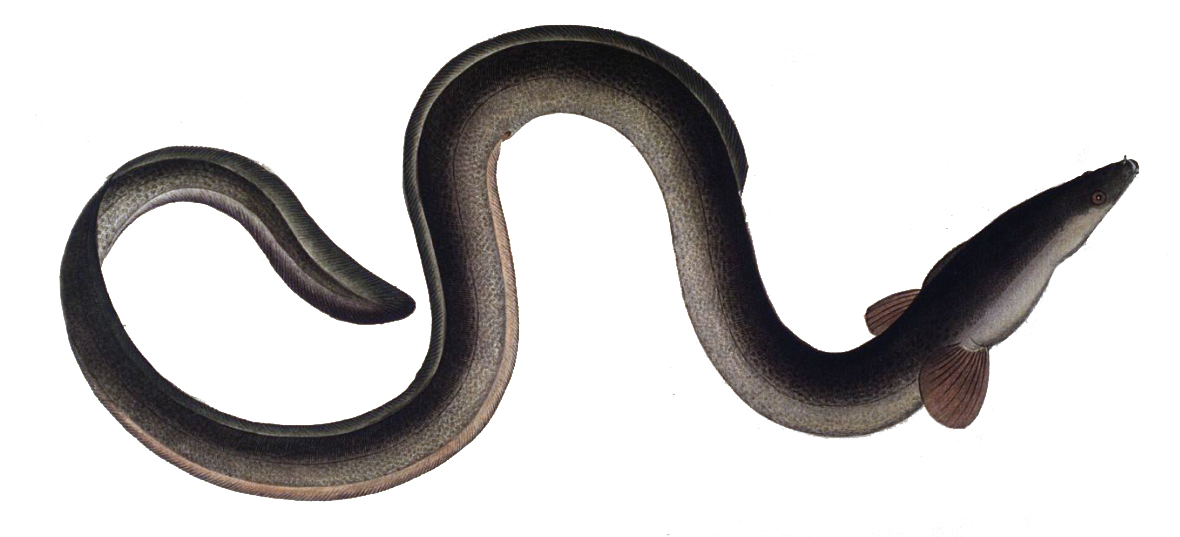
An illustration of the European eel (Anguilla anguilla). Image: public domain, via Wikimedia Commons.
The mechanism
- Born at sea, raised in rivers. Larvae hatch in the Sargasso Sea and drift to Europe, where they grow up in fresh or brackish water for years to decades before maturing.
- Body re-engineered for the journey. As migration nears, the eel stops eating and its gut shrinks, its eyes enlarge and retune toward deep-water blue, and its skin and blood chemistry reorganize for a life in the open ocean.
- A destination never seen as an adult. The mature eel heads for the Sargasso Sea, the region of its own birth, which it left as a tiny larva and to which no living adult has guided it.
- Inherited navigation. Crossing thousands of miles of featureless ocean, the eel orients using the Earth's magnetic field among other cues, holding course toward a target it carries only as inherited information.
- One attempt, no return. The eel spawns and dies; there is no round trip and no chance to learn or correct the route, so the whole program has to be right the first and only time.
Why this points to design
A European eel cannot learn its spawning route by trial and error, because it makes the journey once and dies at the end of it. That means the destination, the timing, the ocean-going body remodel, and the navigation must all be encoded in the animal from birth and execute correctly on the single attempt. Information that is in place before it is ever used, that specifies both a multi-stage developmental program and a precise long-range target, is not the kind of thing random variation tunes by lucky increments, because a half-written route does not carry an eel partway to the Sargasso, it loses it at sea, and a half-finished metamorphosis leaves the animal unable to make the crossing at all. The eel carries a complete, working instruction set for a voyage it has never made as an adult and will not survive to repeat, which is exactly the signature of design. See Information Argument for Design and Specified Complexity.
The evolutionary account, and why it falls short
The standard reply is that the migration lengthened gradually as continents drifted and spawning and feeding grounds separated over geological time, with each generation favored for slightly better orientation and slightly longer journeys, drawing on magnetic and current-sensing abilities common among fish.
The reply sketches a historical trend and assumes the program assembles along the way. The hard problem is not that fish can sense magnetism or ride currents; it is that a precise destination, a timed trigger to stop feeding and metamorphose, a full seawater-and-deep-water body remodel, and a thousand-mile navigation are bound into one inherited program that must run correctly on a single, unrepeatable attempt. A gradually lengthening route still has to keep that whole program coherent at every stage, and an eel with a half-built navigation system or a half-completed metamorphosis does not breed slightly farther out, it dies without spawning, leaving nothing for selection to refine. Naming familiar fish senses and a plausible drift of geography is not the same as exhibiting the genetic encoding of the integrated, first-time-correct route, target, and developmental sequence, or the selectable advantage of each intermediate. That a complete, working set of inherited instructions must be present before its one and only use is what points to a designer.
See also
- Animals That Defy Evolution, the hub this spoke belongs to
- Information Argument for Design, the information case behind inherited migration
- Specified Complexity, functional information as a design signature
- Irreducible Complexity, the integrated-program pattern behind the life cycle
- The salmon, another animal in this hub built around a one-shot inherited migration
Common questions this page answers
Q: Why is the European eel a problem for evolution?
Its spawning migration runs on inherited instructions that must work on a single, unrepeatable attempt: a precise destination in the Sargasso Sea, a timed body remodel for the open ocean, and thousands of miles of navigation, all carried from birth because no adult survives to teach the next generation. A half-written route loses the eel at sea rather than guiding it partway, so there are no individually advantageous intermediate stages, which points to built-in information rather than lucky accumulation.
Q: How does the European eel migrate to the Sargasso Sea?
When it matures, the eel stops feeding, its gut shrinks, its eyes enlarge and retune for deep water, and its body reorganizes for seawater. It then crosses roughly 5,000 to 6,000 kilometers of Atlantic, orienting in part by the Earth's magnetic field, to reach the same ocean region where it hatched, where it spawns and dies.
Q: How does the eel find a place it has never been as an adult?
It was born in the Sargasso Sea and drifted to Europe as a tiny larva, so it carries the route and destination only as inherited information, never having traveled it as an adult. The complete navigation program is built in from birth and has to work correctly on its one and only attempt.
Q: Couldn't the eel's migration have evolved gradually as the oceans changed?
The usual story says the route lengthened over geological time, but that lists a historical trend without explaining the integrated program. A precise target, a timed metamorphosis, and long-range navigation have to form one coherent set of instructions that works on a single try, and an eel with a half-built route or half-finished body remodel dies without spawning rather than breeding slightly farther out. The genetic encoding of that first-time-correct program has never been demonstrated, which is what points to design.