Concept
Salmon
Intro
A salmon is born in a freshwater stream, swims down to the ocean as a juvenile, and spends years roaming hundreds or thousands of miles of open sea. Then it turns around and finds its way back, not just to the right river, but to the very same gravel bed where it hatched, to spawn the next generation. It pulls this off using two senses working in sequence. Far out in the ocean it steers by the Earth's magnetic field, holding a course toward the right stretch of coast. Then, close to home, it switches to smell, following the unique chemical signature of its native stream that it memorized as a young fish. The salmon imprinted on that scent before it ever left, and years later it tracks it upstream through a maze of branching waters to the exact spot. A fish that records its birthplace as a scent and a magnetic position, then navigates back to it across an ocean, is running a program written in advance. Built-in homing points to an author.
In full
Anadromous salmon (Oncorhynchus and Salmo species) hatch in freshwater, migrate to the sea, and return years later to spawn, displaying natal homing of remarkable precision: many individuals return to the specific tributary, and often the specific reach, where they hatched. Two navigation systems operate in sequence. In the open ocean salmon use a geomagnetic map and compass, reading the inclination and intensity of Earth's field to orient toward their natal region, a sense studied through the consistent ways returning runs respond to natural shifts in the geomagnetic field. In freshwater the fish switch to olfactory imprinting: as juveniles (notably at the smolt stage) they memorize the distinctive blend of dissolved chemical cues of their home stream, and as adults they follow that scent gradient upstream, making the correct choice at each junction. The imprinting must occur before seaward migration and the homing must succeed on the single return run, so both the magnetic capacity and the scent-memory-and-tracking rule are inherited and run correctly on the first and only attempt. Coordinating a long-range geomagnetic system with a precise chemical memory laid down years earlier is a feat of built-in information (Information Argument for Design, Specified Complexity).
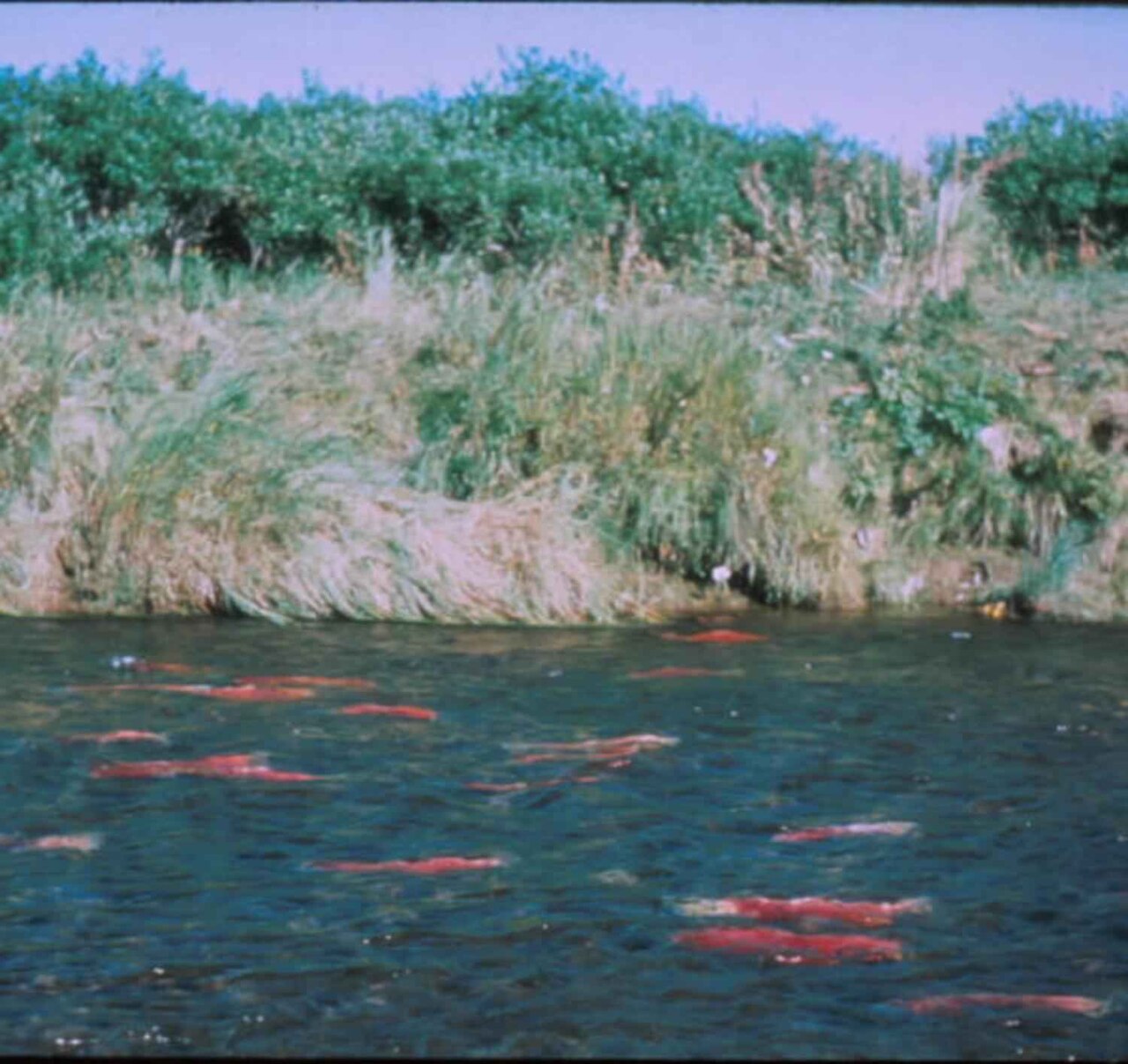
Sockeye salmon on the spawning run. Image: public domain, via Wikimedia Commons.
The mechanism
- Two-stage life. The salmon hatches in a freshwater stream, migrates to the ocean as a juvenile, and returns years later to spawn where it began.
- Ocean magnetic navigation. Far from land it reads the inclination and intensity of Earth's magnetic field to steer toward the right stretch of coastline.
- Scent imprinting. Before leaving, the young fish memorizes the unique chemical signature of its home stream, a blend of dissolved cues specific to that water.
- Following the scent home. Back in freshwater the adult tracks that remembered smell upstream, choosing correctly at each fork in the river system.
- Pinpoint return. The combined systems bring the salmon back not just to the right river but to the same gravel bed where it hatched.
Why this points to design
A returning salmon gets one homecoming. The scent it follows was recorded years earlier as a juvenile, and the magnetic course it holds across the ocean cannot be rehearsed. So the magnetic compass and map, the rule for imprinting the home water's chemistry at the right life stage, the long-term memory that stores it, and the tracking behavior that follows it upstream must all be present and coordinated before they are needed, and they must work on the single return run. A memory laid down at one stage of life to be used at another, paired with a long-range positioning sense, is not the kind of thing random variation cobbles together by lucky increments. It is the kind of forward-looking, integrated instruction set that minds produce. The salmon carries the encoded address of its birthplace and the means to find it again, which is the signature of design. See Information Argument for Design and Specified Complexity.
The evolutionary account, and why it falls short
The standard reply is that the parts are ordinary: fish smell their environment, magnetoreception is widespread, and homing could sharpen gradually as salmon that returned to familiar, proven spawning waters left more surviving offspring than those that strayed, refining both senses over many generations.
The reply lists capacities and assumes their integration. The hard problem is not that salmon smell water or sense magnetism; it is that a geomagnetic map for the ocean leg, a chemical memory imprinted years earlier at a specific life stage, and an upstream tracking rule that resolves every junction are combined into one program that brings a fish back to its exact natal gravel after years at sea, on a single return run. A magnetic sense without the scent memory finds the coast but not the stream, and a scent rule without the imprinting and the long-term storage has nothing to follow, so a half-built version does not guide the salmon partway, it leaves it lost at a river mouth. Naming familiar senses and a plausible selective story is not the same as exhibiting the genetic encoding of the integrated, first-time-correct homing system or the selectable advantage of each intermediate. A complete, working homing program that stores its target years in advance is exactly what points to a designer.
See also
- Animals That Defy Evolution, the hub this spoke belongs to
- Information Argument for Design, the information case behind inherited navigation
- Specified Complexity, functional information as a design signature
- Edge of Evolution, the empirical reach of random mutation
- The sea turtle, another animal in this hub that returns to its birthplace using the Earth's magnetic field
Common questions this page answers
Q: Why is the salmon a problem for evolution?
Its homing depends on a scent memory recorded years earlier and a magnetic course it cannot rehearse, and it gets only one return run. The magnetic map, the imprinting rule, the long-term memory, and the upstream tracking must all be present and coordinated in advance, and a half-built version leaves the fish lost at the coast rather than guiding it partway. A program that stores its destination years before it is used, and must work the first time, is the kind of thing minds design.
Q: How does a salmon find its way back to the stream where it was born?
It uses two systems in sequence. In the open ocean it reads the Earth's magnetic field to steer toward the right stretch of coast, then in freshwater it switches to smell, following the unique chemical signature of its home stream that it memorized as a juvenile, choosing correctly at each fork until it reaches the gravel bed where it hatched.
Q: How does the salmon's sense of smell guide it home?
As a young fish the salmon imprints on the distinctive blend of dissolved chemicals in its home water, storing it in long-term memory. Years later the returning adult tracks that remembered scent gradient upstream, using it to resolve each junction in the river system and arrive at its exact birthplace.
Q: How does a salmon know where home is if it left as a juvenile?
It records its birthplace before it ever leaves, memorizing the home stream's chemical signature and carrying an inherited magnetic sense for the ocean leg. The whole homing program is in place in advance and must run correctly on the single return trip, which is a striking case of built-in biological information.