Concept
Honeyguide
honeyguide, greater honeyguide, honeyguide bird, honeyguide human partnership, Indicator indicator, honeyguide evolution, honeyguide designIntro
In parts of Africa a wild bird and a human go hunting together for honey, and neither was taught to do it. The greater honeyguide knows where the bees are but cannot break open a nest; people can open a nest but often cannot find one. So the bird solves both problems at once. When a honey-hunter gives a special call, the honeyguide answers, flits from tree to tree, and leads the person straight to a hidden bee colony, then waits while the hunter chops it open, smokes out the bees, and takes the honey. The bird's reward is the wax and bee larvae left behind, food it craves and can barely get on its own. What makes this astonishing is that it is a free-living wild animal, not a trained pet, carrying on a back-and-forth conversation with a different species to reach a goal neither could reach alone. A bird with the drive, the navigation, and the signaling to recruit a human partner, paired with humans who answer it, is the kind of prearranged, two-sided fit that points to design.
See this page's graph and discover linked topics
In full
The greater honeyguide (Indicator indicator) of sub-Saharan Africa leads human honey-hunters to wild bee colonies in a genuine interspecies mutualism. The bird locates nests it cannot exploit (it lacks the strength to open them and the means to subdue the bees) and guides people to them through a sequence of perching, calling, and short flights in the nest's direction; after the hunters harvest the honey, the honeyguide feeds on the exposed beeswax and bee brood, which it is unusual among birds in being able to digest. Field research has documented that the communication is reciprocal and learned at the cultural level: in some communities hunters use a specific vocal signal (a trilled call) that significantly raises the chance a honeyguide will both respond and lead them to a nest, and the call is regionally specific, so the bird and the people are exchanging mutually understood signals tuned to each other. The partnership shows obligate-grade interdependence built on a suite of matched traits: the bird's drive to seek out and approach humans, its ability to find nests and convey direction, its rare capacity to live on wax and brood, and a human partner who recognizes and rewards the guiding. No single trait yields the payoff alone. A bird that wanted wax but could not locate nests, or located them but could not recruit and direct a partner, or directed a partner who did not respond or reward it, would gain nothing, and a step-by-step process has no advantageous foothold until the guiding behavior, the signaling, and a cooperating partner are all present together.
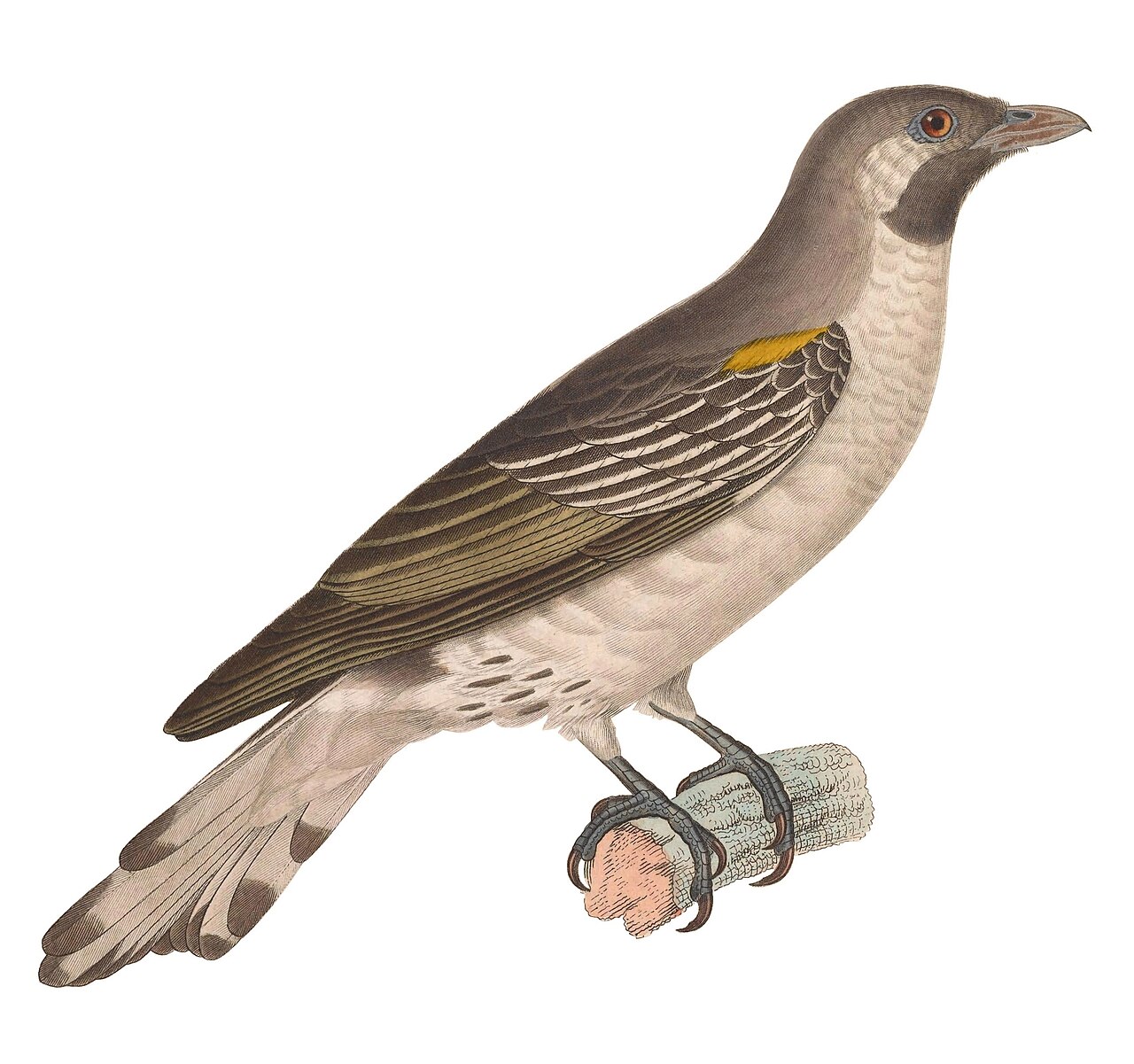
Greater honeyguide (Indicator indicator), a hand-colored illustration from 1838. Image: public domain, via Wikimedia Commons.
The mechanism
- The bird finds the nest. The honeyguide locates wild bee colonies it has no way of opening or robbing on its own.
- It recruits a partner. Hearing a hunter's call, the bird approaches and answers, then leads with a pattern of perching, chattering, and short directional flights toward the nest.
- Two-way signaling. The exchange is reciprocal and learned: in some regions hunters use a specific call that markedly raises the odds the bird will respond and guide, and the signal is regionally tuned, so both sides are reading each other.
- The human opens the nest. The hunter follows, breaks the colony open, smokes out the bees, and takes the honey, doing the part the bird cannot.
- The bird collects its pay. The honeyguide feeds on the leftover beeswax and bee larvae, food it can digest and rarely obtains otherwise.
Why this points to design
The guiding partnership only delivers a meal when several things are present together: the bird's drive to seek out humans, its ability to find nests and signal their direction, its rare power to live on wax and brood, and a human partner who recognizes the guiding and opens the nest. Remove any one and the chain breaks. A bird that craves wax but cannot find nests starves; one that finds them but cannot recruit and direct a partner gets nothing; a guide whose signals no partner answers leads no one. The reward appears only when the whole loop is closed at once, which is not how a series of separately advantageous steps proceeds. A free-living wild bird equipped to navigate, to signal across the species line, and to digest the unusual food its partner uncovers, matched to humans who answer and repay it, is exactly the kind of prearranged, two-sided arrangement that points to a designer. See Intelligent Design and Information Argument for Design.
The evolutionary account, and why it falls short
The standard reply is that the behavior grew by stages: honeyguides already followed larger animals to raided nests for scraps, an ancestral bird that lingered near humans and chattered at them got opened nests more often, people who noticed the pattern began to cooperate, and selection and learning sharpened the guiding and the calling on both sides until the loop became reliable.
The reply sketches a convenient sequence but never builds the thing in question. What needs explaining is not that a bird likes wax; it is the closed, two-way recruitment, a wild animal that actively seeks a human, leads it with directional signals toward a nest the bird located, waits, and is repaid, while the human reads and answers a species-specific call. Pointing to a bird scavenging at an already-opened nest no more explains that conversation than pointing to a hungry bird explains a guide. Naming a path from "scavenging" to "guiding" is not the same as exhibiting the intermediate bird that gained a real reward from a half-formed signal no partner yet understood, or the genetic basis for a drive to recruit a wholly different species. The matched, reciprocal fit, a bird built to lead and a partner built to follow and pay, is what the gradual story cannot deliver and what design accounts for directly.
See also
- Animals That Defy Evolution, the hub this spoke belongs to
- Intelligent Design, the positive design program
- Information Argument for Design, coded, mutually understood signals as a design signature
- Irreducible Complexity, the pattern of jointly-required, individually-useless parts
- The oxpecker, another bird in this hub fitted to a cross-species partnership
Common questions this page answers
Q: Why is the honeyguide a problem for evolution?
The greater honeyguide finds bee nests it cannot open and recruits a human to open them, leading the person with directional signals and feeding on the leftover wax and larvae. The arrangement only yields a meal when the bird's nest-finding, its drive to recruit a partner, its signaling, its rare ability to digest wax, and a cooperating human are all present together. Because a half-built version helps neither side, there is no ladder of separately advantageous steps for selection to climb, and the reciprocal partnership looks engineered.
Q: How does the honeyguide lead people to honey?
When a honey-hunter gives a special call, the bird answers and approaches, then leads the way with a pattern of perching, chattering, and short flights toward a hidden bee colony. The communication is two-way and learned: in some regions hunters use a specific trilled call that markedly raises the chance the bird will respond and guide, and the call is regionally tuned, so the bird and the people are exchanging signals they both understand.
Q: Is the honeyguide trained to do this?
No. The honeyguide is a free-living wild bird, not a tamed or trained animal, yet it carries on a back-and-forth exchange with humans to reach a shared goal. That a wild creature is born with the drive, the navigation, and the signaling to recruit a member of an entirely different species is a large part of why the behavior resists a gradual, step-by-step explanation.
Q: Couldn't the honeyguide's guiding behavior have evolved gradually?
The usual story says it began with birds scavenging at nests other animals had opened, but that skips the hard part: real guiding needs a bird that actively seeks a partner, signals direction, and is answered and repaid, with a human reading a species-specific call. Pointing to a scavenging bird supplies an appetite, not the two-way recruitment, and the intermediate bird and the genetic basis for recruiting another species have never been demonstrated. That prearranged, reciprocal fit is what points to design.