Concept
Sea Turtle
Intro
A sea turtle hatchling digs out of the sand at night, scrambles to the surf, and swims away into the open ocean alone. Decades later, after crossing entire ocean basins, the female returns to nest on the same stretch of coast where she hatched, sometimes within a few miles of her own birthplace. She does this using the Earth's magnetic field as both a compass and a map. Every coastline has its own magnetic signature, a particular combination of field angle and intensity, and the turtle reads those values like global positioning coordinates. The hatchling carries this magnetic map from the moment it enters the water, with no parent to follow and no chance to learn the route by trial and error. A reptile that reads the planet's magnetic field to find one beach out of a whole coastline, on a journey it began as a hatchling, is running a navigation program that had to be in place from the start. Built-in coordinates point to an author.
In full
Sea turtles, including loggerheads (Caretta caretta) and green turtles (Chelonia mydas), display natal homing: females return to nest near their own hatching beach after migrations that can span thousands of miles and decades at sea. The mechanism is geomagnetic. Earth's field varies predictably across the globe in both inclination (the angle at which field lines meet the surface) and intensity, giving each coastal location a distinctive magnetic signature. Experiments by Kenneth and Catherine Lohmann and colleagues show that hatchlings possess an inherited magnetic compass and a magnetic map sense: exposed to field values copied from specific geographic locations, hatchlings orient in the direction that would keep them on their migratory route, even though they have never been to sea. Adults appear to imprint on the magnetic signature of their natal beach and use it to relocate it years later. The full navigational capacity, compass plus positional map, is present in the hatchling on its first swim, so it must be encoded in advance and run correctly the first time. Encoding a geomagnetic positioning system together with the rule for using it is a feat of built-in information (Information Argument for Design, Specified Complexity).
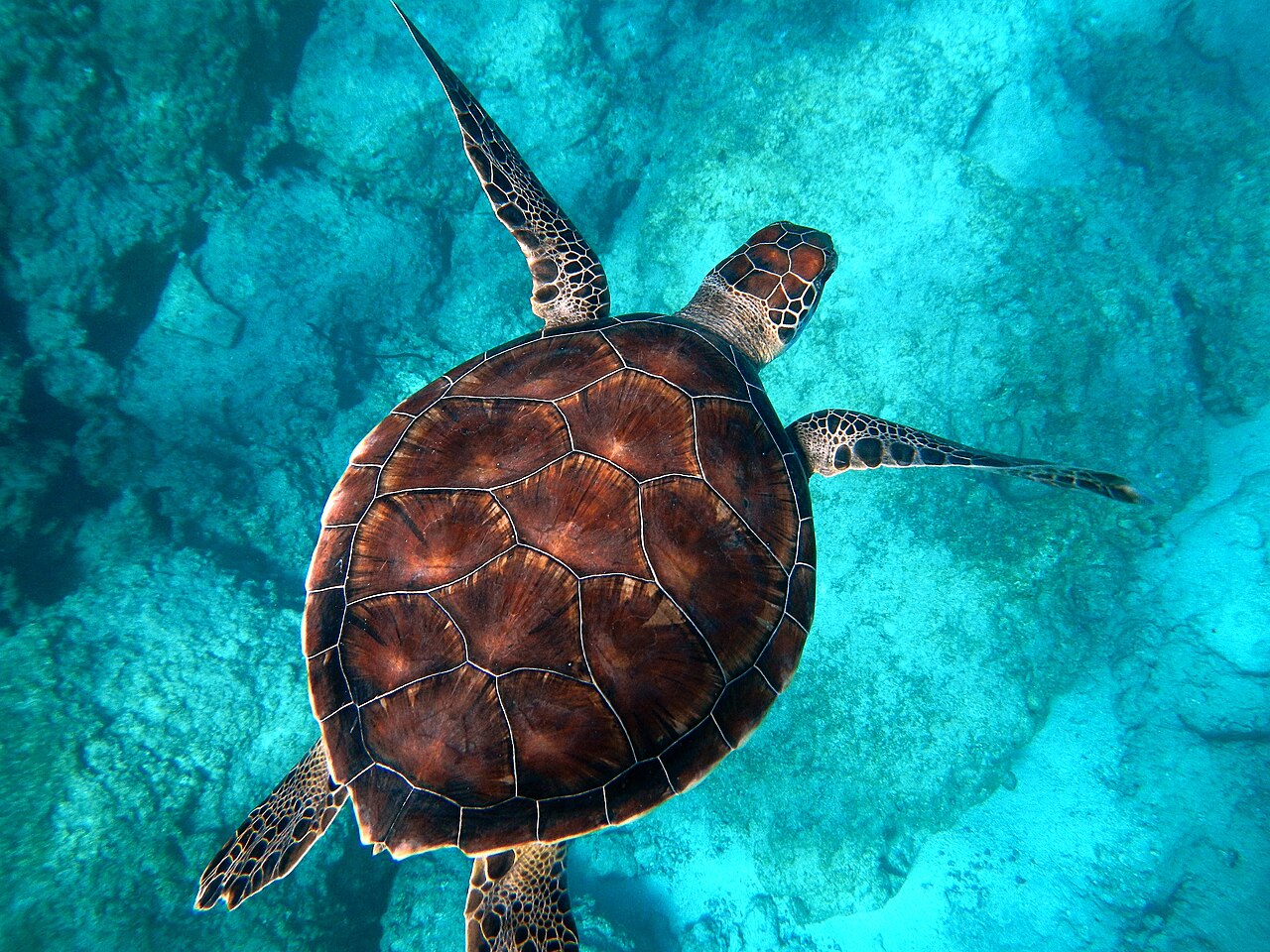
A green sea turtle swimming over a reef. Image: CC0, via Wikimedia Commons.
The mechanism
- Solo start. Hatchlings emerge at night, cross the beach, and swim out into the open ocean with no parent and no guide.
- Magnetic compass. The turtle reads direction from the inclination of Earth's magnetic field, holding a heading far out at sea where there are no landmarks.
- Magnetic map. Because field inclination and intensity vary by location, each coast has a unique signature, and the turtle reads these values as positional coordinates, knowing not just which way is north but roughly where it is.
- Inherited route. Hatchlings tested with field values from specific sites orient in the direction that keeps them on the correct migratory path, though they have never traveled it.
- Natal homing. Females imprint on the magnetic signature of their birth beach and return there to nest after decades and thousands of miles away.
Why this points to design
A loggerhead hatchling cannot practice ocean navigation; its first swim is the real thing, and getting lost means death. So the magnetic compass, the magnetic map, and the inherited rule that links specific field values to the correct heading must all be present and working before the turtle ever reaches the water. Information that is in place before it is first used, and that specifies both how to read the planet's field and what to do with the reading, is not the kind of thing random variation stumbles into by lucky increments. It is the kind of thing minds write. The hatchling carries a working geomagnetic positioning system for a journey it has never made, and the adult carries the imprinted coordinates of a beach it left as a hatchling. That is the signature of design. See Information Argument for Design and Specified Complexity.
The evolutionary account, and why it falls short
The standard reply is that magnetoreception is common across animals, that simple magnetic compasses are widespread, and that natal homing could refine gradually as turtles with slightly better field sensitivity nested a little closer to good beaches and left more offspring, sharpening the map sense over many generations.
The reply names a sense and assumes the system. The hard problem is not that turtles detect magnetism; it is that a directional compass, a positional map that reads both inclination and intensity, and an inherited rule connecting particular field values to the correct migratory heading are integrated into one program that guides a never-been-there hatchling correctly on its first swim and lets an adult relocate a single beach decades later. A compass without the map gives heading but not location, and a map sense without the inherited route gives coordinates with no instruction, so a half-built version does not guide the turtle partway, it loses it. Pointing to common magnetoreception and a plausible trend is not the same as exhibiting the genetic encoding of the integrated, first-time-correct positioning system or the selectable advantage of each intermediate. A complete, working navigation map that must be present before its first use is exactly what points to a designer.
See also
- Animals That Defy Evolution, the hub this spoke belongs to
- Information Argument for Design, the information case behind inherited navigation
- Specified Complexity, functional information as a design signature
- Edge of Evolution, the empirical reach of random mutation
- The salmon, another animal in this hub that returns to its exact birthplace to reproduce
Common questions this page answers
Q: Why is the sea turtle a problem for evolution?
Its magnetic navigation has to work on the hatchling's very first swim, when getting lost means death, so the compass, the positional map, and the inherited rule linking field values to a heading must all be in place in advance. A half-built version gives a heading with no location or coordinates with no instruction, which strands the turtle rather than guiding it partway. A complete, working positioning system that must be present before its first use is the kind of thing minds design.
Q: How does a sea turtle navigate back to the beach where it was born?
It reads the Earth's magnetic field, which varies in angle and strength from place to place, giving every coastline its own magnetic signature. The female appears to imprint on the signature of her hatching beach and uses her magnetic compass and map sense to relocate it years and thousands of miles later, a behavior called natal homing.
Q: How does the sea turtle's magnetic sense actually work?
The turtle detects both the inclination, or angle, of Earth's field lines and the field's intensity. Inclination gives a compass heading, while the combination of inclination and intensity acts like a map coordinate, so the turtle can tell not only which way is north but roughly where it is along its route.
Q: How does a baby turtle know where to swim if it has never been to sea?
It does not learn the route. In experiments, hatchlings exposed to magnetic field values copied from specific ocean locations orient in the direction that keeps them on the correct migratory path, even though they have never traveled it. The navigation program is inherited and must run correctly on the first attempt, which is a striking case of built-in biological information.