Concept
Spider
Intro
A spider spins thread that, weight for weight, is stronger than steel and tougher than the Kevlar in a bulletproof vest, and it does this at body temperature, from a water-based liquid, with no high heat, no harsh chemicals, and no factory. The silk starts as a soluble protein gel inside the spider's body and is converted, in the split second it passes through a spinning organ, into a solid fiber of exactly the right strength and stretch. The spider makes several different silks for different jobs, dragline for the frame, stretchy capture spiral for catching prey, sticky glue, wrapping silk, and lays them down into a geometric web built to absorb the impact of a flying insect without breaking. Materials and machinery this far beyond human engineering, integrated into one small animal, point to a designer.
In full
Spider silk is a protein fiber spun from spidroins, large repetitive proteins stored as a concentrated liquid crystalline dope in the silk glands. As the dope is drawn through a tapering duct and out of the spinnerets, a precisely controlled change in pH, ion concentration, water removal, and shear force triggers the proteins to align and lock into a composite of crystalline beta-sheet regions embedded in a flexible amorphous matrix. The result combines high tensile strength (rivaling or exceeding steel by weight) with extraordinary toughness, the energy absorbed before breaking, exceeding that of Kevlar. Orb-weavers produce up to seven silk types from distinct glands, each tuned in composition for its task, and assemble them into an engineered web: a stiff radial frame, a pre-tensioned capture spiral, and aqueous glue droplets, with proportions and geometry that dissipate a prey strike. The design inference rests on the integration of a specified protein sequence, a controlled spinning process that converts liquid to solid fiber on demand, multiple matched glands and spinnerets, and the instinctive behavior to build the web (Specified Complexity, Information Argument for Design). No part is useful alone; the system delivers its function only assembled.
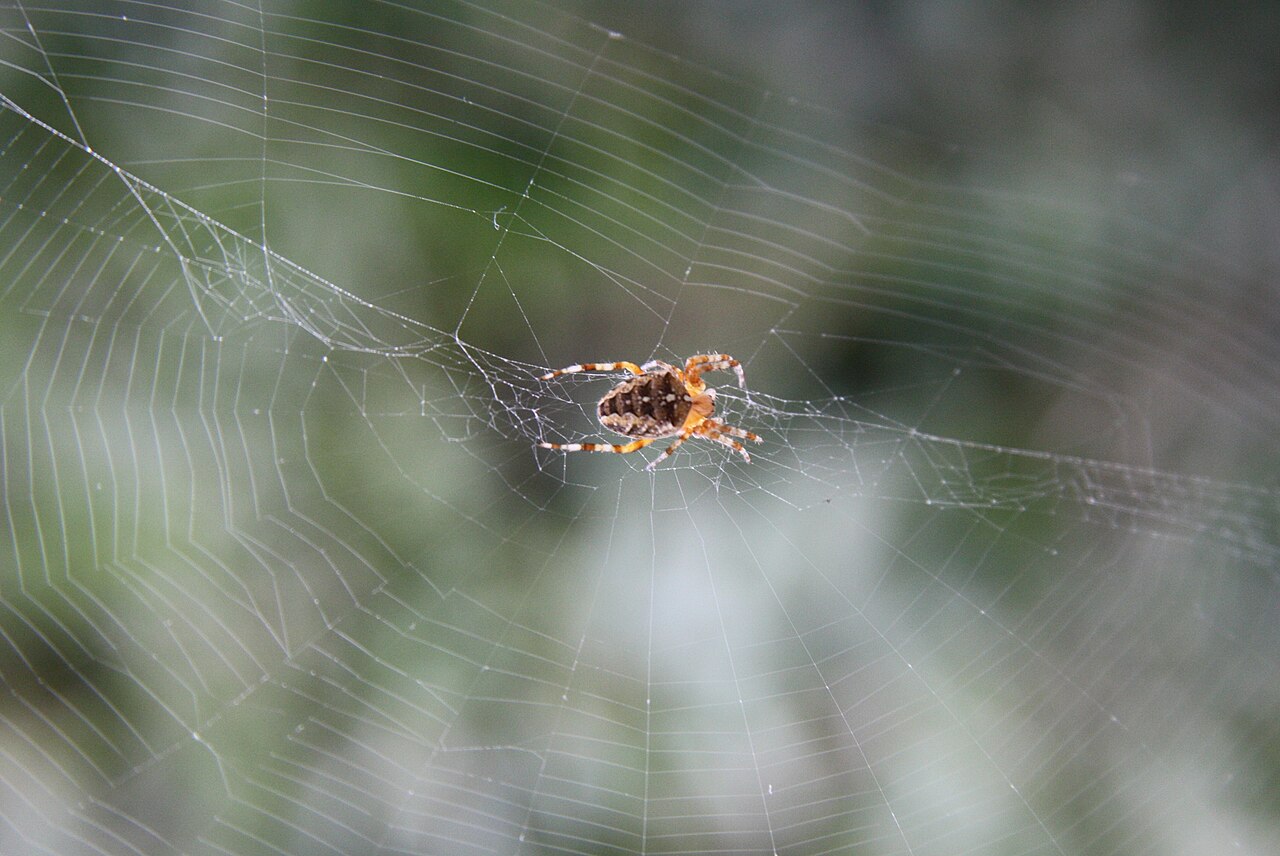
A garden orb-weaver (Araneus diadematus) in its web. Image: public domain, via Wikimedia Commons.
The mechanism
- Liquid silk store. The spider holds silk proteins, spidroins, as a concentrated water-based liquid in its glands, kept soluble and ready until needed.
- Spinning conversion. Drawing the liquid through a narrowing duct changes its acidity and salt balance and removes water while shear force aligns the proteins, snapping them from liquid into a solid fiber at the spinneret.
- Composite structure. The finished thread is a composite of hard crystalline blocks that give strength and soft stretchy regions that give toughness, the same trick human engineers use in advanced materials.
- Several silks. Separate glands produce different silks, a strong dragline frame, an elastic sticky capture line, wrapping and egg-case silk, each matched to its job.
- Engineered web. Movable spinnerets lay the threads into a tensioned geometric web designed to catch and hold a flying insect by spreading the impact across the whole structure.
Why this points to design
Human chemists cannot yet match spider silk. We make strong fibers only with high heat, pressure, or toxic solvents, and we still fall short of silk's combination of strength and toughness, which is why labs around the world try to copy it. The spider does it cold, from water, on demand. That alone is striking, but the deeper point is integration: the specified protein sequence is useless without the precise spinning process that converts it to fiber, the spinning is useless without glands and ducts and spinnerets built to the right geometry, and all of it is useless without the instinct to build a web that actually catches prey. A spider with the silk protein but no spinning apparatus has a clog, not a thread; one with thread but no web-building behavior has string, not a trap. Each layer requires the others to be present and matched, and a multi-part system whose function appears only when protein, machinery, and behavior are assembled together is the hallmark of foresight, not of step-by-step accident. See Specified Complexity and Irreducible Complexity.
The evolutionary account, and why it falls short
The standard reply is gradualist: simple silk glands appear in many arthropods, early silk may have lined burrows or wrapped eggs, and from there selection is said to have improved the protein, multiplied the gland types, and elaborated draglines into capture webs one advantageous step at a time.
The reply gestures at simpler silks elsewhere but never produces the system that needs explaining. The marvel is not that spiders make a fiber; it is that they make a family of tuned, high-performance composites by a controlled liquid-to-solid spinning process and lay them into an engineered, prey-catching web, all coordinated in one animal. Pointing to egg-wrapping silk in some other creature no more explains that than pointing to a thread of cotton explains a suspension bridge. A real evolutionary account would have to demonstrate the selectable intermediates and the genetic changes that built the specified spidroin sequences, the spinning machinery that converts them, the multiple matched glands, and the web-building instinct, each stage a working advantage. Naming a humble starting silk is not that demonstration. The distance between a sticky strand and an integrated silk-and-web system is precisely the gap that points to design.
See also
- Animals That Defy Evolution, the hub this spoke belongs to
- Specified Complexity, functional information as a design signature
- Irreducible Complexity, the all-or-nothing pattern behind silk and web together
- Information Argument for Design, the information case behind the spidroin sequences
- The mussel, another animal in this hub whose protein materials outperform human engineering
Common questions this page answers
Q: Why is spider silk a problem for evolution?
Useful silk requires three matched things at once: a specified protein sequence, a precise spinning process that converts the liquid protein into a solid fiber on demand, and the glands, spinnerets, and instinct to build a web that actually catches prey. A spider with the protein but no spinning apparatus has a clog, and one with thread but no web-building behavior has only string. Function appears only when protein, machinery, and behavior are assembled together, which is the design pattern, and no stepwise account demonstrates how unguided processes built the whole package.
Q: How does a spider make silk stronger than steel?
It stores silk proteins as a concentrated water-based liquid and draws them through a narrowing duct, where a controlled change in acidity, salt, and water removal, plus shear force, snaps the proteins into a solid fiber. The thread is a composite of hard crystalline blocks that give strength and soft stretchy regions that give toughness. All of this happens at body temperature without heat or harsh chemicals, which is why human labs cannot yet match it.
Q: Why can't humans manufacture spider silk?
We can make strong fibers only with high heat, high pressure, or toxic solvents, and we still cannot reproduce silk's combination of strength and toughness from a water-based liquid at body temperature. The spider's spinning process and protein design remain ahead of our best materials engineering, which is exactly why so many labs are trying to copy it. That gap is one reason the silk system points to foresight.
Q: Couldn't spider webs have evolved gradually from simple silk?
Many arthropods make simple silk for lining burrows or wrapping eggs, but that supplies a starting strand, not the system. The marvel is a family of tuned high-performance silks made by a controlled spinning process and laid into an engineered, prey-catching web, all coordinated in one animal. Naming a humble silk elsewhere does not demonstrate the selectable intermediates that built the spidroin sequences, the spinning machinery, the multiple glands, and the web-building instinct together.