Concept
Pistol Shrimp
pistol shrimp, snapping shrimp, Alpheus, pistol shrimp evolution, pistol shrimp design, cavitation shrimp clawIntro
The pistol shrimp carries a weapon that breaks the rules of its own size. One claw is oversized and built like a spring-loaded hammer. The shrimp cocks it open, then snaps it shut so fast that the water itself cannot keep up. A jet shoots out, a vacuum bubble forms, and when that bubble collapses it flashes to thousands of degrees and fires a shockwave that stuns or kills prey a body-length away. The snap is one of the loudest sounds in the ocean. This is not a strong pinch. It is a coordinated system: a matched socket and plunger, a latch that stores energy, a muscle tuned to release it in an instant, and a claw shaped to turn that release into a focused jet. Every part has to be present and tuned together for the weapon to fire at all. That kind of matched, all-or-nothing engineering is the signature of design.
See this page's graph and discover linked topics
In full
Snapping shrimp of the family Alpheidae possess one greatly enlarged chela with a specialized plunger ("dactyl") and socket. The dactyl is held cocked by a co-contraction latch mechanism; when released, it slams into the socket and ejects a high-velocity water jet. The jet drops local pressure below the vapor point and produces a cavitation bubble. The bubble's violent collapse generates a pressure pulse that stuns prey and a flash of light and heat, the heat spike reaching thousands of kelvin (the documented phenomenon termed "shrimpoluminescence"). The functional unit is irreducibly complex: an enlarged claw geometry, a stored-energy latch, a fast-twitch release, a precisely fitted plunger-and-socket, and the surrounding sensory and behavioral control are jointly required. Remove any element and the cavitation weapon does not form. The system is a clear instance of Irreducible Complexity: the lethal output appears only when the matched parts and their timing are all in place, and no partial claw delivers a cavitation strike for selection to favor.
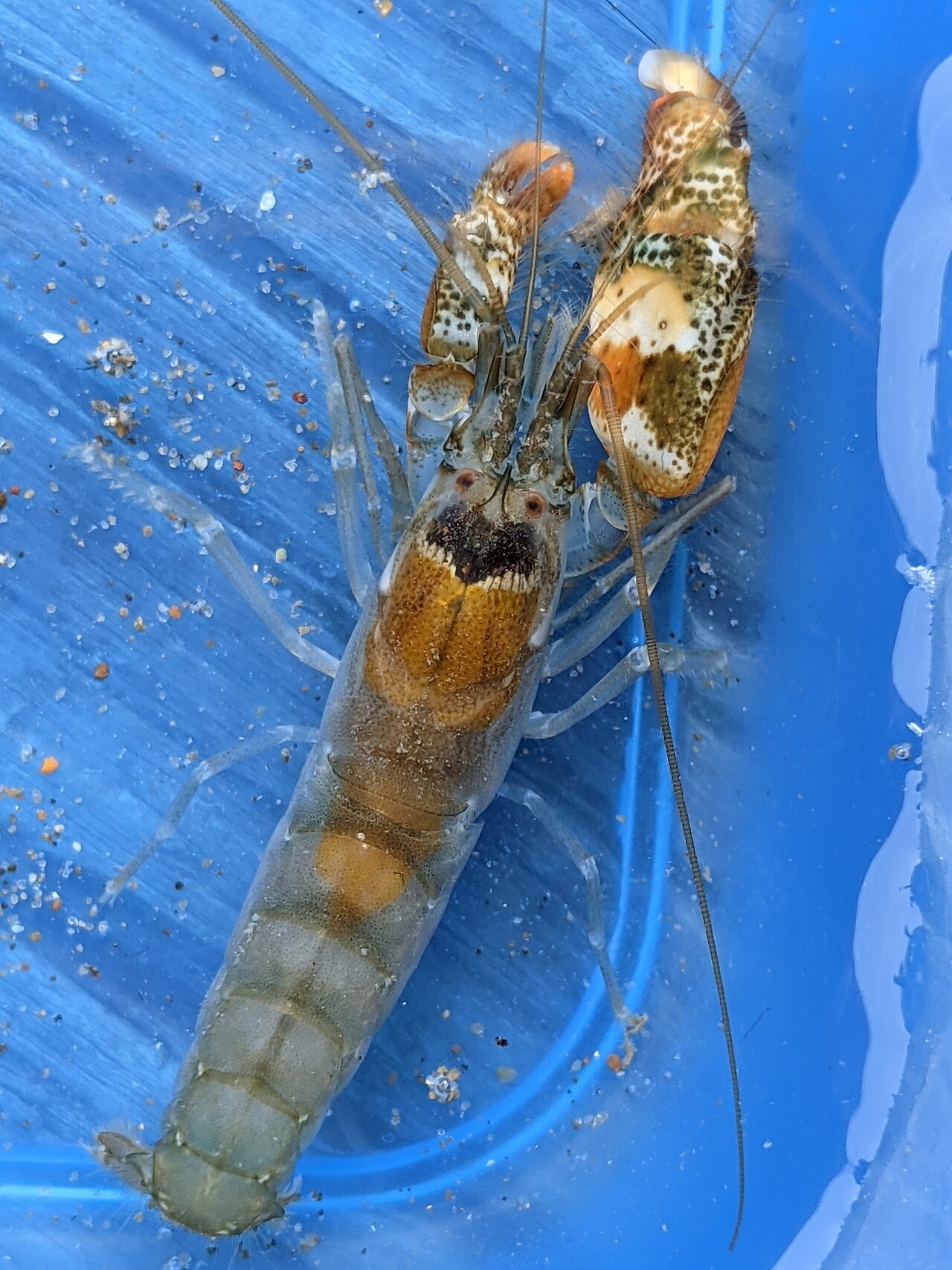
A snapping shrimp (Alpheus clamator) with its oversized snapping claw. Image: CC0, via Wikimedia Commons.
The mechanism
- The oversized claw. One chela grows far larger than the other and is shaped as a plunger-and-socket, not a simple pincer. Its geometry is what turns a fast closure into a focused water jet.
- The latch. The claw is cocked open and held by opposing muscles that co-contract, storing energy like a drawn bow rather than relying on raw muscle speed.
- The snap. When the latch releases, the dactyl closes in well under a millisecond and ejects water at tens of meters per second.
- Cavitation. The jet lowers the water pressure below its vapor point, forming a bubble; the bubble collapses with a crack, a shockwave, and a flash of heat reaching thousands of degrees.
- The kill. The shockwave, not the claw itself, stuns or kills small prey at a distance, letting the shrimp hunt without ever touching the target.
Why this points to design
The cavitation strike is useful only when every component is present and tuned at once: an enlarged claw with the right plunger-and-socket shape, a latch that stores energy, a release fast enough to throw a jet, and water moved hard enough to vaporize. A slightly larger claw with no latch is just a clumsy pincer. A latch with the wrong claw geometry throws no jet. A jet too slow forms no bubble, and no bubble means no shockwave and no stun. There is no climbing series of small, separately useful steps that ends in a working sonic weapon, because the intermediate stages produce no cavitation and therefore no advantage to preserve. A device whose function emerges only when matched parts and split-second timing are assembled together is exactly what intelligent agents build and what unguided, step-by-step processes are not equipped to produce. See Irreducible Complexity and Specified Complexity.
The evolutionary account, and why it falls short
The standard reply is gradual enlargement and co-option: claws vary in size, a bigger claw closes harder and makes a useful snap for fighting or signaling, and once a fast closure existed, selection could refine the socket, the latch, and the jet until cavitation emerged as a bonus that was then sharpened into a weapon.
The reply describes a smooth ramp without showing that the ramp exists. Cavitation is a threshold effect: below a sharp velocity cutoff no bubble forms, so a merely "harder" claw gives no sonic stun to select for, and the leap to the matched plunger-and-socket geometry, the energy-storing latch, and the millisecond release is exactly the part left unexplained. Pointing out that claws can differ in size no more explains a focused cavitation strike than pointing out that springs exist explains a firearm. A narrative that links ordinary pincers to a finished acoustic weapon is not the same as demonstrating the selectable intermediates and the genetic and developmental changes that built the integrated, latch-driven, cavitation-forming system. That unbridged gap between a stronger pinch and a working sonic gun is precisely what points to design.
See also
- Animals That Defy Evolution, the hub this spoke belongs to
- Irreducible Complexity, the core pattern behind the snapping claw
- Edge of Evolution, the empirical reach of random mutation
- Specified Complexity, functional information as a design signature
- The bombardier beetle, another animal in this hub with a high-speed, high-energy weapon
Common questions this page answers
Q: Why is the pistol shrimp a problem for evolution?
Its sonic weapon needs several matched parts working together: an oversized plunger-and-socket claw, an energy-storing latch, a release fast enough to throw a high-speed jet, and the precise geometry that turns that jet into a collapsing cavitation bubble. Below a sharp speed threshold no bubble forms, so a merely bigger or stronger claw produces no sonic stun for selection to build on. The whole system has to be present and tuned at once, which is the Irreducible Complexity pattern, and no stepwise account has shown how unguided processes assemble it.
Q: How does the pistol shrimp's snap actually work?
The shrimp cocks its enlarged claw open and holds it with opposing muscles that act like a latch. When the latch lets go, the claw snaps shut in under a millisecond and shoots out a jet of water so fast that the pressure drops below water's vapor point. A bubble forms and then violently collapses, releasing a shockwave plus a flash of heat reaching thousands of degrees, and that shockwave is what stuns the prey.
Q: How hot and loud is the pistol shrimp's snap?
The collapsing cavitation bubble briefly reaches thousands of degrees, hot enough to emit a faint flash of light, and the snap is among the loudest sounds in the ocean. The shrimp uses this from a small distance, killing or stunning prey with the shockwave rather than by gripping it.
Q: Couldn't a bigger claw have evolved gradually into the pistol shrimp's weapon?
A gradually bigger claw only gives a harder pinch, and cavitation is a threshold effect, so until the closure crosses a sharp speed cutoff there is no bubble, no shockwave, and no advantage to select. Getting to the working weapon requires the matched plunger-and-socket shape, the energy-storing latch, and the millisecond release all at once, and that integrated jump is exactly what gradual stories assume but never demonstrate.