Argument
Yahweh Was an Edomite God Objection Defeater
Yahweh was an Edomite god, Yahweh is an Edomite god, Yahweh Edomite origin, Edomite Yahweh, Yahweh god of Edom, Yahweh came from Edom, Yahweh from Seir, Qos and Yahweh, Qaus and Yahweh, southern origin of Yahweh, Midianite-Kenite hypothesis defeater, Kenite hypothesisIntro
The objection is short: "Yahweh was an Edomite god." The idea is that the God of Israel started out as the local god of Edom, the people descended from Esau who lived south and east of the Dead Sea, and Israel later took him over. If that were true, the God of the Bible would be a borrowed tribal deity with a home address, and his claim to be the one Creator would look like promotion after the fact.
There is real evidence behind the claim, and it should be stated fairly. Several of the oldest poems in the Bible say Yahweh "went forth out of Seir" and "marched out of the field of Edom." Egyptian lists from the 1300s BC name a "land of the Shasu, Yhw" among southern nomads. An inscription from around 800 BC blesses by "Yahweh of Teman," a southern name. Serious scholars argue that Yahweh was first worshipped by southern peoples before Israel.
The answer starts by separating three claims that the slogan blends together. Yahweh is linked with the south: true, and the Bible says so first. Some southern peoples may have known Yahweh early: a live scholarly theory, and one the Bible itself half-expects, since Moses meets God at Horeb while living among the Midianites. Yahweh was Edom's national god: that is the claim the slogan makes, and Edom's own records answer it. Edomite kings, seals and shrines name their god Qos, and the Bible calls the gods of Edom "the gods of the children of Seir," gods that could not save their own people. A god who comes from a place in a victory hymn is not thereby that place's god, and how people first came to know a name never settles whether the one named is real.
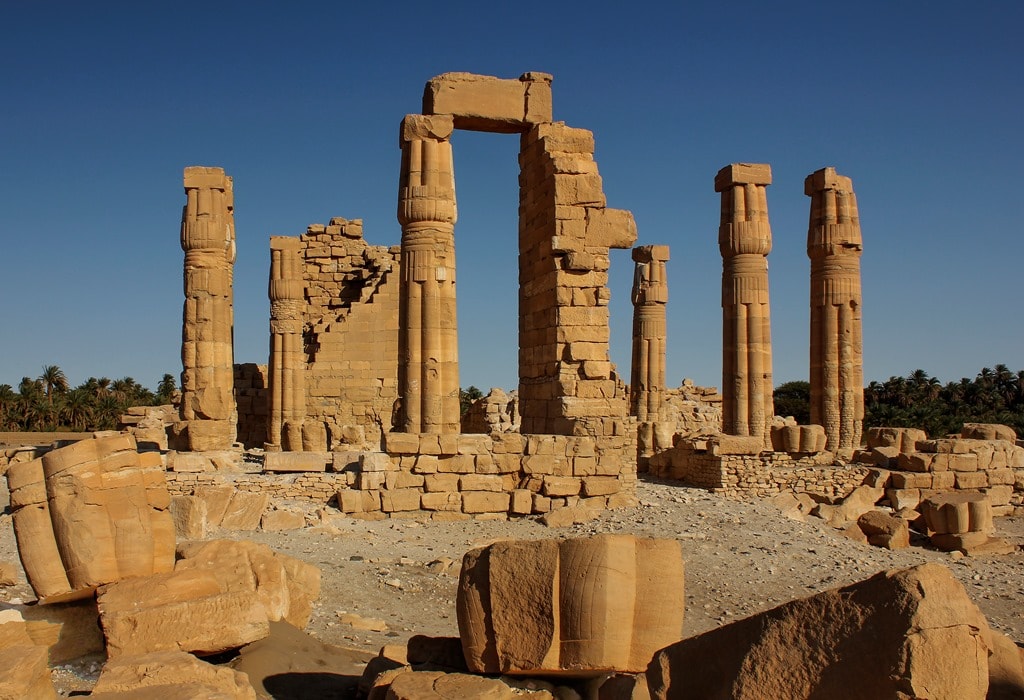
The temple of Amun at Soleb in Nubia (modern Sudan), built under Amenhotep III in the fourteenth century BC. Among the foreign lands listed on its columns is "the land of the Shasu, Yhw," the earliest known occurrence of the consonants of the divine name. Photo: Clemens Schmillen, CC BY-SA 4.0, via Wikimedia Commons.

See this page's graph and discover linked topics
In full
The popular claim compresses a scholarly family usually called the southern-origins or Midianite-Kenite hypothesis. In its classic form, Yahweh was first worshipped by pastoral groups of the southern deserts (Midian, the Kenites, Seir and Edom), and Israel adopted him through contact with those groups, a contact the Bible preserves in Moses' marriage into the household of Jethro, priest of Midian (Exodus 3:1; Exodus 18). Its evidence base is fourfold:
- Archaic poetry that pictures Yahweh marching from the south: Judges 5:4, Deuteronomy 33:2, Habakkuk 3:3 and 3:7, and Psalm 68:7-8.
- Egyptian topographical lists at Soleb (Amenhotep III, fourteenth century BC) and Amara West (Ramesses II, thirteenth century BC) naming a Shasu land or group Yhw alongside Shasu groups associated with Seir.
- The Kuntillet Ajrud blessings (about 800 BC) by "Yahweh of Teman," Teman being a southern region linked with Edom (see Kuntillet Ajrud).
- The Kenite and Midianite thread in the narrative itself: Jethro's sacrifice (Exodus 18:11-12) and the Kenites who travel with Judah (Judges 1:16; Judges 4:11).
Joseph Blenkinsopp's "The Midianite-Kenite Hypothesis Revisited and the Origins of Judah" (JSOT 33.2, 2008) is the standard modern survey. Karel van der Toorn (Family Religion in Babylonia, Syria and Israel, 1996) argued for a southern Yahweh who became Israel's state god under the early monarchy. Thomas Römer's The Invention of God (Harvard University Press, 2015) and Juan Manuel Tebes ("Yahweh's Desert Origins," Biblical Archaeology Review, Fall 2022) make the southern-desert case for general readers. Nissim Amzallag ("Yahweh, the Canaanite God of Metallurgy?", JSOT 33, 2009) ties the southern Yahweh to the copper-working communities of the Arabah. Justin Kelley ("Toward a New Synthesis of the God of Edom and Yahweh," Antiguo Oriente 7, 2009) proposes that Yahweh and the Edomite god Qos share a common origin in northwestern Arabia.
The cautions come from inside the same field. Daniel E. Fleming (Yahweh Before Israel, Cambridge University Press, 2020) reads the Egyptian Yhw as the name of a people within a wider Shasu land, and finds no evidence that this land was limited to the later Edom and Seir. Christian Frevel ("When and from Where did YHWH Emerge?", Entangled Religions 12.2, 2021) judges the extrabiblical evidence for a southern origin weak, holds that "Yahweh of Teman" cannot prove one, and calls a Midian, Paran or Seir origin a speculative hypothesis built on the tradition history of a few biblical texts.
This defeater grants the data and contests the step to "Edomite god." It holds that (1) the slogan equivocates between three distinct claims; (2) Edom's own epigraphy names a different national god, Qos, and the Bible distinguishes Edom's gods from Yahweh; (3) the southern geography is the Bible's own account of where Yahweh revealed himself, and a theophany's direction does not assign a deity a nationality; and (4) even the strongest form of the hypothesis is a claim about how a name travelled, which cannot decide whether the God named exists. The companion case against the Canaanite form of the same objection is at Yahweh Borrowed From the Canaanites Objection Defeater.
Cheatsheet
The 30-second reply:
Edom's god has a name, and it is Qos. Edomite kings in the Assyrian annals are called Qaus-malaku and Qaus-gabri, a letter from an Edomite fort blesses "by Qaus," and an Edomite shrine in the Negev has Qos inscriptions. The Bible calls Edom's idols "the gods of the children of Seir." The poems that have Yahweh marching from Seir describe a warrior coming from Sinai to rescue Israel, and they call him "the God of Israel" in the next line. The Bible already says Yahweh revealed himself in the south. That is the story the objection is quoting.
- Fast facts:
- Soleb (Amenhotep III, fourteenth century BC) and Amara West (Ramesses II, thirteenth century BC): "the land of the Shasu, Yhw," the earliest occurrence of the name's consonants.
- Kuntillet Ajrud (about 800 BC): blessings by "Yahweh of Teman and his asherah."
- Edom's national god is Qos (Qaus): kings Qaus-malaku (tribute to Tiglath-pileser III, about 734-732 BC) and Qaus-gabri (under Esarhaddon and Ashurbanipal, seventh century BC); a seal of Qaus-gabar from Umm el-Biyara; the Horvat Uza ostracon "I bless you by Qaus"; Qos inscriptions at the Edomite shrine of Horvat Qitmit (late seventh to early sixth century BC).
- Josephus, Antiquities 15.253: the Idumean Costobarus came from a family of priests of Koze, "whom the Idumeans had formerly served as a god."
- Judges 5:4-5 and Psalm 68:7-8 both end by naming him "the God of Israel."
- Counter-moves:
- Split the slogan into three claims and ask which one is being defended.
- Ask for one Edomite inscription naming Yahweh as Edom's god.
- Point to Qos, and to 2 Chronicles 25:14-15.
- Show that the southern march is the Bible's own Sinai story.
- Name the genetic fallacy if they move from origin to falsehood.
- Concessions (make them yourself):
- The name is attested in the south early, before "Israel" is named on any monument.
- Serious scholars hold some form of the southern-origins view.
- Moses married into a Midianite priestly household, and the text keeps that in view.
- Then collect: the Bible puts Yahweh's revelation in the south first, and it names a different set of gods as Edom's.
- Closing line: "Edom had a god, and he had a name. It was Qos. The Bible's God came from Sinai to save Israel, and the same poem that has him marching out of Edom calls him the God of Israel."
Grammar and hermeneutics
The objection rests on four poetic texts. Read for their grammar and genre, they describe a divine warrior setting out from the place of revelation to fight for Israel. None of them uses the language of national ownership.
-
The verbs are verbs of setting out. Judges 5:4 opens with two parallel temporal clauses built on infinitives construct with the preposition bə-: bəṣē'təkā ("when thou wentest forth," from yāṣā', "go out") and bəṣa'dəkā ("when thou marchedst," from ṣā'ad, "step, march"). They mark the starting point of a movement, with Seir and "the field of Edom" as the places he set out from. They describe direction of travel.
Jehovah, when thou wentest forth out of Seir, When thou marchedst out of the field of Edom, The earth trembled, the heavens also dropped, Yea, the clouds dropped water. The mountains quaked at the presence of Jehovah, Even yon Sinai at the presence of Jehovah, the God of Israel. (Judges 5:4-5, ASV)
-
The same verb pair appears where the setting is the wilderness march with Israel. Psalm 68:7-8 uses the identical pair, "when thou wentest forth before thy people, When thou didst march through the wilderness." The psalm locates the march "before thy people," which is to say leading Israel through the desert, and like Judges it closes with "the God of Israel." The formula belongs to the exodus-and-wilderness tradition, with Sinai as its fixed point.
-
Deuteronomy 33:2 starts at Sinai and uses sunrise verbs. "Jehovah came (bā') from Sinai, And rose (zāraḥ) from Seir unto them; He shined forth (hôpîa') from mount Paran" (Deuteronomy 33:2, ASV). Zāraḥ is the ordinary verb for the sun rising. The image is light breaking over the southern mountains toward Israel ("unto them"), and the verse goes on to the "fiery law" given to them. The sun rises in the east without belonging to the east.
-
Habakkuk 3 is a theophany hymn with a nation-trembling motif. "God ('ĕlôah) came from Teman, And the Holy One from mount Paran" (Habakkuk 3:3, ASV), and a few lines later "The curtains of the land of Midian did tremble" (Habakkuk 3:7, ASV). In the poem the southern peoples are among those who shake at his approach. A people trembling before a god is an odd way to describe that people's own god.
-
Genre settles the reading. All four texts belong to the archaic victory-hymn or theophany-march form, in which the divine warrior sets out from his mountain, nature convulses, and he fights for his people. The place of departure in this genre is where the god is encountered, which in Israel's tradition is Sinai/Horeb in the southern wilderness (Exodus 3:1). Reading the departure point as the god's ethnicity imports a claim the form does not make.
-
Biblical poetry can have Yahweh "come from Edom" as Edom's judge. "Who is this that cometh from Edom, with dyed garments from Bozrah?" (Isaiah 63:1, ASV). In Isaiah 63:1-6 he comes from Edom after treading it in judgment. Coming "from Edom" in Hebrew poetry therefore carries no fixed implication of belonging to Edom, and in this case means the reverse.
Argument structure
| # | Premise |
|---|---|
| P1 | "Yahweh was an Edomite god" blends three claims: that Yahweh is associated with the south (true), that some southern peoples knew him early (a live hypothesis), and that he was Edom's national god (unsupported); the objection needs the third and argues from the first. |
| P2 | Edom's own inscriptions and royal names identify its national god as Qos, and the Bible treats the gods of Seir as other gods. |
| P3 | The southern association is the Bible's own account of where Yahweh revealed himself, and the geography of a theophany does not assign a deity an ethnicity. |
| P4 | Even the strongest southern-origins reconstruction concerns how a name travelled, and moving from that history to "therefore false" is a genetic fallacy. |
| C | Therefore the claim that Yahweh was an Edomite god fails: the southern evidence corroborates the biblical account, Edom's god was Qos, and no account of a name's travels can show that the God named does not exist. |
Form
Defensive. The defeater concedes the southern data and challenges three inferences: from "associated with Seir" to "Edom's national god" (P1, P2), from "comes from the south" to "belongs to the south" (P3), and from "has a history" to "is false" (P4). Soundness is contemporary: it rests on current epigraphy and on standard points of logic, and it does not require rejecting every form of the southern-origins hypothesis.
P1, The slogan blends three different claims
Affirmative case (second-order arguments)
- Claim A, association with the south, is true and biblical. Sinai/Horeb, Seir, Paran and Teman are all southern, and the Bible names them as the places Yahweh appeared from. No defender of the Bible needs to deny this.
- Claim B, early knowledge of Yahweh among southern peoples, is a serious hypothesis. It is argued by Blenkinsopp, van der Toorn, Römer and Tebes, and it is consistent with the narrative, which has Jethro, priest of Midian, confess and sacrifice to Yahweh (Exodus 18:11-12) and the Kenites travel with Judah (Judges 1:16).
- Claim C, national god of Edom, is a separate and much stronger claim. It needs evidence that Edom as a people or kingdom took Yahweh as its god. Evidence for A and B does not supply it: the Shasu lists name a Shasu group or land, Kuntillet Ajrud is a Judahite and Israelite site with Hebrew-script inscriptions, and the poems are Israelite songs.
- Fleming narrows Claim B further. Daniel Fleming reads the Egyptian Yhw as a people within a broader Shasu land and finds no evidence that the land was confined to later Edom and Seir. Even a scholar who holds that the name is older than Israel declines to make it Edomite.
Anticipated objections
- "Seir is Edom. The Bible says Yahweh came from Seir. So Yahweh came from Edom."
- "You are hair-splitting. If Yahweh was worshipped in the south before Israel, he was someone else's god first."
- "Teman is an Edomite region, and Kuntillet Ajrud says 'Yahweh of Teman.'"
Rebuttals
- "Came from" is not "belonged to." Genesis 36:8 does identify Seir with Esau ("Esau dwelt in mount Seir: Esau is Edom"), so the geography is granted. The conclusion needs a further premise, that a god who comes from a region belongs to its inhabitants, and the Bible itself has Yahweh "come from Edom" as Edom's judge (Isaiah 63:1). See P3.
- Priority of attestation is not ownership. A name attested earlier among Shasu nomads tells us where the name was known, and the Bible already says it was known before Israel, including among non-Israelites such as Jethro. "Someone else's god" also requires showing that this someone worshipped him as their national god, which is Claim C again.
- "Yahweh of Teman" is a regional title used by Hebrew writers. The same site has "Yahweh of Samaria," and no one infers that Yahweh was a Samarian god borrowed by Israel. The epithet names the region where he was invoked or associated, in Hebrew script, at a site on the route from Judah to the Gulf of Aqaba. Christian Frevel, who is no defender of biblical tradition, concludes that "YHWH of Teman" at Kuntillet Ajrud "cannot prove the origin of this deity in the South" (Entangled Religions 12.2, 2021, abstract).
Live-cite kit
- Scripture: Genesis 36:8 (Seir is Edom); Exodus 3:1 (Horeb, while keeping Jethro's flock); Exodus 18:11 (Jethro: "Now I know").
- Scholarly: Blenkinsopp, JSOT 33.2 (2008), the hypothesis at full strength; Fleming, Yahweh Before Israel (2020), a people named Yhw, not confined to Edom; Frevel, Entangled Religions 12.2 (2021), Teman cannot prove a southern origin.
- Aphorism: "Southern, yes. Edomite, show me."
Tactical notes
- Lead with the three-claim split. Most people who use the slogan have not noticed that they are making Claim C.
- Make the concessions on A and B yourself. Doing so costs nothing and makes the refusal of C credible.
- Ask the force-commit question: "Which of the three are you defending?"
P2, Edom's national god was Qos, and the Bible distinguishes Edom's gods from Yahweh
Affirmative case (second-order arguments)
-
Royal names. Two Edomite kings in the Neo-Assyrian records carry the divine element Qaus: Qaus-malaku ("Qaus is king"), who paid tribute to Tiglath-pileser III, and Qaus-gabri ("Qaus is mighty"), named under Esarhaddon and Ashurbanipal. A seal from Umm el-Biyara near Petra reads "Qaus-gabar, king of Edom." Justin Kelley, who himself argues for a shared origin of Qos and Yahweh, quotes J. Andrew Dearman's judgment that these are "the earliest firm references to Qos" and treats them as the primary evidence for Qos as the Edomite national deity.
-
Letters and shrines. An ostracon from Horvat Uza, an administrative letter in Edomite script, carries the blessing hbrktk lqws, "I bless you by Qaus." The Edomite shrine at Horvat Qitmit in the Negev (late seventh to early sixth century BC), excavated by Itzhaq Beit-Arieh, yielded inscriptions bearing the name Qos together with its cult figures.
-
Persistence. Persian-era ostraca from Idumea carry Qos names, Nabatean inscriptions honour Qos, and Josephus reports that Costobarus, an Idumean, came from a family of priests of Koze, "whom the Idumeans had formerly served as a god" (Antiquities 15.253). For a thousand years the record of Edom's religion keeps returning to one name, and it is Qos.
-
The Bible names Edom's gods as other gods. After defeating Edom, King Amaziah brought home "the gods of the children of Seir," set them up and worshipped them, and Yahweh's prophet rebuked him:
Now it came to pass, after that Amaziah was come from the slaughter of the Edomites, that he brought the gods of the children of Seir, and set them up to be his gods, and bowed down himself before them, and burned incense unto them. Wherefore the anger of Jehovah was kindled against Amaziah, and he sent unto him a prophet, who said unto him, Why hast thou sought after the gods of the people, which have not delivered their own people out of thy hand? (2 Chronicles 25:14-15, ASV)
If Edom's god were Yahweh, this rebuke would make no sense. The Chronicler treats Edom's gods as rivals to Yahweh.
Anticipated objections
- "The Bible never mentions Qos. That silence is suspicious, as if the writers were hiding that Edom's god was really Yahweh." This is the puzzle Kelley's 2009 article sets out to solve.
- "Qos is attested only from the eighth century. Before that Edom could have worshipped Yahweh and switched later."
- "Qos and Yahweh may be the same god under two names, or two branches of one desert god."
Rebuttals
- The silence is partial, and the Bible is not silent about Edom's gods. Edom's gods appear as a group in 2 Chronicles 25:14-15. Biblical writers often refer to foreign gods generically. A temple-servant family called Barkos also appears among the returning exiles in Ezra 2:53 and Nehemiah 7:55, a name many scholars read as Aramaic bar Qos, "son of Qos," which would mean the name was known. An argument from silence also has to say what the writers would have gained by suppressing Qos while freely naming Chemosh, Milcom, Molech and Baal.
- "Could have" is the whole argument. No Edomite inscription names Yahweh as Edom's god at any period. The Late Bronze Shasu-Yhw attestation is a name in an Egyptian list, and Fleming's reading makes it a people. Some scholars (Bustenay Oded, followed cautiously by others) have even suggested that Egyptian lists may preserve early Qos names among Shasu groups, which would push Qos earlier as well. A switch from Yahweh to Qos is a hypothesis without a document.
- Common origin is a different claim. Kelley's proposal that Qos and Yahweh share a northwestern Arabian origin, if correct, would make Yahweh the cousin of Edom's god. It would not make him Edom's god. Kelley himself treats Qos as Edom's national deity. Identity of the two would need a text that equates them, and none exists.
Live-cite kit
- Scripture: 2 Chronicles 25:14-15 (the gods of the children of Seir); Ezra 2:53 (Barkos).
- Epigraphy: Qaus-malaku (Tiglath-pileser III); Qaus-gabri (Esarhaddon, Ashurbanipal); Umm el-Biyara seal; Horvat Uza ostracon ("I bless you by Qaus"); Horvat Qitmit inscriptions; Josephus, Antiquities 15.253 (Koze).
- Scholarly: Justin Kelley, "Toward a New Synthesis of the God of Edom and Yahweh," Antiguo Oriente 7 (2009), pp. 255-280; John R. Bartlett, Edom and the Edomites (1989); Itzhaq Beit-Arieh (ed.), Horvat Qitmit: An Edomite Shrine in the Biblical Negev (1995).
- Aphorism: "Edom's kings were named for their god, and his name was Qos."
Tactical notes
- Ask for the inscription: "Name one Edomite text that calls Yahweh the god of Edom." Then supply Qos.
- Do not overclaim Barkos. Present it as a widely held reading of the name, and make the point that the Chronicles passage is the decisive text.
- If the opponent retreats to "common origin," note that this abandons the slogan.
P3, The southern association is the Bible's own account, and a theophany's direction is not a deity's nationality
Affirmative case (second-order arguments)
- The Bible places the revelation in the south before any critic does. Moses flees to Midian and lives with its priest (Exodus 2:15-16); he is keeping Jethro's flock when he comes "to the mountain of God, unto Horeb" (Exodus 3:1, ASV); the law is given at Sinai. When the poems have Yahweh setting out from Sinai, Seir and Paran, they are remembering the same journey.
- The name is disclosed as the God of the patriarchs. At the bush Moses has to ask the name, and the answer ties it to a family line rather than to the land around him: "Jehovah, the God of your fathers, the God of Abraham, the God of Isaac, and the God of Jacob" (Exodus 3:15, ASV).
- Jethro is the learner. "Now I know that Jehovah is greater than all gods" (Exodus 18:11, ASV). The chapter runs from Jethro hearing, to Moses telling, to Jethro confessing. The full treatment of the Midianite reading, including Midian's descent from Abraham (Genesis 25:1-2), is at Yahweh Borrowed From the Canaanites Objection Defeater.
- Yahweh gives lands to Edom, Moab and Ammon alike. "I have given mount Seir unto Esau for a possession" (Deuteronomy 2:5, ASV), with the same formula for Moab (2:9) and Ammon (2:19). Amos makes the principle general: Yahweh brought Israel from Egypt, the Philistines from Caphtor and the Syrians from Kir (Amos 9:7). On the Bible's terms he is sovereign over Edom's territory as he is over every nation's, which is why he can give Seir to Esau.
Anticipated objections
- "The poems are older than the Exodus narrative. The narrative is a later attempt to explain away an Edomite god."
- "Sinai itself may have been in Edom or Midian, so the Bible's own story concedes the point."
Rebuttals
- Then the oldest texts are the ones that say "the God of Israel." If Judges 5 is among the oldest poems in the Hebrew Bible, as critical scholars commonly hold, the oldest witness to the southern march also names him "Jehovah, the God of Israel" (Judges 5:5, ASV). The early date strengthens the identification with Israel.
- Location of a mountain is not ownership of a god. Grant every proposed location for Sinai, in the Sinai peninsula, in Midian east of the Gulf of Aqaba (see Jabal al-Lawz) or near Seir. The text still has a God revealing himself there to Israel's ancestor-line and sending Moses back to Egypt. A meeting place does not make a god the property of whoever lives next to it, just as Paul's encounter on the Damascus road did not make Christ a Syrian deity.
Live-cite kit
- Scripture: Exodus 3:1; Exodus 3:13-15; Exodus 18:11; Deuteronomy 2:5, 9, 19; Amos 9:7; Isaiah 63:1.
- Scholarly: Frank Moore Cross, Canaanite Myth and Hebrew Epic (1973), on the archaic poetry and the divine-warrior march.
- Aphorism: "The sun rises from the east and is not an easterner."
Tactical notes
- Turn the evidence: "You are quoting the Bible's own Sinai story back to me."
- Read Judges 5:4-5 aloud to the end of verse 5. The phrase "the God of Israel" usually ends the exchange.
P4, The history of a name cannot decide whether the God named exists
Affirmative case (second-order arguments)
- Origin and truth are different questions. Even granting the strongest southern-origins model, the conclusion "therefore Yahweh is not God" does not follow. Inferring falsehood from how a belief arose is the Genetic Fallacy.
- The Bible expects knowledge of God outside Israel. Melchizedek (Genesis 14:18-20), Jethro and Job are non-Israelites who know the true God. If early knowledge of Yahweh among southern peoples were proven, it would match the biblical picture of a God known before Israel existed and revealing himself fully to Israel.
- Edom's history with Israel fits brother-nation rivalry and does not fit a shared national cult. Edom is called Israel's brother (Deuteronomy 23:7; Numbers 20:14), yet refuses Israel passage (Numbers 20:18-21) and is condemned for pursuing "his brother with the sword" (Amos 1:11, ASV) and for cheering the fall of Jerusalem (Psalm 137:7). The whole book of Obadiah is an oracle "concerning Edom" in Yahweh's name (Obadiah 1). The texts consistently picture Edom as a kindred nation with other gods and a hostile policy.
Anticipated objections
- "Israel turned an Edomite god against Edom. That is what the oracles are."
- "If Yahweh had a regional beginning, he is a human invention."
Rebuttals
- That is a story without a source. It requires an Edomite Yahweh cult, which the evidence does not show, then a takeover, then a suppression, each stage inferred from the one before. Against it stands the positive evidence that Edom's god was Qos.
- A regional beginning of human knowledge is not a regional beginning of God. Every known fact entered history somewhere. The location of first knowledge says nothing about whether the thing known is real.
Live-cite kit
- Scripture: Genesis 14:18-20; Deuteronomy 23:7; Numbers 20:14-21; Amos 1:11; Psalm 137:7; Obadiah 1-4; Malachi 1:2-3.
- Logic: Genetic Fallacy.
- Aphorism: "Where you first heard a name does not tell you whether its bearer exists."
Tactical notes
- Use P4 last. Leading with it sounds evasive. After P1 to P3, it closes the last exit.
Conclusion
The Edomite-god slogan fails. Its evidence shows that Yahweh was associated with the southern wilderness, which the Bible says first, and possibly that some southern peoples knew his name early, which the Bible allows. It does not show that Yahweh was Edom's god. Edom's kings, letters and shrines name their god Qos, and the Bible treats the gods of Seir as other gods. The poems the objection quotes describe a divine warrior setting out from Sinai to fight for Israel and name him the God of Israel. And no history of a name, however it is reconstructed, can settle whether the One named exists.
Master objections to the argument as a whole
- "You rely on scholars who doubt the Bible when they help you." The defeater cites Frevel and Fleming because they are mainstream critical scholars. When they decline to call Yahweh Edomite, that is not a confessional reading.
- "The evidence is thin on both sides, so this is a draw." A draw is enough to defeat an objection presented as an established fact. Beyond that, the positive evidence on Edom's religion points to Qos.
Tactical opening / closing
Opening line: "Before we decide Yahweh was Edom's god, tell me the name of Edom's god in Edom's own inscriptions."
Closing landing strip: "The south is where the Bible says God met Moses, and the poems you quoted say so too. Edom's kings were named for Qos. The God who marched from Seir is called, in the very next line, the God of Israel."
Connection to Scripture
- Judges 5:4-5, the march from Seir, ending "the God of Israel"
- Deuteronomy 33:2, Yahweh came from Sinai and rose from Seir unto them
- Habakkuk 3:3, 7, God from Teman; the tents of Midian tremble
- Psalm 68:7-8, the wilderness march before his people
- Exodus 3:1, 3:13-15, Horeb and the name of the God of the fathers
- Exodus 18:11, Jethro's confession
- 2 Chronicles 25:14-15, the gods of the children of Seir
- Obadiah, the oracle against Edom
Patristic / scholarly note
Proponents of a southern origin: Joseph Blenkinsopp (JSOT 33.2, 2008); Karel van der Toorn (Family Religion in Babylonia, Syria and Israel, 1996); Thomas Römer (The Invention of God, 2015); Juan Manuel Tebes (Biblical Archaeology Review, Fall 2022); Nissim Amzallag (JSOT 33, 2009); Justin Kelley (Antiguo Oriente 7, 2009).
Critical cautions: Daniel E. Fleming, Yahweh Before Israel: Glimpses of History in a Divine Name (Cambridge University Press, 2020); Christian Frevel, "When and from Where did YHWH Emerge? Some Reflections on Early Yahwism in Israel and Judah," Entangled Religions 12.2 (2021).
On Edom's religion: John R. Bartlett, Edom and the Edomites (1989); Itzhaq Beit-Arieh on Horvat Qitmit and Horvat Uza.
Scholarship
Published academic works this page draws on, each matched to a publisher, index or library catalog record.
- Nissim Amzallag, "Yahweh, the Canaanite God of Metallurgy?" Journal for the Study of the Old Testament 33 (2009). doi:10.1177/0309089209105686
- Joseph Blenkinsopp, "The Midianite-Kenite Hypothesis Revisited and the Origins of Judah," Journal for the Study of the Old Testament 33 (2008). doi:10.1177/0309089208099253
- Frank Moore Cross, Canaanite Myth and Hebrew Epic (Harvard University Press, 1973). doi:10.4159/9780674030084
- Daniel E. Fleming, Yahweh before Israel: Glimpses of History in a Divine Name (Cambridge University Press, 2020). doi:10.1017/9781108875479 open access
- Christian Frevel, "When and from Where did YHWH Emerge? Some Reflections on Early Yahwism in Israel and Judah," Entangled Religions 12 (2021). doi:10.46586/er.12.2021.8776 open access
- Thomas Römer, The Invention of God (Harvard University Press, 2015). doi:10.4159/9780674915732
- Karel van der Toorn, Family Religion in Babylonia, Syria and Israel: Continuity and Change in the Forms of Religious Life (Brill, 1996). doi:10.1163/9789004668867
See also
- Yahweh Borrowed From the Canaanites Objection Defeater, the Canaanite form of the same objection and the full Midianite-Jethro treatment
- Kuntillet Ajrud, the "Yahweh of Teman" inscriptions
- Yahweh is a Son of Elyon Defeater, the companion defeater on Deuteronomy 32 and El Elyon
- H3068 - YHWH, the divine name itself
- Sacred Names Movement, modern debates over the pronunciation of the name
- OT Polytheism Objection Defeater, the wider Old Testament polytheism objection
- Israel Emerged From Within Canaan Objection Defeater, the settlement-archaeology companion
- Mesha Stele, a neighbouring kingdom's ninth-century witness to Yahweh as Israel's God
- Genetic Fallacy, the logical error at the end of the objection
- Moses, the prophet who met God at Horeb while living in Midian
- Arguments, master index
Common questions this page answers
Q: Was Yahweh originally an Edomite god?
The evidence does not show it. Yahweh is linked in the Bible's oldest poems with Seir, Edom and Teman, and some scholars think southern peoples knew him before Israel did. But Edom's own records name its national god Qos: Edomite kings were called Qaus-malaku and Qaus-gabri, and Edomite letters and shrines invoke Qos. The Bible itself calls Edom's idols "the gods of the children of Seir."
Q: Why does the Bible say Yahweh came from Seir and Edom?
Because the Bible places God's revelation to Moses in the southern wilderness, at Horeb or Sinai. Poems such as Judges 5:4-5 and Deuteronomy 33:2 describe God setting out from those southern mountains to fight for Israel, and Judges 5:5 calls him "the God of Israel" in the same breath. The verbs describe a journey from a starting point, toward the battle where Israel stood.
Q: Who was the god of the Edomites?
Qos, also spelled Qaus. His name appears in the names of Edomite kings in Assyrian records, on a seal of an Edomite king from Umm el-Biyara, in a letter blessing "by Qaus" from Horvat Uza, and in inscriptions at the Edomite shrine of Horvat Qitmit in the Negev. Josephus later mentions an Idumean family of priests of Koze, the same god.
Q: What is the Midianite-Kenite hypothesis?
It is the theory that Yahweh was first worshipped by southern desert groups such as the Midianites and Kenites, and that Israel came to worship him through contact with them, as in Moses' marriage into the family of Jethro, priest of Midian. Joseph Blenkinsopp, Thomas Römer and others defend versions of it, while scholars such as Christian Frevel call the southern origin speculative. Even in its strongest form it concerns how a name travelled, and it does not show that Yahweh was Edom's national god.
Q: Does the "Yahweh of Teman" inscription prove Yahweh came from Edom?
No. The Kuntillet Ajrud blessings use "Yahweh of Teman" alongside "Yahweh of Samaria," regional titles written in Hebrew script by Israelites and Judahites. Teman associates Yahweh with the south, which the Bible also does, and even the critical scholar Christian Frevel concludes that the inscription cannot prove a southern origin.
Q: If people knew Yahweh's name before Israel, does that mean Israel borrowed him?
The Bible itself says people called on the name of Yahweh long before Israel, and it shows non-Israelites such as Melchizedek and Jethro knowing the true God. Early knowledge of the name outside Israel fits that picture. Where people first learned a name does not tell you whether the God named is real; arguing that it does is the genetic fallacy.