Argument
King David Never Existed Objection Defeater
king david never existed, did king david exist, was king david real, is there evidence for king david, king david is a myth, david was a legend like king arthur, no archaeological evidence for david, house of david inscription, king david archaeology, was david a real kingIntro
The objection goes like this: "There is no evidence King David ever lived. No palace, no tomb, no royal records. He is a national legend, like King Arthur, invented by later writers to give Judah a glorious past."
For a while in the early 1990s, some serious scholars argued exactly that. Then, in 1993, workers at Tel Dan in northern Israel turned over a stone in an ancient gate and found Aramaic writing on it. It was a piece of a victory monument set up by an enemy king of Damascus, usually identified as Hazael. In it he boasts of killing the king of Israel and the king of the "House of David." That is how a foreign enemy, writing about 150 years after David's time, named the royal family of Judah.
Royal houses in that world were named after the man who founded them. So the stone tells us there was a founder named David whose family still held the throne in Jerusalem generations later. That is why most historians, including many who doubt much of the Bible's account, now accept that David was a real person.
Honesty matters here too. Archaeology has not shown how large David's kingdom was, and it has not confirmed the fight with Goliath or most of the details in the books of Samuel and Kings. The real debate today is not whether David existed but how big and how powerful his kingdom was.
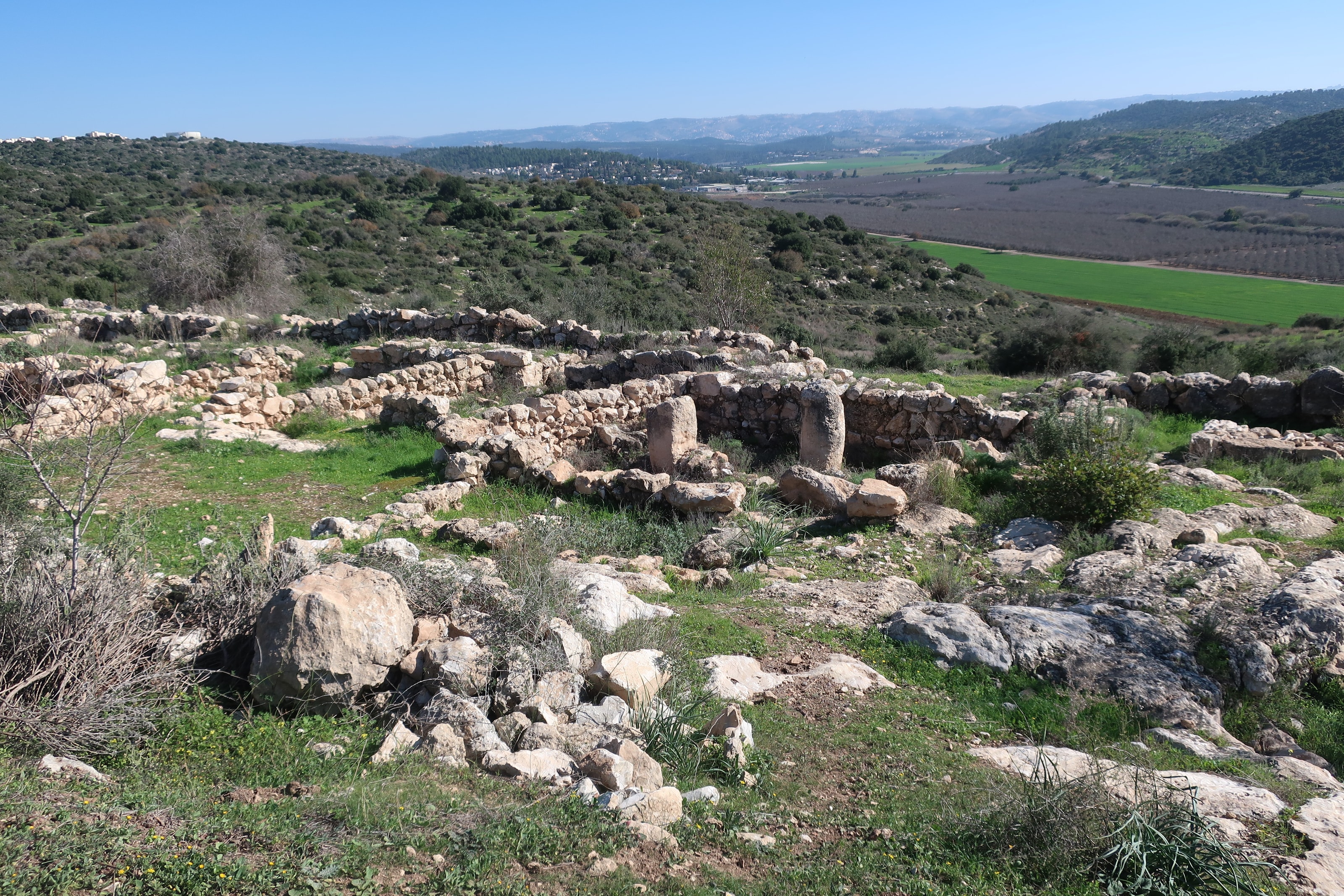
Khirbet Qeiyafa, a fortified hilltop town in the Judean lowlands dated by radiocarbon to around the late 11th and early 10th century BC, the era the Bible assigns to Saul and David. Photo by Davidbena, 2024, CC0, via Wikimedia Commons.
See this page's graph and discover linked topics
In full
Defeater for the claim that David son of Jesse is a literary fiction with no historical individual behind him. The objection comes in three forms. (A) The popular form: "No evidence outside the Bible, so David is a myth." (B) The minimalist form of the 1990s Copenhagen and Sheffield schools: the narratives of Samuel and Kings were composed in the Persian or Hellenistic period, and "ancient Israel" as the Bible draws it is a literary construct (Philip Davies, In Search of 'Ancient Israel', 1992; Thomas L. Thompson, The Mythic Past, 1999; Niels Peter Lemche, The Israelites in History and Tradition, 1998). (C) The low-chronology form, which is not a denial at all: Israel Finkelstein and Neil Asher Silberman (David and Solomon, 2006) hold that David was real but was a minor chieftain of a thinly settled Judah, later magnified by Judahite writers.
The defeat structure has four steps. (1) The Tel Dan witness: an Old Aramaic victory stele of the second half of the 9th century BC, excavated under controlled conditions in 1993 and 1994, names a "king of the House of David" (BYTDWD) beside a "king of Israel." (2) The dynasty-founder inference: in Iron Age Levantine and Assyrian usage, "House of X" names a royal line after its founder, so the phrase entails an eponymous founder named David within living tradition of the stele's author. (3) Graded corroboration: the Mesha Stele line 31 reading (probable but disputed), Khirbet Qeiyafa (a real 10th-century fortified site whose political identity is disputed), the Jerusalem structures (real, dating disputed), and Kenneth Kitchen's proposed "heights of David" in the Shoshenq I list (speculative). (4) Reciprocal concessions: grant that the size of the kingdom and the details of the narratives are not settled by archaeology, and collect the larger concession that David's existence is.
Graded conclusions. The page claims exactly this much, and no more:
| Claim | Grade | Basis |
|---|---|---|
| A royal dynasty named for David ruled Judah in the 9th century BC | Strong | Tel Dan Stele, line 9 |
| David was a historical individual, the founder of that dynasty | Strong inference | "House of X" naming convention; the founder sits roughly 150 years before the stele |
| A second 9th-century reference in the Mesha Stele | Probable, disputed | Line 31, read "House of David" by Lemaire and Langlois, "Balak" by Finkelstein, Na'aman and Römer |
| A sizeable united kingdom ruling from Jerusalem | Debated | Low chronology vs modified conventional chronology |
| The Goliath combat and the detailed narratives of Samuel and Kings | Not established archaeologically | No artifact speaks to them directly |
Where this sits in the codex. It applies the method of Bible Stories Are All Fiction Objection Defeater to one figure, alongside Moses Did Not Exist Objection Defeater and Patriarchal Historicity Objection Defeater. The artifacts have their own pages: Tel Dan Stele, Mesha Stele, Goliath Inscription at Tel es-Safi, Ophel Inscription and Solomon's Gates at Hazor, Megiddo and Gezer. The person is at David.
Cheatsheet
The 30-second reply (read aloud). In 1993, archaeologists at Tel Dan found part of a victory stone set up by an Aramean king, usually identified as Hazael of Damascus, in the 9th century BC. He boasts that he killed the king of Israel and the king of the "House of David." Kings in that world were named by their founder's house: Assyria called Israel the "House of Omri" because Omri founded its dynasty. So an enemy of Judah, writing about 150 years after David, calls Judah's royal line by David's name. You can argue about how big David's kingdom was. Scholars do. But the man himself is on an enemy's monument.
The 5 fast facts:
- Found 1993 and 1994. Three fragments of the Tel Dan Stele were excavated at Tel Dan by Avraham Biran's team, published by Biran and Joseph Naveh (Israel Exploration Journal, 1993 and 1995), and are now in the Israel Museum, Jerusalem.
- "King of the House of David." Line 9 reads BYTDWD, "House of David," in a parallel with "king of Israel" in line 8.
- An enemy witness. The author is an Aramean king (Hazael on the usual identification) writing in Aramaic, boasting of victory over Judah, not praising it.
- The convention. Assyrian scribes called the kingdom of Israel Bit-Humri, "House of Omri," after its founder, and Aramean states were named in the same way (Bit-Agusi after Gusi, Bit-Adini after Adini). The Bible uses the same phrase for Judah's dynasty (1 Kings 12:19).
- Even the low chronology accepts David. Finkelstein and Silberman, the best-known archaeological skeptics of the biblical account, write about David as a real ruler of Judah; they dispute his kingdom's size, not his existence.
The 3 strongest counter-moves:
- "Who is the House named after, then?" If not a founder called David, the objector owes a better reading of BYTDWD that also explains the parallel with "king of Israel." Three decades of alternatives (a place name, a divine epithet) have not persuaded the field.
- "Then you accept that the man existed?" Many objectors will retreat to "he was only a chieftain." That is the low chronology, which concedes the point at issue.
- "Is silence evidence?" Ask what 10th-century inscriptions survive from any comparable small Levantine kingdom. Very few. Jerusalem's 10th-century levels lie under a living city, on a steep, eroded and repeatedly rebuilt hill.
Reciprocal concessions (grant the small point, then collect a bigger one):
- Grant: no inscription from David's own lifetime names him. Now collect: the same is true of most kings of that century in the region, and the Tel Dan reference is closer to its subject than the earliest surviving sources for many ancient rulers whose existence no one doubts.
- Grant: the size of David's kingdom is genuinely debated, and the low chronology is a serious scholarly position. Now collect: the debate is between "real king of a small state" and "real king of a larger state." "Never existed" is no longer on the table in that debate.
- Grant: archaeology has not confirmed the fight with Goliath, and the inscription from Gath does not name him. Now collect: the objection was about whether David existed, and on that the enemy's stone has spoken.
The closing line. David's enemies remembered his name. Hazael's stone was meant to celebrate Judah's defeat, and it ended up naming Judah's founder.
Argument structure
| # | Premise |
|---|---|
| P1 | The Tel Dan Stele, an authentic Old Aramaic royal inscription of the second half of the 9th century BC, refers to a "king of the House of David" (BYTDWD) ruling Judah. |
| P2 | In Iron Age Levantine and Assyrian usage, "House of X" names a dynasty after its founder, and such founders are historical persons; so a founder named David stood at the head of Judah's royal line, roughly 150 years before the stele. |
| P3 | Further evidence is consistent with a 10th-century Judahite polity: the probable Mesha Stele line 31 reading, fortified Khirbet Qeiyafa, and the Jerusalem structures. It is graded honestly, and none of it is needed for P1 and P2. |
| P4 | The absence of 10th-century inscriptions naming David is what the regional record predicts and does not count against his existence. |
| C | Therefore the claim that King David never existed is false. David is best explained as a historical founder of Judah's royal dynasty. The size of his kingdom and the details of the biblical narratives remain open questions, judged on their own evidence. |
Form
Defensive (a defeater), with an abductive core. P1 is an empirical datum. P2 is an inference to the best explanation of that datum, resting on the observed naming convention. P3 is cumulative corroboration, deliberately graded so that the argument does not lean on contested items. P4 neutralizes the argument from silence. Soundness is contemporary: P1 is the consensus reading, P2 is widely granted even by sceptical historians, and P3 is marked item by item.
P1, The Tel Dan Stele names the House of David
Affirmative case
- Controlled excavation. Fragment A was found in July 1993, built into a wall near the outer gate at Tel Dan; fragments B1 and B2 followed in 1994. All three came from secondary use in Iron Age construction, recorded by Avraham Biran's expedition (Biran and Naveh, IEJ 43, 1993; IEJ 45, 1995).
- Securely ancient. The script and language are Old Aramaic of the 9th century BC; the narrative fits the wars of Aram-Damascus against Israel and Judah in the generation of 2 Kings 8:28-29 and 2 Kings 9.
- The reading. Line 8 mentions a "king of Israel," and line 9 a "king of the House of David," most often restored as Joram of Israel and Ahaziah of Judah, the two kings who die in 2 Kings 9. The parallel shows BYTDWD is a political name for Judah's ruling house, set beside the political name "Israel."
- A hostile author. The stele's author celebrates harm to Judah. He has no motive to invent a Judahite dynastic founder.
Anticipated objections
- "BYTDWD is one word with no word divider, so it is a place name, like Bethlehem, not 'House of David.'" (Philip Davies, "'House of David' Built on Sand," Biblical Archaeology Review, 1994.)
- "DWD could be a title or a divine epithet ('beloved'), not a personal name." (Alternatives floated by minimalist writers in the mid-1990s.)
- "The fragments could be forged."
- "Even if it says 'House of David,' it shows only that a family called that existed, not a state of Judah." (Davies's later fallback, 2010.)
Rebuttals
- The word-divider argument fails on Aramaic and Hebrew practice. Compound names and fixed construct phrases are often written without a divider; Anson Rainey answered Davies in the same magazine in 1994 on precisely this point. More decisively, a place name cannot do the work the line needs: the parallel in line 8 is a king of Israel, a polity, so line 9 needs a king of a polity too.
- No better reading has emerged. A divine-epithet reading leaves "king of the House of [a god]" as a description of the ruler of Judah, which has no parallel. The standard reading remains the consensus of epigraphers, among them Biran, Naveh, André Lemaire, Anson Rainey and Kenneth Kitchen.
- Forgery does not fit the find. The fragments came from controlled, recorded excavation in ancient construction fill, not from the antiquities market. Suggestions of forgery have never gained traction among epigraphers.
- Davies's fallback concedes the point at issue. The claim on this page is that David existed. A "family named for David" holding the throne of Judah in the 9th century is that concession. Whether 10th-century Judah was a "state" is the separate debate of P3.
Live-cite kit
- Scripture: 2 Kings 9:24 and 2 Kings 9:27, the deaths of Joram and Ahaziah; 1 Kings 12:19, "So Israel rebelled against the house of David unto this day" (1 Kings 12:19, ASV).
- Scholarly: Biran and Naveh, IEJ 43 (1993) and 45 (1995); Lemaire, "The Tel Dan Stela as a Piece of Royal Historiography," JSOT 81 (1998).
- Aphorism: "Judah's enemy wrote David's name in stone."
Tactical notes
- Lead with the stele, then the naming convention. Do not lead with Qeiyafa or the Jerusalem palace; they are contested and invite a detour.
- Ask the objector to supply an alternative reading of BYTDWD that also fits line 8. Most cannot.
- What NOT to defend here: that the stele confirms the details of Jehu's revolt. The stele credits the killings to its own author, while 2 Kings 9 credits Jehu. Royal boasts routinely claim credit for allied or coincident action, but the point is a side issue; see Tel Dan Stele.
P2, "House of David" means a founder named David
Affirmative case
- The naming convention. Assyrian records call the kingdom of Israel Bit-Humri, "House of Omri," long after Omri's own dynasty had fallen; Jehu is styled a "son of Omri" on the Black Obelisk. Aramean states were named the same way after their founders, for example Bit-Agusi (Arpad) and Bit-Adini.
- Founders are persons. In every case where the founder of such a "house" can be checked, he is a historical ruler. The convention points to a person, not to a legend.
- The time gap is short. On the Bible's chronology David reigned around 1010-970 BC; the stele dates to the second half of the 9th century, roughly 150 years later. That is about the distance from the American founding to the early 20th century. A dynasty's founder is well within living institutional memory at that range.
- The Bible uses the same idiom. "The house of David" is how the biblical text names Judah's dynasty, for example "And it was told the house of David, saying, Syria is confederate with Ephraim" (Isaiah 7:2, ASV), and the dynastic promise of 2 Samuel 7:16: "And thy house and thy kingdom shall be made sure for ever before thee: thy throne shall be established for ever" (2 Samuel 7:16, ASV).
Anticipated objections
- "Dynasties invent glorious founders. Rome had Romulus."
- "A name a century and a half later proves only that people believed in David, like the British believing in Arthur."
Rebuttals
- Romulus is the wrong comparison. Rome's founder legend was attached to a city, set centuries earlier in a mythic age, and never served as the working name of a reigning royal house in foreign diplomatic and military usage. "House of David" is a political label used by a neighbouring enemy state for a ruling dynasty, which is exactly how Assyria used "House of Omri" for a real founder.
- Arthur fails on the evidence pattern. No contemporary or near-contemporary foreign record names a "House of Arthur" ruling a kingdom. For David we have one, written by an enemy within about six generations. The two cases are not parallel; the analogy is doing the work the evidence cannot.
Live-cite kit
- Scripture: 2 Samuel 7:12-16, the dynastic promise of a "house."
- Scholarly: Lawrence Mykytiuk, Identifying Biblical Persons in Northwest Semitic Inscriptions of 1200-539 B.C.E. (2004), which counts David among identified persons on this basis; see Biblical Figures Confirmed by Archaeology.
- Aphorism: "You do not name a royal house after someone who never lived."
Tactical notes
- Use the Omri parallel; it is the cleanest. Omri is accepted by everyone, and he is known to Assyria chiefly as the name of a "house."
- What NOT to defend here: David's biblical dates to the year. The argument needs only "roughly a century and a half."
P3, The wider evidence, graded
Affirmative case
- Mesha Stele, line 31 (probable, disputed). The Moabite stone of King Mesha (c. 840 BC, Louvre) has a damaged line 31. André Lemaire proposed in 1994 that it reads bt[d]wd, "House of David." In 2019 Michael Langlois, using reflectance transformation imaging of the stone and the 19th-century paper squeeze (Semitica 61), judged the reading hypothetical but the most probable. In the same year Israel Finkelstein, Nadav Na'aman and Thomas Römer (Tel Aviv 46) argued instead for the name Balak, the Moabite king of Numbers 22. Lemaire and Jean-Philippe Delorme, working from new RTI images and backlit photographs of the squeeze, argued in Biblical Archaeology Review (Winter 2022) that the "House of David" letters are confirmed; Finkelstein said he could not see what they see. Fair summary: probable, not settled.
- Khirbet Qeiyafa (real site, identity disputed). A fortified town with a casemate wall and two gates overlooking the Elah Valley, excavated 2007-2013 by Yosef Garfinkel and Saar Ganor. Radiocarbon dates on olive pits place it around the late 11th and early 10th century BC. An ink inscription on a potsherd (the Qeiyafa ostracon, found 2008) and a jar inscription naming an "Ishbaal son of Beda" show writing there. Garfinkel reads the site as a Judahite fortress of David's kingdom. Others disagree: Finkelstein and Alexander Fantalkin (2012) linked it to an early north Israelite polity, and others have argued for a local Canaanite or Philistine context. Fair summary: real 10th-century fortification near Judah's border; its political owner is debated.
- The Jerusalem structures (real, dating disputed). Eilat Mazar excavated the Large Stone Structure on the City of David ridge from 2005 and identified it as David's palace. The adjoining Stepped Stone Structure is a massive retaining system. Amihai Mazar treats the two as one complex of the late 11th or 10th century BC; Finkelstein and colleagues dated parts of both much later. Fair summary: monumental building in Jerusalem around this period is plausible, but neither the date nor the "palace" label is agreed. The Ophel Inscription adds a 10th-century inscribed jar from nearby.
- Shoshenq I's list (speculative). Pharaoh Shoshenq I, the biblical Shishak of 1 Kings 14:25, listed conquered places on his relief at Karnak around 925 BC. Kenneth Kitchen proposed (1997) that one Negev entry reads "heights of David." One letter does not match cleanly, and the reading has not won general acceptance. Fair summary: an interesting possibility; do not lean on it.
- The Goliath Inscription (context only). A potsherd from Tell es-Safi (Philistine Gath), from roughly the 10th or 9th century BC, carries two names, alwt and wlt, which the excavators compared with the name Goliath. It does not name the biblical Goliath and says nothing about David. It shows only that a name of this type is at home at Gath in the period. See Goliath Inscription at Tel es-Safi.
The three scholarly positions
- Minimalist (1990s): Davies, Thompson, Lemche. David and the united monarchy are late literary creations. Largely abandoned on the question of David's existence after Tel Dan; Davies continued to argue that a "House of David" proves a family, not a state.
- Low chronology: Israel Finkelstein (from 1996) and Neil Asher Silberman (The Bible Unearthed, 2001; David and Solomon, 2006). David was historical, a local ruler of a small, thinly settled Judah; the grand united monarchy is a later picture. Much monumental building traditionally assigned to the 10th century is redated to the 9th.
- Middle and maximalist: Amihai Mazar's "modified conventional chronology" (see his debate with Finkelstein in The Quest for the Historical Israel, 2007) holds that a modest but real Jerusalem-based polity existed in the 10th century. William Dever (What Did the Biblical Writers Know and When Did They Know It?, 2001), no conservative, argues for a historical David and an emerging state. Kenneth Kitchen (On the Reliability of the Old Testament, 2003) and Yosef Garfinkel (Debating Khirbet Qeiyafa, 2016, with Igor Kreimerman and Peter Zilberg) defend a larger 10th-century kingdom.
Anticipated objections
- "Your evidence is all contested. Qeiyafa might be Philistine, the palace might be later, and the Mesha reading is a guess."
- "Finkelstein, the leading archaeologist of the period, says there was no great kingdom."
Rebuttals
- Granted, and the argument does not rest on them. P1 and P2 carry the conclusion. P3 is corroboration, and it is graded on this page precisely so that nothing contested is made to bear weight. Removing every P3 item leaves David's existence where Tel Dan puts it.
- Finkelstein is a witness for this page's conclusion. His dispute is over scale. He and Silberman write about a historical David. An objector who cites the low chronology has moved from "David never existed" to "David's kingdom was small," which is the concession the defeater was built to collect.
Live-cite kit
- Scripture: 1 Kings 14:25, "And it came to pass in the fifth year of king Rehoboam, that Shishak king of Egypt came up against Jerusalem" (1 Kings 14:25, ASV); 1 Samuel 17:2, the Israelite camp "in the vale of Elah" (1 Samuel 17:2, ASV), the valley Khirbet Qeiyafa overlooks.
- Scholarly: Finkelstein and Mazar, The Quest for the Historical Israel (2007), both sides in one book; Langlois, Semitica 61 (2019); Finkelstein, Na'aman and Römer, Tel Aviv 46 (2019).
- Aphorism: "The argument is over the size of the throne, not whether anyone sat on it."
Tactical notes
- Volunteer the grades before the objector attacks them; it builds trust and keeps the debate on Tel Dan.
- What NOT to defend here: Eilat Mazar's palace identification, Kitchen's Shoshenq reading, or Qeiyafa as proof of a Davidic administration. Present each as "one serious view."
P4, Silence is the expected record
Affirmative case
- Few royal inscriptions survive from the 10th-century southern Levant at all. The great monumental inscriptions of the region (Mesha, Tel Dan, Kurkh) belong mostly to the 9th century and after.
- Jerusalem is a hard site. The 10th-century city lies on a narrow, steep ridge, under centuries of later building, destruction and quarrying, and much of it under a living city where excavation is limited.
- Neighbours rarely name small kings. Assyrian records begin naming Israelite kings only when Assyria reaches the west in the 9th century (Ahab at Qarqar, 853 BC). David's reign predates that contact.
Anticipated objections
- "Absence of evidence is evidence of absence when the evidence should be there."
Rebuttals
- True only when the evidence should be there. For a 10th-century Levantine king, the expected yield of a surviving monumental inscription is low, so silence carries little weight. And the silence is not total: Tel Dan names David's house within about 150 years.
Live-cite kit
- Scholarly: Kitchen, On the Reliability of the Old Testament (2003), on the patchiness of the 10th-century record.
- Aphorism: "Silence where nothing survives is not testimony."
Tactical notes
- Use P4 only after P1 and P2. Leading with silence sounds defensive; following Tel Dan with it sounds proportionate.
Master objections
| Objection | Move | Answer |
|---|---|---|
| "One inscription is not enough." | Raises the bar selectively | One hostile, near-contemporary, excavated royal inscription is more than survives for many ancient rulers whose existence no historian doubts. |
| "Minimalists showed the Bible was written late." | Assumes the 1990s thesis stands | Tel Dan forced even Davies to the fallback that BYTDWD shows a family, not a state. Late composition of a text does not erase a person attested outside it. |
| "Archaeologists say David was a chieftain." | Swaps the claim | That is the low chronology. It affirms David's existence. |
| "Christian archaeologists are biased." | Poisons the well | Biran, Naveh, Finkelstein, Na'aman, Mazar and Dever are not apologists; the stele's author was Judah's enemy. |
| "The Goliath inscription is a fake proof." | Attacks an overclaim | Agreed that it does not name the biblical Goliath; this page does not use it as proof of David. |
Tactical opening and closing
Opening line: "Before we talk about Goliath or Solomon's gold, can we agree on one test? If an enemy king, writing within a few generations, names Judah's royal house after David, does that count as evidence David existed?"
Closing landing strip: "Here is what I am claiming and what I am not. I am claiming that David was a real man who founded Judah's royal dynasty, because Judah's enemies called that dynasty by his name. I am not claiming archaeology has measured his kingdom or confirmed every story. Those are fair questions. 'He never existed' is not one of them anymore."
Live-cite kit
Scripture (ASV):
- 2 Samuel 7:16, the promise of a lasting "house."
- 1 Kings 12:19, "the house of David" as the Bible's own name for Judah's dynasty.
- 1 Kings 14:25, Shishak's invasion, the event commemorated by Shoshenq I at Karnak.
- 2 Kings 9, the deaths of Joram and Ahaziah, the event the Tel Dan Stele boasts of.
Archaeological (each graded): Tel Dan Stele, late 9th century BC, found 1993-1994 (strong); Mesha Stele line 31, c. 840 BC (probable, disputed); Khirbet Qeiyafa, late 11th to early 10th century BC (real site, identity disputed); Large Stone Structure and Stepped Stone Structure, Jerusalem (dating disputed); Shoshenq I list, c. 925 BC (speculative); Goliath Inscription, Tell es-Safi (names only, not the biblical Goliath).
Scholarly: Biran and Naveh (IEJ 1993, 1995); Lemaire (BAR 1994; JSOT 1998); Langlois (Semitica 2019); Finkelstein, Na'aman and Römer (Tel Aviv 2019); Finkelstein and Silberman, David and Solomon (2006); Finkelstein and Mazar, The Quest for the Historical Israel (2007); Dever (2001); Kitchen (2003); Garfinkel, Kreimerman and Zilberg (2016); Mykytiuk (2004).
Aphorism: "Hazael meant to celebrate Judah's defeat, and he signed David's name to it."
Connection to Scripture
- 2 Samuel 7:12-16, the covenant of a dynastic house, which the Tel Dan phrase presupposes.
- 2 Samuel 5, David's capture of Jerusalem: "Nevertheless David took the stronghold of Zion; the same is the city of David" (2 Samuel 5:7, ASV).
- 1 Samuel 17, the Elah Valley setting of the Goliath narrative.
- Amos 9:11, "the tabernacle of David," the prophetic hope built on David's house.
- Matthew 1:1, Jesus as "the son of David."
Scholarship
Published academic works this page draws on, each matched to a publisher, index or library catalog record.
- Philip R. Davies, In Search of 'Ancient Israel' (JSOT Press, 1992). Open Library
- William G. Dever, What did the biblical writers know, and when did they know it? (2001). Open Library
- Israel Finkelstein and Neil Asher Silberman, The Bible unearthed (Free Press, 2001). Open Library
- Israel Finkelstein and Amihai Mazar, The quest for the historical Israel (Society of Biblical Literature, 2007). Open Library
- Israel Finkelstein and Alexander Fantalkin, "Khirbet Qeiyafa: An Unsensational Archaeological and Historical Interpretation," Tel Aviv 39 (2012). doi:10.1179/033443512x13226621280507
- Israel Finkelstein, Nadav Na’aman and Thomas Römer, "Restoring Line 31 in the Mesha Stele: The ‘House of David’ or Biblical Balak?" Tel Aviv 46 (2019). doi:10.1080/03344355.2019.1586378 open access
- K. A. Kitchen, On the Reliability of the Old Testament (2003). Open Library
- André Lemaire, "The Tel Dan Stela as a Piece of Royal Historiography," Journal for the Study of the Old Testament 23 (1998). doi:10.1177/030908929802308101
- Niels Peter Lemche, The Israelites in history and tradition (1998). Open Library
- Lawrence J. Mykytiuk, Identifying Biblical persons in Northwest Semitic inscriptions of 1200-539 B.C.E (Society of Biblical Literature, 2004). Open Library
- Thomas L. Thompson, The Mythic Past (1999). Open Library
See also
- David, the person, with the evidence table.
- Tel Dan Stele, the "House of David" inscription.
- Mesha Stele, the disputed second reference in line 31.
- Goliath Inscription at Tel es-Safi, what the Gath sherd does and does not show.
- Ophel Inscription and Solomon's Gates at Hazor, Megiddo and Gezer, evidence in the 10th-century debate.
- Biblical Figures Confirmed by Archaeology and Lawrence Mykytiuk, David among the persons confirmed in inscriptions.
- Bible Stories Are All Fiction Objection Defeater, the hub this page belongs to.
- Moses Did Not Exist Objection Defeater and Patriarchal Historicity Objection Defeater, the same question for earlier figures.
- Davidic Covenant, the promise of the house the stele names.
- Kenneth Kitchen, the maximalist voice and the "heights of David" proposal.
- Biblical Archaeology, the parent survey.
- Atheism, the master hub.
Common questions this page answers
Q: Is there any archaeological evidence that King David existed?
Yes. The Tel Dan Stele, a 9th-century BC Aramaic victory inscription found in northern Israel in 1993 and 1994, refers to the king of the "House of David," meaning Judah's royal dynasty. Since royal houses were named after their founders, it points to a real founder named David about 150 years earlier.
Q: What is the House of David inscription?
It is the Tel Dan Stele, three fragments of a basalt victory monument written in Old Aramaic and usually attributed to Hazael, king of Damascus. Line 9 reads BYTDWD, "House of David," alongside a "king of Israel" in line 8. It is in the Israel Museum in Jerusalem.
Q: Was King David a myth like King Arthur?
The comparison does not hold. No foreign record from near Arthur's supposed time names a "House of Arthur," but an enemy kingdom named Judah's dynasty after David within about six generations. Most historians, including sceptics of much of the biblical account, now treat David as a historical person.
Q: Does the Mesha Stele mention King David?
Possibly. André Lemaire read line 31 as "House of David" in 1994, and Michael Langlois's 2019 imaging study judged that the most probable reading. Israel Finkelstein, Nadav Na'aman and Thomas Römer argued the same year that it names Balak instead. It is best described as probable but disputed.
Q: Do archaeologists think David's kingdom was large?
That is the real debate. Israel Finkelstein's low chronology sees David as the ruler of a small, thinly populated Judah, while Amihai Mazar, William Dever, Kenneth Kitchen and Yosef Garfinkel argue for a more substantial 10th-century polity. Both sides accept that David existed.
Q: Has archaeology found evidence of Goliath?
Not of the biblical Goliath. A potsherd from Tell es-Safi, the Philistine city of Gath, carries two names that excavators compared with the name Goliath, which shows such names were at home there in roughly the right period. It does not name the giant of 1 Samuel 17, and the battle itself is not confirmed archaeologically.
Q: What is Khirbet Qeiyafa and does it prove David's kingdom?
Khirbet Qeiyafa is a fortified hilltop town above the Elah Valley, dated by radiocarbon to around the late 11th and early 10th century BC. Its excavator Yosef Garfinkel sees it as a fortress of David's Judah, but others link it to a northern Israelite or local polity. It shows real fortification in the region at the time; who built it is disputed.
Q: Did minimalist scholars change their view after the Tel Dan find?
Largely, on David's existence. Philip Davies first argued in 1994 that BYTDWD was a place name, an argument that did not persuade most epigraphers. By 2010 he was arguing that even a "House of David" would prove only that a family existed, not a state, which grants the point that matters for whether David lived.