Person
Hagar
Hagar the Egyptian, Agar, Hajar, Mother of IshmaelIntro
Hagar was an Egyptian woman who served Sarah, the wife of Abraham. When Sarah could not have children, she gave Hagar to Abraham so that Hagar could bear a child for the family. Hagar became pregnant with Ishmael, the household turned bitter, and she ran away into the desert.
There the angel of the LORD found her by a spring. God saw her, heard her, and promised her descendants too many to count. Hagar gave God a name: "Thou God seest me" (Genesis 16:13, KJV). Years later, when she and her son were sent away and the water ran out, God heard the boy crying and opened her eyes to a well. An African woman, a slave and an outsider, is one of the people in Genesis whom God meets most personally.
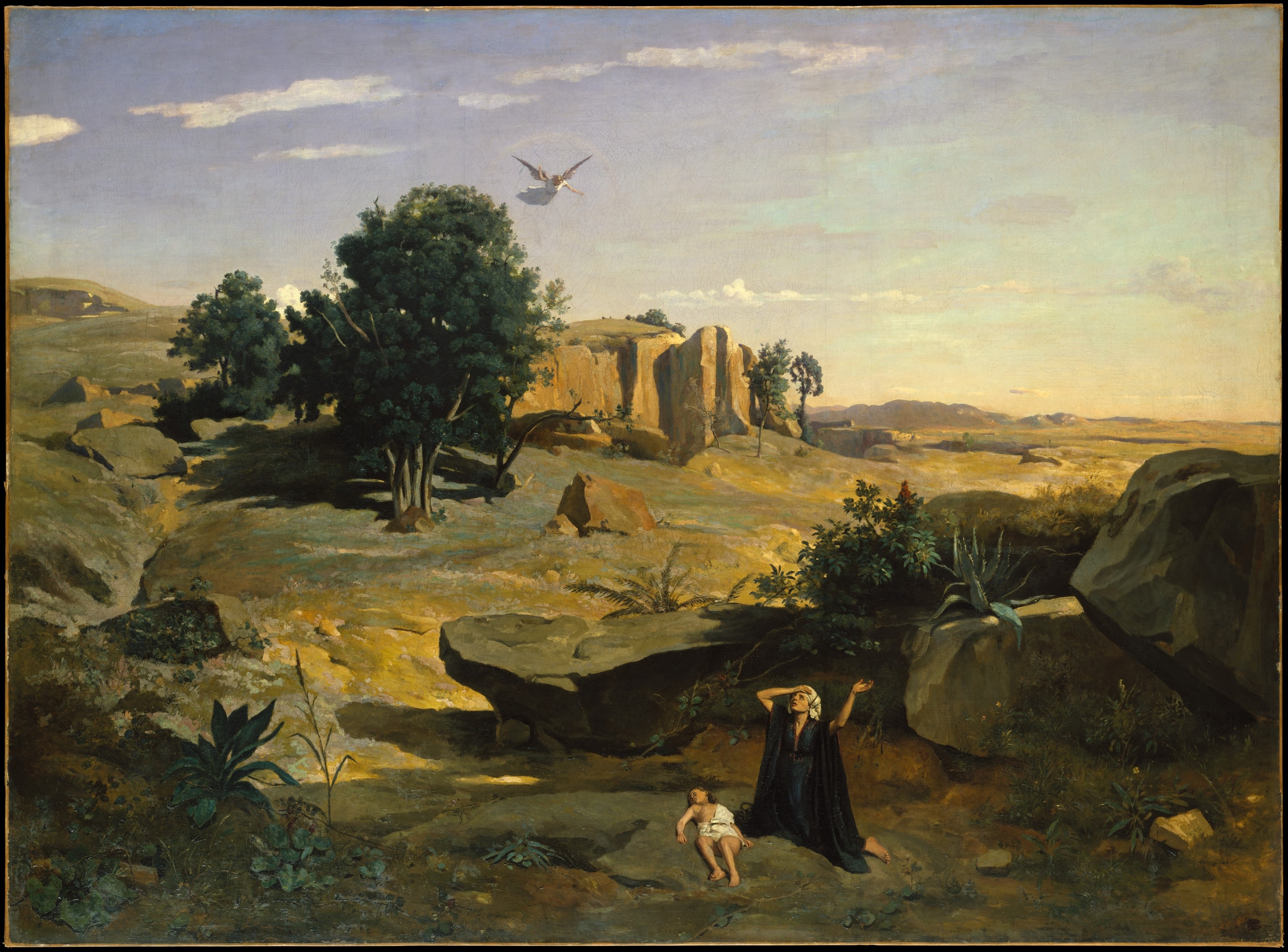 Hagar in the Wilderness, Jean-Baptiste-Camille Corot, 1835, Metropolitan Museum of Art. CC0 public domain (Wikimedia Commons), resized.

See this page's graph and discover linked topics
In full
Hagar appears in Genesis 16, 21:8-21 and 25:12, and in Paul's allegory in Galatians 4:21-31. Genesis calls her "an handmaid, an Egyptian" (Genesis 16:1, KJV), Hebrew shiphḥah mitsrit, a female servant of Sarai. Her origin in Mizraim, the Bible's name for Egypt (see Africa in the Table of Nations), makes her the first named African woman in the Bible.
Genesis 16. Sarai gives Hagar to Abram as a wife to bear a child on her behalf. Hagar conceives and looks on her mistress with contempt; Sarai treats her harshly, and Hagar flees toward Shur, on the road to Egypt. The angel of the LORD finds her by a spring, tells her to return and submit, and promises: "I will multiply thy seed exceedingly, that it shall not be numbered for multitude" (Genesis 16:10, KJV). Her son is to be called Ishmael, "God hears," because "the LORD hath heard thy affliction" (Genesis 16:11, KJV). Hagar names the LORD El Roi, "God of seeing," and the well is called Beer-lahai-roi.
Genesis 21. After Isaac's birth, Sarah sees Ishmael "mocking" (or playing) and demands that Abraham cast out the slave woman and her son. God tells Abraham to listen to Sarah, because Isaac is the child of promise, but adds that he will make Ishmael a nation too. Hagar wanders in the wilderness of Beersheba; when the water is gone she puts the boy under a bush and sits a bowshot away so she will not watch him die. "And God heard the voice of the lad" (Genesis 21:17, KJV), the angel calls to her, and God opens her eyes to a well. Ishmael grows up in the wilderness of Paran, and his mother takes him a wife "out of the land of Egypt" (Genesis 21:21, KJV).
Genesis 25:12-18 lists Ishmael's twelve sons, princes of tribes, fulfilling the promise God made to Hagar and to Abraham.
Surrogacy in the ancient Near East
Sarah's plan was legal and customary in her world, which helps explain both the arrangement and its conflict:
- Nuzi. A marriage contract from Nuzi (fifteenth century BC) obliges a wife who bears no children to provide her husband with a slave woman, and the children count as the wife's. See Nuzi Tablets.
- The Laws of Hammurabi (§146). If a priestess-wife gives her husband a slave woman who bears children and then claims equality with her mistress, the mistress may not sell her but may reduce her again to slave status.
The parallel is close. Hagar's pride and Sarah's harshness follow a script the law codes anticipated. Genesis records the custom without endorsing it, and the story's sympathy repeatedly falls on Hagar.
The God who sees and hears
Several firsts gather around Hagar:
- The first appearance of "the angel of the LORD" in the Bible is to Hagar (Genesis 16:7), not to Abraham.
- She names God. She is often described as the only person in the Bible who gives God a name: El Roi, "the God who sees me."
- A promise of descendants in the language of the promise to Abraham (compare Genesis 16:10 with Genesis 15:5).
- God hears twice. Ishmael's name means "God hears," and in Genesis 21 God hears the boy's voice in the wilderness.
The narrative treats the Egyptian servant as a person God addresses directly, not a tool in someone else's story.
Paul's allegory (Galatians 4)
In Galatians 4:21-31 Paul reads Hagar and Sarah as two covenants. Hagar, the slave woman, stands for Mount Sinai and the present Jerusalem in bondage; Sarah, the free woman, stands for the Jerusalem above. "For this Agar is mount Sinai in Arabia" (Galatians 4:25, KJV). Paul applies Genesis 21:10, "Cast out the bondwoman and her son" (Galatians 4:30, KJV), to the Galatian controversy over circumcision.
Two cautions keep this from being misread:
- The allegory is about covenants, not ethnicities. Paul's "children of Hagar" are those who seek justification through the Law, and his opponents were Jewish-Christian teachers, not Egyptians or Arabs.
- Paul says he is speaking allegorically (Galatians 4:24). The allegory does not erase Genesis, where God protects and blesses Hagar and Ishmael.
Hagar in other traditions
- Jewish. Genesis Rabbah (45:1) makes Hagar a daughter of Pharaoh given to Sarah. Some rabbinic sources (Genesis Rabbah 61:4) and Rashi identify her with Keturah, whom Abraham married after Sarah's death (Genesis 25:1), so that Abraham took her back.
- Islamic. Hajar is honoured as the mother of Ishmael (Ismail), ancestor of the Arabs through whom Muslims trace Muhammad. The Quran does not name her, but hadith (for example Sahih al-Bukhari 3364) tell of Abraham leaving Hajar and Ismail at Mecca, her running seven times between the hills of Safa and Marwa in search of water, and the spring of Zamzam. The pilgrims' run (sa'i) re-enacts her search. See Islam.
- Womanist theology. Delores S. Williams, in Sisters in the Wilderness (1993), read Hagar as a figure of Black women's experience: enslaved, sexually exploited, cast out, and met by God in survival rather than liberation. Phyllis Trible included Hagar among the "texts of terror" (1984). These readings take the story's suffering seriously; they also note what Genesis itself stresses, that God saw her.
- African American spirituality. Hagar's flight and God's care in the wilderness echoed through Black preaching and song as a story of God meeting the enslaved and the abandoned.
Was Hagar African?
Egypt is in Africa, and Genesis calls her Egyptian, so in the plain geographic sense she is the first named African woman in Scripture. What Egyptians of the patriarchal period looked like is a separate and much-debated question; ancient Egypt was a Nile civilization with ties both south to Kush and north to the Levant. Genesis does not describe her appearance. The point the text makes is not her complexion but her standing before God.
Scholarship
Published academic works this page draws on, each matched to a publisher, index or library catalog record.
- Delores S. Williams, Sisters in the Wilderness (1993). Open Library
See also
- Africa in the Table of Nations, where Mizraim (Egypt) first appears
- Zipporah, another foreign wife in Israel's founding families
- Africans in Scripture Argument, the cumulative case for African presence in Scripture
- Nuzi Tablets, the ancient surrogacy contracts behind Genesis 16
- Islam, where Hajar is honoured as the mother of Ishmael
- Paul the Apostle, author of the Galatians allegory
- Curse of Ham Objection Defeater, on another misuse of Genesis against Africans
- Africa and Christianity
Common questions this page answers
Q: Who was Hagar in the Bible?
Hagar was an Egyptian servant of Sarah whom Sarah gave to Abraham to bear a child. She became the mother of Ishmael, ran away when Sarah mistreated her, and later was sent away with her son, and both times God met her in the wilderness (Genesis 16 and 21).
Q: Was Hagar African?
Yes, in the geographic sense: Genesis calls her an Egyptian, and Egypt is in Africa. The Bible does not describe her appearance.
Q: What does El Roi mean?
El Roi means "God of seeing" or "the God who sees me." Hagar gave God this name after the angel of the LORD found her by a spring in the desert (Genesis 16:13).
Q: Why did Abraham send Hagar away?
After Isaac was born, Sarah saw Ishmael mocking or playing and demanded that Hagar and her son be cast out. God told Abraham to agree, because the promise would come through Isaac, but promised that Ishmael would also become a nation (Genesis 21:8-13).
Q: What does Hagar represent in Galatians 4?
Paul uses Hagar as an allegory for the covenant from Mount Sinai and those who seek righteousness through the Law, set against Sarah as the covenant of promise. The allegory is about covenants, not about any ethnic group.
Q: Is Hagar in the Quran?
The Quran does not name her, but Islamic tradition honours her as Hajar, mother of Ishmael. Hadith tell of her search for water between Safa and Marwa at Mecca and the spring of Zamzam.
Q: Why did Sarah give Hagar to Abraham?
Sarah was childless, and ancient Near Eastern custom, attested at Nuzi and in the Laws of Hammurabi, allowed a barren wife to give her servant to her husband so the child would count as hers.