Argument
God Did Not Create Ex Nihilo Objection Defeater
God didn't create ex nihilo, God did not create out of nothing, Genesis 1:2 preexisting matter objection, The water was already there objection, Did God create from preexisting matter, Eternal matter objection, Genesis teaches creation from chaosIntro
"Christians say God made everything out of nothing. But read Genesis. In verse 2 the earth is already there, the deep is already there, and the Spirit is hovering over waters nobody made. God didn't create from nothing. He took a mess that already existed and organized it."
The objection sounds like a close reading, and it points at something real: Genesis 1:2 does describe an earth that is "waste and void" and dark water before God says "Let there be light." But it skips a step. Showing that the earth was unformed when the story zooms in is not the same as showing that the earth was never made.
Think of a builder's site photo taken on the first morning: bare dirt, puddles, no walls yet. Nobody concludes from the photo that the dirt and the puddles are eternal. The photo shows the condition of the site at the start of the work, and the sentence before it in Genesis tells you who made the site: "In the beginning God created the heavens and the earth" (Genesis 1:1, ASV).
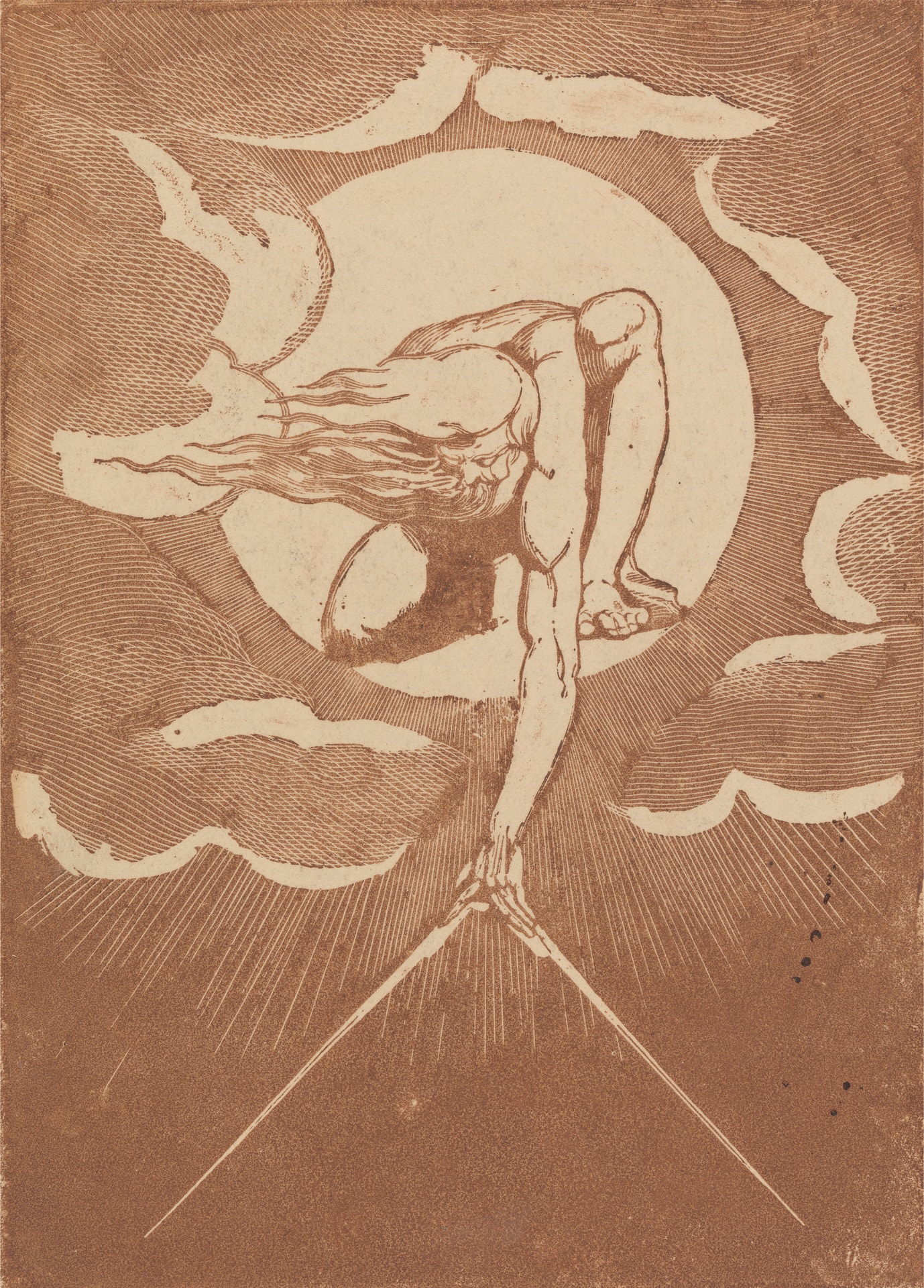
William Blake, The Ancient of Days, relief etching printed in color, 1794. Image: public domain, via Wikimedia Commons.
See this page's graph and discover linked topics
Cheatsheet
The 30-second reply:
Verse 2 tells you what the earth was like. Verse 1 tells you where it came from: God created the heavens and the earth, which in Hebrew is the way of saying everything. Nothing in Genesis says the water was eternal. And the rest of Scripture closes the door: the deep had a time when it did not exist (Proverbs 8:24), the waters above the heavens "were created" (Psalm 148:4-5), and "without him was not anything made that hath been made" (John 1:3). So are you saying God organized matter, which Christians agree He did in Genesis 1:2 onward, or that matter is eternal and uncreated? Only the second contradicts creation from nothing, and the text never says it.
The fast facts:
- Verse 1 is the act, verse 2 is the condition. Verse 2 opens with "and the earth" placed before its verb (wəhāʾāreṣ hāyətāh), the Hebrew way of pausing the action to describe a state. It is not the next event, and it is not an event before verse 1.
- "The heavens and the earth" means everything. The pair is a merism for the whole created order (see H8414 - tohu). If God created the whole in verse 1, the earth of verse 2 is part of what He created.
- Tōhû wābōhû means unformed and empty, not eternal. The words describe what the earth lacks (shape, inhabitants), and the next six days supply exactly those two lacks.
- The deep has a beginning. Wisdom says "When there were no depths, I was brought forth" (Proverbs 8:24, ASV). The Hebrew word for "depths" is the plural of təhôm, the "deep" of Genesis 1:2.
- The waters were created. "Ye waters that are above the heavens... he commanded, and they were created" (Psalm 148:4-5, ASV).
- Nothing is left out. "All things were made through him; and without him was not anything made that hath been made" (John 1:3, ASV). John says it twice, positively and negatively, so there is no remainder.
The 3 strongest counter-moves:
- "Where does Genesis say the water existed eternally, or apart from God?" It does not. Silence about when water was made is not a statement that it was never made.
- "Are you claiming God organized matter, or that matter is uncreated?" Force the distinction. Christians affirm the first. Only the second is the objection.
- "If matter is eternal, what explains it?" Then there are two eternal realities, God and matter, and the objector owes an account of a necessary, uncaused physical stuff, which modern cosmology does not supply.
Reciprocal concessions (grant the small point, then collect a bigger one):
- Grant: the phrase "out of nothing" is not in Genesis 1. Now collect: neither is the phrase "out of eternal matter." The question is which reading the whole canon supports, and only one has texts that say "all things," "created" and "when there were no depths."
- Grant: some translations, the Jewish Publication Society's 1985 version among them, read verse 1 as a dependent clause, "When God began to create." Now collect: even on that reading, verse 2 describes conditions at the start of the narrative and says nothing about those conditions being uncreated. The construct reading changes the sentence structure, not the theology.
- Grant: the doctrine was formulated in precise philosophical language in the second century. Now collect: the conviction it formulates, that God made "all things," is already in Isaiah, the Psalms, John, Paul and Hebrews. Late vocabulary is not a late belief.
- Grant: ancient Near Eastern myths like Enuma Elish begin with primeval waters that the gods did not make. Now collect: Genesis is written against that picture. In the myths the waters are a goddess and creation is a war; in Genesis the deep is a thing, it has no will, and God's word alone does the work.
The closing line:
Verse 2 is a picture of a building site, not a claim that the site is eternal. The Builder is named in verse 1, and every later text that speaks to the question says He made the water too.
In full
The objection reads Genesis 1:2 (an earth tōhû wābōhû, darkness over təhôm, the Spirit over the waters) as evidence that primordial matter pre-existed God's creative speech, so that Genesis 1 teaches formation from an uncreated substrate rather than creatio ex nihilo. The argument equivocates between two propositions: (A) God shaped and filled an earth that existed in an unformed state, and (B) the unformed earth and waters existed uncreated, independently of God. Classical Christian theology affirms (A); it is the subject of days one to six. Only (B) contradicts creation from nothing, and Genesis 1:2 does not assert it.
Three lines of response converge. Syntactically, the Masoretic vocalization, the Septuagint (en archē) and the Vulgate (in principio) read Genesis 1:1 as an independent clause narrating the creation of the totality ("the heavens and the earth," a merism), with verse 2 a circumstantial clause describing the earth's initial state; see H7225 - reshit and H1254 - bara. Canonically, later texts that address the origin of the very elements named in verse 2 assign them a beginning (Proverbs 8:24 on the təhōmôt; Psalm 148:4-5 on the waters above the heavens) and assert universal creation without remainder (John 1:3; Colossians 1:16-17; Revelation 4:11; Hebrews 11:3; Romans 4:17). Metaphysically, uncreated matter would be a second necessary being alongside God, contradicting divine Aseity and making God a demiurge in the manner of Plato's Timaeus; the patristic argument against eternal matter (Theophilus, To Autolycus 2.4; Irenaeus, Against Heresies 2.10.4) turns on exactly this point.
The defeater does not need to win the debate over whether Genesis 1:1 is absolute or construct. It holds under both readings, because neither reading has the text assert that the earth and waters were uncreated.
Grammar and hermeneutics
The objection falls at the level of the text before any philosophy is needed.
-
Verse 1 reads most naturally as a complete sentence. Bərēʾšît bārāʾ ʾĕlōhîm ʾēt haššāmayim wəʾēt hāʾāreṣ. The Masoretic pointing, the Septuagint and the Vulgate all take it as an independent main clause: "In the beginning God created the heavens and the earth." The alternative, reading bərēʾšît as a construct ("in the beginning of God's creating," followed by Rashi and by some modern translations), is grammatically possible and is a minority reading. See H7225 - reshit.
-
The object of the verb is the totality. "The heavens and the earth" is a merism, two poles naming everything between them. The verb bārāʾ in its basic stem takes only God as subject and never names a material (H1254 - bara). Verse 1 therefore states that God created the whole, which includes the earth that verse 2 goes on to describe.
-
Verse 2 is circumstantial, not sequential. Hebrew narrative advances with the wayyiqtol verb form ("and God said," "and there was," from verse 3 onward). Verse 2 instead opens with wə plus the noun plus the perfect verb: wəhāʾāreṣ hāyətāh, "now the earth was." That construction pauses the story to describe a state. It is a snapshot of the earth's condition, not an event, and nothing in it places that condition before or outside verse 1.
-
The two nouns name absences, which the six days then fill. Tōhû ("waste, formless") and bōhû ("void, empty") describe what the earth lacks. Days one to three give it form (light and darkness, waters above and below, land and seas); days four to six fill it (lights, birds and fish, animals and humans). The pair sets up the narrative; it says nothing about duration or uncreatedness. See H8414 - tohu.
-
Genre and purpose. Genesis 1 is a narrative about God's ordering and filling of the world, written against ancient myths in which the primeval waters are a deity. In Genesis the deep (təhôm) is not a person, is not fought, and is not divine. Reading verse 2 as a claim about the metaphysical status of matter asks the text a question it is not answering, and then treats its silence as a "no."
-
The canon answers the question the objector is asking. When later Scripture speaks directly to whether the deep and the waters had a beginning, it says they did: "When there were no depths [təhōmôt], I was brought forth" (Proverbs 8:24, ASV); "ye waters that are above the heavens... he commanded, and they were created" (Psalm 148:4-5, ASV).
Argument structure
| # | Premise |
|---|---|
| P1 | The objection needs Genesis 1:2 to assert that matter existed uncreated and independently of God, not merely that the earth was once unformed. |
| P2 | Genesis 1:1 narrates God's creation of the totality, and verse 2 describes the condition of that creation. |
| P3 | Later Scripture assigns a beginning to the very elements named in verse 2 and asserts creation of "all things" without remainder. |
| P4 | Uncreated matter would be a second necessary being, which contradicts God's aseity and the biblical distinction between Creator and creature. |
| C | Genesis 1:2 does not show that God formed pre-existing, uncreated matter; the biblical and metaphysical case for creation from nothing stands. |
Form
Defensive. The core move is a distinction between two propositions the objection runs together (formation of an unformed earth, which Christians affirm, and the eternity of matter, which the text never states). P2 is grammatical, P3 canonical, P4 metaphysical; the conclusion follows if any one of them holds, and the three are independent. The page is built so that conceding the minority construct reading of Genesis 1:1 costs nothing.
Premise 1, The objection needs uncreated matter, not just unformed matter
Affirmative case (second-order arguments)
- Two different claims. "God organized an unformed earth" and "matter exists eternally apart from God" are different propositions. Only the second contradicts creatio ex nihilo.
- Christians already affirm the first. The six days are precisely God shaping and filling. Pointing out that God shapes something in Genesis 1:2 onward is common ground, not an objection.
- The burden sits with the objector. To get eternal matter, one needs a text that says the waters had no beginning. Genesis 1 never says so.
Anticipated objections
- "If God made the water, Genesis would say so. It describes light, sky, land, plants and animals being made, but not the water."
- "The Spirit hovers over waters that are simply there. That is the language of something pre-existing."
Rebuttals
- Argument from silence, and the wrong silence. Genesis also never narrates the making of darkness, yet no one infers darkness is eternal. The water is included in "the heavens and the earth" of verse 1, and Psalm 148:4-5 says outright that the waters "were created."
- "There" in the scene is not "there forever." Every narrative opens with things already present in the scene. Presence at the start of the scene is not a claim about having no origin. The question "where did it come from?" is answered in verse 1.
Tactical notes
- Lead with the force-commit question: "Organized matter, or eternal matter? Which one are you claiming?" Most objectors mean the first and have not noticed it is not an objection.
- Do not defend more than you need. You do not need to prove Genesis 1:1 alone teaches ex nihilo; you only need to show 1:2 does not teach eternal matter.
Premise 2, Verse 1 is the creation of the whole, verse 2 its condition
Affirmative case (second-order arguments)
- Independent-clause reading. The Masoretic pointing, the Septuagint and the Vulgate read verse 1 as a complete sentence.
- Merism. "The heavens and the earth" names the whole cosmos; nothing material sits outside it.
- Circumstantial syntax in verse 2. The noun-first clause describes a state, so verse 2 depends on verse 1 rather than preceding it.
- John reads it this way. "In the beginning was the Word... All things were made through him" (John 1:1-3) takes Genesis 1:1 as the absolute beginning and places the Word before it.
Anticipated objections
- "Many scholars read verse 1 as 'When God began to create,' so verse 2 describes what was already there when He began." This is the construct reading, found in Rashi and in some modern translations.
- "Verse 1 is just a title or summary for the chapter, not an act."
Rebuttals
- Granted as possible, and it still does not deliver eternal matter. On the construct reading, verse 2 describes the state of things when God's creating began. The verse still says nothing about how that state came to be or whether it had a beginning. The canonical texts of Premise 3 then answer that question.
- A title still names the act. If verse 1 summarizes the chapter, it summarizes it as God's creating "the heavens and the earth," the whole. The summary does not carve out an uncreated remainder.
Live-cite kit
- Scripture: Genesis 1:1; Genesis 1:2; John 1:1-3.
- Aphorism: "Verse 2 is a site photo. Verse 1 names the Builder."
Premise 3, The canon gives the deep and the waters a beginning
Affirmative case (second-order arguments)
- The deep had a "when not." "When there were no depths, I was brought forth; When there were no fountains abounding with water" (Proverbs 8:24, ASV). The depths are the təhōmôt, the plural of the very word Genesis 1:2 uses.
- The waters were commanded into existence. Psalm 148:4-5 calls on "ye waters that are above the heavens" to praise God, "For he commanded, and they were created" (ASV).
- All things, without remainder. John 1:3 states it positively and negatively; Colossians 1:16-17 includes "things visible and things invisible"; Revelation 4:11 grounds the existence of "all things" in God's will.
- Not from what appears. "What is seen hath not been made out of things which appear" (Hebrews 11:3, ASV). God "calleth the things that are not, as though they were" (Romans 4:17, ASV).
- The Jewish witness before the New Testament. A mother in 2 Maccabees 7:28 tells her son that God made heaven and earth "of things that were not" (KJV Apocrypha). Protestants do not treat the book as Scripture, but it shows the conviction was held in Judaism before Christianity.
Anticipated objections
- "Hebrews 11:3 says the world came from invisible things. That could be invisible pre-existing matter, as in Plato."
- "Wisdom of Solomon 11:17 says God made the world 'of matter without form.' So Jewish tradition taught formless pre-existing matter."
- "2 Maccabees 7:28 may mean 'from things that did not yet exist in their present form,' not absolute nothing."
Rebuttals
- Hebrews grounds the world in the word of God, not in a hidden stuff. The contrast is between God's word and visible materials; the verse names no invisible material, and the same author says the Son "upholdeth all things by the word of his power" (Hebrews 1:3). Reading Plato into it adds what the verse does not say.
- Wisdom describes the forming stage, which Genesis 1:2 also describes. "Formless matter" is the tōhû wābōhû earth that God then shapes. Wisdom does not say that matter was uncreated. It is also outside the Protestant canon, so it cannot overrule John, Colossians or Hebrews.
- Grant the ambiguity, then collect. Even if 2 Maccabees is read as weakly as possible, the New Testament texts are not weak: "all things," "without him was not anything made." The case does not rest on Maccabees.
Tactical notes
- Proverbs 8:24 is the sharpest single text, because it uses the same word as Genesis 1:2. Read it aloud and name the word.
- Keep the deuterocanon in its place: a historical witness, not the foundation.
Premise 4, Uncreated matter would be a second god
Affirmative case (second-order arguments)
- Aseity. If matter exists uncaused and necessarily, God is not the source of all things; He is one eternal reality alongside another. See Aseity and Classical Theism.
- The patristic argument. Theophilus of Antioch argued that if matter were uncreated like God, God would not be the maker of all things and His power would be no greater than a human craftsman's (To Autolycus 2.4). Irenaeus made the same contrast: humans need material; God called into being the very substance of what He made (Against Heresies 2.10.4).
- The universe began. A physical reality that began to exist is not a necessary, eternal substrate. See Big Bang, Borde-Guth-Vilenkin Theorem and Argument from the Creation of Time.
Anticipated objections
- "Why couldn't God and matter both be eternal, with God ordering it?" The Platonic and Latter-day Saint model.
- "The Big Bang is not 'nothing'; maybe there was a quantum vacuum before it."
Rebuttals
- Then God is a craftsman, not the Creator. The model makes matter a second uncaused reality and leaves its existence unexplained. Scripture's God is the one "that maketh all things" (Isaiah 44:24, ASV), not a shaper of what He found. See God Is the Eternal Atoms Objection Defeater and Mormonism.
- A vacuum is not nothing. A quantum vacuum has structure, energy and laws. If it existed, it is part of the physical order whose existence needs explaining, which is the question Causal Principle and Zero and the Metaphysics of Nothing address.
Master objections to the whole argument
- "Gerhard May showed creation from nothing is a second-century invention." May showed the doctrine was formulated explicitly in the late second century against Gnostic and Platonist views. That is a claim about vocabulary and precision. The conviction it formulates, that God made "all things," is in the texts of Premise 3, which are centuries earlier.
- "John Walton says Genesis 1 is about function, not material origins." Walton's thesis is about what Genesis 1 focuses on, the ordering of the cosmos as God's temple. A text focused on function is not a text denying material creation, and Walton himself does not deny that God made matter. A focus is not a denial.
- "Genesis borrows the primeval waters from Babylonian myth." The motif is shared; the theology is reversed. In Enuma Elish the waters are the goddess Tiamat, slain to make the world. In Genesis the deep is impersonal matter under the Spirit's hovering and God's word. Borrowing an image in order to strip it of divinity is polemic, not dependence.
Live-cite kit
- Scripture:
- Genesis 1:1, God created the heavens and the earth, the whole
- Genesis 1:2, the state of that creation, unformed and empty
- Proverbs 8:24, "When there were no depths, I was brought forth" (ASV)
- Psalm 148:4-5, the waters above the heavens "were created" (ASV)
- John 1:3; Colossians 1:16-17; Revelation 4:11
- Hebrews 11:3; Romans 4:17
- Scholarly:
- Paul Copan and William Lane Craig, Creation out of Nothing: A Biblical, Philosophical, and Scientific Exploration (Baker Academic, 2004)
- Gerhard May, Creatio ex Nihilo: The Doctrine of "Creation out of Nothing" in Early Christian Thought (1978; English 1994), for the opposing history
- Theophilus of Antioch, To Autolycus 2.4; Irenaeus, Against Heresies 2.10.4; Augustine, Confessions XII.7
- John H. Walton, The Lost World of Genesis One (IVP Academic, 2009), the functional reading
- Aphorism: "Unformed is not uncreated." / "A builder's site photo does not prove the dirt is eternal."
Tactical notes
- Order: P1 (force the distinction), then Proverbs 8:24 and Psalm 148:4-5 (P3), then the syntax (P2) only if the objector presses Hebrew, then P4 if they bite the bullet on eternal matter.
- What not to defend: do not claim Genesis 1:1 by itself proves creation from nothing beyond dispute, and do not claim the Big Bang proves it. Neither is needed.
- Watch for the switch. Objectors often move from "God organized matter" (harmless) to "so matter is eternal" (the real claim) without arguing for the step. Name the step out loud.
Scholarship
Published academic works this page draws on, each matched to a publisher, index or library catalog record.
- John H. Walton, The lost world of Genesis One (IVP Academic, 2009). Open Library
See also
- Creatio ex Nihilo, the doctrine this page defends
- H7225 - reshit, the "beginning" of Genesis 1:1 and the absolute or construct question
- H1254 - bara, the verb only God performs
- H8414 - tohu, the "waste" of Genesis 1:2
- God Is the Eternal Atoms Objection Defeater, the pantheist and eternal-matter cousin of this objection
- Argument from the Creation of Time, why time itself is part of creation
- Six Day Creation Falsified Objection Defeater, the companion objection about the days
- Kalam Cosmological Argument, the philosophical case that the universe began
Common questions this page answers
Q: Does Genesis 1:2 prove God did not create out of nothing?
No. Genesis 1:2 describes the condition of the earth, unformed and empty, at the start of the narrative. Verse 1 has already said God created "the heavens and the earth," the Hebrew way of saying everything, and nothing in verse 2 says the earth or the water was uncreated.
Q: Where did the water in Genesis 1:2 come from?
God made it. The water belongs to "the heavens and the earth" created in verse 1, and later Scripture says so directly: the waters above the heavens "were created" at God's command (Psalm 148:4-5), and Wisdom speaks of a time "when there were no depths" (Proverbs 8:24), using the same word as the "deep" of Genesis 1:2.
Q: Did God just organize matter that already existed?
God did organize and fill an unformed earth; that is what the six days describe. But organizing an unformed earth is different from working with eternal, uncreated matter. The Bible affirms the first and denies the second: "without him was not anything made that hath been made" (John 1:3).
Q: Is "When God began to create" a better translation of Genesis 1:1?
It is a possible minority reading, found in Rashi and in some modern translations. The Masoretic pointing, the Septuagint and the Vulgate read verse 1 as a complete sentence. Either way, verse 2 does not say matter was eternal, so the doctrine of creation from nothing does not depend on settling the translation.
Q: Is creation out of nothing a later invention of the church?
The precise formulation came in the second century, against teachers who said matter was eternal. The belief it states is much older: Isaiah, the Psalms, John, Paul and Hebrews all say God made "all things," and 2 Maccabees 7:28 shows the idea in Judaism before the New Testament.
Q: Doesn't Genesis copy the Babylonian creation myth?
Genesis shares the image of primeval waters but reverses its meaning. In Enuma Elish the waters are a goddess killed in battle to make the world. In Genesis the deep is impersonal, nothing is fought, and God creates by His word alone.