Concept
Fire of God in Scripture
Fire of God, Divine fire, Fire in the Bible, Tongues of fire, Tongues as of fire, Fire from heaven, Consuming fire, Holy fire, Fire of the Holy SpiritIntro
Fire is one of the Bible's main pictures of God. It shows up when God appears (the burning bush, Mount Sinai), when He accepts a sacrifice (Elijah on Mount Carmel), when He cleans someone (the hot coal on Isaiah's lips), when He judges, and when He gives His people power to speak for Him (the tongues of fire at Pentecost). "Our God is a consuming fire," says Hebrews 12:29.
People often connect these scenes, and some of the connections are real. But it helps to read each one on its own terms before linking them. Elijah's fire fell on an altar to prove who God is. Isaiah's coal touched his mouth to take away his guilt. The fire at Pentecost rested on people to show the Holy Spirit had come. Same image, different jobs. And Scripture itself warns against treating the fire as if it were God: on Mount Horeb, Elijah saw the fire, but "Jehovah was not in the fire" (1 Kings 19:12).
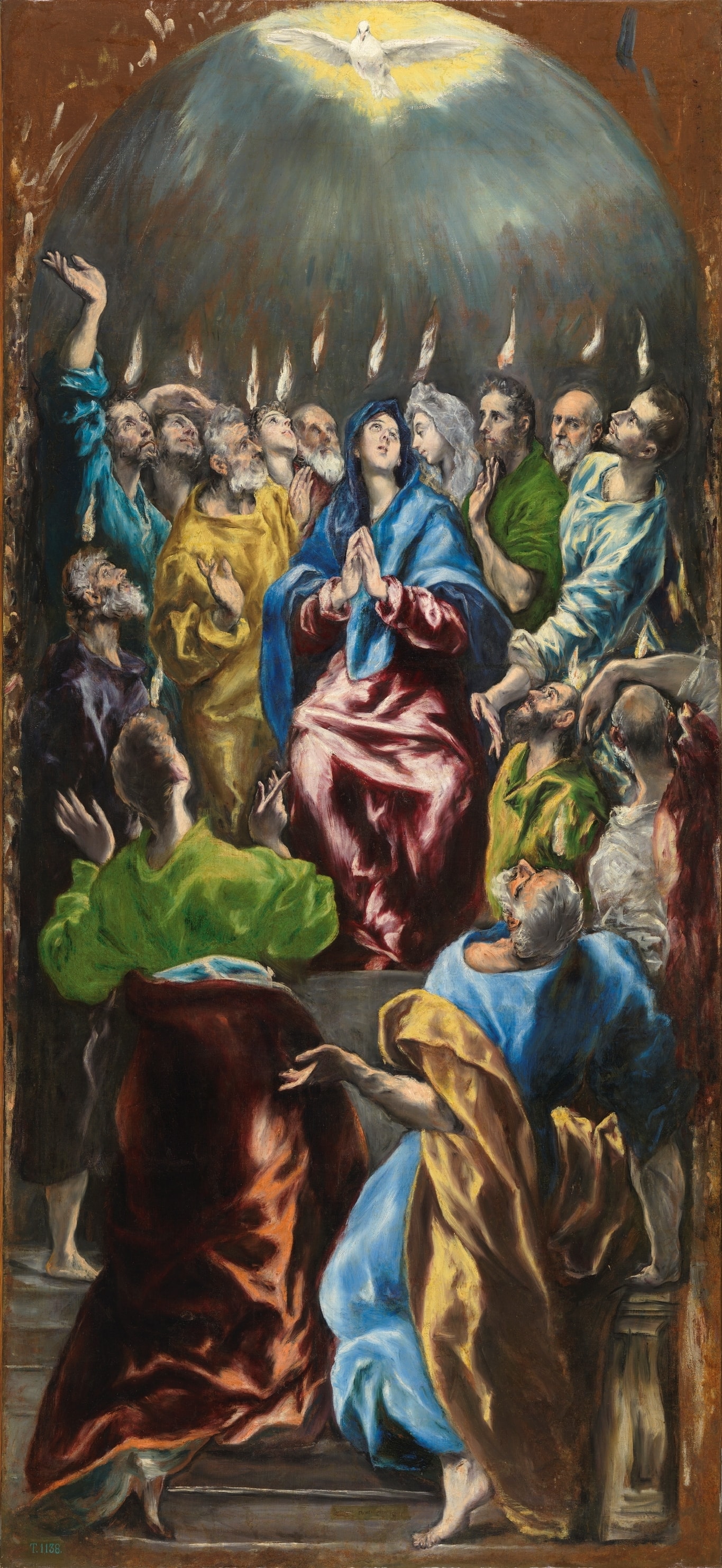
Tongues as of fire rest on each of the disciples at Pentecost (Acts 2:3). El Greco, Pentecost, c. 1600, Museo del Prado, Madrid. Public domain, via Wikimedia Commons.
See this page's graph and discover linked topics
In full
Fire (Hebrew esh; Greek pyr) is the most persistent theophanic and cultic image in the biblical canon. It functions in at least five distinguishable roles, which frequently overlap in a single text:
- Presence. Fire marks the place where God is: the bush that burns without being consumed (Exodus 3:2), the pillar of fire (Exodus 13:21), Sinai wrapped in smoke "because Jehovah descended upon it in fire" (Exodus 19:18), the throne of fiery flame in Daniel 7:9-10.
- Acceptance. Fire from God consumes an offering as a sign that He receives it: at the inauguration of the tabernacle (Leviticus 9:24), at the dedication of Solomon's temple (2 Chronicles 7:1), and on Carmel (1 Kings 18:38).
- Judgment. The same fire destroys what opposes God's holiness: Nadab and Abihu's "strange fire" (Leviticus 10:1-2), the captains sent against Elijah (2 Kings 1:10-12), the fire of the last day (1 Corinthians 3:13).
- Purification. Fire refines rather than destroys: the coal that removes Isaiah's guilt (Isaiah 6:6-7), the refiner's fire of Malachi 3:2-3.
- Empowered speech. Fire is associated with God's word in a prophet's mouth: "I will make my words in thy mouth fire" (Jeremiah 5:14), "as it were a burning fire shut up in my bones" (Jeremiah 20:9), and the "tongues parting asunder, like as of fire" at Pentecost (Acts 2:3).
The theological root of all five is holiness. Fire is the image of a God who cannot be approached casually, who is dangerous to sin and life-giving to those He cleanses. Deuteronomy 4:24 and Hebrews 12:29 state it as a description of God Himself: "a devouring fire," "a consuming fire."
At the same time, the canon carefully keeps the image from becoming an identity. The fire is God's instrument and sign, never God. That is the force of the Horeb scene, and it is what separates biblical fire imagery from the fire and storm gods of the surrounding cultures.
Four scenes compared
| Carmel (1 Kings 18) | Horeb (1 Kings 19) | Isaiah's call (Isaiah 6) | Pentecost (Acts 2) | |
|---|---|---|---|---|
| What the fire touches | Sacrifice, altar, water | Nothing; it passes by | The prophet's lips | Each believer |
| Source | From heaven | A natural phenomenon | A coal from the altar | From heaven, with a sound like wind |
| Purpose | Proves Yahweh is God | Shows God is not the fire | Removes guilt, prepares a messenger | Signals the Spirit's arrival and empowers witness |
| Result | "Jehovah, he is God" | The still small voice and a new commission | "Here am I; send me" | Speech in other languages, then Peter's sermon |
| Key word | esh (fire) | qol demamah daqqah | ritspah (glowing coal) | glōssai hōsei pyros (tongues as of fire) |
Elijah and the fire
On Carmel the fire is evidence. The terms of the contest are "the God that answereth by fire, let him be God" (1 Kings 18:24), and the fire falls on a soaked altar after Baal's prophets have failed. Baal was worshipped as the storm god, the rider of the clouds who wields lightning, so the fire from the sky is a direct polemic: the power Baal's worshippers credited to him belongs to Yahweh. See Elijah.
Fire follows Elijah through his story. It falls on the captains sent to arrest him (2 Kings 1:10-12), and a chariot of fire separates him from Elisha when he is taken up (2 Kings 2:11). The Jewish wisdom book Sirach, written around 180 BC and received as Scripture in the Catholic and Orthodox canons, sums up his career in the same image: Elijah "stood up... as fire, and his word burned like a lamp" (Sirach 48:1, KJV).
Scripture never says Elijah had a tongue of fire. The idea people sometimes reach for comes from Sirach's description of his word as burning, which belongs with Jeremiah's picture of prophetic speech as fire.
Isaiah and the coal
In the year King Uzziah died, Isaiah sees the Lord enthroned and hears the seraphim cry "Holy, holy, holy." His response is not wonder but dread: "Woe is me! for I am undone; because I am a man of unclean lips" (Isaiah 6:5). A seraph takes a live coal with tongs from the altar and touches his mouth: "Lo, this hath touched thy lips; and thine iniquity is taken away, and thy sin forgiven" (Isaiah 6:7, ASV).
- The coal comes from the altar, the place of sacrifice, so the cleansing is tied to atonement.
- The verb at the end of verse 7 is from kaphar, the vocabulary of atonement (see H3722 - kaphar). YLT renders it literally: "thy sin is covered."
- The sequence is conviction, cleansing, forgiveness, commission. Only after his lips are cleansed does Isaiah answer, "Here am I; send me."
- The coal cleanses the very organ Isaiah confessed was unclean, and that organ is the one his calling will use.
The full exegesis is at Isaiah 6.5-7.
Pentecost and the tongues as of fire
"And suddenly there came from heaven a sound as of the rushing of a mighty wind... And there appeared unto them tongues parting asunder, like as of fire; and it sat upon each one of them. And they were all filled with the Holy Spirit, and began to speak with other tongues, as the Spirit gave them utterance" (Acts 2:2-4, ASV).
- "Like as of fire." Luke writes hōsei pyros, "as if of fire." He describes what was seen without claiming it was ordinary combustion.
- "Parting asunder." Diamerizomenai means divided or distributed. The fire is not one flame over the group but a portion resting on each person, which matches the point that the Spirit is given to every believer.
- Tongues of fire, then tongues of speech. Luke uses glōssa for both the fire-shapes and the languages that follow. The wordplay is in the text itself: the tongues they see become the tongues they speak.
- "Tongue of fire" is a Hebrew idiom. The Old Testament speaks of a flame as a "tongue of fire" (Isaiah 5:24, literally leshon esh, which the ASV renders "the tongue of fire"). A Jewish reader would hear the phrase naturally.
John the Baptist had promised that the one coming after him would "baptize you in the Holy Spirit and in fire" (Matthew 3:11; Luke 3:16), and Jesus said, "I came to cast fire upon the earth" (Luke 12:49). Pentecost is the first visible answer to both sayings. See Pentecost and Tongues as Evidence of the Spirit.
Grammar and hermeneutics: typology or fulfillment?
The popular sermon line runs straight from Carmel's fire to Pentecost's flame. The connection is a fair theme, but the texts set limits on it.
- Acts 2 never cites Elijah. When Peter explains Pentecost, he quotes Joel (Acts 2:16-21, citing Joel 2:28-32), not 1 Kings 18. Calling Pentecost "the fulfillment of Carmel" says more than Luke says.
- The scenes differ in what the fire does. On Carmel fire falls on a sacrifice to settle who is God. At Pentecost fire rests on people to mark the Spirit's coming. They share the image of fire from heaven, which is real common ground, but not a single function.
- A Sinai background is the stronger candidate. Fire, a sound from heaven and God's word given to an assembled people point back to Sinai (Exodus 19:16-19). The first-century Jewish philosopher Philo of Alexandria described the voice at Sinai as flame becoming articulate speech in the hearers' own language (On the Decalogue 46), and later Jewish tradition linked the Feast of Weeks with the giving of the law. Whether Luke intends the echo is debated among scholars, but it fits his account more closely than Carmel does.
- Isaiah 6 is closer in function than Carmel. Isaiah's coal and the Pentecost fire both prepare a person to speak for God. Even there the emphasis differs: Isaiah's coal deals with guilt, while Pentecost deals with power for witness.
- The safe statement. Throughout Scripture, fire from God marks His holy presence and His claim on those who serve Him. Carmel, Isaiah's call and Pentecost each show a facet of that, and none of the later texts claims to be the fulfillment of an earlier one. Teaching the connections as typology, with the difference named, is honest. Announcing them as explicit fulfillment is not.
What the fire is not
- Not God Himself. "Jehovah was not in the fire" (1 Kings 19:12). Biblical faith worships the Lord of the fire, not the fire.
- Not a tool for human anger. When James and John wanted to call down fire on a Samaritan village as Elijah had, Jesus rebuked them (Luke 9:54-55).
- Not something to manufacture. Nadab and Abihu offered "strange fire, which he had not commanded them," and died (Leviticus 10:1-2). Worship on human terms rather than God's is the opposite of the fire that falls from heaven.
See also
- Elijah, the prophet of Carmel and Horeb
- Isaiah 6.5-7, the coal from the altar
- Isaiah the Prophet, the prophet whose lips were touched
- Pentecost, the tongues as of fire in Acts 2
- Tongues as Evidence of the Spirit, the speech that followed the fire
- Pneumatology, the doctrine of the Holy Spirit
- H3722 - kaphar, the atonement vocabulary of Isaiah 6:7
- Philo of Alexandria, the Sinai fire as articulate speech
Common questions this page answers
Q: What does fire represent in the Bible?
Fire represents God's holy presence and what that presence does: it reveals God (the burning bush, Sinai), accepts sacrifice (Carmel), judges sin (Nadab and Abihu), purifies (Isaiah's coal, the refiner's fire of Malachi 3) and empowers speech (Jeremiah's word as fire, Pentecost). Hebrews 12:29 sums it up: "our God is a consuming fire."
Q: Is Pentecost the fulfillment of Elijah calling down fire on Mount Carmel?
Not explicitly. Peter explains Pentecost by quoting Joel, not 1 Kings 18. Both events involve fire from heaven, but on Carmel the fire proves who God is by consuming a sacrifice, while at Pentecost it rests on believers to mark the Spirit's coming. The link is a fair theme, not a stated fulfillment.
Q: Did Elijah have a tongue of fire?
The Bible never says so. The closest idea is in the book of Sirach, which says Elijah stood up "as fire, and his word burned like a lamp" (Sirach 48:1, KJV). That describes the power of his preaching, much like God's words becoming "fire" in Jeremiah's mouth (Jeremiah 5:14).
Q: What does the burning coal on Isaiah's lips mean?
It means God cleansed Isaiah's guilt before sending him. The coal came from the altar, the place of sacrifice, and the seraph declared, "thine iniquity is taken away, and thy sin forgiven" (Isaiah 6:7). Only then did Isaiah volunteer, "Here am I; send me."
Q: Why were the tongues at Pentecost "like as of fire"?
Luke says the tongues looked like fire (hōsei pyros), describing what was seen without calling it ordinary flame. The image recalls God's presence at Sinai and John the Baptist's promise of a baptism "in the Holy Spirit and in fire" (Matthew 3:11), and it plays on the word tongue: the tongues of fire become tongues of speech.