Concept
Christ's Descent to the Dead
Harrowing of Hell, Descent into Hell, Descent to the Dead, Spirits in prison, descensus ad inferos, descendit ad inferos, He descended into hell, Christ's descent into Hades, Holy Saturday, did Jesus go to hell, did Jesus preach to people in hell, spirits in prison 1 Peter 3:19, Christ preached to the deadIntro
Between the cross and the empty tomb, where was Jesus? His body lay in the grave. Christians have long confessed that He Himself went to the place of the dead, and the Apostles' Creed says so in a clause many believers recite without knowing what it means: "He descended into hell."
The Bible gives a handful of short, hard texts on this, above all 1 Peter 3:19, where Christ "went and preached unto the spirits in prison." Christians read these texts in three main ways. Some say Christ entered the realm of the dead to announce His victory and lead out the righteous who had died before Him. Some say He proclaimed His triumph over the fallen angels who were imprisoned for their rebellion in Noah's day. Others say Peter means that Christ preached through Noah to people of Noah's generation, who are now dead. What none of the texts teaches is a second chance after death for everyone who rejected God in life.
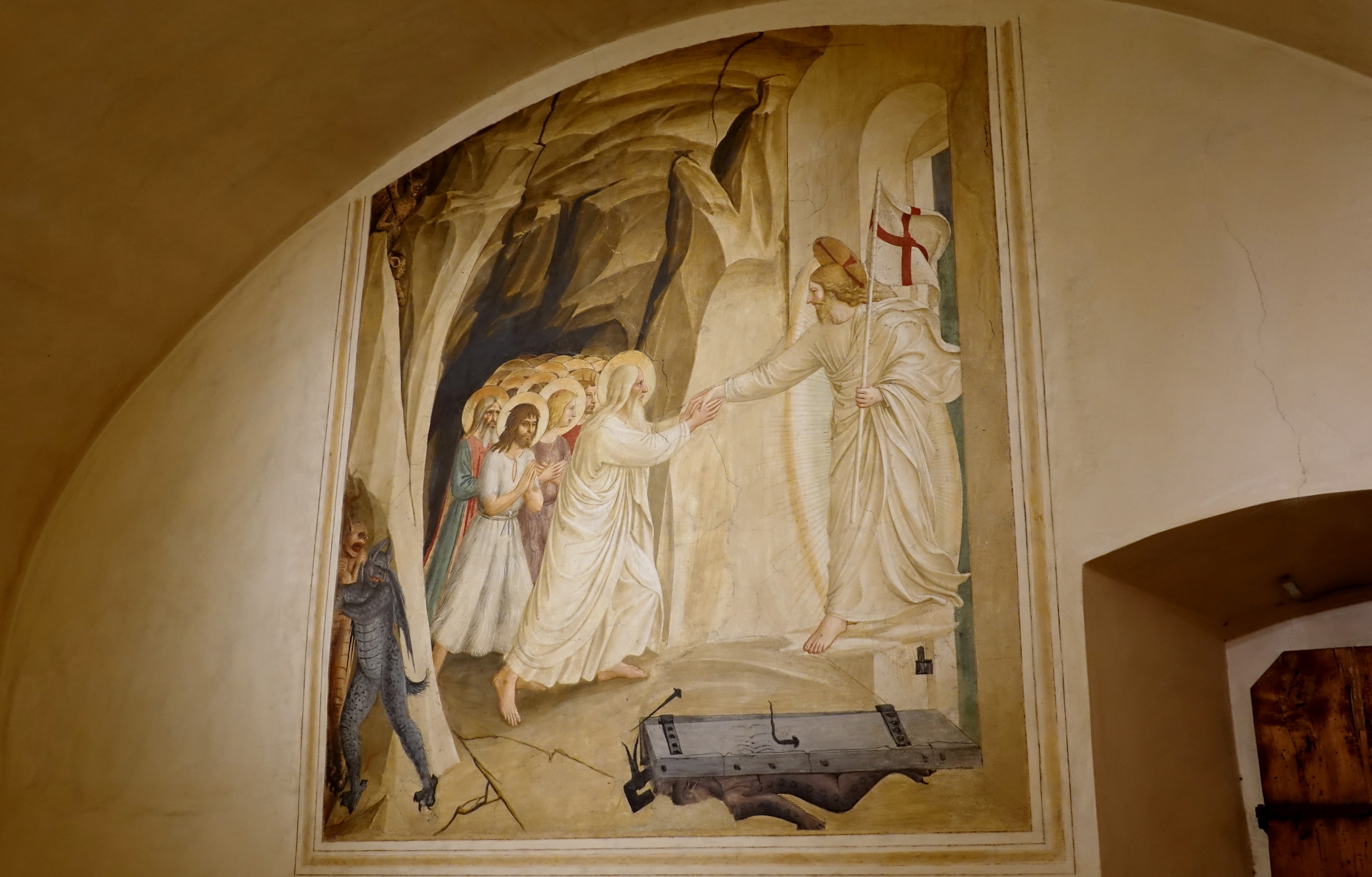
Christ in Limbo, fresco by Fra Angelico and workshop (c. 1440s), Convent of San Marco, Florence. The fallen door under Christ's feet is the traditional sign that the gates of death are broken. Photo: Prof. Mortel, public domain, via Wikimedia Commons, resized.

The 30-second version:
When Jesus died, His body went to the tomb and He went to the realm of the dead, which the New Testament calls Hades. Peter says He was not abandoned there. Christians agree on that much and differ on what He did. The Eastern church celebrates Him breaking the gates of death and freeing Adam and Eve. Many scholars read 1 Peter 3:19 as Christ announcing victory to rebel angels. Augustine read it as Christ preaching through Noah. No reading teaches a second chance after death for all.
See this page's graph and discover linked topics
In full
The doctrine of Christ's descent (Latin descensus ad inferos) concerns the state and activity of Christ between His death and resurrection. Its textual base is narrow: 1 Peter 3:18-20, 1 Peter 4:6, Ephesians 4:8-10, and Peter's use of Psalm 16:10 in Acts 2:27 and 31, with supporting texts such as Matthew 12:40, Romans 10:7 (as a phrase only) and Revelation 1:18. Only Acts 2 states without dispute that Christ was in Hades, the realm of the dead (G0086 - hades), and that He was not left there. Whether any text describes activity there is the contested question.
Three readings of 1 Peter 3:19 dominate the history of interpretation: (1) a proclamation to the dead in Hades, usually understood as announcing victory or releasing the righteous of the old covenant, the reading behind the Eastern and Western "harrowing of hell" tradition; (2) a proclamation of victory and judgment to the fallen angels imprisoned since the flood, read against the background of 1 Enoch and argued at length by William J. Dalton; (3) Christ's preaching "in the spirit" through Noah to his contemporaries, now dead, defended by Augustine in his Letter 164 and by Wayne Grudem among modern evangelicals. The creedal clause "descended into hell" entered the creeds late: a descent clause appears in the Dated Creed of Sirmium (359), and in the Western baptismal creed it is first attested in the Aquileian form Rufinus commented on around 404. It has been explained differently by Catholic, Orthodox, Lutheran and Reformed confessions. Grudem has argued it should be dropped; others defend it. No major tradition teaches from these texts a universal post-mortem offer of salvation to those who rejected the gospel in life.
The texts
1 Peter 3:18-20, the spirits in prison
Because Christ also suffered for sins once, the righteous for the unrighteous, that he might bring us to God; being put to death in the flesh, but made alive in the spirit; in which also he went and preached unto the spirits in prison, that aforetime were disobedient, when the longsuffering of God waited in the days of Noah, while the ark was a preparing, wherein few, that is, eight souls, were saved through water: (1 Peter 3:18-20, ASV)
What the Greek establishes, and what it leaves open:
- "Preached" is ekēryxen, the aorist of kēryssō (G2784), to proclaim as a herald. The verb names the act of announcing. It does not by itself say whether the message was good news, a declaration of victory, or a sentence of judgment. Context decides.
- "Spirits" is pneumasin (G4151). In the New Testament, pneumata used without qualification usually refers to non-human spirits; when human spirits are meant, the text normally says so, as in "the spirits of just men made perfect" (Hebrews 12:23, ASV). This is the strongest lexical point for the angelic reading. It is a tendency, not a rule.
- "In prison" is en phylakē, a place of custody. 2 Peter 2:4 and Jude 6 both speak of angels who sinned being kept in chains or pits of darkness "unto the judgment" (2 Peter 2:4, ASV; Jude 6).
- "Went" is poreutheis, the same participle Peter uses three verses later of the ascension: "having gone into heaven" (1 Peter 3:22, ASV). Dalton and others take this as a sign that 3:19 describes the risen Christ's journey of exaltation, not a descent.
- "Made alive in the spirit; in which also" places the proclamation in the sphere of the Spirit. Readers who hold the Noah view take "in which" to mean the Spirit by whom Christ spoke through Noah (compare 1 Peter 1:11, where the Spirit of Christ spoke in the prophets). Readers who hold the descent or angelic views take it to mean Christ in His resurrected or disembodied state.
- The time marker ("aforetime were disobedient, when the longsuffering of God waited in the days of Noah") dates the disobedience, and on the Noah view the preaching too, to the generation of the flood.
1 Peter 4:6, the gospel preached to the dead
For unto this end was the gospel preached even to the dead, that they might be judged indeed according to men in the flesh, but live according to God in the spirit. (1 Peter 4:6, ASV)
- A different verb. Here the verb is euēngelisthē, the aorist passive of euangelizō (G2097 - euangelizo), "the good news was announced". In 3:19 Peter wrote ekēryxen, "he proclaimed". The two passages are related in theme but not in vocabulary, and they need not describe the same event.
- Who are "the dead"? Verse 5 has just said God is "ready to judge the living and the dead" (1 Peter 4:5, ASV). Many modern commentators read 4:6 as believers who heard the gospel while alive and have since died: the world judged them by dying "according to men in the flesh", but they will live "according to God in the spirit". The older reading takes it as preaching to people already dead, linked with 3:19.
- Fit with the letter. 1 Peter is written to suffering Christians. On either reading, the point is that death does not cancel God's vindication of those who believed.
Ephesians 4:8-10, the lower parts of the earth
Wherefore he saith, When he ascended on high, he led captivity captive, And gave gifts unto men. (Now this, He ascended, what is it but that he also descended into the lower parts of the earth? He that descended is the same also that ascended far above all the heavens, that he might fill all things.) (Ephesians 4:8-10, ASV)
- "The lower parts of the earth" (ta katōtera merē tēs gēs) can be read two ways grammatically. As a partitive, "the parts lower than the earth", it points to the underworld. As an appositional genitive, "the lower parts, namely the earth", it points to the incarnation, the descent from heaven to earth.
- A third reading. W. Hall Harris III (The Descent of Christ: Ephesians 4:7-11 and Traditional Hebrew Imagery, Brill, 1996) argues that the descent follows the ascent and refers to Christ descending as the Spirit at Pentecost to give the gifts listed in 4:11.
- Psalm 68:18. Paul's quotation reads "gave gifts", where the Hebrew of Psalm 68:18 reads "Thou hast received gifts among men" (Psalm 68:18, ASV). Interpreters discuss this alongside the Jewish tradition that associated the psalm with Moses ascending Sinai.
- "Led captivity captive" was read by many Fathers as Christ leading the righteous dead out of Hades. The text itself says only that the ascending victor led captives.
Acts 2:27, 31, not abandoned to Hades
Peter applies Psalm 16:10 to Jesus: "Because thou wilt not leave my soul unto Hades, Neither wilt thou give thy Holy One to see corruption" (Acts 2:27, ASV), and explains that David "spake of the resurrection of the Christ, that neither was he left unto Hades, nor did his flesh see corruption" (Acts 2:31, ASV). The Hebrew of the psalm has Sheol (H7585 - sheol), "thou wilt not leave my soul to Sheol" (Psalm 16:10, ASV).
This is the firmest text. It presupposes that Christ's soul went where the dead go, and it insists He did not stay. It says nothing about preaching.
Supporting texts
- Matthew 12:40, the Son of Man "three days and three nights in the heart of the earth" (ASV).
- Luke 23:43, "To-day shalt thou be with me in Paradise" (ASV). Any account of the descent must fit this promise to the thief. Those who affirm a descent often take Paradise to be the blessed part of the realm of the dead; Grudem takes the verse as one reason to deny a descent to Hades altogether.
- Revelation 1:18, "I have the keys of death and of Hades" (ASV).
- Matthew 27:52-53, the saints raised at the crucifixion, often read in the tradition alongside the descent.
Hades is not Gehenna
Much confusion comes from one English word. Older translations render both hadēs and geenna as "hell".
- Hades (G0086 - hades), the Greek equivalent of Hebrew Sheol, is the realm of the dead between death and resurrection. It is temporary: at the end, "death and Hades were cast into the lake of fire" (Revelation 20:14, ASV).
- Gehenna (G1067 - geenna) is the place of final judgment that Jesus warns of.
- Tartarus (G5020 - tartaroo) appears once, in verb form, in 2 Peter 2:4, for the confinement of angels who sinned.
When the creed says Christ "descended into hell", the Latin is ad inferos or ad inferna, "to those below" or "to the lower regions". It means the realm of the dead, not the lake of fire. No mainstream tradition holds that Christ suffered in Gehenna after His death.
Three readings of 1 Peter 3:19
| Reading | What happened | Main support | Main difficulty |
|---|---|---|---|
| Descent to the dead | Between death and resurrection Christ entered Hades, announced His victory, and (in most forms) led out the righteous dead | Early and widespread patristic reading; Acts 2 places Christ in Hades; fits the creedal clause and the "harrowing" tradition | "Spirits" unqualified more often means angels; the spirits named are the disobedient of Noah's day, not the righteous |
| Proclamation to fallen angels | The risen Christ, on His way to exaltation, proclaimed His victory and their doom to the angels imprisoned since the flood | Pneumata usage; 2 Peter 2:4 and Jude 6; 1 Enoch's Watchers; poreutheis in 3:19 and 3:22; fits 3:22 "angels... being made subject unto him" | Requires reading 1 Peter against 1 Enoch; Noah's flood links the spirits to disobedient humans in Genesis 6 for some readers |
| Christ preaching through Noah | Before the flood, Christ "in the spirit" preached through Noah, "a preacher of righteousness" (2 Peter 2:5, ASV), to his contemporaries, who are now "spirits in prison" | 1 Peter 1:11 has the Spirit of Christ speaking in the prophets; 3:20 dates the setting to Noah; Augustine, Letter 164 | "Spirits in prison" then describes their present state, not their state when preached to; the sequence in 3:18-19 reads more naturally as after Christ's death |
1. Descent to proclaim victory and release the righteous dead
- Early witnesses. Ignatius of Antioch writes that the prophets who awaited Christ were raised by Him when He came (To the Magnesians 9). Justin Martyr cites a saying he attributes to Jeremiah, that the Lord "descended to preach to them His own salvation" (Dialogue with Trypho 72). Irenaeus reports a presbyter's teaching that the Lord descended to the regions beneath the earth to announce His coming there also (Against Heresies 4.27.2). See Ignatius of Antioch, Justin Martyr, Irenaeus of Lyons.
- Later narrative. The apocryphal Gospel of Nicodemus (the Descent into Hell section attached to the Acts of Pilate) gives the dramatic form of the harrowing: Christ breaks the gates of bronze, binds Satan, and leads out Adam and the righteous. It is a later, non-canonical work, and its details are legend, but it shaped medieval art and drama.
- The core claim is modest: Christ truly died, went where the dead go, and as Victor announced the triumph of the cross to those who had died in hope before Him.
2. Proclamation of judgment to fallen angels
- Background. In 1 Enoch, the Watchers, angels who sinned with human women before the flood (compare Genesis 6:1-4, Nephilim and the Sons of God), are bound under the earth until the judgment, and Enoch is sent to announce to them that they will have no peace (1 Enoch 10-16).
- William J. Dalton, Christ's Proclamation to the Spirits: A Study of 1 Peter 3:18-4:6 (Analecta Biblica 23, Pontifical Biblical Institute, 1965; 2nd ed. 1989), is the standard defence. Dalton argues that Christ, as the new Enoch, proclaims His victory to these spirits during His ascension, and that 3:22 completes the thought: angels and authorities are made subject to Him.
- Pastoral point in 1 Peter. Suffering readers are told that the powers behind their persecutors have already been defeated.
3. Christ preaching through Noah
- Augustine, Letter 164 (to Evodius, c. 414), wrestles with the passage at length. He affirms that Christ descended to hell, but declines to read 1 Peter 3:19 as preaching to the dead there, and proposes that Christ, in the spirit, preached through Noah to the unbelievers of that generation. See Augustine.
- Wayne Grudem defends the same reading in his Tyndale commentary 1 Peter (1988).
- Strength. It keeps the preaching inside history, where 1 Peter 1:11 already places the Spirit of Christ speaking through prophets, and it matches 2 Peter 2:5, which calls Noah "a preacher of righteousness".
The creedal clause
- Not in the earliest creeds. The Old Roman Creed and the other early baptismal creeds lack it. Rufinus of Aquileia, commenting on his own church's creed around 404, notes that descendit ad inferna is found in the creed of Aquileia but not in the creed of the Roman church nor in the creeds of the Eastern churches, and suggests its meaning is already contained in "buried" (Commentary on the Apostles' Creed 18).
- Earlier conciliar use. A descent clause appears in the Dated Creed of Sirmium (359), which says the gatekeepers of Hades saw Him and trembled, an echo of Job 38:17 ("Have the gates of death been revealed unto thee? Or hast thou seen the gates of the shadow of death?", ASV). See Job 38.17.
- Later standard text. The clause became fixed in the Western received text of the creed. See Apostles' Creed for the creed's history.
- Wayne Grudem's plea. In "He Did Not Descend into Hell: A Plea for Following Scripture Instead of the Apostles' Creed" (Journal of the Evangelical Theological Society 34, no. 1, March 1991, 103-113), Grudem argues that the phrase is a late addition, that no text clearly teaches a descent to preach in hell, that Luke 23:43 and Luke 23:46 point to Christ's spirit going to the Father, and that churches should omit the clause or explain it as "He descended to the dead". David Scaer replied in the same journal the next year, "He Did Descend to Hell: In Defense of the Apostles' Creed" (JETS 35, no. 1, 1992, 91-99).
How the traditions read it
- Eastern Orthodox. The descent is central to Pascha. The resurrection icon (Anastasis) shows Christ standing on the broken gates of Hades, pulling Adam and Eve from their tombs. The Paschal hymn proclaims that Christ has risen, "trampling down death by death". Orthodoxy treats the descent as Christ's victory over death and the release of the righteous, without teaching a general emptying of hell. See Eastern Orthodox.
- Roman Catholic. The Catechism of the Catholic Church (632-637) teaches that Christ descended to the realm of the dead as Savior, and that He did not descend to deliver the damned or to destroy the hell of damnation, but to free the just who had gone before Him (633). Thomas Aquinas treats the descent in Summa Theologiae III, q. 52. See Thomas Aquinas.
- Lutheran. The Formula of Concord (Article IX) confesses that the whole person of Christ, God and man, descended into hell after His burial, conquered the devil, and destroyed hell's power, and warns against speculating on how. Lutherans typically treat it as the first step of Christ's exaltation, not the last step of His humiliation. See Martin Luther.
- Reformed. Calvin (Institutes 2.16.8-12) reads the clause as the spiritual anguish Christ bore under God's wrath on the cross, and the Heidelberg Catechism (Q&A 44) follows him: Christ endured inexpressible anguish, pains and terrors of soul, a hellish agony, so that believers are delivered from hellish anguish. The Westminster Larger Catechism (Q&A 50) explains the clause as Christ "continuing in the state of the dead, and under the power of death till the third day". See John Calvin, Heidelberg Catechism.
- Evangelical. Views spread across the three readings. Many evangelical commentators now favor the angelic reading of 1 Peter 3:19 and the "died and was buried" sense of the clause; some, with Grudem, would drop it; others keep it and teach the victory reading.
What the texts do not teach
- No second chance for all. None of these passages says that everyone who refused God in life will hear the gospel after death and may then accept it. 1 Peter 3:19 concerns a specific group, the disobedient of Noah's day (on any reading), and "preached" there is kēryssō, not euangelizō. 1 Peter 4:6 is most naturally about believers who have died. "It is appointed unto men once to die, and after this cometh judgment" (Hebrews 9:27, ASV).
- What remains open. Whether Christ's work reached the righteous of the old covenant who died before Him is a separate question, and most traditions answer yes in some form: they were saved by the same Christ in whom they hoped (compare Hebrews 11:39-40). How God deals with those who never heard is treated on Salvation of the Unevangelized, where post-mortem evangelism is one of the positions examined and its textual base is weighed.
- Not purgatory or universalism. The descent texts are sometimes pressed into service for purgatory or for Universalism. The Catholic Catechism itself rejects the idea that Christ freed the damned, and the Orthodox tradition does not teach that hell was emptied.
See also
- Apostles' Creed, the creed that carries the clause
- G0086 - hades, the realm of the dead, distinct from Gehenna
- G1067 - geenna, the place of final judgment
- H7585 - sheol, the Hebrew word behind Psalm 16:10
- G2097 - euangelizo, the verb of 1 Peter 4:6
- Salvation of the Unevangelized, the wider question of those who never heard
- Hell and Eternal Punishment, final judgment and its nature
- Resurrection of the Body, the hope the descent points toward
- Nephilim and the Sons of God, the Genesis 6 background of the angelic reading
- Job the Patriarch, one of the righteous who died long before Christ
- Christology, the person and work of Christ
Common questions this page answers
Q: Did Jesus go to hell after He died?
He went to the realm of the dead, which the New Testament calls Hades, and was not left there (Acts 2:27, 31). That is not Gehenna, the place of final punishment. When the Apostles' Creed says "He descended into hell", the Latin means "to the lower regions", the place of the dead.
Q: Who are the "spirits in prison" in 1 Peter 3:19?
There are three main answers: the dead in Hades to whom Christ announced His victory; fallen angels imprisoned since Noah's day, to whom He proclaimed His triumph (the view William Dalton defended); or people of Noah's generation, now dead, to whom Christ preached through Noah (Augustine's view). The word "spirits" without qualification usually means non-human spirits in the New Testament, which is a strong point for the angelic reading.
Q: Did Jesus give people in hell a second chance to be saved?
No text teaches that. 1 Peter 3:19 uses a verb meaning "proclaimed", not "preached the gospel", and concerns the disobedient of Noah's day. 1 Peter 4:6 most likely refers to believers who heard the gospel in life and later died. Hebrews 9:27 says judgment follows death.
Q: What is the Harrowing of Hell?
It is the traditional name for Christ's victorious entry into the realm of the dead between Good Friday and Easter, breaking its gates and leading out the righteous who died before Him, especially Adam and Eve. It is central to Eastern Orthodox Easter worship and common in medieval Western art and drama.
Q: Why do some churches leave "He descended into hell" out of the Apostles' Creed?
The clause is a later addition. Rufinus noted around 404 that it was in the creed of Aquileia but not in the Roman or Eastern creeds. Wayne Grudem argued in 1991 that Scripture does not clearly teach a descent into hell and that the clause should be dropped or rendered "He descended to the dead". Others, such as David Scaer, defend keeping it.
Q: What is the difference between Hades and Gehenna?
Hades is the temporary realm of the dead between death and resurrection, the Greek counterpart of Hebrew Sheol. Gehenna is the place of final judgment Jesus warned about. At the end, Hades itself is cast into the lake of fire (Revelation 20:14).
Q: What do Calvin and the Heidelberg Catechism say about the descent?
They read "He descended into hell" as the spiritual anguish Christ bore under God's wrath on the cross, so that believers are spared that anguish. The Westminster Larger Catechism instead explains it as Christ remaining in the state of the dead until the third day.
Q: What does Ephesians 4:9 mean by "the lower parts of the earth"?
It may mean the underworld (the parts below the earth), the earth itself (Christ's coming down from heaven in the incarnation), or, as W. Hall Harris argues, Christ's descent as the Spirit at Pentecost after His ascension to give gifts to the church.