Argument
Yahweh Is a Canaanite God Objection Defeater
Yahweh is a Canaanite god, yahweh is a canaanite god defeater, is yahweh a canaanite god, yahweh canaanite god, Yahweh Borrowed From the Canaanites Objection Defeater, yahweh borrowed from canaanites, yahweh stolen from canaanites, yahweh not in ugaritic texts, israel stole yahweh, yahweh is el, canaanite origins of yahweh, what does yahweh mean, meaning of the name yahweh, ehyeh asher ehyeh, is yahweh a hebrew word, shasu of yhw, shasu of yah, sashu of yah, soleb inscription yahweh, yahweh borrowed deity objection, origin of yahwehIntro
You have probably heard it said with total confidence: "Yahweh was just a Canaanite god. Israel borrowed him from the people next door, the way one town copies another town's mascot, then called it revelation." If that were true, the God of the Bible would be a repackaged local idol.
Start with His name, because it answers the claim better than anything dug out of the ground. At the burning bush, Moses asks God what His name is. God answers, "I AM THAT I AM" (Exodus 3:14). In Hebrew that is ehyeh asher ehyeh, from the everyday Hebrew verb "to be": ehyeh means "I am" or "I will be." In the very next verse God gives the name His people are to use forever: YHWH, which English Bibles print as "the LORD" (Exodus 3:15). YHWH is the same verb turned to the third person. When God speaks of Himself, He says "I am." When we speak of Him, we say "He is."
Think about what that means. If your family started calling your dog by a word from another language, the word would mean nothing to you; it would just be a sound. That is how borrowed god-names behave. The Greeks took the god Adonis from a Semitic word meaning "lord," and in Greek it meant nothing at all; it was just a name. Yahweh is the opposite. It is a sentence in Israel's own language, "He is," and Israel's founding story explains it at the very moment the name is given.
Now look at Canaan itself. The biggest library of Canaanite religion ever found, the clay tablets of Ugarit, names El, Baal, Asherah, Anat, Yam (Sea) and Mot (Death). It never names Yahweh. Daniel Fleming, a leading scholar who argues that Yahweh came from outside Israel, still states plainly that Yahweh is missing from every god-list of Canaan and Syria in the second millennium BC. You cannot borrow a god your neighbors never had.
And the record runs the other way. The name first shows up among the Shasu, desert herders the Egyptians listed apart from Canaan's cities. Then it shows up in Israel, on stone, in letters and in the names Israelites gave their own children, centuries before the exile to Babylon.
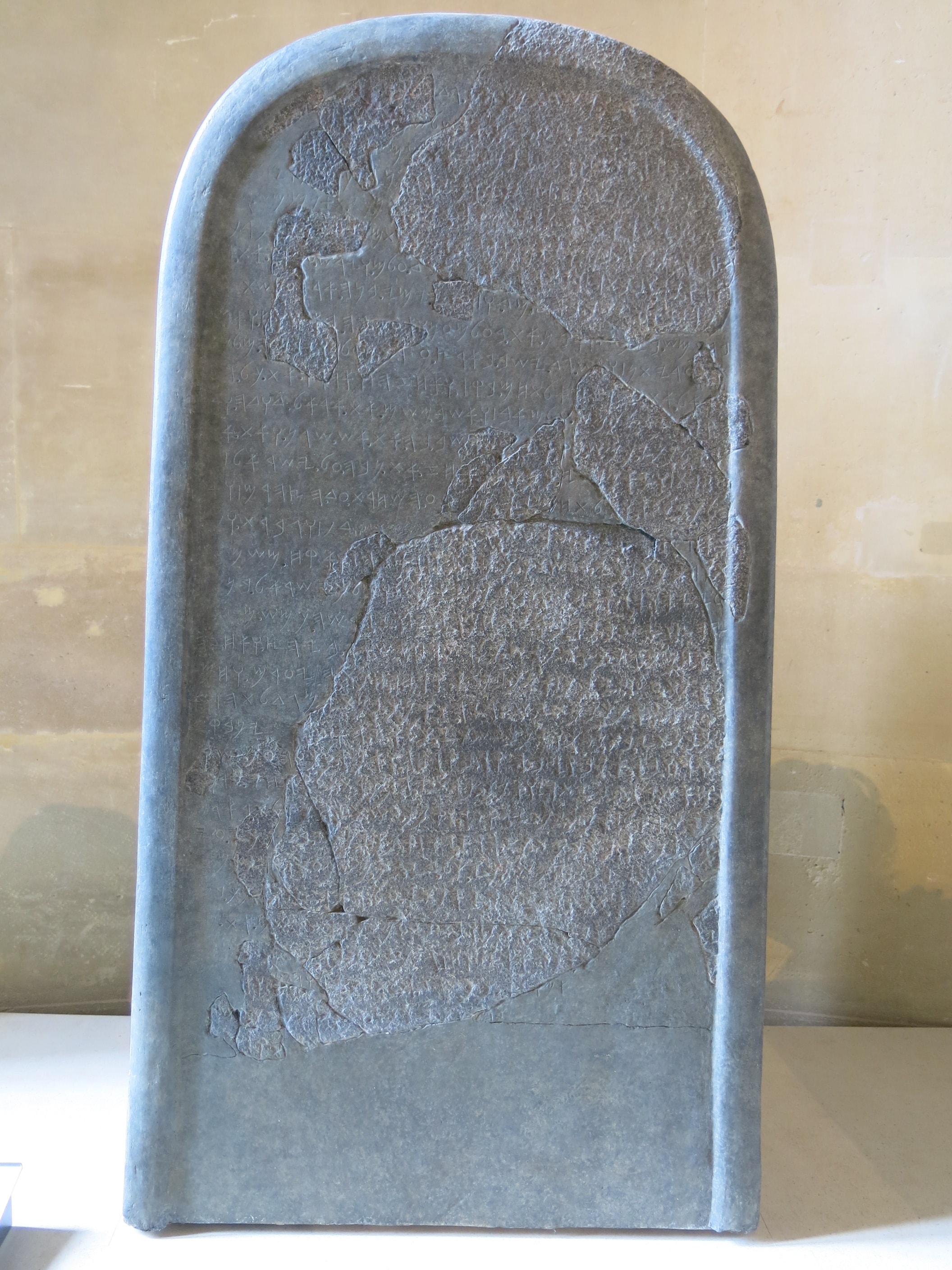
The Mesha Stele (about 840 BC), set up by Mesha, king of Moab, now in the Louvre. It boasts of taking the vessels of Yahweh from Israel's sanctuary at Nebo: the earliest datable mention of Yahweh outside the Bible, and Israel's enemy names Him as Israel's God. Image: public domain, via Wikimedia Commons.

The short version:
- God's name, YHWH, is a Hebrew verb: "He is," the third-person form of the "I AM" God speaks at the burning bush.
- Israel's own founding text gives that meaning at the moment the name is revealed. Borrowed god-names do not come with a meaning in the borrower's language.
- Canaan's own religious texts never name Yahweh, so there was no Canaanite Yahweh to borrow.
- From the earliest mention to the Babylonian exile, the evidence shows the name outside Canaan's pantheon and then at the heart of Israel's life.
- And even if Israel's words for God had a long history, where a word comes from cannot tell you whether the God it names is real.
See this page's graph and discover linked topics
In full
The objection compresses a history-of-religions reconstruction associated with Mark S. Smith (The Early History of God) and Frank Moore Cross (Canaanite Myth and Hebrew Epic): early Israelite religion emerged from a West Semitic matrix in which El was the high god; Yahweh entered from elsewhere and was later identified with El; and folk practice kept traces of polytheism. The strongest reply begins with the name. The specialists agree the Tetragrammaton is a finite verb, "a 3rd masc. sing. imperfect" in Karel van der Toorn's words (Dictionary of Deities and Demons in the Bible, 1999, p. 913), built on the root hwh/hyh, "to be"; biblical Hebrew preserves both the older root (Strong's H1933, for example the third-person yehu, "it shall be," in Ecclesiastes 11:3) and the classical hayah (H1961), and Exodus 3:14-15 moves from the first-person ehyeh to the third-person name. That root belongs to Hebrew, Aramaic and Moabite; the coastal Canaanite languages of the pantheon texts, Ugaritic and Phoenician, formed "to be" from a different root, kwn (Anson Rainey). A theonym that is a predication in the worshipping community's own language, with that community's own account of its meaning, is not what the borrowing of a foreign deity name produces: borrowed divine names typically travel as opaque labels, as Semitic adon, "lord," became the meaningless Greek name Adonis. The epigraphy agrees. Yahweh is absent from every Bronze Age Canaanite and Syrian god-list (Fleming, Yahweh before Israel, 2020, p. 5; van der Toorn, p. 910); the earliest probable attestation, "the Shasu-land of Yhw" at Soleb (Amenhotep III, about 1390 to 1352 BC), sits among pastoral Shasu, not in a Canaanite pantheon; the scholars who study Yahweh's origins most closely (Fleming, Römer, Smith, Tebes, Day) place them outside the Canaanite pantheon, and Fleming explicitly denies that Yahweh began as El. The honest limits are stated on the page: the Exodus explanation has been called theology rather than etymology, Semitic languages share roots, and an Arabian etymology ("he blows") has serious defenders. None of those limits produces a Canaanite god named Yahweh, and none can bridge the final gap in the objection, the inference from a word's history to a God's unreality, which is the genetic fallacy.
Argument structure
| # | Premise |
|---|---|
| P1 | The name YHWH is a Hebrew verb, "He is," the third-person form of the ehyeh ("I am") God speaks in Exodus 3:14; Israel's own text explains it as the name is revealed, and its root is the Hebrew-Aramaic-Moabite verb of being, not the one the Canaanite pantheon languages used. Borrowed divine names arrive as opaque labels. |
| P2 | The earliest probable attestation of the name (Soleb, about 1390 to 1352 BC) places it among the pastoral Shasu, outside the Canaanite city-states and their pantheon, and the Bible's oldest poetry independently has Yahweh coming from the south. |
| P3 | Yahweh is absent from every Bronze Age Canaanite and Syrian god-list, including the rich archive of Ugarit, so there was no Canaanite Yahweh to borrow. |
| P4 | The "they stole El" claim equivocates: el is both the proper name of a Canaanite god and the ordinary Semitic word for "god," and the Bible openly identifies Yahweh with God Most High as a claim of supremacy, not a hidden theft. |
| P5 | Even granting a long development, "Israel's religion has a history, therefore its God is not real" is a genetic fallacy, and the syncretism critics cite is exactly what the prophets condemned. |
| C | Therefore the claim that Yahweh is a Canaanite god Israel borrowed fails: the name is a Hebrew sentence explained in Israel's own founding text, the Canaanite record has no Yahweh, the evidence runs from outside Canaan's pantheon into Israel, and the final inference from origin to unreality is a logical fallacy. |
Cheatsheet
The 30-second reply:
Start with the name. At the burning bush God says "I AM THAT I AM," ehyeh asher ehyeh, from the Hebrew verb "to be." The next verse gives His name, YHWH, the same verb in the third person: "He is." Borrowed god-names don't come with a meaning in your own language and an explanation in your own founding story. And Canaan never had a Yahweh to lend: the Ugaritic tablets name El, Baal, Asherah, Yam and Mot, and even scholars who say Yahweh came from outside Israel admit no Canaanite god-list names him. So which Canaanite text are you thinking of?
- Fast facts:
- YHWH is a third-person masculine verb form, "He is," from the root "to be" (Strong's H3068 from H1961; older form H1933). Even critical reference works agree the name is "a finite verbal form" (van der Toorn, DDD 1999, p. 913).
- The Hebrew root of "to be" behind the name is shared with Aramaic and Moabite; Ugaritic and Phoenician used a different root, kwn (Anson Rainey).
- Yahweh appears in no Bronze Age Canaanite or Syrian god-list (Fleming 2020, p. 5).
- Soleb (about 1390 to 1352 BC) and Amarah West (about 1279 to 1213 BC) list "the Shasu-land of Yhw," among desert herders, not in a pantheon.
- The Mesha Stele (about 840 BC) is the earliest datable mention of Yahweh outside the Bible, as Israel's God.
- About 91 percent of personal names in excavated Hebrew inscriptions honor Yahweh (Jeffrey Tigay).
- Counter-moves: (1) Translate the name: "He is." (2) Ask for the Canaanite text that names Yahweh. (3) Walk the timeline. (4) Split the pun on el. (5) Name the genetic fallacy and give a reductio.
- Concessions (say them yourself, it builds trust): Hebrew belongs to the same language family as Canaan's languages; the Bible uses El language and borrows poetic imagery from the region; scholars debate the name's exact derivation; and Israelites did sometimes worship other gods, which the prophets condemned.
- Closing line: "Ask what 'Baal' means and you get 'lord.' Ask what 'Yahweh' means and you get a sentence: 'He is.' Israel did not borrow a label. God told them who He is."
Grammar and hermeneutics
- Two persons of one verb. In Exodus 3:14 the Hebrew is ehyeh asher ehyeh: ehyeh is the first-person imperfect of hayah, "to be" (Strong's H1961, the tag the KJV text carries on "I AM"), meaning "I am" or "I will be." Exodus 3:15 then gives the name YHWH (H3068), which the lexicons derive from the same verb. The text moves on purpose from God's first person ("I AM hath sent me") to the third person of the name ("The LORD... this is my name for ever"). The name is what God's self-description becomes on human lips: "He is."
- Why the name is Yahweh and not yihyeh. The classical third person of hayah is yihyeh. The name is built on hawah, an older form of the same verb (Strong's H1933), which Hebrew still uses in a few places: "be lord over thy brethren" (Genesis 27:29), "be thou a covert to them" (Isaiah 16:4), and, in the third person masculine exactly like the name, yehu, "there it shall be" (Ecclesiastes 11:3). The precise vowels of the name are debated, so the claim here is the root, the person and the prefix, all of which are attested Hebrew.
- Qal or causative, it is still a verb of being. Most lexicons read the name as the simple form, "He is"; a minority (Albright, Cross, Freedman) read a causative, "He causes to be." Either way it is a Hebrew-type verb of being describing the God who exists and creates.
- Shortened forms show the name lived in Israelite mouths. The short form Yah ("hallelu-yah") and names such as Elijah (Eliyahu, "my God is Yahweh") and Isaiah (Yeshayahu, "Yahweh saves") are Hebrew sentences built around the name. Israelites wrapped their children's names around it in their own language.
- Revelation, not coinage. Exodus 6:3 ("by my name JEHOVAH was I not known to them") concerns how God made Himself known to the patriarchs, not when the syllables were first spoken: Genesis uses the name from chapter 2 on, and Genesis 4:26 has people calling on it before Abraham.
Logical fallacies in the objection
The objection usually arrives as a single confident sentence. Taken apart, it leans on six separate errors of reasoning. Each is named below in plain terms, located in the objection, and then tested by a reductio: the same reasoning applied to a case where everyone can see the conclusion is wrong.
1. The genetic fallacy
- What it is: judging a claim true or false by where it came from, instead of by the evidence for it. How a belief started is one question; whether it is true is another.
- Where the objection commits it: "Israel's religion grew out of the same world as the Canaanites', so its God is not real." Even if every step of the history were granted, the conclusion does not follow from it.
- Reductio: English speakers call the Creator "God," a word inherited from Germanic tribes who used it of their pagan gods. Thursday is Thor's day, and Mars and Jupiter carry the names of Roman gods. Chemistry grew out of alchemy, astronomy out of astrology, and the first form of the Hippocratic oath swears by Apollo. If an origin in pagan or mistaken practice made a thing false, chemistry would be false and so would this sentence, written in a language full of pagan words. Nobody accepts that, so the origin of Israel's words and customs cannot settle whether Israel's God is real.
2. The argument from silence
- What it is: concluding that something did not exist, or came late, only because one source does not mention it.
- Where the objection commits it: "Yahweh is not in the Ugaritic texts, so Israel must have got him later from somewhere else."
- Reductio: The Linear B tablets of Mycenaean Greece, from the same centuries as Ugarit, name Zeus; Ugarit's tablets do not. By the objection's rule, Zeus did not exist in Greece either. A city's archive records that city's gods. Silence in a northern Syrian library tells us nothing about a God whose earliest mention is among desert herders outside Canaan's cities.
3. Equivocation
- What it is: letting one word slide between two meanings in the middle of an argument.
- Where the objection commits it: "The Bible calls God El, and El was a Canaanite god, so the Bible's God is the Canaanite god." The first el is the ordinary Semitic word for "god"; the second is the proper name of one Canaanite deity.
- Reductio: Muslims and Arab Christians both say Allah, the Arabic word for God, and Spanish speakers say Dios from the Latin deus, a word Romans used for Jupiter. On the objection's logic, every Arabic Bible worships the god of Mecca and every Spanish Bible worships Jupiter. Sharing a word for "god" is not sharing a god.
4. The fallacy of the undistributed middle (guilt by shared features)
- What it is: concluding two things are the same because they share some feature. "Canaanite gods had titles and sanctuaries; Yahweh had titles and sanctuaries; so Yahweh is a Canaanite god."
- Where the objection commits it: every shared title ("Most High," "rider of the clouds"), shared ritual (altars, sacrifice) or shared poetic image is treated as proof of identity.
- Reductio: Canaanite kings had palaces, armies and scribes; so did the kings of Egypt. By the same reasoning Pharaoh was a Canaanite king. Two things in the same region and the same century will share a great deal. Identity needs a shared origin shown by evidence, not overlapping features.
5. The false dilemma
- What it is: offering two options as if they were the only ones, when others exist.
- Where the objection commits it: "Either Yahweh fell from heaven with a brand-new name and vocabulary, or he was borrowed from the Canaanites." The Bible's own account is a third option: God made Himself known within a real people, in their own language, over generations, beginning before Israel existed (Genesis 4:26; Exodus 3:15).
- Reductio: "Either English was handed down complete from the sky, or English is secretly French because it borrowed French words." Both options are false; languages and peoples develop, and a real history of development is what we should expect if God revealed Himself to a real people.
6. Begging the question
- What it is: assuming the conclusion in order to prove it.
- Where the objection commits it: "Gods are human inventions that spread from culture to culture; Yahweh is a god; so Yahweh spread from another culture." The first premise already assumes that no god is real, which is the very point in dispute.
- Reductio: A believer could argue the same way in reverse: "Every true thing comes from God; the Bible is true; so the Bible comes from God." A skeptic would rightly reject that as circular. The borrowing objection is circular in the same way: it only reaches "Yahweh is a human construct" by assuming it at the start.
The hidden premise: the objection assumes God is a myth
Underneath every version of the objection sits an unstated premise: gods are human inventions, so the only question worth asking about Yahweh is which people invented him first. That premise is the whole debate, and the objection never argues for it. It simply assumes it, then reads every piece of history through it.
Take it out and look at what is left. Suppose, for the sake of argument, the critic were right about every historical detail: that Israel's words for God, its poetry and even its earliest worship grew up among neighboring peoples. None of that could show that Yahweh is not the true God. A true God who made Himself known to real people would be known in their language, among their neighbors, inside their history. The question "where did Israel's knowledge of God come from?" is a question about people. The question "is Yahweh the God who actually exists?" is a question about God, and history alone cannot answer it.
So the right question is the one the objection skips: what would a true God have to be like, and does the God of the Bible fit?
Which God is real? The five marks of a true God
The codex's full case is made at Christian God is the Only True God. It sets out five marks any true God must have, then tests every serious candidate against them. Here is how they bear on this page:
- He must exist necessarily, owing His being to nothing. A god who came into being, or depends on anything else, is just another part of the world. Yahweh's very name says this: "He is." The God of Exodus 3:14 is the one being who simply is, "from everlasting to everlasting" (Psalm 90:2). Canaan's gods, by contrast, have parents, rivals and deaths in their own myths: in the Ugaritic Baal Cycle, Baal goes down into the throat of Mot, the god of death, and returns only after the goddess Anat destroys Mot.
- He must be personal and relational. An impersonal force cannot speak, love or make promises. Yahweh is the God who speaks at the bush, gives His name, and binds Himself to a people in covenant.
- He must ground objective right and wrong. Morality that is real for everyone needs a source beyond any one culture. Yahweh's law flows from His own character: "Ye shall be holy; for I Jehovah your God am holy" (Leviticus 19:2, ASV).
- He must show Himself in public history. A god known only through private feelings cannot be checked. The God of the Bible acts in datable history, and above all in the resurrection of Jesus, argued at Argument from the Resurrection.
- He must explain the human condition: why we are made for good and still do wrong, and how that can be put right. The Bible's answer is a God who is both just and merciful, and who meets our guilt at the cross (Romans 3:26).
The full page shows that pantheons, impersonal absolutes, deism and the other candidates each fail at least one mark, and that only the triune God of Christianity meets all five. That is how the question of the true God is actually settled: by what God is, not by which neighbor used a word first. Read the full case at Christian God is the Only True God.
The timeline: what the record shows, in order
Read the evidence in the order it was written, and the borrowing story has nowhere to stand. At no point does a Canaanite Yahweh appear. The name surfaces outside Canaan's pantheon, and the next time we can see it clearly it is at the center of Israel's life.
| When | Evidence | What it shows |
|---|---|---|
| About 2300 BC | The archive of Ebla in Syria. A claimed god "Ya" was once read there. | The specialists reject it: the reading was a name ending, and "his cult at Ebla is a chimera" (van der Toorn, DDD, p. 911). |
| About 1800 to 1700 BC | Amorite personal names in the Mari archive, such as Yahwi-ilum and Yahwi-Adad. | A verb, "is" or "is present," joined to another god's name ("El is," "Adad is"). A shared Semitic verb of being, and no god called Yahweh. |
| About 1390 to 1352 BC | Soleb temple list, Amenhotep III: "the Shasu-land of Yhw." | The earliest probable occurrence of the name, among Shasu, the pastoral herders Egypt listed apart from Canaan's city-states. Whether it names a place, a people or a god is debated; it is not in any pantheon. |
| About 1400 to 1185 BC | The tablets of Ugarit, the richest Canaanite religious archive ever found, written until the city fell. | El, Athirat (Asherah), Baal, Anat, Yam and Mot. No Yahweh. A single damaged "yw" in one myth is rejected as Yahweh by most specialists; its context concerns Yam, the sea god. |
| About 1279 to 1213 BC | Amarah West list, Ramesses II: the Shasu-land of Yhw again, beside a land read as Seir. | The name stays tied to the Shasu, outside the Canaanite pantheon. |
| About 1208 BC | Merneptah Stele. | A people called Israel is already in Canaan. |
| Israel's oldest poetry | Judges 5:4; Deuteronomy 33:2; Habakkuk 3:3 | Yahweh comes from Seir, Edom, Teman and Sinai: the south, not Canaan's cities. |
| About 840 BC | Mesha Stele (Moab). | The earliest datable mention of Yahweh outside the Bible, named by Israel's enemy as Israel's God. |
| About 850 to 750 BC | Samaria ostraca. | Israelite names built on the short form of the name (-yau). |
| About 800 BC | Kuntillet Ajrud, a waystation in the Sinai. | Blessings "by Yahweh of Samaria" and "Yahweh of Teman." Teman means "the south." The phrase "and his Asherah" shows the folk religion the prophets condemned. |
| 8th to 6th century BC | Personal names on Hebrew seals, letters and ostraca. | Of names from controlled excavations, about 91 percent are Yahwistic and about 9 percent honor other gods (Jeffrey Tigay, Bible Review, 2004). |
| About 600 BC (excavators' date; some argue later) | Ketef Hinnom silver scrolls, Jerusalem. | The priestly blessing, "Jehovah bless thee, and keep thee" (Numbers 6:24-26), the oldest surviving text of a biblical passage, on the excavators' dating written before the exile. |
| About 590 BC | Lachish letters. | Officers write "As Yahweh lives" and "May Yahweh cause my lord to hear tidings of peace," with names such as Hoshayahu and Konyahu. |
| 586 BC | Babylon destroys Jerusalem. | Every item above already exists, so Yahweh's name and worship cannot be an invention of the exile. |
| 5th century BC | Elephantine papyri, Egypt. | A Jewish garrison with its own temple of YHW, older than the Persian conquest of 525 BC: Yahweh worship long established far from Jerusalem. |
What the sequence proves. Three things, beyond reasonable dispute. First, Canaan's own records never contain a god named Yahweh, at any period, so the specific claim "Israel borrowed a Canaanite god" has nothing to borrow from. Second, the name surfaces among non-Canaanite herders and next appears as Israel's God, at the center of Israelite worship and family life, centuries before Babylon. Third, the name is a verb of being from the beginning: the Amorite names show the verb, and Israel's text explains the God. The timeline does not prove the Christian faith by itself; the case for which God is real is made below and at Christian God is the Only True God. What it does is remove the borrowing objection from the table.
How peoples actually borrow gods: what history and anthropology show
Historians of religion have watched ancient peoples adopt and identify foreign gods for centuries, and the pattern is clear. When it happens, one of two things occurs.
- The foreign god is translated into your own god's name. The Greeks called this identifying gods across cultures; Romans called it interpretatio romana. Herodotus equates the Egyptian Amun with Zeus and Osiris with Dionysus. The planet Mars is a three-step translation: the Babylonian war god Nergal became the Greek Ares, who became the Roman Mars.
- Or the foreign name is kept, as a foreign word. Rome imported the Phrygian mother goddess in 204 BC and kept her Phrygian name, Cybele. The Greeks took Adonis from the Semitic title adon, "lord," and in Greek the name meant nothing; it was just a label.
Yahweh fits neither pattern. There is no Canaanite god He is a translation of, because Canaan's god-lists never name Him. And His name is not an opaque foreign label: Israelites understood it as their own verb, explained it in their founding story, shortened it to Yah and built it into their children's names. Historians use what a people names its children after as evidence of whose god it is (Jeffrey Tigay's method), and Israel's naming record, about nine in ten names in the inscriptions honoring Yahweh, says this God was Israel's own.
Mark S. Smith, whose scholarship the objection often leans on, also documents the other side of the story: Israel, unlike its neighbors, increasingly refused to translate its God into anyone else's. Jan Assmann, the Egyptologist, summed up that difference: in a polytheistic world gods could be translated across cultures, but the God of Israel could not. That is the behavior of a people who believed their God was unique, the opposite of a people quietly borrowing.
P1, The name is a Hebrew sentence, explained in Israel's own founding text
Affirmative case (second-order arguments)
- The name means "He is." YHWH has the shape of a Hebrew verb: the prefix y- marks the third person masculine, on the root "to be." Van der Toorn's standard reference article states "it is widely agreed that the name represents a verbal form" (DDD, p. 913), and most scholars "follow the Israelite interpretation" that it is a form of "to be" (p. 914). The codex's own lexicon entries, H3068 - YHWH and H1961 - hayah, give the derivation.
- Israel's founding text explains the name at the moment it is given. Moses asks, "what is his name?" (Exodus 3:13); the answer is a statement about being, followed by the name built from it. Van der Toorn describes the same mechanism: Israel understood the third-person name as the counterpart of God's own "I am."
- The root is not the Canaanite pantheon's verb for "be." Hebrew, Aramaic and Moabite build "to be" from hwh/hyh; Ugaritic and Phoenician, the coastal languages in which Canaan's god-lists and myths were written, used a different root, kwn (Anson Rainey, Israel Exploration Journal 57, 2007). A name lifted from Ugaritic or Phoenician religion would not be built on the verb at the heart of YHWH.
- Borrowed divine names in the Bible look completely different. When the Hebrew Bible names foreign gods, it uses their names as opaque proper nouns and never explains them from Hebrew: Dagon of the Philistines (1 Samuel 5:2), Chemosh of Moab (1 Kings 11:7), Tammuz (Ezekiel 8:14), Nisroch of Assyria (2 Kings 19:37).
- Canaan's great gods bear noun names. At Ugarit they are El ("god"), Baal ("lord"), Yam ("sea"), Mot ("death"), Athirat and Anat. Gods with verb names are known elsewhere, in Arabia (Ya'uq, "he protects") and Mesopotamia, which points away from Canaan, not toward it.
- The meaning carries the theology the rest of Scripture builds on. "He is" names the One whose existence is borrowed from nothing: "from everlasting to everlasting, thou art God" (Psalm 90:2); "For I, Jehovah, change not" (Malachi 3:6, ASV). The Greek Old Testament rendered Exodus 3:14 egō eimi ho ōn, "I am the One who is," and Jesus' "Before Abraham was, I am" (John 8:58) draws on the same self-designation.
Anticipated objections
- "Hebrew is itself a Canaanite language, so a name that means something in Hebrew could still be Canaanite." The strongest linguistic objection.
- "Frank Moore Cross argued the name began as an epithet of El, 'He who creates (the hosts),' so the verb proves Yahweh came out of El."
- "Exodus 3:14 is folk etymology. Van der Toorn calls it 'a piece of theology rather than a reliable etymology.'"
- "The name may come from an Arabic verb 'to blow,' making Yahweh a storm god like Baal."
- "Amorite names with yahwi- show the name existed before Israel."
Rebuttals
- Grant the family resemblance, then look at the actual verb and the actual god. Hebrew is classed with Phoenician and Moabite in the Canaanite branch of Semitic. But the specific root of "to be" in YHWH is the Hebrew-Aramaic-Moabite one, and the languages of Canaan's pantheon texts used another (Rainey). More decisively, the objection is not about a language; it is about a god, and no Canaanite text names a god Yahweh (Fleming 2020, p. 5). Sharing a language family with your neighbors is not sharing their gods, any more than Hebrew Adonai ("my Lord") made Israel worship the Greek Adonis, though both come from adon.
- Cross's epithet has never been found. No inscription has produced "El who creates the hosts"; John Day and others note the epithet is unattested. Van der Toorn calls the idea that a god's proper name was replaced by a verb "unparalleled in ancient Near Eastern religions" and positing another divine name "really a last option" (DDD, p. 914). Daniel Fleming, no traditionalist, writes that he does not think Yahweh "began as any form of 'The God' El" (2020, p. 4). And even on Cross's view the name is a Semitic sentence describing the Creator, which concedes the grammatical point and identifies Him as the Creator the Bible says He is (Genesis 14:22).
- "Folk etymology" concedes the point that matters. A folk etymology is how ordinary speakers understand a word. To call Exodus 3 a folk etymology is to admit that Israelites heard the name as their own verb of being. That is exactly what a borrowed name does not do: the Greeks heard nothing in "Adonis." And the explanation is grammatically exact, the same root in the right person, unlike wordplay explanations elsewhere (Genesis 11:9).
- An Arabian "blow" etymology points away from Canaan. Its defenders (Wellhausen, Knauf, Römer) use it to argue Yahweh came from the deserts south of Israel, the opposite of a Canaanite origin. Van der Toorn adds that Yahweh's storm imagery was taken from Baal in conflict, not inherited: "Inheritance is too peaceful a process" (DDD, p. 915). And no etymology fixes what the God named is actually like; van der Toorn himself warns against "overestimating etymologies" (p. 913).
- The Amorite names prove the verb, not the god. In Yahwi-ilum and Yahwi-Adad, yahwi is a verb ("is," "is present") with another god as its subject. As van der Toorn and others note, they attest no god called Yahweh. If anything they confirm that West Semites heard ya-hwi as "he is," which is what Israel heard.
Live-cite kit
- Scripture: Exodus 3:13-15; Exodus 6:2-3; Ecclesiastes 11:3; Psalm 90:2; Malachi 3:6; John 8:58.
- Lexical: H3068 - YHWH; H1961 - hayah; Strong's H1933 hawah.
- Scholarly: Karel van der Toorn, "Yahweh," Dictionary of Deities and Demons in the Bible, 2nd ed. (1999), pp. 910 to 919; Daniel E. Fleming, Yahweh before Israel (Cambridge, 2020), pp. 3 to 5; Anson F. Rainey, "Whence Came the Israelites and Their Language?" Israel Exploration Journal 57 (2007).
- Aphorism: "Baal means 'lord.' Yahweh means 'He is.' One is a title. The other is a testimony."
Tactical notes
- Translate the name early and slowly. Most people who repeat the objection have never been told it means anything.
- Then ask the question the objection cannot answer: "Which Canaanite text names Yahweh?"
- Do not overclaim. Grant that Semitic languages share roots; the argument still defeats "borrowed from the Canaanites."
P2, The earliest attestation sits early and outside the Canaanite pantheon
Affirmative case (second-order arguments)
-
The Soleb inscription dates and locates the name. The Egyptian temple at Soleb in Nubia, built under Amenhotep III around 1400 BC, carries a topographical list of foreign peoples that includes the phrase rendered "the land of the Shasu of Yhw." The Shasu were pastoral herders whom Egypt listed apart from the settled city-states of Canaan; many scholars place this Shasu-land in the south, near Seir, though Fleming argues it was not restricted to the south. This is the earliest known occurrence of the consonants of the divine name, and it is repeated in a later list at Amarah-West under Ramesses II (~1250 BC). The name is therefore attested early, among herders outside the Canaanite city-states. How far the Soleb evidence reaches. The lists say "the Shasu-land of Yhw" (Egyptian tꜣ šꜣsw yhwꜣ). Scholars agree it is the earliest probable occurrence of the name, but not on what it named: van der Toorn notes it is used as a place name and that "whether the god took his name from the region or vice versa remains undecided" (DDD, p. 911), and Daniel Fleming argues the Shasu-land of these lists need not be restricted to the south (Yahweh before Israel, 2020). What every reading shares is the point that matters here: the name sits among the Shasu, the herders Egypt listed apart from Canaan's city-states, and not in any Canaanite pantheon.
-
The date kills "borrowed later." Soleb (~1400 BC) is contemporaneous with, and arguably earlier than, the bulk of the Ugaritic tablets (~1400 to 1200 BC). A deity already named on an Egyptian monument by 1400 BC cannot also be a thing Israel quietly absorbed from the Canaanite world centuries afterward. The chronology in the objection runs backward.
-
The Bible's oldest poetry independently agrees on the south. Texts widely regarded, even by critical scholars, as the most archaic in the Hebrew corpus describe Yahweh as coming from the southern wilderness: "Yahweh came from Sinai and dawned on them from Seir" (Deuteronomy 33:2); "Yahweh, when you went out from Seir, when you marched from the region of Edom" (Judges 5:4); "God came from Teman, the Holy One from Mount Paran" (Habakkuk 3:3); compare Psalm 68:7-8. Independent epigraphy and independent text converge on the same origin point. Convergence of that kind is corroboration, not collusion.
-
Concede the chronology outright, because Scripture concedes more. The name is attested at Soleb around 1400 BC; the earliest extrabiblical mention of Israel is the Merneptah Stele, about 1208 BC. So the name does appear in the record roughly two centuries before "Israel" does, among Shasu nomads rather than Hebrews. Grant it without hedging, then collect: the Bible says something stronger. Genesis 4:26 puts men calling on the name of Yahweh generations before Abraham, let alone Israel. Jethro, priest of Midian and no Israelite, blesses Yahweh and offers sacrifice in Exodus 18:10-12. Melchizedek, priest of God Most High, blesses Abram in Genesis 14:18-20. Job is not an Israelite. On the text's own account Yahweh was known outside Israel before Israel existed, so an inscription showing exactly that confirms the frame rather than breaking it.
-
Disclosure is not coinage. Exodus 6:2-3, "by my name Yahweh I was not known to them," is regularly quoted as an admission that the name was invented at Sinai. It says the opposite of that: it concerns how God made himself known to the patriarchs, in what character and covenantal weight, not when the syllables were first uttered. The same book has the name in the mouths of pre-Sinai speakers, and Genesis uses it from chapter 2 onward. A text about revelation is being read as a text about etymology.
Anticipated objections
- "The Shasu-yhw is a place name, not the god." Opponent's move: the hieroglyphs may denote a region or a people called Yhw rather than a deity, so this is not really the earliest mention of the god Yahweh.
- "One inscription is too thin to build on." A single fourteenth-century reference cannot carry the weight of an origin claim.
- "Yahweh inscriptions predate Jews and Hebrews, so he was somebody else's god first." The Midianite or Kenite hypothesis, and the sharpest form of the objection. It grants everything above and turns it: if the name is on an Egyptian monument two centuries before Israel is named on one, and it sits among Shasu herders outside Israel, then Yahweh was some other people's deity whom Israel later adopted and eventually monotheised. Israel did not receive him; Israel acquired him.
Rebuttals
-
The toponym reading helps, not hurts. Grant for the sake of argument that "Yhw" names a territory or a people. Toponyms in the ancient Near East are routinely formed from the resident deity (compare countless "house/land of god X" names), and on the usual reading the region named lies in the south the Bible assigns to Yahweh's origin; on every reading it lies outside Canaan's pantheon. So even on the cautious reading, the earliest "Yhw" sits in Yahweh's biblical homeland, which still defeats the late-northern-theft story. The critic cannot lean on this inscription to date Yahweh and then disown it when its location is inconvenient.
-
It is thin because it is early, and it does not stand alone. Fourteenth-century evidence of anything is rare; that the name surfaces this early at all is striking. And it is reinforced downstream by the Mesha Stele (~840 BC), Kuntillet Ajrud (~800 BC), the Ketef Hinnom scrolls (~600 BC), and the Lachish and Arad ostraca, plus the convergent biblical poetry. The objection needs the archaeology to show a late import; the archaeology shows the reverse.
-
Grant the chronology, refuse the inference, and note what the inscription does not say. The Midianite-Kenite hypothesis is held by serious scholars and should not be waved off; the dating is correct and the southern setting is correct. Three things break the move from it to "Israel acquired him."
First, priority of attestation is not authorship. That a name appears earlier in a surviving record establishes antiquity, not invention. The Egyptian scribe who cut that list was cataloguing foreign peoples, not reporting a theology.
Second, the inscription is a name in a list and carries nothing else. We know essentially nothing about Shasu religion. Every description of what "the Shasu Yahweh" was supposedly like, his character, his consort, his rank in a pantheon, is reconstruction laid over a toponym. An argument that Israel inherited a specific deity needs to say what was inherited, and the evidence does not supply it.
Third, the text volunteers the awkward part. Exodus 18:10-12 has Jethro, a Midianite priest, blessing Yahweh, offering sacrifice, and then instructing Moses on how to govern Israel. If the tradition were covering up a borrowed god, leaving the Midianite priest in the story as a worshipper and an advisor is a remarkable way to go about it. The material the hypothesis needs is preserved in the text by the very people alleged to be hiding it.
And even granting the strongest form, the conclusion does not follow. If Israel first heard the name from Midianites, that is a fact about how a name travelled, not about whether the One named exists. Compare: learning of a country from a foreign trader does not make the country his invention.
Fourth, and decisively, Midian is a son of Abraham, so Midianite knowledge of God is not an outside source at all. It is a branch of the same family.
And Abraham took another wife, and her name was Keturah. And she bare him Zimran, and Jokshan, and Medan, and Midian, and Ishbak, and Shuah. (Genesis 25:1-2, ASV)
That single genealogical fact reverses the hypothesis. The Kenite-Midianite proposal needs Yahweh to reach Israel from a religiously foreign desert people. But Genesis makes Midian a son of Abraham by Keturah, sent east with gifts during Abraham's lifetime (Genesis 25:6), which places the Midianites downstream of the man to whom God had already revealed Himself. Genesis even supplies the transmission mechanism explicitly:
For I have known him, to the end that he may command his children and his household after him, that they may keep the way of Jehovah, to do righteousness and justice... (Genesis 18:19, ASV)
Abraham is commissioned to teach his household the way of Yahweh. Midian is part of that household. So a Midianite priest with genuine knowledge of Yahweh is exactly what the narrative predicts, and it is evidence of shared Abrahamic descent rather than of borrowing. The same overlap shows up incidentally in the Joseph account, where the traders are called Midianites and Ishmaelites in consecutive verses (Genesis 37:28, 37:36), both lines being Abraham's.
Fifth, Exodus 18 records a conversion, not a catechism. Jethro's confession is introduced by an adverb the hypothesis cannot absorb:
Now I know that Jehovah is greater than all gods... (Exodus 18:11, ASV)
'Attāh yāda'tî, "now I know," reports newly acquired knowledge. Had Jethro been Moses's source for Yahweh-faith, the phrase is unintelligible. And the direction of information runs the wrong way for the hypothesis at every step of the chapter: Jethro heard what God had done (18:1), Moses told him (18:8), Jethro rejoiced (18:9), then blessed (18:10), then confessed (18:11), then sacrificed (18:12). The passage the hypothesis leans on is a report of Moses evangelising his father-in-law.
The independent disclosure also precedes all of it. At the bush Moses has to ask the name (Exodus 3:13), which he would have no reason to do if his father-in-law's household had been teaching it to him, and the answer ties the name to a prior covenant line rather than to Midian: "Jehovah, the God of your fathers, the God of Abraham, the God of Isaac, and the God of Jacob" (Exodus 3:15, ASV).
Calibration note, because this argument can be over-driven. Jethro is worth citing for two different things and they must be kept apart. He shows the tradition preserved an awkward detail instead of scrubbing it, which is evidence of textual honesty. He does not show that Midian as a people had true religion, and the canon says the reverse: Midianite women lead Israel into the Baal-Peor apostasy (Numbers 25:17-18) and Midian later oppresses Israel for seven years (Judges 6:1). The claim is about one man in the Abrahamic line, not about a nation. Lean on Jethro for honesty and for Abrahamic descent; do not let an opponent upgrade him into a Midianite national theology.
Live-cite kit
- Scripture: Deuteronomy 33:2 (from Sinai and Seir); Judges 5:4 (out of Edom); Habakkuk 3:3 (from Teman and Paran); Psalm 68:7-8. For the pre-Israel worship concession: Genesis 4:26 (men begin to call on the name), Exodus 18:10-12 (Jethro, priest of Midian), Genesis 14:18-20 (Melchizedek), Exodus 6:2-3 (disclosure, not coinage).
- Scholarly: the Soleb and Amarah-West "Shasu of Yhw" lists (Egyptian topographical inscriptions, fourteenth to thirteenth century BC); the Merneptah Stele (~1208 BC) as the earliest extrabiblical mention of Israel, which is the chronological anchor the objection depends on; Frank Moore Cross, Canaanite Myth and Hebrew Epic (1973), on the southern origin and the El-Yahweh relation.
- Aphorism: "The oldest stone and the oldest song agree: early, and outside Canaan's gods."
- On the Midianite-Kenite form: "Concede the date. The Bible dates him earlier than the inscription does."
Tactical notes
- Lead with the date. The single most effective move is to show the earliest evidence predates the alleged borrowing window.
- Force the opponent to pick a lane on the Shasu-yhw reading; both lanes (deity or toponym) land among the Shasu, outside the Canaanite pantheon.
P3, Absence from Ugarit is expected and evidentially inert
Affirmative case (second-order arguments)
- Ugarit was one city, not a census of all Levantine gods. Ras Shamra (Ugarit) was a specific north-Syrian coastal city-state. Its tablets record the local Ugaritic-Amorite pantheon headed by El, with Baal, Athirat (Asherah), Yam, and Mot. It is a snapshot of one city's cult, not a master directory of every god worshiped from Anatolia to Arabia.
- A southern god is not expected in a northern city's list. If Yahweh's early home lay outside Canaan's cities, as the Soleb lists and the biblical poetry both suggest, his absence from a far-northern city's pantheon is exactly what the southern hypothesis predicts. The silence is not a problem to explain away; it is a confirmed prediction.
- Argument from silence is the weakest evidential form. Inferring "Israel borrowed Yahweh late" from "Yahweh is not at Ugarit" is a textbook argument from silence. Silence at the wrong place and time tells you nothing about presence at the right place and time, where the evidence (Soleb) actually exists.
Anticipated objections
- "Ugarit is our best window on Canaanite religion, so what is missing there is telling." The corpus is rich enough that a major deity should leave a trace.
- "Other regional gods do appear at Ugarit, so why not Yahweh?" The pantheon is cosmopolitan, so the gap is meaningful.
Rebuttals
- Best window does not mean panoramic window. Ugarit is the best-preserved Canaanite religious archive, which is a statement about preservation, not about geographic reach. It documents the cult of one northern city superbly and tells us little by design about the deities of the southern nomads, who left almost no archive at all. Richness in the north is not coverage of the south.
- The cosmopolitan list still tracks contact, not the desert fringe. The foreign gods that appear at Ugarit are those of its trading and political orbit. The Shasu of the Edomite desert were on the far margin of Egyptian, not Ugaritic, attention, which is precisely why their god shows up first on an Egyptian monument and not in a Syrian temple archive.
Christian satisfaction
The southern-origin model the critic invokes actually fits the biblical self-presentation better than the borrowing model does. Scripture does not present Yahweh as a Canaanite high god of the settled north; it presents him as the God who meets Israel in the wilderness, at Sinai, away from Canaan, and who then enters the land in judgment on its gods. The geography the archaeology supplies is the geography the text already claims.
Live-cite kit
- Scripture: Exodus 19 (Yahweh at Sinai, outside Canaan); Deuteronomy 33:2; the wilderness-origin frame of Exodus through Deuteronomy.
- Scholarly: the Ugaritic Baal Cycle and the Ras Shamra pantheon texts (for what the corpus actually contains); William G. Dever, Did God Have a Wife? (2005), on the regional and folk shape of Israelite religion.
- Aphorism: "Not finding a desert god in a seaport's temple is not a discovery. It is a map."
Tactical notes
- Name the argument from silence explicitly; once the audience hears the label, the move loses force.
- Keep redirecting from "where he is absent" (Ugarit) to "where he is present" (Soleb, the south). Control which datum the debate stands on.
P4, "They stole El" equivocates on the word "el"
Affirmative case (second-order arguments)
- "El" is a common noun before it is a name. In Northwest Semitic, "el" is the ordinary word for "god" or "deity," and only secondarily the proper name of the Canaanite high god El. When Hebrew calls Yahweh El Shaddai, El Elyon, or uses the plural Elohim, it is using the available word for deity and then asserting which deity is meant. Shared vocabulary is not shared substance, any more than English-speaking Christians calling God "God" means they borrowed a being from Anglo-Saxon paganism.
- The Bible asserts the identification openly, as a takeover. The text does not smuggle El in; it claims him. "I am Yahweh. I appeared to Abraham, to Isaac, and to Jacob as El Shaddai, but by my name Yahweh I did not make myself known to them" (Exodus 6:3). The move is a polemical annexation: the high-god language of the culture rightly refers to Yahweh, and the rival named El is not a separate true god to be robbed. You cannot covertly steal what you loudly claim.
- Polemical reuse of a rival's vocabulary is assertion of superiority, not derivation. The prophets take Baal's storm-god imagery and apply it to Yahweh precisely to displace Baal (Yahweh rides the clouds, sends the rain, defeats the sea). Using a rival's categories to subordinate the rival is the opposite of borrowing the rival's divinity.
Anticipated objections
- "The El epithets prove Yahweh just is the Canaanite El under a new name." The continuity of titles shows genetic identity, not mere wordplay.
- "Deuteronomy 32:8-9 shows Yahweh as one of El Elyon's sons, a subordinate in the Canaanite divine council." On the Dead Sea Scrolls reading ("sons of God"), El Elyon apportions the nations and Yahweh receives Israel, implying El is the superior high god and Yahweh a junior member.
Rebuttals
- Identity of reference is what the Bible claims; derivation is the unproven add-on. That Yahweh is identified with the high-god role is conceded and is biblical. What does not follow is that Yahweh is therefore nothing but the Ugaritic character El with the serial numbers filed off. Two cultures can use the same generic high-god vocabulary while making incompatible claims about who actually holds that office and what he is like. The Ugaritic El is an aging, sexually active father-god atop a pantheon; the biblical El-Yahweh is the sole Creator who brooks no consort and no peers. Same word, contradictory theology. Borrowing a label is not inheriting a nature.
- Deuteronomy 32 is read by the tradition as collapsing the council into Yahweh, not subordinating him. Even granting the "sons of God" textual variant, the passage's own punchline is that Yahweh is El Elyon's portion-holder and, in the wider Song of Moses, the only living God against the "no-gods" and "demons" of verse 17. The chapter is a polemic for Yahweh's supremacy, not a confession of his rank under a separate El. The history-of-religions reading takes a verse the text deploys against polytheism and tries to enlist it for polytheism. This specific Deuteronomy 32 reconstruction (Smith, Barker) is treated in depth at Yahweh is a Son of Elyon Defeater, and the broader divine-council material at OT Polytheism Objection Defeater.
Christian satisfaction
The pattern of taking the surrounding culture's best language for deity and insisting it terminates on the true God is exactly how special revelation into history is expected to work. God reveals himself to real people in a real language they already speak; he does not hand them a private vocabulary from nowhere. Continuity of words with discontinuity of nature is the signature of revelation in a culture, not of theft from one. The fuller positive case that this God alone fills the role is at Christian God is the Only True God.
Live-cite kit
- Scripture: Exodus 6:3 (the El Shaddai to Yahweh identification); Deuteronomy 32:8-9, 17 (the council polemic); Psalm 29 and Psalm 68 (storm-god imagery annexed to Yahweh).
- Scholarly: Mark S. Smith, The Origins of Biblical Monotheism (2001), on the El-Yahweh "convergence" (cited as the position to engage, not endorsed wholesale); Frank Moore Cross on the El epithets in patriarchal religion.
- Aphorism: "Calling God 'God' is not plagiarism. It is grammar."
Tactical notes
- The whole objection lives on the pun; split it early and the rest deflates.
- Do not deny the El epithets or Exodus 6:3; affirm them and reframe as an open takeover claim. Owning the data disarms the "gotcha."
- If the opponent goes to Deuteronomy 32, keep the chapter's own anti-polytheism punchline in view; do not get dragged into the variant in isolation.
P5, "Developed historically, therefore false" is a genetic fallacy, and the syncretism confirms the text
Affirmative case (second-order arguments)
- Origins do not settle truth. How a belief arose is a separate question from whether it is true. Arithmetic, law, and language all developed historically and absorbed prior cultures' vocabulary; that says nothing about whether their content is correct. The inference from "Israelite religion has a developmental history" to "its central claim is false" is a genetic fallacy, full stop.
- Revelation into history predicts continuity, not contamination. If God genuinely discloses himself within a real culture over time, you would expect exactly what we find: shared Semitic vocabulary, progressive disclosure (El Shaddai to the patriarchs, the name Yahweh made central at the Exodus, Exodus 3 and 6:3), and engagement with the surrounding religious world. The developmental texture is evidence of revelation entering history, not evidence against it.
- The surviving syncretism is what the prophets condemn, so finding it confirms the narrative. The Kuntillet Ajrud inscriptions ("Yahweh of Teman and his Asherah") and the persistence of high-place and Asherah worship document folk Israelites mixing Canaanite cult into Yahwism. That is the precise behavior the Old Testament denounces from Exodus to the prophets. Excavating Israel's idolatry corroborates the Bible's own storyline of chronic apostasy; it does not expose a secret the Bible was hiding.
Anticipated objections
- "The scholars you cite are atheists building a naturalistic account." The Smith and Cross reconstructions are themselves the case against you.
- "Exodus 6:3 admits the name Yahweh was new, so the religion was being constructed as it went." The text concedes its own late assembly.
Rebuttals
- Most of these scholars are not arguing atheism, and their reconstruction is theologically neutral. Mark S. Smith and Frank Moore Cross are describing how Israelite religion changed over time; that is a historical thesis, compatible with God's existence and with progressive revelation. The leap from their developmental account to "therefore no God, therefore Judaism is false" is supplied by the atheist debater, not by the data or by the scholars. The objection is metaphysical naturalism wearing an archaeology costume. The pattern of mistaking a worldview commitment for an empirical result is treated at Atheism.
- Exodus 6:3 is progressive revelation of the name, not invention of the deity. The text presents the name Yahweh as newly emphasized at the Exodus while the patriarchal narratives still use it, and it flags the development openly. A document fabricating a god to backdate would not advertise that its central name was a later disclosure; the candor is a mark of a tradition reporting its own history, not manufacturing it. The broader source-critical machinery behind this objection is handled at Documentary Hypothesis.
Live-cite kit
- Scripture: Exodus 3:13-15 and Exodus 6:3 (the disclosure of the name); the prophetic anti-Asherah polemic (for example the Elijah cycle and Jeremiah); Deuteronomy 32:17 ("they sacrificed to demons, not God").
- Scholarly: Mark S. Smith, The Early History of God (1990; 2nd ed. 2002), as the reconstruction to engage; William G. Dever, Did God Have a Wife? (2005), on Asherah and folk religion; the Kuntillet Ajrud and Khirbet el-Qom inscriptions.
- Aphorism: "Finding the idol in the dirt is the prophet's complaint coming true, not his bluff being called."
Tactical notes
- Say the words "genetic fallacy" out loud and define them; it relabels the whole objection as a logic error rather than a discovery.
- Pre-empt the Asherah card by raising it yourself and turning it into confirmation of the prophetic indictment.
- Distinguish the scholars from the atheist using them; it isolates the unwarranted final step.
"But the Bible was written in Babylon"
A common companion claim says the Yahweh stories were only written down during the Babylonian exile (after 586 BC) or later, by exiles who borrowed from Babylonian myths such as the Enuma Elish. Many scholars do hold that parts of the Hebrew Bible reached their final form in that period. But a book's final form and the age of what it records are different things: a story has the date it happened, the date people began telling it, the date it was first written and the date its text was finished, and these can lie centuries apart. For this page the decisive fact is simpler. The timeline above shows Yahweh's name carved by Israel's enemy in Moab, blessed in the Sinai, built into Israelite family names and written on silver in Jerusalem before Babylon took the city. A God whose name is that deeply rooted before the exile was not invented in it. The full answer, with the linguistic dating of biblical Hebrew and the Babylonian parallels, is at The Bible Was Written in Babylon Objection Defeater.
Comparative-religion failure analysis
The objection assumes that a deity with a developmental history and shared regional vocabulary must be a borrowed human construct. Apply that test evenly and it overreaches into incoherence.
| Claim under test | Borrowing-objection verdict | What the evidence actually shows |
|---|---|---|
| Yahweh's name is a borrowed foreign label | Assumed | False: the name is a Hebrew verb, "He is," explained in Exodus 3:14-15 and built into Israelite names |
| Yahweh attested late and only in Canaan | Asserted | False: Soleb (about 1390 to 1352 BC) lists him among the Shasu, outside the Canaanite pantheon, centuries before the alleged borrowing |
| Canaanite texts name Yahweh | Implied | False: no Bronze Age Canaanite or Syrian god-list names him (Fleming 2020, p. 5) |
| Absence at Ugarit proves late import | Treated as decisive | Argument from silence at the wrong region; predicted by the southern model |
| Shared term "el" proves stolen deity | Treated as identity | Equivocation: "el" is the generic word for god; identification is an open takeover claim |
| Development entails falsehood | Assumed | Genetic fallacy; development is what revelation-in-history predicts |
| Surviving Asherah cult refutes the Bible | Treated as exposure | Confirms the prophetic polemic the Bible itself records |
Related claim: "and Abraham himself was a Canaanite"
The same cluster often adds a second link: if Yahweh is a repackaged Canaanite deity, then Abraham was just a Canaanite too, and the whole patriarchal story is local myth. By the Bible's own categories the claim is false, and the categories are the point.
- Origin. Abraham comes from Ur of the Chaldeans, then Harran in Aram-Naharaim, and enters Canaan as a resident foreigner: "the Canaanite was then in the land" (Genesis 12:6) frames him as a migrant into a land that was already someone else's.
- Lineage. The Table of Nations files Canaan as a son of Ham (Genesis 10:6), while Abraham descends from Shem through Eber (Genesis 11:10-26); the term "Hebrew" (ʿibri) ties to Eber, and Abram is called "the Hebrew" at Genesis 14:13. Canaanite and Hebrew are the genealogy's opposite branches, not the same one.
- Self-identification. The creed of Deuteronomy 26:5 is "a wandering Aramean was my father," not a Canaanite; and the patriarchs deliberately source wives from Mesopotamia and Aram with an explicit firewall against Canaanite marriage (Genesis 24:3-4; Genesis 28:1).
The wrinkle to anticipate is linguistic: Canaanite and Hebrew are both Semitic languages, and Hebrew is in fact a Canaanite dialect. But the Table of Nations organizes peoples by kinship and alignment, not by modern language family, so shared language is not shared descent, the same move exposed at P3. And the "Israel emerged from within Canaan" model associated with Israel Finkelstein is about Iron Age (~1200 BC) highland ethnogenesis, not about Abraham centuries earlier; it concedes only material and linguistic overlap, not shared creed or borrowed deity. That highland-settlement reconstruction is the scholarly engine running under this whole cluster, and it gets its own dedicated treatment at Israel Emerged From Within Canaan Objection Defeater.
Conclusion
The borrowing objection fails on every joint. It misdates the evidence, since the earliest attestation of the name (Soleb, ~1400 BC) is early and outside the Canaanite pantheon, not a late Canaanite acquisition. It misreads a regional absence, treating silence at one northern city as proof against presence among the Shasu herders outside Canaan's cities, where the evidence actually sits. It equivocates on "El," mistaking a shared generic word for god, which the Bible openly annexes, for a covert theft of a divine being. And it ends in a genetic fallacy, sliding from "Israelite religion has a history" to "Israelite religion is false," while the very syncretism it cites is the apostasy the prophets denounce. Read in order, the archaeology corroborates the Bible's own oldest tradition of a God who came from the south. The objection is not a finding about the past; it is an inference the data do not license.
Master objections to the argument as a whole
- "You are just harmonizing scholarship you actually reject." No. The defeater grants the mainstream reconstruction's data and even much of its developmental description; it rejects only the atheological conclusion the debater bolts on. Conceding the history and contesting the inference is the honest division of the question, not selective harmonization.
- "Christianity inherits this problem from Judaism." The defeater is upstream of that worry: if Yahweh is not a stolen Canaanite deity, the foundation Christianity rests on is intact. The distinct Christological questions are handled in their own hubs; this page secures the Old Testament base.
- "This is special pleading for revelation." It is not pleading; it is a prediction. Revelation entering a real culture should look continuous with that culture's language and should be reported with its own developmental history. The model is falsifiable: a genuinely late, northern, El-derived Yahweh with no early southern footprint would have damaged it. The evidence runs the other way.
Tactical opening / closing
Opening line: "Before we talk about whether Israel stole Yahweh, let me ask what His name means. It means 'He is.' At the burning bush God says 'I AM,' and His name is that same verb in the third person, in Israel's own language. Now: which Canaanite text names Yahweh? Because the Canaanite god-lists we have never do."
Closing landing strip: "Here is where the evidence leaves us. His name means "He is" in Israel's own language, and the oldest inscription and the oldest Hebrew poetry agree: Yahweh, early, and outside Canaan's gods. He is missing from Ugarit because Ugarit was a different city with different gods. The shared word 'el' is the word for 'god,' not a stolen deity. And even the secular account of how the religion grew up cannot, by itself, tell you the religion is false. That last step is a logic error, not a dig report. The theft you described has no date and no crime scene."
Connection to Scripture
- Exodus 3:13-15, the disclosure of the divine name to Moses
- Exodus 6:3, Yahweh identified with the El Shaddai of the patriarchs, the name made central
- Deuteronomy 32:8-9, 17, the divine-council polemic turned against polytheism
- Deuteronomy 33:2, Yahweh from Sinai and Seir, the southern origin
- Judges 5:4, Yahweh marching out of Edom
- Habakkuk 3:3, God from Teman and Mount Paran
- Psalm 68:7-8, the wilderness march from the south
Patristic / scholarly note
Classical / patristic:
- Augustine (City of God), on the true God reclaiming the language and longings the nations had misdirected toward idols, applied here to the annexation of high-god vocabulary.
Modern (engaging the reconstruction critically):
- Frank Moore Cross, Canaanite Myth and Hebrew Epic (1973), the El epithets and the southern origin of Yahweh worship.
- Mark S. Smith, The Early History of God (1990; 2nd ed. 2002) and The Origins of Biblical Monotheism (2001), the "convergence" model, cited as the position to engage.
- William G. Dever, Did God Have a Wife? (2005), Asherah and the shape of Israelite folk religion.
Epigraphy (the primary evidence):
- Soleb and Amarah-West topographical lists, "the land of the Shasu of Yhw" (fourteenth to thirteenth century BC).
- The Mesha Stele (~840 BC), YHWH as Israel's national God.
- Kuntillet Ajrud and Khirbet el-Qom inscriptions (~800 BC), "Yahweh and his Asherah."
- The Ketef Hinnom silver scrolls (~600 BC), the priestly benediction.
Scholarship
Published academic works this page draws on, each matched to a publisher, index or library catalog record.
- Frank Moore Cross, Canaanite Myth and Hebrew Epic (Harvard University Press, 1973). doi:10.4159/9780674030084
- William G. Dever, Did God have a wife? (2004). Open Library
- Daniel E. Fleming, Yahweh before Israel: Glimpses of History in a Divine Name (Cambridge University Press, 2020). doi:10.1017/9781108875479 open access
- Mark S. Smith, The early history of God: Yahweh and the other deities in ancient Israel (1990). Open Library
- Mark S. Smith, The Origins of Biblical Monotheism: Israel's Polytheistic Background and the Ugaritic Texts (Oxford University Press, 2001). doi:10.1093/019513480x.001.0001
- K. van der Toorn, Bob Becking and Pieter Willem van der Horst, Dictionary of deities and demons in the Bible DDD (1999). Open Library
See also
- Christian God is the Only True God, the positive comparative case that the high-god role terminates on Yahweh alone
- Israel Emerged From Within Canaan Objection Defeater, the settlement-archaeology companion: the "Israel was just Canaanites / no exodus" version of the same cluster
- Yahweh is a Son of Elyon Defeater, the companion defeater for the Deuteronomy 32 "subordinate son of Elyon" reconstruction
- OT Polytheism Objection Defeater, the broader divine-council and Old-Testament-polytheism objection
- Genesis ANE Myth Borrowing Objection Defeater, the parallel "Genesis copied Babylonian myth" defeater with the same genetic-fallacy structure
- Define the God You Deny (Debate Traps), the definitional discipline that keeps origin-of-religion debates honest
- Documentary Hypothesis, the source-critical machinery often paired with this objection
- Atheism, the worldview supplying the unwarranted "therefore false" step
- The Bible Was Written in Babylon Objection Defeater, the late-composition companion objection
- H3068 - YHWH and H1961 - hayah, the lexicon entries for the name and its verb
- Arguments, master index
- Yahweh Was an Edomite God Objection Defeater, the Edomite form of the origins objection, and Edom's god Qos
Common questions this page answers
Q: Is Yahweh a Canaanite god?
No. His name is a Hebrew sentence, "He is," the third-person form of the "I AM" God speaks at the burning bush (Exodus 3:14-15), and Israel's own founding text explains it when the name is given. Canaan's religious texts, including the large archive of Ugarit, name El, Baal, Asherah, Yam and Mot but never Yahweh, and even scholars who think Yahweh came from outside Israel, such as Daniel Fleming, agree no Canaanite or Syrian god-list of the second millennium BC names him. There was no Canaanite Yahweh to borrow.
Q: What does the name Yahweh mean?
YHWH is a form of the Hebrew verb "to be": "He is" or "He will be," with a minority of scholars reading "He causes to be." At the burning bush God calls Himself ehyeh asher ehyeh, "I AM THAT I AM," and then gives the name YHWH, the same verb in the third person. When God speaks, He says "I am"; when His people speak of Him, they say "He is."
Q: Isn't Hebrew itself a Canaanite language?
Hebrew belongs to the Canaanite branch of the Semitic languages, alongside Phoenician and Moabite. But the root of "to be" in the name YHWH is the one Hebrew shares with Aramaic and Moabite, while Ugaritic and Phoenician, the languages of Canaan's god-lists, used a different root for "to be." And the objection is about a god, not a language: sharing a language family with your neighbors is not sharing their gods.
Q: Was the Bible written in Babylon, making Yahweh a late invention?
Parts of the Hebrew Bible reached their final form during and after the exile, but Yahweh's name and worship are on record long before it: on the Mesha Stele (about 840 BC), at Kuntillet Ajrud (about 800 BC), in Israelite personal names, in the Lachish letters and on the Ketef Hinnom silver scrolls. The full answer is at The Bible Was Written in Babylon Objection Defeater.
Q: If Yahweh's worship has a history, does that mean He isn't real?
No. Judging whether God is real by where a word or custom came from is the genetic fallacy: English speakers call the Creator by a word Germanic pagans used, and chemistry grew out of alchemy, but neither fact makes the thing false. Which God is real is settled by what God is, the question taken up at Christian God is the Only True God.
Q: Is Yahweh in the Ugaritic texts, and does his absence mean Israel borrowed him from the Canaanites?
Yahweh is not in the Ugaritic pantheon, but that absence proves nothing about borrowing. Ugarit was a single north-Syrian city whose tablets record its own local gods (El, Baal, Asherah, Yam, Mot), not a directory of every deity in the region. Yahweh's earliest attestation, the Soleb inscription from around 1400 BC, lists him among the Shasu, herders Egypt kept apart from Canaan's cities, which fits the Bible's oldest poetry of Yahweh coming from the south. A southern god missing from a far-northern city's god-list is what you would expect, not evidence of a late theft.
Q: What is the earliest archaeological mention of Yahweh?
The earliest known mention of the name is the Soleb inscription, carved in an Egyptian temple in Nubia under Amenhotep III around 1400 BC. It refers to "the land of the Shasu of Yhw," nomads of the Edom and Seir region, and the same phrase reappears at Amarah-West under Ramesses II about 1250 BC. After that the chain runs through the Mesha Stele (about 840 BC), the Kuntillet Ajrud inscriptions (about 800 BC), and the Ketef Hinnom silver scrolls (about 600 BC).
Q: The Bible calls God "El," the name of a Canaanite god. Doesn't that prove Yahweh is just El renamed?
No, because "el" is the ordinary Northwest Semitic word for "god" as well as the proper name of the Canaanite high god. When the Bible says El Shaddai or Elohim, it is using the available word for deity and asserting which deity it means, the way English Christians call God "God." The Bible openly identifies Yahweh with the high-god role (Exodus 6:3), but that is a polemical takeover claim, not a hidden borrowing. The Ugaritic El and the biblical God have contradictory natures, an aging father-god atop a pantheon versus the sole Creator with no consort, so a shared label is not a shared being.
Q: Even if Israelite religion developed out of Canaanite religion, why doesn't that make it false?
Because how a belief arose is a different question from whether it is true; concluding "it developed, therefore it is false" is a genetic fallacy. If God reveals himself within a real culture over time, you would expect shared vocabulary, progressive disclosure, and engagement with neighboring religion, which is exactly what the record shows. The leftover Canaanite worship that critics cite, such as the "Yahweh and his Asherah" inscriptions, is the very idolatry the prophets condemn, so unearthing it confirms the Bible's own account of chronic apostasy rather than exposing a fraud.
Q: Are the scholars behind this objection proving atheism?
Mostly not. The reconstruction the objection leans on (Mark S. Smith, Frank Moore Cross, William Dever) is a historical account of how Israelite religion changed, and it is compatible with God's existence and with progressive revelation. The jump from that account to "therefore there is no God and Judaism is false" is added by the atheist debater, not contained in the scholarship. The objection is a metaphysical conclusion dressed up as an archaeological one.
Q: Is Yahweh just a son of El Elyon?
No. This leans on Deuteronomy 32:8-9 to make Yahweh a junior member of a divine council under a higher god "Elyon," but "Elyon" (Most High) is a superlative title Scripture binds directly to Yahweh, not the name of a separate superior. Genesis 14:22 has Abram swear by "Yahweh, El Elyon, maker of heaven and earth," fusing the names, and Psalm 83:18 says outright that "Yahweh" is "Elyon over all the earth." Those two verses win the exchange fastest. The full seven-prong treatment, including the Dead Sea Scrolls textual stability and the unanimous patristic reading, is at Yahweh is a Son of Elyon Defeater.
Q: What is the "Shasu of Yah", and is it the origin of Yahweh or of Israel?
It is the Egyptian phrase "the land of the Shasu of Yhw", listed at Soleb (c. 1400 BC) and Amarah-West (c. 1250 BC) among the Shasu, pastoral herders Egypt listed apart from Canaan's cities (many scholars place them near Edom and Seir, though that is debated); it is sometimes repeated as "Shasu of Yah" or "Sashu of Yah". It is the earliest mention of the name outside the Bible and places it early and outside the Canaanite pantheon, which fits the biblical poetry of Yahweh coming from Seir and Teman. It is a name in a list: it records no theology, no pronunciation and no history of Israel, so it cannot show that Israel acquired its God from someone else (see the Midianite-Kenite objection above).