Concept
Woodpecker
woodpecker, woodpecker evolution, woodpecker design, woodpecker skull, woodpecker tongueIntro
A woodpecker slams its beak into solid wood up to twenty times a second, day after day, and walks away with its brain, eyes, and beak intact. To do that it carries a whole matched kit: a brain packed so tightly it cannot rattle, a third eyelid that snaps shut a split second before each strike to hold the eyeball in place, a chisel beak that wears sharp instead of dull, gripping feet and a stiff propping tail that turn the bird into a stable tripod, and a remarkable tongue that wraps all the way around the back of the skull. Drilling at that speed is punishing, and every one of these features has to be present for the bird to survive its own lifestyle. A set of parts that only makes sense as a working whole is the signature of design.
See this page's graph and discover linked topics
In full
Woodpeckers (family Picidae) excavate wood by rapid pecking, with impact decelerations on the order of hundreds of g. Survival depends on an integrated suite: a tight-fitting brain held with minimal cerebrospinal cushion so it cannot slosh; a hyoid apparatus whose horns wrap up and around the cranium and anchor near the nostril or forehead, supporting and extending a long, barbed tongue; a nictitating membrane that closes immediately before impact to restrain the eye and block debris; a self-renewing chisel beak; and zygodactyl feet (two toes forward, two back) with stiffened tail feathers for bracing. These features are jointly required, the dangerous drilling behavior is viable only when the protective and mechanical systems are already in place, which is the Irreducible Complexity pattern. A bird that hammered hard before its brain stabilization, eye restraint, reinforced beak, and bracing were in place would injure itself, so there is no advantageous halfway stage for selection to climb.
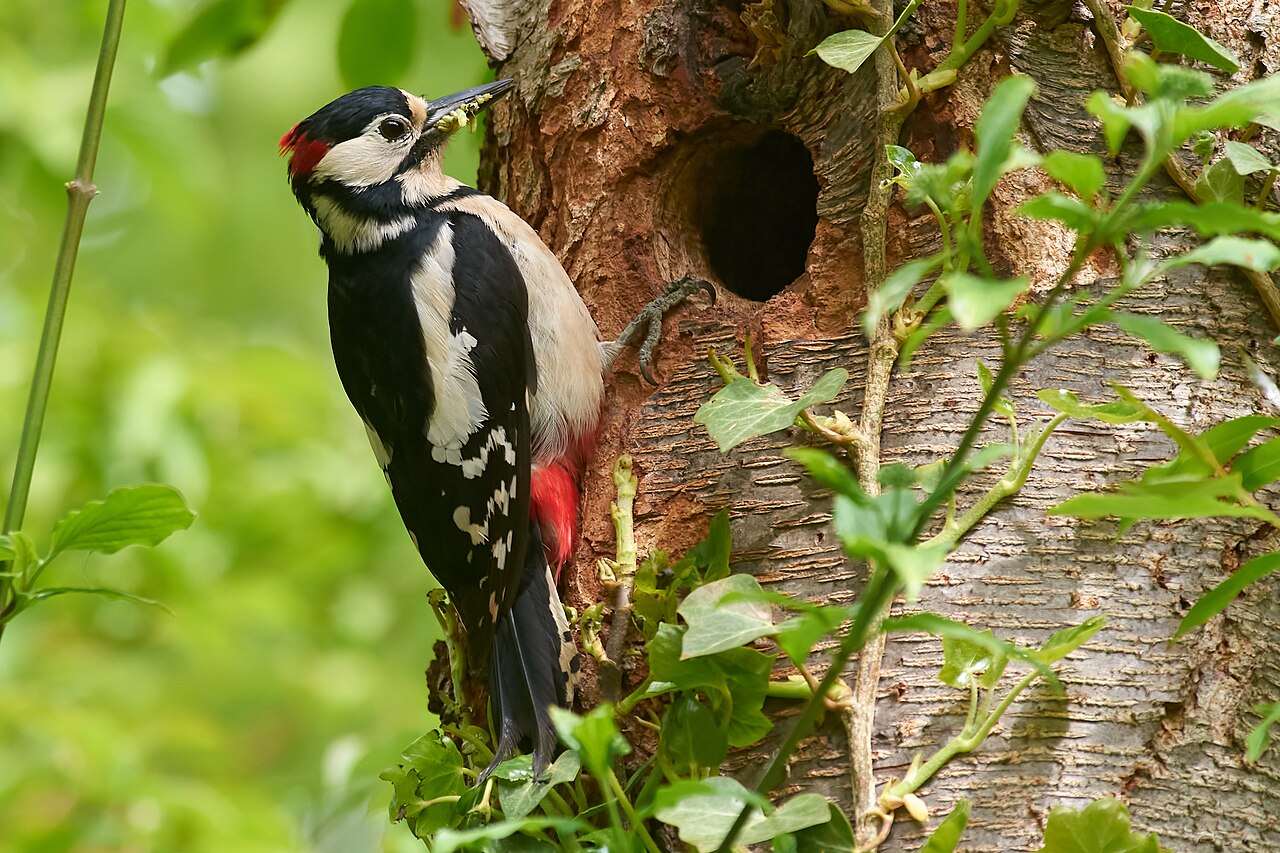
A great spotted woodpecker (Dendrocopos major) at its nest hole. Image: CC0, via Wikimedia Commons.
The mechanism
- Brain stabilization. A tight-fitting brain with minimal cushioning fluid and a small, favorably shaped brain mass keeps the brain from moving destructively inside the skull during impact.
- The hyoid sling. The tongue's supporting bone splits and runs up over the back of the skull, around the top, and anchors near the front, letting the tongue extend far beyond the beak and helping stabilize the head.
- Eye protection. A nictitating membrane closes a millisecond before each strike, holding the eyeball firmly and shielding it from flying chips.
- The drill. A chisel-tipped beak that wears to stay sharp, driven by powerful neck musculature in a near-straight line that avoids shearing forces.
- Bracing. Zygodactyl feet grip the trunk and stiff tail feathers prop against the bark, turning the bird into a stable tripod so the blows drive into the wood, not the body.
- Extraction. A long, extensible, barbed tongue, often coated in sticky saliva, probes tunnels for insects.
Why this points to design
Effective, repeated drilling requires the protective and mechanical systems all at once. A bird that pounds wood without brain stabilization, eye restraint, a reinforced beak, and solid bracing is a bird that concusses itself, detaches a retina, or shatters its bill on an early attempt. Because the behavior is only safe when the whole package is present, the package cannot be assembled by a slow series of individually advantageous steps, the steps before completion are injuries waiting to happen, not improvements. A suite of distinct features that are useless or harmful apart and powerful only together is what intelligent design produces and what unguided gradualism is poorly placed to build. See Irreducible Complexity.
The evolutionary account, and why it falls short
The standard reply is behavioral gradualism: many birds glean bark, probe crevices, and tap lightly, so the woodpecker is said to have intensified that behavior step by step, with the beak, neck, bracing, eye protection, and tongue strengthening incrementally as pecking grew harder.
The reply describes a destination and assumes the road. What it does not supply is the coordination. The wraparound hyoid tongue, the millisecond-precise eyelid timing, the self-renewing chisel beak, the brain held against high-speed impact, and the tripod bracing are separate systems that must change together to keep the bird from injuring itself as the pecking escalates; an intensifying behavior with only some of the protections in place is a recipe for harm, not a smooth climb. Naming a plausible sequence of behaviors is not the same as demonstrating the selectable intermediate anatomies or the genetic and developmental changes that built the coordinated drilling specialist. The integration is the very thing that points to a designer rather than to an accumulation of lucky steps.
See also
- Animals That Defy Evolution, the hub this spoke belongs to
- Irreducible Complexity, the core pattern behind the woodpecker
- Edge of Evolution, the empirical reach of random mutation
- The giraffe, another integrated-systems vertebrate case in this hub
Common questions this page answers
Q: Why is the woodpecker a problem for evolution?
Drilling into wood twenty times a second is dangerous, and the bird survives only because it carries a whole matched kit at once: a stabilized brain, an eye-restraining third eyelid, a self-sharpening chisel beak, a wraparound tongue, and tripod bracing. Each feature is useless or harmful without the others, which is the Irreducible Complexity pattern, so there is no series of individually advantageous half-steps for selection to climb. The coordinated package looks engineered for the task.
Q: How does a woodpecker peck without injuring itself?
It combines a tightly fitted brain held with minimal cushioning fluid, a small and favorably shaped brain mass, a stiff skull and straight-line strike that direct force into the wood, and a third eyelid that closes just before each blow to hold the eye in place. Gripping feet and a stiff tail brace the body so the impact does not shake the whole bird. These systems only protect the animal when they work together.
Q: Why is the woodpecker's tongue wrapped around its skull?
The tongue is supported by the hyoid bone, whose long horns run up over the back of the skull, around the top, and anchor near the front of the head. This lets the tongue extend far past the beak to probe insect tunnels, and the looping structure also helps stabilize the head during drilling. It is one feature in an integrated set that all serve the same demanding lifestyle.
Q: Couldn't the woodpecker have evolved its drilling gradually?
The usual story starts from light tapping and intensifies it over time, but that only names a sequence of behaviors; it does not show how the separate protective systems stayed coordinated along the way. An intensifying peck with only some of the safeguards in place injures the bird rather than improving it, so the demand is for the selectable intermediate anatomies and the actual genetic changes, which have not been demonstrated. The need for everything to advance together is exactly what points to design.