Person
William Wade Harris
William Wadé Harris, Prophet Harris, William Wade Harris (prophet), Wade HarrisIntro
William Wade Harris was a Liberian Grebo preacher who, in about eighteen months in 1913 and 1914, walked along the coast of Ivory Coast and the Gold Coast (now Ghana) calling people to burn their charms, turn to the one true God and be baptized. Estimates of those he baptized run to over 100,000. He worked for no mission, and the French colonial government expelled him. Ten years later, Methodist missionaries arriving in Ivory Coast found thousands of his converts waiting for teachers. He is the clearest example of Africans, not colonizers, driving the growth of African Christianity.
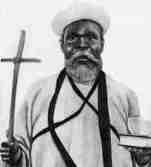 William Wade Harris. Photo: unknown photographer, early twentieth century, released for free use (Wikimedia Commons). Only a small copy survives on Commons.

See this page's graph and discover linked topics
In full
Harris belongs to a wave of African prophets in the early twentieth century, alongside Garrick Braide in the Niger Delta and Simon Kimbangu in the Belgian Congo, whose preaching produced mass turnings to Christ outside missionary control. His movement is a key case for historians such as Adrian Hastings, Andrew Walls and Lamin Sanneh, who argue that African Christianity spread mainly through African agents. The best-known scholarly study is David A. Shank's work on Harris's life and message.
Life
- Background. Born around 1860 at Graway in Liberia, among the Grebo (a Kru people). His mother was a Christian. As a boy he lived in the household of a Methodist minister, Jesse Lowrie, and was baptized in the early 1880s.
- Teacher and catechist. In 1892 he joined the American Episcopal mission as a teacher and catechist. He also worked as an interpreter and was active in Grebo politics against the Americo-Liberian government.
- Prison and call. In 1910 he was imprisoned for his part in a Grebo rising, associated with an attempt to bring the area under British rather than Liberian control. In prison, he later said, the angel Gabriel appeared to him and called him to be a prophet.
- The great walk. In 1913 he set out east along the coast, barefoot, dressed in a white robe, carrying a cross-staff, a Bible, a calabash rattle and a bowl for baptism. Through 1913 and 1914 he preached in Ivory Coast and into the western Gold Coast.
- Expulsion. In late 1914 or early 1915 the French colonial authorities, nervous of mass movements during the First World War, arrested him and deported him to Liberia. Later journeys took him to Sierra Leone.
- Death. He died in 1929 in poverty in Liberia.
Message and method
- One God, no fetishes. He told hearers to destroy their charms and shrines and worship only God.
- Baptism first, teaching later. He baptized large numbers and told them to build churches, keep the Sabbath and wait for teachers who would come "with the Bible." He appointed local leaders, often called "twelve apostles," to lead the new congregations.
- No mission of his own. He directed converts to existing Catholic and Methodist churches where they existed, and did not set out to found a denomination.
- African practice. He tolerated polygamy among converts and was himself married to more than one wife, a point on which missions disagreed with him.
What happened to his converts
| Outcome | Detail |
|---|---|
| Methodist growth | When British Methodist missionaries, led by William J. Platt, arrived in Ivory Coast around 1924, they were welcomed by thousands of Harris converts who had kept their faith without outside help. Methodism in Ivory Coast largely grew from this base. |
| Catholic growth | Many converts joined Catholic parishes. |
| The Harrist Church | Converts who did not accept mission discipline, especially on polygamy, formed the Harrist Church, an African Initiated Church that continues today. |
| Ghana | Harris's influence also shaped the Twelve Apostles Church of Ghana, led after him by his convert Grace Tani. |
Significance
- African agency. Harris reached more people in a year and a half than many mission stations had in decades, without mission funding or colonial backing. The colonial state treated him as a threat, not an ally. See Christianity and Colonialism in Africa.
- Against the "white man's religion" charge. The largest single turning to Christ in West African history was led by a Black Liberian prophet. See Christianity Is the White Mans Religion Objection Defeater.
- Power encounter. His preaching took the spiritual world seriously and confronted it directly, a pattern that reappears in African Pentecostal and Charismatic Christianity.
Tensions
- Numbers. The 100,000-plus figure for baptisms is an estimate given in the scholarly literature, notably by David Shank; it cannot be checked precisely.
- Polygamy. Harris's acceptance of polygamous converts set him against both Catholic and Methodist missions. Some evangelical writers see it as a compromise; defenders argue he was a first-generation evangelist who left discipleship to the churches.
See also
- Simon Kimbangu, the Congolese prophet of 1921
- African Initiated Churches, the Harrist Church and its kin
- Christianity and Colonialism in Africa, African agency versus colonial power
- African Pentecostal and Charismatic Christianity, later echoes of the prophetic pattern
- Africa and Christianity, the master hub
Common questions this page answers
Q: Who was the Prophet William Wade Harris?
He was a Liberian Grebo evangelist who, in 1913 and 1914, walked the coast of Ivory Coast and the Gold Coast (Ghana) in a white robe with a cross, calling people to abandon their charms and be baptized. Scholars estimate he baptized over 100,000 people in about eighteen months.
Q: How many people did William Wade Harris baptize?
Estimates in the scholarly literature, notably from David Shank, put the number at over 100,000 in roughly eighteen months during 1913 and 1914. The figure is an estimate and cannot be checked precisely.
Q: Why was Prophet Harris expelled from Ivory Coast?
The French colonial authorities feared the mass movement he had started, especially once the First World War began, and deported him to Liberia around the end of 1914 or the start of 1915.
Q: What is the Harrist Church?
It is an African Initiated Church formed by followers of William Wade Harris, mainly in Ivory Coast, who did not join the Catholic or Methodist missions. Many other Harris converts became Methodists or Catholics.
Q: Did William Wade Harris work for a mission?
He had been a Methodist and then an Episcopal mission teacher, but his famous preaching tour of 1913-1914 was independent. He sent converts to existing churches and told them to wait for teachers with the Bible.