Argument
Why Doesn't God Feed Starving Children Objection Defeater
why doesn't God feed starving children, why doesnt god feed starving children, why does God let children starve, if God is good why do children starve, Christians pray for starving children, prayer doesn't feed the hungry, unanswered prayer for the hungry, starving children objection, world hunger and God, why is there hunger if God existsIntro
The objection is one of the most painful in the whole debate, and it deserves to be stated at full strength. Christians pray for hungry children. They ask God, who they say owns everything and loves everyone, to feed them. Many of those children stay hungry, and some die. If a loving and all-powerful God existed, the objector says, He would answer that prayer. He does not. So He is either not loving, not powerful, or not there.
The first thing a Christian should do is agree that a starving child is a real evil, not a puzzle. Then four things need to be said, carefully.
First, the strong form of the objection says God and a hungry child cannot both exist. That needs a hidden premise: that a good God would always stop every case of hunger, by miracle if necessary, the moment He is asked. Nobody has shown that premise is true, and even leading atheist philosophers have stopped claiming it.
Second, most hunger in the world runs through human hands. The United Nations' own yearly reports on world hunger name war, economic shocks, poverty and inequality as major drivers, alongside drought and climate.
Third, the Bible never lets a Christian pray for the hungry instead of feeding them. James mocks the person who says "be warmed and filled" and hands over nothing. Jesus told His disciples, when a hungry crowd needed food, "give ye them to eat." God's usual way of feeding a hungry child is a person with bread.
Fourth, honesty. No Christian knows why God allows this child to go hungry, and nobody should pretend to. Not seeing the reason is not the same as there being no reason. But that is a reason to keep trusting and keep feeding, never a reason to shrug.
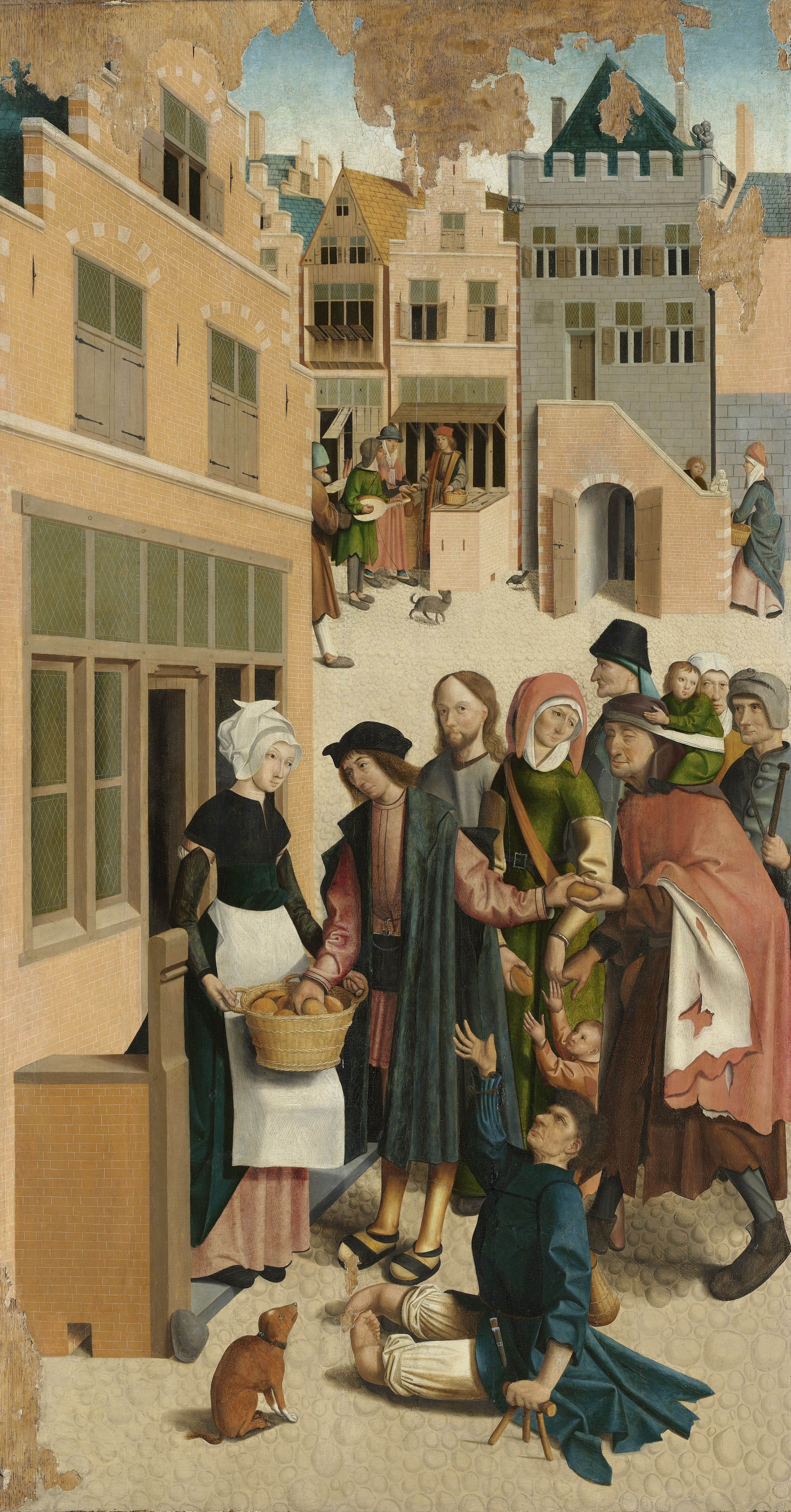
Feeding the Hungry, the first panel of the Seven Works of Mercy by the Master of Alkmaar (1504), Rijksmuseum, Amsterdam. The painter set Christ among the poor receiving bread, after Matthew 25:40. Image: public domain, via Wikimedia Commons, resized.
The 30-second version:
A starving child is a real evil, and the question is fair. But the claim that God and hunger cannot both exist rests on an unproved premise, and most hunger runs through war, poverty and human failure. The Bible never treats prayer as a substitute for food: James condemns saying "be warmed and filled" while giving nothing, and Jesus told His disciples, "give ye them to eat." God usually feeds the hungry through His people. Why He allows a particular child to suffer, nobody knows, and not knowing a reason is not proof there is none.
See this page's graph and discover linked topics
In full
The objection is a specific, prayer-shaped instance of the Problem of Evil. Formally: (1) if a perfectly loving and omnipotent God exists, He would feed starving children, at least when believers ask Him to; (2) believers ask, and children still starve; (3) therefore no perfectly loving and omnipotent God exists. It is usually pressed with a second, ad hominem edge: (4) Christians who pray for the hungry are either deceived about prayer or are using prayer as a comfortable substitute for action.
The defeater runs in six moves:
- Separate the logical from the evidential versions (P1). As a logical argument, premise (1) carries the whole weight and has never been established. Since Plantinga's free will defense (1974), the consensus in philosophy of religion, including atheist philosophers such as William Rowe (1979), is that no one has shown evil to be logically incompatible with God. What remains is the evidential version: hunger makes God less probable.
- Locate the causes (P2). The United Nations' annual State of Food Security and Nutrition in the World identifies conflict, climate variability and extremes, and economic slowdowns and downturns as the major drivers of hunger, worsened by poverty and inequality (SOFI 2021). A large share of hunger is therefore the downstream effect of human choices, which folds this case into the free-will part of the problem of evil, while some (drought, crop failure) belongs to its natural-evil part.
- Correct the picture of prayer (P3). Premise (1) assumes prayer is a request for God to act instead of the one praying. Scripture rejects that model outright: James 2:15-16, Matthew 25:35-40, 1 John 3:17-18, Isaiah 58:7. The objection's edge in (4) is a charge the Bible itself brings first.
- God's ordinary means is His people (P4). In the feeding of the five thousand Jesus answers the disciples' "send the multitudes away" with "give ye them to eat" (Matthew 14:16), and the bread reaches the crowd through the disciples' hands. The church's earliest recorded relief effort was famine aid (Acts 11:27-30).
- State the skeptical-theist point honestly (P5). From "I see no reason God could have for permitting this child's hunger" it does not follow that there is none, unless we would expect to see such reasons if they existed (Wykstra's CORNEA condition). This is a limit on an inference, not an explanation of any child's suffering, and it does not license inaction, because the duty to feed is revealed even where the reason for permission is not (Deuteronomy 29:29).
- The objection presupposes what it denies (P6). The objection is strongest when it insists that a starving child is objectively wronged and that bystanders are obligated to help. Christianity grounds both claims; the objector must ground them too. See Evidential Problem of Evil Defeater.
Argument structure
| Premise | Notes | |
|---|---|---|
| P1 | The logical version needs an unproved premise: that a good God must always prevent hunger, by miracle if asked | Mackie 1955; Plantinga 1974; Rowe 1979 |
| P2 | Most hunger has human causes (conflict, economic shocks, poverty, inequality), with drought and climate as further drivers | FAO and partners, SOFI 2021 and 2025 |
| P3 | Scripture never treats prayer as a substitute for feeding the hungry; it condemns that substitution | James 2:15-17; Matthew 25:35-40; 1 John 3:17-18; Isaiah 58:7 |
| P4 | God's ordinary means of feeding the hungry is His people | Matthew 14:16-19; Acts 11:27-30; Galatians 2:10 |
| P5 | Our inability to see God's reason in a particular case is weak evidence that there is no reason, and gives no permission to stand still | Wykstra 1984; Skeptical Theism |
| P6 | The objection's moral force depends on objective moral facts that theism grounds | Moral Argument |
| C | Child hunger is a real evil and a serious question, but it neither disproves God nor shows prayer to be a sham |
Form
Defensive, with a strong positive turn. The reply grants that the evil is real and the question legitimate, removes the logical form of the objection, narrows the evidential form, and then hands the question back as a demand on the church. It deliberately does not offer an explanation of why any particular child goes hungry.
Cheatsheet
The 30-second reply (read aloud). I agree a starving child is a horror, and I am not going to explain it away. But look at the argument. It assumes a good God would have to stop every case of hunger by miracle the moment He is asked. Nobody has shown that, and even atheist philosophers no longer claim God and evil are logically incompatible. Most hunger comes through war, collapse and poverty, which is people. And the Bible never lets me pray instead of feeding. James says if you tell a hungry person "be warmed and filled" and give him nothing, your faith is dead. When the disciples wanted Jesus to send a hungry crowd away, He said, "give ye them to eat." I cannot tell you why God allows this particular child to suffer. I can tell you what He told me to do about it.
The 6 fast facts:
- The logical problem is widely regarded as answered. J. L. Mackie (1955) argued that God and evil are logically inconsistent. Alvin Plantinga's free will defense (God, Freedom, and Evil, 1974) is widely held to have shown they are not, and William Rowe, who framed the modern evidential argument, granted in his 1979 paper that no one had succeeded in establishing the inconsistency.
- Hunger is mostly downstream of human action. The UN's 2021 report on world food security names conflict, climate variability and extremes, and economic slowdowns and downturns as the major drivers, made worse by poverty and inequality. The 2025 edition estimates about 673 million people faced hunger in 2024, roughly 8 percent of the world, with Africa above 20 percent.
- James condemns prayer-as-substitute. "If a brother or sister be naked and in lack of daily food, and one of you say unto them, Go in peace, be ye warmed and filled; and yet ye give them not the things needful to the body; what doth it profit?" (James 2:15-16, ASV).
- Jesus hands the job to His disciples. "They have no need to go away; give ye them to eat" (Matthew 14:16, ASV). Then He "gave the loaves to the disciples, and the disciples to the multitudes" (Matthew 14:19, ASV).
- The judgment scene is about bread, not words. "For I was hungry, and ye gave me to eat" (Matthew 25:35, ASV).
- The earliest church ran famine relief. When Agabus foretold a famine, "the disciples, every man according to his ability, determined to send relief unto the brethren that dwelt in Judæa" (Acts 11:29, ASV).
The 4 strongest counter-moves:
- "Is your claim that God and hunger cannot both exist, or that hunger makes God less likely?" Make the objector choose. The first needs a premise he cannot supply. The second is a serious argument, and it gets a serious, more modest reply.
- "Who is holding the food?" Ask whether the world's hungry are hungry mainly because food cannot exist where they are, or because of war, collapse, poverty and distribution. The objection asks why God does not do by miracle what human beings refuse to do by choice.
- "Which Christian teaching says prayer replaces feeding?" There is none. The Bible's own verdict on that kind of prayer is harsher than the skeptic's.
- "Is the child objectively wronged?" If yes, ask what grounds that on atheism. If no, the argument loses its force.
Reciprocal concessions (grant the small point, then collect a bigger one):
- Grant: Christians have often prayed for the hungry and done nothing, and some still do. Now collect: that is exactly what James 2 and 1 John 3 condemn. The failure is a charge against Christians by the standard of the Bible, which means the Bible is not the problem.
- Grant: I cannot tell you why God permits this particular child's hunger. Now collect: you cannot tell me that there is no such reason. Neither of us sees far enough, which is why the logical version fails and the evidential version is weaker than it feels.
- Grant: God could feed every child by miracle. Now collect: if He did that every time, He would also have to undo every war, every theft and every hoarded granary as it happened, and the question becomes the one answered on Why Doesn't God Intervene Objection Defeater: what would be left of human responsibility?
What not to say:
- Never say a child starves because of their own or their parents' sin. Jesus rejected that reasoning in the case of the man born blind (John 9:1-3).
- Never offer a confident explanation of why God allowed a particular child's suffering. You do not know it.
- Never say spiritual needs matter more than food in a way that excuses not giving food. James 2 forbids exactly that.
- Never present prayer as a vending machine that failed. The Bible never promised it was one.
The closing line. You asked why God does not feed the hungry child. The Bible asks why the people holding bread do not. Both are fair questions, and only one of them is in our hands tonight.
Grammar and hermeneutics
The objection invokes biblical texts on prayer, so it is fair to ask what those texts actually say. Read on their own terms, they do not promise what the objection says was broken, and they assign the feeding to the one who prays.
- James 2:16, the imperatives with no agent. The empty well-wisher says hypagete en eirēnē, thermainesthe kai chortazesthe, "Go in peace, be ye warmed and filled" (James 2:15-16). Thermainesthe and chortazesthe are present imperatives in the middle or passive form: they command a state ("be warmed," "be fed") while naming no one who will do the warming or feeding. James's next clause, mē dōte, "ye give them not," names the person who should have. The grammar exposes the move the objection describes, words that hand a need to someone else, and James calls the result useless and the faith behind it dead (James 2:17; see G4102 - pistis).
- Matthew 14:16, the emphatic "you." Jesus says dote autois hymeis phagein, "give ye them to eat." Greek does not need the pronoun hymeis, because the imperative dote already marks the subject as "you" plural. Including it adds emphasis: you yourselves give. The disciples had proposed sending the hungry away to buy food (Matthew 14:15); Jesus refuses to let them. In the miracle that follows, the bread passes from His hands to theirs and from theirs to the crowd (Matthew 14:19). The narrative gives the disciples a real part in feeding the crowd, and does not have Jesus feed it while they watch.
- 1 John 3:17, the closed heart. "Whoso hath the world's goods, and beholdeth his brother in need, and shutteth up his compassion from him, how doth the love of God abide in him?" (1 John 3:17, ASV). The word for "compassion" is splanchna, literally the inward parts, the seat of feeling, and the verb kleisē means to shut it like a door. The test is put to the one who has goods and sees need. John's next line rules out the substitution the objection describes: "let us not love in word, neither with the tongue; but in deed and truth" (1 John 3:18, ASV).
- Matthew 7:7-11, what "ask" promises. "Ask, and it shall be given you" (Matthew 7:7, ASV) is the text usually quoted as a broken promise. The imperatives aiteite, zēteite, krouete are present imperatives, the form that presents asking as ongoing, and the argument of the paragraph is from a father's goodness: the Father gives "good things to them that ask him" (Matthew 7:11, ASV). Luke's parallel names the gift as "the Holy Spirit" (Luke 11:13, ASV). The promise is that a good Father answers with good gifts, not that every specified outcome will be delivered on request.
- John 14:13-14 and 1 John 5:14, the conditions. "Whatsoever ye shall ask in my name" (John 14:13, ASV) is qualified by "in my name," which in biblical idiom means in accord with the person and purposes of the one named (see G3686 - onoma), and John's own letter states the condition plainly: "if we ask anything according to his will, he heareth us" (1 John 5:14, ASV; see G2307 - thelema). The New Testament never presents prayer as a mechanism that obligates God to override every evil when asked.
- Matthew 25, judged by deeds. The verdict in the judgment scene turns on past acts, "ye gave me to eat," and on what was not done, "ye did it not" (Matthew 25:45). The text never asks whether the hungry were prayed for. It asks whether they were fed (Matthew 25:31-46).
The objection therefore leans on a reading of the prayer texts that the texts do not support, and passes over the texts that speak most directly to hunger, all of which put the bread in the hands of the one who prays.
P1, The logical version needs a premise nobody has proved
Affirmative case
- Where the weight sits. The logical form works only if it is necessarily true that a perfectly good, omnipotent God would prevent every instance of child hunger. That is not a self-evident truth; it is a substantive claim about what goodness requires of God in every possible circumstance.
- The free will defense. Plantinga argued that it is possible that God has good reason to create a world with free creatures, and that free creatures who can genuinely do good can also genuinely do evil, including the evils of war, theft and neglect that produce hunger. If that is even possible, the logical inconsistency fails. See Free Will Defense and Problem of Evil, Free Will Defense.
- The concession from the other side. William Rowe, the atheist philosopher whose 1979 paper set the terms of the modern evidential argument, acknowledged in it that no one had succeeded in establishing that evil is logically inconsistent with God, and built his own case on probability instead.
Anticipated objections
- "Free will explains war, but not drought. A drought-stricken child is not the victim of anyone's choice."
- "Answering a prayer for food would not violate anyone's freedom."
Rebuttals
- Partly true, and the evidential reply covers it. Some hunger traces to natural evil, and the free will defense does not cover that by itself. The Evidential Problem of Evil Defeater treats natural evil separately (natural-law, fallen-creation and soul-making accounts). Even there, whether drought becomes famine usually depends on human factors: storage, roads, markets, governance and war. The UN's reports discuss conflict and economic shocks alongside climate for exactly that reason.
- Then the question changes. If the claim is that God could feed this child without overriding anyone's freedom, that is true, and Christians believe He sometimes does provide in ways they cannot explain. The claim that He must do so every time is the one that needs proof, and it is the question of how much intervention God owes, treated on Why Doesn't God Intervene Objection Defeater.
P2, Most hunger runs through human hands
Affirmative case
- What the UN reports say. The State of Food Security and Nutrition in the World is produced each year by FAO, IFAD, UNICEF, WFP and WHO. The 2021 edition identified conflict, climate variability and extremes, and economic slowdowns and downturns as the major drivers of hunger, compounded by poverty and high inequality. The 2025 edition estimated about 673 million people facing hunger in 2024 (a range of roughly 638 to 720 million), about 8.2 percent of the world's population, with the share in Africa above 20 percent, and pointed to food price inflation as a drag on recovery.
- Conflict and collapse. Armies burn fields, block roads, seize aid and drive families from farms. Economic collapse prices food out of reach of families who could otherwise buy it. These are human acts and human systems.
- What follows. The objection asks why God does not do by miracle what human beings will not do by choice. That is not a separate problem from the rest of the problem of evil; it is its most familiar case.
Anticipated objections
- "You are blaming the victims' governments to get God off the hook."
- "Even if humans cause it, God could stop them."
Rebuttals
- No victim is blamed. The point is that the causes are human agents, not that the hungry are at fault. The children are wholly innocent; the people who make war and hoard are not. That is the moral picture the Bible itself paints: "He that oppresseth the poor reproacheth his Maker; But he that hath mercy on the needy honoreth him" (Proverbs 14:31, ASV).
- Yes, and that is the intervention question. Whether God should block every harmful human choice as it is made is answered on Why Doesn't God Intervene Objection Defeater: a world in which every harmful act is stopped is a world in which no act matters, and there is no principled place to draw the line short of that.
P3, Scripture never treats prayer as a substitute for feeding
Affirmative case
- James. "If a brother or sister be naked and in lack of daily food, and one of you say unto them, Go in peace, be ye warmed and filled; and yet ye give them not the things needful to the body; what doth it profit? Even so faith, if it have not works, is dead in itself" (James 2:15-17, ASV).
- Jesus. "For I was hungry, and ye gave me to eat; I was thirsty, and ye gave me drink" (Matthew 25:35, ASV), and "Inasmuch as ye did it unto one of these my brethren, even these least, ye did it unto me" (Matthew 25:40, ASV).
- John. "Whoso hath the world's goods, and beholdeth his brother in need, and shutteth up his compassion from him, how doth the love of God abide in him?" (1 John 3:17, ASV).
- The prophets. Isaiah defines true worship as action: "Is it not to deal thy bread to the hungry, and that thou bring the poor that are cast out to thy house?" (Isaiah 58:7, ASV). The law commands the same: "Thou shalt surely open thy hand unto thy brother, to thy needy, and to thy poor, in thy land" (Deuteronomy 15:11, ASV).
- Even the prayer for bread is no substitute. Jesus taught His disciples to pray, "Give us this day our daily bread" (Matthew 6:11, ASV). Christians pray that prayer and then go to work; nobody reads it as an instruction to stop farming. Praying for the hungry and feeding them stand in the same relation.
Anticipated objections
- "Then prayer is useless. If you have to do it yourself anyway, why pray?"
Rebuttals
- Prayer is not a delivery request. In Christian teaching prayer is communion with God, dependence on Him and alignment with His will, and it is often the means by which God moves the one praying to act. A Christian who prays for a hungry child and is then moved to give has not had an unanswered prayer. The objection assumes a model of prayer (I ask, God acts instead of me) that the New Testament never taught. See Prayer.
P4, God's ordinary means of feeding the hungry is His people
Affirmative case
- The feeding of the five thousand. The disciples' instinct was to send the hungry away. Jesus refused, gave the work back to them, and fed the crowd through their hands (Matthew 14:15-21). The one time the Gospels show mass hunger met by miracle, the miracle still runs through human hands.
- The church's first relief effort. Facing a famine foretold by Agabus, the believers in Antioch sent relief to Judea "every man according to his ability" (Acts 11:27-30). Paul's agreement with the Jerusalem leaders included one request: "only they would that we should remember the poor; which very thing I was also zealous to do" (Galatians 2:10, ASV). His collection for the poor of Jerusalem runs through Romans 15:26 and 2 Corinthians 8 to 9.
- The witness of an enemy. The emperor Julian, who tried to restore paganism, complained in a letter to Arsacius, high priest of Galatia (Letter 22, c. 362, preserved by Sozomen, Church History 5.16), that the Christians supported not only their own poor but pagan poor as well, while the pagans were seen to neglect their own. The complaint is evidence of what Christian charity looked like to a hostile observer.
- Basil in the famine. Gregory of Nazianzus, in his funeral oration for Basil of Caesarea (Oration 43), describes Basil, during a severe famine, gathering the hungry of Caesarea and feeding them from stores he had collected.
- The modern record. Many large relief agencies were founded by Christians for exactly this purpose, among them Catholic Relief Services (founded by the bishops of the United States in 1943), World Vision (founded by Bob Pierce in 1950) and Compassion International (founded by Everett Swanson in 1952).
Anticipated objections
- "Plenty of secular charities feed the hungry too. You do not need God for that."
- "Christians have also caused famines and ignored them."
Rebuttals
- Granted, gladly. The point is not that only Christians feed the hungry. It is that the objection pictures God as absent from feeding, when Christians hold that every act of mercy, by anyone, is one of the ways God's goodness reaches the hungry (Psalm 146:7: Jehovah "giveth food to the hungry"). The atheist who feeds a child is not evidence against God; Christians would call it common grace.
- Also granted. Where Christians have caused or ignored hunger they have broken the commands quoted above, and the Bible is the standard by which they stand condemned. See the reciprocal concession in the Cheatsheet.
P5, The skeptical-theist point, stated honestly
Affirmative case
- The evidential argument's key step. The evidential argument moves from "I can see no good reason God could have for permitting this child's hunger" to "probably there is no such reason." Rowe made that inference central in 1979.
- CORNEA. Stephen Wykstra (1984) argued that the inference is reasonable only if, were there such a reason, we would be likely to see it. Given the gap between an infinite mind's purposes and ours, and the reach of consequences across lives and generations, that condition is doubtful. This is the core of Skeptical Theism.
- What it does and does not do. It does not explain why any particular child suffers. It does not say the suffering is good, or that it is secretly not so bad. It says only that the step from "I do not see a reason" to "there is no reason" is weaker than it feels. Christians should say so plainly: I do not know why God has allowed this child to suffer.
- Scripture's own posture. "The secret things belong unto Jehovah our God; but the things that are revealed belong unto us and to our children for ever, that we may do all the words of this law" (Deuteronomy 29:29, ASV). What is hidden is God's reason for permitting; what is revealed is our duty to feed.
Anticipated objections
- "Skeptical theism proves too much. If we cannot judge whether God has reasons, we cannot judge whether we should stop any evil either. It produces moral paralysis."
- "This is just 'God works in mysterious ways', an excuse that would cover anything."
Rebuttals
- Our duties do not depend on seeing God's reasons. The skeptical-theist point concerns God's reasons for permitting; it says nothing about our obligations, which are revealed and clear. A Christian is commanded to feed the hungry whatever God's reasons for permitting hunger may be. That is why the posture of Deuteronomy 29:29 does not lead to paralysis but to obedience.
- It is a limit on one inference, not a theory. "Mysterious ways" offered as an explanation would be empty. Offered as a reply to a specific inference ("I see no reason, so there is none"), it is a standard point about the limits of evidence. It must be paired, as here, with the positive case for God's goodness, centered on the cross. See Evidential Problem of Evil Defeater and Theodicy.
P6, The objection presupposes what it denies
Affirmative case
- The objection's force is moral. It works because we know a starving child is wronged, and that anyone who could help and does not is at fault. Both are claims of objective moral fact.
- Theism grounds those facts. On Christianity the child bears God's image, so the child's suffering matters absolutely and the bystander's duty is real. See Moral Argument.
- The atheist must ground them too. If moral facts are not objective, the objection becomes a report of distress rather than an argument. If they are, the atheist owes an account of them. Either way, the question is not one-sided.
Anticipated objections
- "I do not need God to know starving children is bad."
Rebuttals
- Agreed, about knowing. The claim is not that atheists cannot know hunger is evil. It is about what makes it evil and makes the duty to help binding, which is a question of grounding, not of knowledge.
Master objections to the defeater
MO1: "You keep changing the subject from God to Christians."
- The subject was a prayer for hungry children. Christianity's answer about that prayer includes what it commands the one praying to do, so the change is in the objection's picture of prayer, not in the reply.
MO2: "A good father would not leave his child hungry while he waited for his other children to share."
- The analogy assumes God's relation to the world is that of one parent to one household with no other goods at stake. The Christian claim is that God is bringing a whole world of free persons to maturity and to judgment, and that He has entered hunger Himself (Matthew 4:2) and promised an end to it: "They shall hunger no more, neither thirst any more" (Revelation 7:16, ASV). The analogy is not frivolous, which is why the honest reply includes P5.
MO3: "If God fed even one child by miracle, why not all?"
- That is the question of how much intervention God owes, and it has no principled stopping place short of total prevention. See Why Doesn't God Intervene Objection Defeater, Premise 3.
Tactical notes
- Lead with agreement. The person asking may have watched a child go hungry. Polemical on the argument, tender on the person.
- Make them choose the version. Logical or evidential. Most people mean the evidential form once it is put to them.
- Bring James early. It disarms the charge that Christian prayer is a comfortable substitute for action.
- What not to defend: that every case of hunger has a human cause (some do not), that Christians have a good record everywhere (they do not), or that you know God's reason in a particular case (you do not).
- End with action. The strongest closing in a live conversation is an invitation to help feed someone together.
Tactical opening / closing
- Opening. "That is one of the hardest questions there is, and I am not going to give you a slogan. Can I show you what the Bible says about people who pray for the hungry?"
- Closing. "I do not know why God allows this child to be hungry. I know He told me to feed her. If you want, we can start there together."
Connection to Scripture
- James 2:14-17, faith without works is dead, illustrated by the hungry brother.
- Matthew 14:15-21, "give ye them to eat."
- Matthew 25:31-46, the King identifies with the hungry.
- 1 John 3:17-18, love "in deed and truth."
- Acts 11:27-30, the first famine relief.
- Isaiah 58, true fasting is bread for the hungry.
- Deuteronomy 29:29, hidden reasons, revealed duties.
- John 9:1-3, suffering is not to be read as punishment of the sufferer.
Live-cite kit
Scripture:
- "Go in peace, be ye warmed and filled; and yet ye give them not the things needful to the body; what doth it profit?" (James 2:16, ASV)
- "They have no need to go away; give ye them to eat." (Matthew 14:16, ASV)
- "For I was hungry, and ye gave me to eat" (Matthew 25:35, ASV)
- "My little children, let us not love in word, neither with the tongue; but in deed and truth." (1 John 3:18, ASV)
Scholarly and historical:
- J. L. Mackie, "Evil and Omnipotence," Mind 64 (1955)
- Alvin Plantinga, God, Freedom, and Evil (1974)
- William L. Rowe, "The Problem of Evil and Some Varieties of Atheism," American Philosophical Quarterly 16 (1979)
- Stephen Wykstra, "The Humean Obstacle to Evidential Arguments from Suffering," International Journal for Philosophy of Religion 16 (1984)
- FAO, IFAD, UNICEF, WFP and WHO, The State of Food Security and Nutrition in the World 2021 and 2025
- Julian, Letter 22, to Arsacius (c. 362); Gregory of Nazianzus, Oration 43
Aphorism:
- "God's usual answer to a prayer for bread is a person carrying bread."
- "The Bible's verdict on prayer without bread is harsher than the skeptic's."
- "I do not know why God allows it. I know what He told me to do about it."
Scholarship
Published academic works this page draws on, each matched to a publisher, index or library catalog record.
- Alvin Plantinga, God, freedom, and evil (1974). Open Library
- Stephen J. Wykstra, "The humean obstacle to evidential arguments from suffering: On avoiding the evils of?appearance?" International Journal for Philosophy of Religion 16 (1984). doi:10.1007/bf00136567
See also
- Why Doesn't God Intervene Objection Defeater, the general form: why God does not stop every evil
- Problem of Evil, the master hub, logical and evidential versions
- Evidential Problem of Evil Defeater, the full reply to the probabilistic form, including natural evil
- Skeptical Theism, the limits of "I see no reason, so there is none"
- Free Will Defense, the reply to the logical problem
- Theodicy, positive accounts of why God permits evil
- Prayer, what Christian prayer is and is not
- Moral Argument, why the objection's moral force needs grounding
- Atheism, master hub
Common questions this page answers
Q: Why doesn't God feed starving children if Christians pray for them?
Christians do not know why God allows any particular child to go hungry, and should not pretend to. But most hunger runs through war, economic collapse, poverty and inequality, and the Bible never treats prayer as a substitute for feeding the hungry. God's ordinary way of feeding a hungry child is a person with bread, which is why Jesus told His disciples, "give ye them to eat."
Q: Does world hunger prove God does not exist?
No. The claim that God and evil cannot logically coexist depends on the premise that a good God must always prevent every evil, which has never been shown, and even atheist philosophers such as William Rowe have conceded the point. Hunger can still be raised as evidence against God, which is a serious but more modest argument, answered on the evidential problem of evil.
Q: What does the Bible say about praying for the hungry without helping them?
It condemns it. James 2:15-16 describes someone who says "be warmed and filled" to a hungry person without giving food, and asks what good that does. 1 John 3:17-18 says love must be "in deed and truth," not in word only, and Matthew 25:35 judges people by whether they fed the hungry.
Q: Didn't Jesus promise that whatever we ask in prayer will be given?
Jesus promised that a good Father gives good things to those who ask (Matthew 7:11), and Luke names the gift as the Holy Spirit. The promises to ask in His name are tied to His will, as 1 John 5:14 says: "if we ask anything according to his will, he heareth us." The New Testament never presents prayer as a mechanism that obligates God to override every evil on request.
Q: Is it fair to blame hunger on people rather than God?
Largely, yes. The United Nations' annual report on world food security names conflict, climate extremes and economic downturns as major drivers, made worse by poverty and inequality. Some hunger has natural causes such as drought, but whether drought becomes famine usually depends on human factors like war, storage, roads and governance. None of this blames the hungry themselves, who are innocent.
Q: Have Christians actually done anything about hunger?
From the start. The first recorded relief effort of the church was famine aid sent from Antioch to Judea (Acts 11:27-30). In the fourth century the emperor Julian complained that Christians fed pagan poor as well as their own, and Basil of Caesarea organized famine relief. Major modern relief agencies such as Catholic Relief Services, World Vision and Compassion International were founded by Christians.
Q: Isn't saying God has reasons we cannot see just a cop-out?
It would be if it were offered as an explanation. It is a reply to one specific step in the argument, the move from "I see no reason for this suffering" to "there is no reason." That step is only as strong as our ability to see God's reasons, which is limited. It never excuses inaction, because the duty to feed the hungry is plain even where God's reasons are hidden.