Argument
Who Created God Objection Defeater
Who Created God, Who Made God, Who Caused God, What Caused God, Who Designed the Designer, If Everything Needs a Cause What Caused GodIntro
"If everything needs a cause, then who caused God?" It is one of the most common objections to belief in God, and it sounds like it ends the conversation. It does not.
No serious argument for God says that everything needs a cause. The arguments say that whatever begins to exist, or whatever depends on something else to exist, needs a cause. A chair needs a carpenter. A son needs a father. The universe, which began and is made of parts that change, needs an explanation outside itself. God, as Christians have always understood Him, did not begin and depends on nothing. Asking who made Him is like asking who painted the painter's own existence into being: it treats the source of everything as one more thing in the line.
That is not a dodge. It is the whole reason a first cause is needed. If every cause needed a cause, nothing would ever get started, the way a line of borrowed cups of sugar never fills anyone's bowl unless someone actually has sugar.
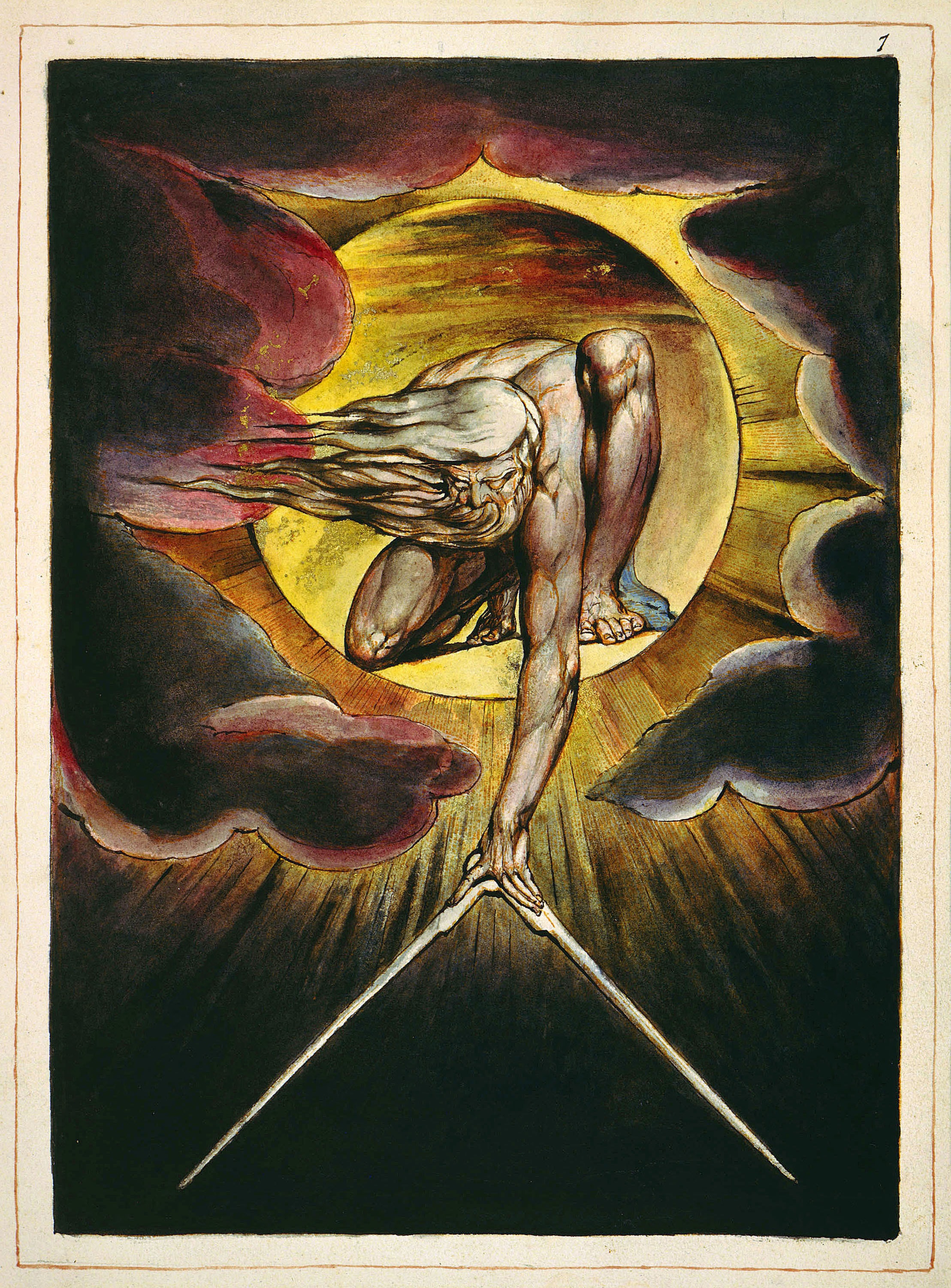
William Blake, frontispiece to Europe a Prophecy (1794), known as The Ancient of Days. Fitzwilliam Museum, Cambridge (copy K). Image: public domain, via Wikimedia Commons.
A note on the picture. In Blake's own mythology the figure is not God. It is Urizen, a fallen, rule-bound "maker" whom Blake used to criticize the stern lawgiver he saw in the religion of his day. This page argues for the very God Blake's Urizen caricatures: not a cosmic engineer inside the world, but the uncaused ground of everything. The image is used anyway because it became the most famous picture ever made of a Maker measuring out the world, and its compasses echo Scripture's own picture of creation, when God "set a compass upon the face of the depth" (Proverbs 8:27, KJV). Read that way, the painting makes this page's point twice: a figure who stands inside the world with tools is exactly the kind of maker who would need a cause, and the God of the Bible is not that kind of maker.
See this page's graph and discover linked topics
Cheatsheet
30-second reply. "The argument never said everything needs a cause. It says things that begin, or that depend on something else, need a cause. That's why a first cause has to be something that didn't begin and doesn't depend on anything, or the chain never starts. So 'who caused God?' is asking who caused the uncaused thing. The real question is whether such a thing exists, and that's what the cosmological argument is about. Want to look at it?"
Fast facts.
- The objection is old. Bertrand Russell reported in "Why I Am Not a Christian" (1927) that it was the question from John Stuart Mill's Autobiography that turned him: "Who made God?"
- Richard Dawkins restated it as "who designed the designer?" in The God Delusion (2006).
- Aquinas's Second Way (Summa Theologiae I q.2 a.3) argues from causes that are themselves caused. It never claims that every being has a cause.
- Aquinas argued that in God essence and existence are identical (Summa Theologiae I q.3 a.4), so God does not receive existence from anything. He calls God ipsum esse subsistens, subsistent being itself (I q.44 a.1).
- Aristotle's four causes are four kinds of explanation for things that come to be and change. They were never a rule that every reality whatever has four outside causes.
Counter-moves.
- "That's special pleading." Special pleading is an exception without a reason. The reason is stated: God does not belong to the class the principle covers (things that begin or depend). See Special Pleading.
- "Then why can't the universe be uncaused?" Because it has the very features that make something need a cause: it began, it is made of parts, and it changes. See P4.
- "You just defined God into existence." No. Defining a necessary being does not prove one exists. The cosmological arguments do that work. This defeater only shows the question "who made God?" does not refute them.
Concessions, and what each one collects.
- Grant: a definition is not a proof. Collect: then the objection is not a refutation either. It only asks whether a necessary being exists, which is the question the cosmological arguments answer.
- Grant: the category distinction between God and the world must be justified, not merely asserted. Collect: it is justified by properties anyone can check (beginning, composition, change, dependence), and the universe has every one of them.
- Grant: proving a first cause is not yet proving the God of the Bible. Collect: the objection was that a first cause is incoherent. Once a first cause is admitted, the conversation has moved to which first cause, and the atheist has given up the ground he started on.
Closing line. "If every cause needed a cause, nothing would exist. Something exists. So something exists that needs no cause."
In full
The objection runs: the cosmological argument assumes everything has a cause; God is something; so God has a cause; so either the argument fails or God is not ultimate. The first premise misstates the argument. Every classical form of the causal principle is restricted:
- Kalam form: whatever begins to exist has a cause (Kalam Cosmological Argument).
- Thomistic form: whatever passes from potential to actual, or whose existence is distinct from its essence, depends on a cause that actualizes it (First Way - Motion, Second Way - Efficient Causality).
- Leibnizian form: whatever exists contingently has an explanation outside itself (Contingency Argument, Principle of Sufficient Reason).
God, on the classical account, satisfies none of the triggering conditions. He did not begin (Psalm 90:2). He has no unrealized potential (Actus Purus). His essence is His existence (Ipsum Esse Subsistens), so He is necessary rather than contingent (Necessary vs Contingent Being). The objection therefore commits a Category Error: it applies a principle about dependent things to the one reality defined as independent.
Two honest limits keep the reply strong:
- A category distinction must be earned. Saying "God is in a different category" settles nothing unless the categories are marked by real properties. They are: contingent things begin, are composite, change, and have an essence that does not include existence. P3 argues this.
- The defeater does not prove God exists. It shows the objection fails. Whether a necessary, uncaused reality exists is the work of the positive cosmological arguments, and whether that reality is personal is further work (Necessary Being is an Intelligent Mind).
Argument structure
| # | Premise |
|---|---|
| P1 | The causal principle in every serious cosmological argument covers what begins to exist or depends on another, not everything that exists. |
| P2 | A series of caused causes cannot explain itself; if anything exists, there must be a cause that is not itself caused. |
| P3 | The distinction between dependent things and an independent first cause is marked by real, checkable properties, not by stipulation. |
| P4 | The universe has the properties of a dependent thing, so it cannot be the uncaused first cause. |
| C | "Who created God?" misapplies a principle about dependent things to the one independent reality. It refutes no cosmological argument; it only asks whether such a reality exists, which those arguments answer. |
Form
The defeater is defensive. It does not prove God's existence; it shows that the objection rests on a false premise (P1) and on a category confusion (P3). P2 turns the objection around: the very regress the objector raises against God is the reason a first cause is needed. P4 blocks the common fallback that the universe itself could be the uncaused reality.
The argument is valid. Its contested premises are P2 (some philosophers accept an infinite regress or a brute-fact universe) and the properties listed in P3 (some deny that composition or change implies dependence). Both are answered below.
P1, The causal principle covers what begins or depends, not everything
Affirmative case (second-order arguments)
- The texts say so. Aquinas's Second Way begins from "an order of efficient causes" in the world we observe, things caused by other things (Summa Theologiae I q.2 a.3). The Kalam premise is "whatever begins to exist has a cause." Leibniz restricts his principle to contingent things. No major formulation says "everything has a cause."
- Aristotle's four causes are about things that come to be. In Physics II.3 Aristotle lists material, formal, efficient and final causes as the four ways of answering "why?" about natural things and artifacts that come into being and change. His own Unmoved Mover (Metaphysics XII.7) has no efficient cause at all. See Aristotle's Four Causes.
- The restriction is not ad hoc; it is where the need for a cause comes from. A thing needs a cause because it began, or because it does not explain its own existence. Remove those conditions and the reason for needing a cause disappears with them.
Anticipated objections
- "Popular apologists do say 'everything has a cause.'"
- "Restricting the principle to things that begin is gerrymandered to exempt God."
Rebuttals
- Then correct the popular version, not the argument. A careless statement of an argument is not the argument. The objection refutes a version no philosopher defends.
- The restriction predates the dispute and is motivated independently. Aristotle restricted causal explanation to change centuries before anyone used it to argue for the God of the Bible, and the restriction tracks why we ask for causes in daily life. Nobody asks what caused the number seven.
Live-cite kit
- Scripture: Psalm 90:2, "from everlasting to everlasting, thou art God."
- Scholarly: Aquinas, Summa Theologiae I q.2 a.3; Aristotle, Physics II.3.
- Aphorism: "Whatever begins has a cause. God did not begin."
Tactical notes
- Ask the objector to state the premise he thinks the argument uses. Then read him the actual premise.
- Do not let the debate become about whether "everything has a cause." Concede at once that it does not. That concession is your premise, not his.
P2, A series of caused causes cannot explain itself
Affirmative case (second-order arguments)
- The extension cords. Imagine a thousand extension cords plugged end to end. Each passes along power it receives from the next. However long the line, no cord produces electricity. Unless one end reaches a source that has power rather than borrowing it, the lamp at the end stays dark.
- The hanging chain. A chandelier hangs from a chain. Each link holds the one below and is held by the one above. Add links forever and nothing holds the chain up. It needs a hook that hangs from nothing else.
- The mirrors. A room of mirrors can pass light back and forth endlessly, but a million mirrors cannot make light. Something must shine rather than reflect.
- The author and the character. A character in a novel depends on the author for every line of his existence. Ask "who wrote the author into the book?" and you have mistaken the author for a character. The author is not in the story at all.
These four images illustrate one point Aquinas makes about causes that are simultaneously dependent (a "per se" or essentially ordered series): every member holds its causal power only on loan, so the series as a whole explains nothing unless it ends in a member whose power is underived.
Anticipated objections
- "Why not an infinite regress?"
- "The analogies are physical; God is not a battery or a hook."
Rebuttals
- An infinite series of borrowers is still a series of borrowers. Lengthening the chain does not change what each link lacks. In an essentially ordered series the regress does not postpone the problem; it multiplies it. For the separate case against an infinite temporal past, see Argument from the Impossibility of an Actual Infinite Past.
- Correct, and that is the point of an analogy. The images show the structure of derived power, not the nature of the source. Nobody concludes from the chain that God is made of iron.
Live-cite kit
- Scripture: Acts 17:28, "in him we live, and move, and have our being"; Colossians 1:17, "in him all things consist."
- Scholarly: Aquinas, Summa Theologiae I q.2 a.3; Edward Feser, Five Proofs of the Existence of God (2017).
- Aphorism: "A million mirrors cannot make light."
Tactical notes
- Lead with the extension cords for a general audience and the author analogy for a philosophically minded one.
- Say plainly that the analogies illustrate rather than prove. It disarms the obvious objection before it comes.
P3, The distinction between dependent things and the first cause is real, not stipulated
Affirmative case (second-order arguments)
- Essence and existence. For any ordinary thing we can know what it is without knowing whether it is. Aquinas's example is the phoenix: one can understand what a phoenix is and still not know that any exists (De Ente et Essentia ch. 4). A thing whose nature does not include existence must receive existence from outside. Aquinas argues that in God the two are the same (Summa Theologiae I q.3 a.4): God does not have existence, He is subsistent existence itself, ipsum esse subsistens (I q.44 a.1). See Ipsum Esse Subsistens.
- Composition. Whatever is made of parts depends on those parts and on whatever holds them together. A first cause cannot be composite, or it would depend on its parts. See Divine Simplicity.
- Change. Whatever changes moves from potential to actual and needs something already actual to bring that about. A first cause must have no unrealized potential. See Actus Purus.
- These are checkable. Beginning, composition, change and dependence are not theological labels. They are features we observe in every physical thing, which is why the line between dependent and independent is drawn by evidence and not by definition.
Anticipated objections
- "You just defined God as uncaused. A definition proves nothing."
- "Calling it a category error is a debating trick to avoid the question."
Rebuttals
- Agreed, and the defeater does not claim otherwise. The definition answers the objection, not the question of God's existence. The objection said a first cause is incoherent because it would need a cause. The definition shows it would not. Whether one exists is settled by the cosmological arguments.
- It is a trick only if the categories are invented. They are marked by the four properties above. Ask the objector which of the four God would have to have, and why.
Live-cite kit
- Scripture: Exodus 3:14, "I AM THAT I AM"; John 5:26, "the Father hath life in himself."
- Scholarly: Aquinas, De Ente et Essentia ch. 4; Summa Theologiae I q.3 a.4.
- Aphorism: "God doesn't have existence. He is it."
Tactical notes
- Ask the force-commit question: "What property would make something need a cause?" Whatever the objector names (beginning, parts, change), point out that God lacks it and the universe has it.
P4, The universe cannot be the uncaused first cause
Affirmative case (second-order arguments)
- It began. Standard cosmology traces the observable universe to a hot, dense beginning a finite time ago. See Big Bang and Kalam Cosmological Argument.
- It is composite. Atoms are made of particles, protons of quarks and gluons. Everything physical we know of is made of parts.
- It changes. The universe expands, cools and runs down. Something with unrealized potential is not purely actual.
- It looks contingent. Its constants, laws and initial conditions could apparently have been otherwise, which is why physicists ask why they are as they are. See Fine-Tuning Argument.
Anticipated objections
- "If you can say God just exists necessarily, I can say the universe exists necessarily."
- "Maybe the universe is a brute fact with no explanation."
- "Maybe the most basic physical level, some field or law, is necessary, even if what we see is not."
Rebuttals
- You can say it; you cannot fit it. A necessary thing cannot fail to exist and cannot be otherwise. The universe began, is made of parts, and changes. The objection treats "necessary" as a label anyone can stick on anything. It is a property with requirements, and the universe does not meet them. See Necessary vs Contingent Being.
- A brute fact gives up on explanation exactly where it matters most. Science works by refusing to accept "it just is" for things that could have been otherwise. Accepting it for the whole of reality is not a scientific result but a decision to stop asking. See Principle of Sufficient Reason.
- Then it inherits the same questions. Any proposed fundamental field or law either has parts, structure and potential (and so depends on something), or it lacks them all, in which case it is no longer physical and has the properties classical theism ascribes to God.
Live-cite kit
- Scripture: John 1:3, "All things were made through him"; Romans 11:36, "of him, and through him, and unto him, are all things."
- Scholarly: Alexander Pruss, The Principle of Sufficient Reason (2006); Feser, Five Proofs (2017).
- Aphorism: "Calling the universe necessary doesn't make it stop changing."
Tactical notes
- This is the objector's strongest move. Do not rush it. Walk through beginning, parts and change one at a time.
- Do not defend the age of the universe here. The argument from contingency works even on an eternal universe; keep that in reserve.
Conclusion
"Who created God?" refutes no cosmological argument. The principle it attacks was never "everything has a cause" (P1). The regress it raises is the reason a first cause is needed (P2). The line between God and creation is drawn by real properties (P3), and the universe falls on the dependent side of it (P4). What remains is the question the cosmological arguments were built to answer: does an uncaused, necessary reality exist? Once that question is on the table, the objection has already been set aside.
Master objections to the whole argument
- "This is all medieval metaphysics." The objection itself is a metaphysical claim about causes. The reply has to be in the same currency. Modern defenders (Pruss, Feser, Craig, Koons) state the same distinctions in contemporary logic.
- "Even if there's a first cause, it isn't your God." Correct as far as it goes, and a different argument. A first cause that is uncaused, unchanging, simple and necessary already rules out every god who is a part of nature. See Necessary Being is an Intelligent Mind and Cosmological Arguments.
- "Who designed the designer?" Dawkins's version adds that a designer must be more complex than what he designs. But God, on the classical account, is not complex: He has no parts (Divine Simplicity). The objection assumes the conclusion it needs.
Tactical opening / closing
Opening line: "Good question, and I'd ask it too if the argument said everything has a cause. Can I show you what it actually says?"
Closing landing strip: "If every cause needed a cause, nothing would exist. Something exists. So something exists that needs no cause. The question isn't who made God. It's whether that uncaused reality is a mindless universe that began and keeps changing, or the God who said, 'I AM THAT I AM.'"
Connection to Scripture
- Exodus 3:14, God names Himself "I AM THAT I AM"
- Psalm 90:2, "from everlasting to everlasting, thou art God"
- John 1:3, all things made through the Word
- John 5:26, the Father has life in Himself
- Acts 17:25, God is not served "as though he needed anything"
- Acts 17:28, in Him we live and move and have our being
- Colossians 1:17, in Him all things consist
- Romans 11:36, of Him, through Him, unto Him are all things
Patristic / scholarly note
Classical / patristic / medieval:
- Aristotle (Physics II.3; Metaphysics XII.7), the four causes and the unmoved mover
- Augustine (Confessions XI), God as the unchanging Creator of time itself
- Thomas Aquinas (Summa Theologiae I q.2 a.3; q.3 a.4; q.44 a.1; De Ente et Essentia ch. 4), the Five Ways and the identity of essence and existence in God
Modern:
- Gottfried Leibniz (Monadology, 1714), the principle of sufficient reason and the contingent world
- Edward Feser (Five Proofs of the Existence of God, 2017), the essentially ordered series defended for a modern audience
- Alexander Pruss (The Principle of Sufficient Reason, 2006), the contemporary case for the principle
- William Lane Craig (Reasonable Faith, 3rd ed. 2008), the Kalam and the "who made God?" reply
Scholarship
Published academic works this page draws on, each matched to a publisher, index or library catalog record.
- William Blake, Europe, a prophecy (1794). Open Library
- William Lane Craig, Reasonable Faith (2008). Open Library
- Edward Feser, Five Proofs of the Existence of God (2017). Open Library
- Alexander R. Pruss, The Principle of Sufficient Reason: A Reassessment (Cambridge University Press, 2006). doi:10.1017/cbo9780511498992
See also
- Special Pleading, why the exemption is not special pleading
- Category Error, the mistake the objection makes
- Aristotle's Four Causes, the framework the objection misreads
- Necessary vs Contingent Being, the distinction this defeater depends on
- Ipsum Esse Subsistens, God as subsistent being itself
- Actus Purus, why the first cause has no unrealized potential
- Kalam Cosmological Argument, "whatever begins to exist has a cause"
- Contingency Argument, the Leibnizian form
- Second Way - Efficient Causality, Aquinas's argument from caused causes
- Arguments, master index
Common questions this page answers
Q: If everything needs a cause, who created God?
The argument never says everything needs a cause. It says whatever begins to exist, or depends on something else to exist, needs a cause. God did not begin and depends on nothing, so the question asks who caused the uncaused. The real question is whether such a reality exists, which the cosmological arguments address.
Q: Isn't saying God doesn't need a cause just special pleading?
No. Special pleading is making an exception without a reason. Here the reason is stated: the causal principle covers things that begin, have parts, change or depend on others, and God, as classically understood, has none of those features.
Q: Why can't the universe be the thing that needs no cause?
Because the universe has every feature that makes something need a cause. It began a finite time ago, it is made of parts, it changes, and its laws and constants seem as if they could have been different. Calling it necessary does not give it the properties a necessary being must have.
Q: Why can't there be an infinite chain of causes?
In a chain where each cause only passes along power it receives, adding more links never supplies the power. A thousand extension cords produce no electricity without a source, and a chain hangs only from a hook. The regress multiplies the problem instead of solving it.
Q: Does answering "who made God?" prove God exists?
No, and it does not claim to. It shows the objection fails. Whether an uncaused, necessary reality exists is shown by the cosmological arguments, and whether that reality is a personal mind is a further step.