Concept
Waiting Time Problem
Waiting time problem, Waiting for Two Mutations, Durrett and Schmidt 2008, Two coordinated mutations problem, Coordinated mutation waiting time, 84 million years for two mutations, 216 million years two mutationsIntro
Some biological changes only help once two or more specific mutations are both in place. One alone does nothing, or even harms. The waiting time problem asks how long a population has to wait before such a matched set of mutations shows up and spreads. If the answer is longer than the time evolution had available, the standard story has a timing problem.
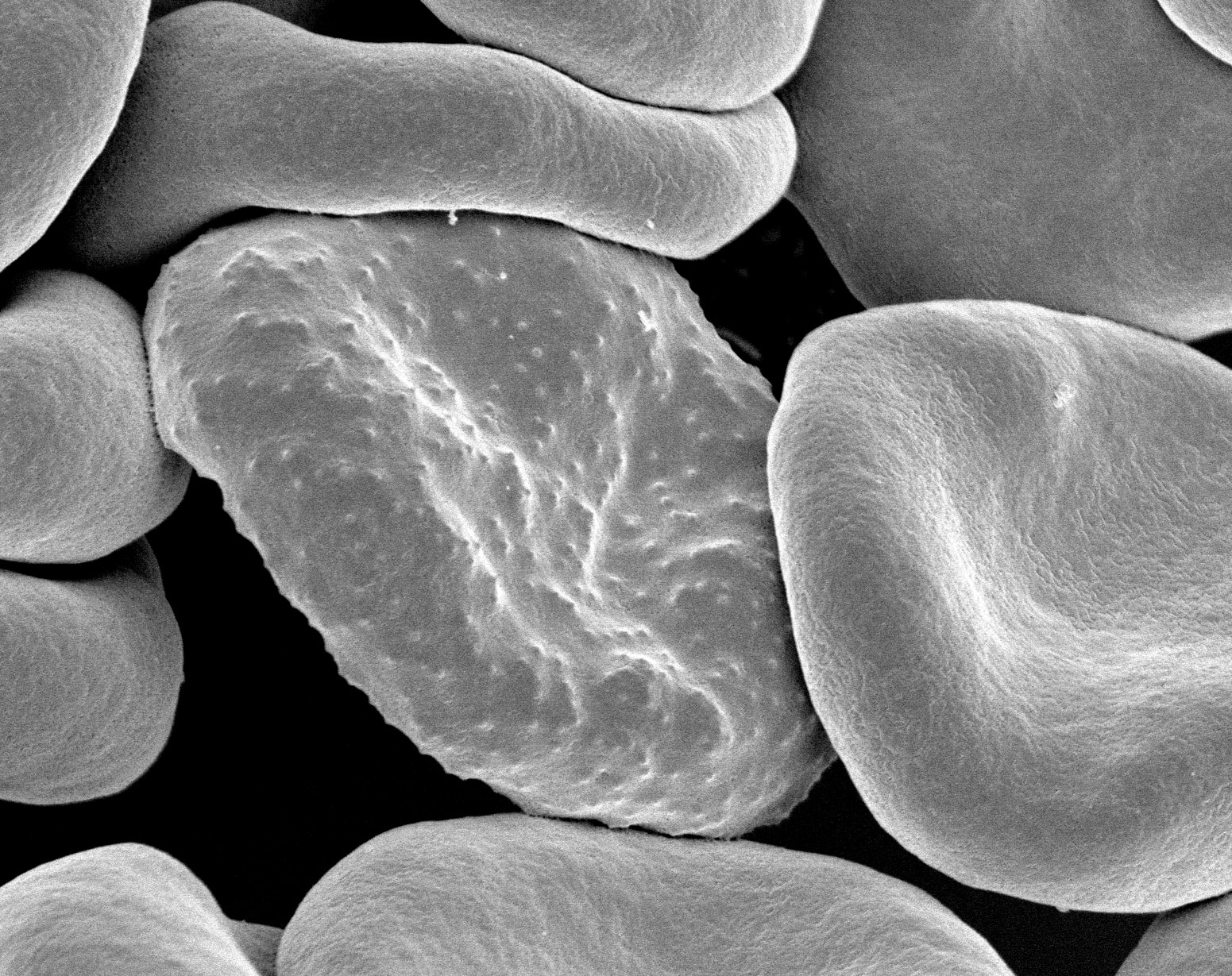 A red blood cell infected with Plasmodium falciparum (center, with surface knobs) among uninfected cells. The malaria parasite's slow path to chloroquine resistance started the modern argument over how long coordinated mutations take. Scanning electron micrograph: Rick Fairhurst and Jordan Zuspann, National Institute of Allergy and Infectious Diseases. Public domain (Wikimedia Commons), resized.

The question is not fringe. It has been worked on in mainstream genetics journals by mathematicians who are not design advocates. The best-known result comes from Rick Durrett and Deena Schmidt in 2008. They modelled a simple change to a gene switch in a human-sized population: one mutation knocks out an old switch, a second mutation builds a new one. Their answer was about 216 million years. That is more than thirty times longer than the roughly six to seven million years usually given for the split between the human and chimpanzee lines.
The figure is for one particular pair of mutations, which is exactly the point: when a function needs a particular pair, that is the wait it faces. Durrett and Schmidt answered that with thousands of genes, some useful pair turns up much sooner; the reply below shows why that does not touch the specific changes the human lineage needed. The often-quoted "84 to 216 million years" joins two different studies, and the page gives each number its source and its exact meaning, so the edge lands with full force.
See this page's graph and discover linked topics
In full
The waiting time problem is the population-genetics question of the expected time until a population first contains, and then fixes, a prespecified combination of two or more mutations whose benefit appears only when the combination is complete. Because the first mutation is at best neutral (and often mildly harmful), it is not driven up in frequency by selection; the population must wait for the second mutation to arise in a carrier of the first. Waiting time therefore scales with mutation rate, effective population size and generation length, and grows steeply with the number of required coordinated changes.
The problem was posed sharply by Michael Behe and David Snoke (Protein Science 13, 2004) and by Behe's The Edge of Evolution (2007), was criticized by Michael Lynch (Protein Science 14, 2005), and received its most-cited mainstream treatment in Rick Durrett and Deena Schmidt, "Waiting for Two Mutations: With Applications to Regulatory Sequence Evolution and the Limits of Darwinian Evolution" (Genetics 180, 2008). A published exchange followed between Behe and Durrett and Schmidt (Genetics 181, 2009). John Sanford, Wesley Brewer, Franzine Smith and John Baumgardner later ran numerical simulations of the same question in a model hominin population ("The Waiting Time Problem in a Model Hominin Population", Theoretical Biology and Medical Modelling 12, 2015). Experimental work on the malaria chloroquine-resistance transporter (Summers et al., PNAS 111, 2014) supplies an empirical case of a function that requires at least two mutations before it appears at all.
This page states what each study actually found, where the popular figures come from, the strongest objection and the design response. The argument page that deploys it is Edge of Evolution Argument.
What the studies found
| Study | System modelled | Key assumptions | Result |
|---|---|---|---|
| Durrett and Schmidt 2008 (Genetics 180) | A regulatory switch: mutation 1 inactivates an existing transcription-factor binding site, mutation 2 creates a new one nearby | Human case: effective population 10,000, mutation rate 10^-8 per site per generation, 25-year generations, first mutation neutral | Drosophila: a few million years suffices. Humans: predicted about 216 million years (about 8.7 million generations); their simulation came in near 75 percent of that, about 162 million years. A single new binding site, by contrast, can appear in tens of thousands of years. |
| Behe letter 2009 (Genetics 181) | Critique of the 2008 paper | Argues the first mutation in a protein needs one specific nucleotide (not any of ten), and is likely harmful rather than neutral | Claims the model underestimates waiting time by a factor of 30 or more, and by many orders of magnitude if the first mutation is strongly harmful |
| Durrett and Schmidt reply 2009 (Genetics 181) | Response | Grants the mutation-rate point ("Behe is right on this point"); estimates a mildly harmful first mutation lengthens the wait by a factor of 2 or 3 | Maintains the core model; argues that because the human genome has some 20,000 genes and many possible pairs, double mutations "can easily have caused a large number of changes" since the human-chimp split, if the first mutation is neutral or mildly deleterious |
| Sanford et al. 2015 (TBMM 12) | Numerical simulation of establishing a specific short nucleotide string in a regulatory region | Population 10,000, 20-year generations, strong selection, a 10 percent fitness benefit for the completed string, no interference from other mutations | 1 nucleotide: about 1.5 million years. 2 nucleotides: about 84 million years. 8 nucleotides: about 18.5 billion years. The authors call these best-case figures, since realistic conditions would lengthen them. |
| Summers et al. 2014 (PNAS 111) | Laboratory measurement of over 100 variants of the malaria transporter PfCRT | Expressed in frog egg cells, chloroquine transport measured directly | At least two mutations were needed for low-level chloroquine transport, about four for full activity, and the mutations had to be added in a particular order to avoid losing activity |
Where "84 to 216 million years" comes from
The range that circulates in debate stitches together the Sanford team's 84 million years (a two-nucleotide string under strong selection) and Durrett and Schmidt's 216 million years (a two-mutation regulatory switch in humans). Three points give it its full force:
- Name the studies. Two different models with different assumptions produced the two numbers. Cite each by author and year.
- It is a specific pair. Both figures are for a particular combination, the kind a specific function requires, rather than for any two mutations whatever or for the whole of speciation.
- Durrett and Schmidt are not design advocates. Their paper was written in part to criticize Behe. That is what gives their human figure its weight: it comes from critics. Cite it as their number, not as their conclusion.
The precise form for live use: "Durrett and Schmidt, writing in Genetics in 2008 as critics of Behe, calculated that one specific two-step regulatory change would take on the order of 200 million years in a human-sized population. Sanford's team, under deliberately generous assumptions, got about 84 million years for a specific two-letter change. The human and chimp lines are said to have split six or seven million years ago. How many such coordinated changes does the human lineage need, and how were they paid for?"
The strongest objection, and the design reply
The objection (Durrett and Schmidt; most population geneticists). A waiting time for one prespecified pair is the wrong measure. Evolution is not aiming at a target chosen in advance. With some 20,000 genes and many regulatory regions, a very large number of different two-mutation pairs could each be useful. The waiting time for some useful pair is far shorter than for this pair, just as someone wins the lottery every week though no particular ticket is likely to win. Most evolutionary change also proceeds by single beneficial steps, standing variation, duplication and recombination, not by required pairs.
The reply.
- Function chooses the target. Where a specific function needs a specific pair, as with chloroquine transport in PfCRT (Summers et al. 2014), the relevant waiting time is for that pair. The multiplicity argument assumes many alternative pairs are each available and adaptive at the moment needed; that is an empirical claim about the landscape of function, not a mathematical given.
- The question is the specific changes that occurred. If human-specific traits depend on particular coordinated regulatory and protein changes, each one inherits the prespecified waiting time. Appealing to "some pair somewhere" explains that change happens; it does not show that the actual changes the human lineage needed could be obtained in the time available.
- Even generous models are slow. The Sanford simulations gave selection every advantage (strong benefit, full dominance, no interference) and still produced tens of millions of years for two specific letters. Durrett and Schmidt's own concessions in 2009 (a thirty-fold correction, longer times for harmful intermediates) moved in Behe's direction.
- The target is coordinated change. Single beneficial mutations and changes built on existing variation occur quickly, and nobody disputes them. The waiting-time edge is aimed at the changes that need several parts at once, which is precisely where the origin of new functions, switches and machines lies.
Applications in the design literature
- Human origins. The waiting time for coordinated regulatory changes is compared with the six to seven million years since the inferred human-chimp split. See Edge of Evolution Argument, Top 25 Reasons We Do Not Share a Common Ancestor With Apes and Population Genetics for Historical Adam Argument.
- Whales. Richard Sternberg, in Discovery Institute lectures and interviews, applied the Durrett-Schmidt equations to the fossil sequence from Pakicetus to Basilosaurus and Dorudon, arguing that the window of roughly ten million years or less is too short for the many coordinated anatomical changes involved. Critics reply with the prespecified-pair objection above and note that the whale population parameters are estimates. See Vestigial Organs and Anatomy Objection Defeater for the whale pelvis.
- Orphan genes. New genes that must acquire several features at once (a start signal, a reading frame, a fold, a regulatory switch) raise the same coordination question. See Orphan Genes.
Tensions
- Behe's malaria extrapolation versus Durrett and Schmidt. Edge of Evolution Argument extrapolates from the roughly 10^20 parasites behind chloroquine resistance to the human lineage. Durrett and Schmidt argue that this direct extrapolation ignores a square-root effect in the waiting-time formula and that the 10^20 figure is itself a model-based inference rather than a direct count. Behe argues that their model is the inadequate one because it disagrees with observation. Both positions are recorded; the empirical PfCRT work (Summers et al. 2014) supports Behe's claim that the resistance function needs at least two mutations.
Scholarship
Published academic works this page draws on, each matched to a publisher, index or library catalog record.
- Michael J. Behe, The Edge of Evolution (Free Press, 2007). Open Library
- Rick Durrett and Deena Schmidt, "Waiting for Two Mutations: With Applications to Regulatory Sequence Evolution and the Limits of Darwinian Evolution," Genetics 180 (2008). doi:10.1534/genetics.107.082610 PubMed 18791261
See also
- Edge of Evolution, the concept hub for Behe's rate argument
- Edge of Evolution Argument, the debate-prep deployment
- Genetic Entropy, Sanford's related mutational-load argument
- Population Genetics for Historical Adam Argument, population genetics and human origins
- Orphan Genes, the gene-origin coordination problem
- Common Descent Critique, the broader corpus engagement
- Irreducible Complexity Argument, the structural sister of the coordination problem
- Michael Behe, originator of the modern form of the argument
- 100 Questions for Evolutionists, question 19 on coordinated mutations
Common questions this page answers
Q: What is the waiting time problem in evolution?
It is the question of how long a population must wait for a specific set of two or more mutations that only help when they are all present. Because the first mutation gives no advantage on its own, selection cannot push it forward, and the expected waiting time can become very long in populations the size of early humans.
Q: What did Durrett and Schmidt 2008 find?
Writing in Genetics, Rick Durrett and Deena Schmidt modelled a two-step change to a gene's regulatory switch. In fruit flies a few million years sufficed. In a human-sized population they predicted about 216 million years for one specific pair, with simulations near 162 million years. They also argued that some of Behe's estimates were far too high, and that many different useful pairs could arise much faster than any particular one.
Q: Does it take 84 to 216 million years for two mutations to become fixed?
Not as a general rule. The 84 million figure comes from Sanford and colleagues (2015) for a specific two-letter DNA change under strong selection, and the 216 million figure from Durrett and Schmidt (2008) for a specific two-mutation regulatory switch in humans. Both concern prespecified changes under stated assumptions; neither says that every pair of mutations, or every new species, needs that long.
Q: Does the waiting time problem disprove human evolution from a common ancestor with chimpanzees?
It does not disprove it by itself, but it sharpens a real question. If the human lineage required many specific coordinated changes, each one faces a waiting time far longer than the six to seven million years usually allowed. Mainstream geneticists reply that most change does not require coordinated pairs and that some useful pair is always more likely than a particular one.
Q: Did Behe and Durrett and Schmidt agree on anything?
Yes. In their 2009 reply in Genetics, Durrett and Schmidt accepted Behe's point that a protein change usually needs one specific nucleotide rather than any of several, writing that "Behe is right on this point," which lengthened their estimate about thirty-fold. They disagreed with him on how to extrapolate from malaria and on how many alternative pairs are available.
Q: Is there experimental evidence that some functions need two mutations at once?
Yes. Summers and colleagues (PNAS, 2014) tested more than 100 versions of the malaria parasite's PfCRT transporter and found that at least two mutations were needed before it could carry chloroquine at all, with about four needed for full activity, added in a specific order.