Argument
Virtue Ethics Without God Defeater
Virtue Ethics Without God, Secular Virtue Ethics, Is virtue ethics subjective, Flourishing Without God, Aristotle Without God, Neo-Aristotelian Ethics Without God, Eudaimonia Without GodIntro
Some atheists answer the moral argument by pointing to virtue ethics. "I do not need God to be good. Aristotle showed that courage, honesty, justice and self-control are what make a human life go well. Be that kind of person and you will flourish. No commandments required."
This deserves a serious answer, because virtue ethics is a serious tradition. Christians have used it for fifteen centuries. Augustine and Thomas Aquinas built much of their moral teaching on it, and it is true that character matters more than rule-keeping.
The question is what makes a trait a virtue. Virtue ethics says a virtue is what helps a human being flourish. So everything depends on two further questions. What are human beings for? And why am I bound to pursue that, rather than whatever I happen to want? A goal is just something I aim at. A purpose is something a thing is for. An obligation is something I owe. Flourishing can tell me what is good for me, but on its own it cannot tell me why I must pursue it when I would rather not. If human beings were made for a purpose, by Someone who intended it, the gap closes. If we are the unplanned products of natural selection, it is hard to see where a binding purpose comes from.
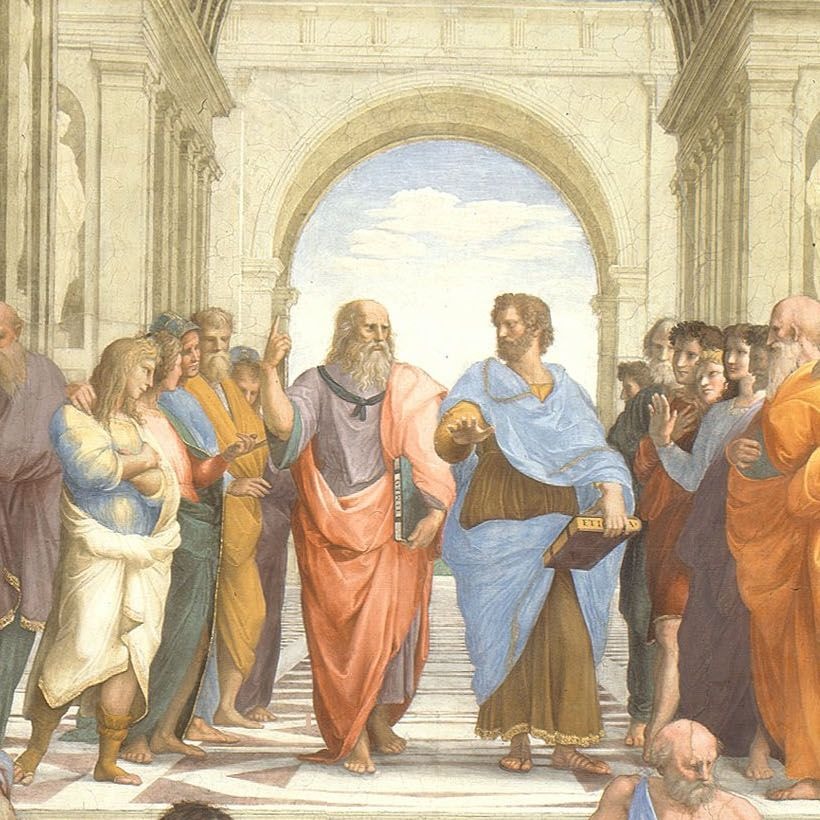
Aristotle (right) holds his Ethics and gestures toward the earth; Plato beside him points upward. Detail of The School of Athens by Raphael, 1509-1511, Apostolic Palace, Vatican. Image: public domain, via Wikimedia Commons, cropped and resized.

See this page's graph and discover linked topics
In full
Defeater for the objection: "Secular virtue ethics grounds objective morality in human nature and flourishing; therefore God is not needed for ethics."
The objection appeals to the neo-Aristotelian revival. Aristotle's function (ergon) argument (Nicomachean Ethics I.7) holds that a thing's good lies in performing its characteristic function well, that the human function is rational activity, and therefore that the human good is activity of the soul in accordance with virtue over a complete life. Philippa Foot's Natural Goodness (2001) argues that moral evaluation shares the grammar of evaluation of any living thing: a wolf that will not hunt with the pack is defective as a wolf, and a human who lacks justice or courage is defective as a human. Rosalind Hursthouse's On Virtue Ethics (1999) develops the same naturalism, identifying the ends by which a social, rational animal is assessed. Alasdair MacIntyre's After Virtue (1981) is a partial ally of both sides: it argues that modern morality collapsed when it lost a human telos, while trying in that book to recover the virtues without Aristotle's metaphysical biology.
The defeat structure has five parts. P1 separates three readings of virtue ethics (subjective, cultural, objective) and shows that only the objective one answers the moral argument. P2 argues that flourishing explains what is good for a human but not why flourishing is morally authoritative. P3 distinguishes goal, purpose, desire and obligation, and argues that a telos in the strong sense requires either a purpose-giver or a nature that is intrinsically for something. P4 presses the is-ought gap and Moore's open question against natural-norm theories, and argues that Darwinian function (what a trait was selected for) is not moral good. P5 shows how Christian virtue ethics grounds the telos in the image of God and in Christ.
The defeater does not say atheists cannot be virtuous. Many are, as Romans 2:14-15 expects. It says that secular virtue ethics, followed to its foundations, needs a real human purpose and a source of obligation that naturalism struggles to supply. The parallel case against secular deontology is at Kantian Ethics Without God Defeater; the concept hub is Virtue Ethics.
Cheatsheet
The 30-second reply:
Virtue ethics says a virtue is a trait that helps a human being flourish. Fine. Then what makes flourishing morally binding, as opposed to merely desirable? And what are human beings for? A goal is what I aim at, a purpose is what I am for, and an obligation is what I owe. On naturalism the only "purpose" I have is what my ancestors' traits were selected for, and selection does not care about justice. Aristotle's ethics works because he thought natures have real ends. Christianity says they do, because they were made.
Cross-examination lines:
- "What makes a particular trait objectively a virtue, rather than one your culture admires?"
- "If two societies disagree about whether a trait is a virtue, what decides which one is right?"
- "Is human flourishing intrinsically good? If so, what grounds that goodness independently of human opinion?"
- "What makes flourishing morally authoritative rather than simply desirable?"
- "Who or what determines what a human being is for?"
- "If I can flourish by your standard while doing something wrong, what does your theory say?"
- "Why am I obligated to cultivate virtue rather than pursue what I want?"
Fast facts:
- Aristotle, Nicomachean Ethics I.7: the function argument; the human good is activity of soul in accordance with virtue.
- Hume, A Treatise of Human Nature 3.1.1: the move from "is" to "ought" needs explaining.
- G. E. Moore, Principia Ethica (1903): the open question argument.
- Anscombe, "Modern Moral Philosophy" (1958): the moral "ought" outlived the law-conception of ethics that gave it sense.
- Foot, Natural Goodness (2001); Hursthouse, On Virtue Ethics (1999): the leading secular neo-Aristotelian accounts.
- MacIntyre, After Virtue (1981): modern morality is fragments of a lost teleological scheme. In Dependent Rational Animals (1999) he revised his earlier attempt to do ethics independently of biology.
- Sharon Street, "A Darwinian Dilemma for Realist Theories of Value," Philosophical Studies 127 (2006): evolutionary pressures shaped our evaluative attitudes without regard to independent moral truth.
Counter-moves:
- Ask which reading (subjective, cultural, objective) they hold. Only the third competes with theism.
- Separate "good for" from "ought to."
- Ask where the human telos comes from on naturalism.
- Grant the virtues; contest the grounding.
Concessions (state them yourself):
- Virtue ethics is a serious and largely correct account of moral psychology. Character matters.
- Atheists can be courageous, honest and just.
- Foot and Hursthouse are rigorous philosophers whose work is far stronger than the slogan version.
- Then collect: the tradition's own best voices (Anscombe, MacIntyre) say modern ethics lost its footing when it lost a real human purpose.
Closing line: "Your virtues are excellences relative to a purpose. I am asking who gave the purpose. Aristotle needed natures with ends. I can tell you where they come from."
Argument structure
| # | Premise |
|---|---|
| P1 | Virtue ethics can be read as subjective, cultural or objective; only the objective reading answers the moral argument, and it takes on the burden of grounding objective facts about human goodness. |
| P2 | Flourishing explains what is good for a human being, but a further premise is needed to make flourishing morally authoritative and to generate obligation; secular virtue ethics has no agreed account of that premise. |
| P3 | A goal is not a purpose and neither is an obligation; a telos in the sense virtue ethics needs requires a nature intrinsically directed to an end, which is most naturally explained by a purposer and is denied by mechanistic naturalism. |
| P4 | Natural-norm theories face the is-ought gap and the open question, and on a Darwinian account a trait's natural function is what it was selected for, which is not the same as what is morally good. |
| P5 | Christian virtue ethics supplies what the secular version lacks: a telos given by God (the image of God, conformity to Christ), virtues that are both acquired and given by grace, and an obligation owed to a Person. |
| C | Therefore secular virtue ethics does not show that objective morality stands without God; followed to its foundations, it presses toward the theistic account of human purpose it was offered to replace. |
Form
Defensive and cumulative. P1 fixes the target, P2 to P4 locate the grounding gap from three directions (authority, teleology, naturalism), and P5 offers the theistic account that closes it. The argument grants the descriptive content of virtue ethics and contests only its secular metaethical foundation. Soundness is marked contemporary because P2 to P4 are live debates in current metaethics with able defenders on the other side.
P1, Three readings of virtue ethics, and only one competes
Affirmative case (second-order arguments)
- Subjective virtue ethics. A virtue is whatever trait an individual values. This answers no one: it makes the virtuous and the cruel equally correct by their own lights, and no virtue ethicist in the Aristotelian tradition holds it.
- Cultural virtue ethics. A virtue is whatever a society praises. This makes moral reform unintelligible, since a reformer who condemns his society's admired traits is wrong by definition. It also cannot say that a society which prized cruelty to outsiders was mistaken.
- Objective virtue ethics. Virtues are grounded in facts about human nature and what a good human life is. This is Aristotle's view and the view of Foot and Hursthouse. It is the only version that answers the moral argument, because it claims objective moral facts without God.
- So the debate is about grounding. An atheist can consistently hold objective virtue ethics. The question is whether the proposed foundation, human nature and flourishing on naturalism, can carry the weight.
Anticipated objections
- "Virtue ethics is not subjective. You are attacking a strawman."
- "Cultures largely agree on the core virtues, so relativism is not a real threat."
Rebuttals
- Agreed, and that is why P1 sets the subjective version aside. The objective version is the strong one, and the rest of the argument engages it at full strength.
- Agreement is evidence, and it needs explaining. Broad convergence on courage, honesty and justice fits the Christian claim that the moral law is written on the heart (Romans 2:14-15). It does not by itself show that the convergence tracks objective truth rather than shared survival pressures (see P4).
Live-cite kit
- Scripture: Romans 2:14-15, the law written on the heart.
- Scholarly: Hursthouse, On Virtue Ethics (1999); Foot, Natural Goodness (2001).
- Aphorism: "Agree that it is objective. Now tell me what makes it so."
Tactical notes
- Ask the question directly: "Is your virtue ethics subjective, cultural or objective?" Then hold them to the answer.
P2, Flourishing tells us what is good for us, and binding force needs a further premise
Affirmative case (second-order arguments)
- "Good for" and "morally required" are two claims. Sunlight is good for a plant; that does not make the plant obligated to grow toward it. That honesty is good for human life is plausible. That I am bound to be honest when dishonesty serves me better is a further claim.
- The free-rider problem. Foot's own example is a wolf that does not join the hunt. The wolf is defective. A clever human who free-rides on others' honesty may flourish, in every measurable sense, better than an honest one. Aristotle answers that the unjust man does not truly flourish, but that answer assumes a conception of flourishing that already includes justice, so it cannot be used to derive justice.
- Hursthouse's candour. Hursthouse argues that ethical naturalism cannot validate ethics from a neutral standpoint outside it; the assessment is made from within an ethical outlook already held, like repairing a ship at sea. That is a defensible position, but it concedes that flourishing does not justify the virtues to someone who does not already share them.
- Williams' doubt. Bernard Williams (Ethics and the Limits of Philosophy, 1985), no theist, doubted that an Aristotelian account of human nature could deliver ethical conclusions in the way Aristotle hoped, since human nature as biology describes it is compatible with many ways of life.
Anticipated objections
- "Asking why flourishing is good is like asking why health is good. The question is confused."
- "Obligation is a theological leftover. Virtue ethics can drop it, as Anscombe suggested."
Rebuttals
- Health is the right comparison, and it helps the theist. Health is good for an organism. Nobody thinks an organism is morally blameworthy for being unhealthy. If moral goodness is like health, the theory has explained excellence and lost blame, guilt and duty.
- Dropping obligation proves the point. Anscombe's proposal was diagnostic: the moral "ought" made sense within a law-conception of ethics with a divine lawgiver. If the secular virtue ethicist accepts her advice and gives up obligation, the moral argument's premise about binding obligation stands unanswered.
Live-cite kit
- Scholarly: Anscombe, "Modern Moral Philosophy," Philosophy 33 (1958); Williams, Ethics and the Limits of Philosophy (1985); Foot, Natural Goodness, on defect in living things.
- Aphorism: "Flourishing tells me what is good for me. It does not tell me what I owe."
Tactical notes
- Use the free-rider. Ask: "Describe the successful, admired, well-fed liar. By your standard, is he flourishing?"
P3, Goal, purpose, desire and obligation are four different things
Affirmative case (second-order arguments)
- Definitions.
- A goal is a desired outcome or end toward which an agent directs action.
- A desire is a psychological inclination toward something.
- A purpose is what a thing is for, the reason it exists or is done.
- An obligation is what one morally ought to do.
- Having a goal does not create an obligation. Someone may aim at becoming rich; that does not make becoming rich good or required. If flourishing is merely the goal humans in fact pursue, it is one more desire, and the question why one ought to pursue it remains.
- A telos is a purpose. Aristotle's ethics works because he held that natures are intrinsically directed to ends (Final Causality): an eye is for seeing, a human for rational activity. That is a purpose built into a nature, independent of what anyone wants.
- Purposes are most naturally explained by a purposer. A knife's purpose comes from its maker. Aristotle held natural ends without a designing God, but his natures were eternal and intrinsically teleological. Mechanistic naturalism denies intrinsic ends altogether. Between a nature made for an end and a nature with no ends, theism offers the clearest account of why human nature has a real telos at all (G5056 - telos).
- MacIntyre's diagnosis. After Virtue argues that the classical scheme had three parts: human nature as it is, human nature as it could be if it realised its telos, and ethics as the means from the first to the second. Modernity rejected the second, leaving rules and raw nature with nothing to connect them. MacIntyre first tried to rebuild the virtues on practices, narrative and tradition without Aristotle's metaphysical biology, and later, in Dependent Rational Animals (1999), judged that an ethics independent of biology was a mistake.
Anticipated objections
- "Aristotle did not need a creator for his teleology, so neither do I."
- "Purposes can be self-chosen. I give my own life its purpose."
Rebuttals
- Then accept Aristotle's metaphysics. Aristotle's teleology needs natures with intrinsic final causes. If the objector accepts that, he has left mechanistic naturalism, and the question becomes what best explains a world of natures directed to ends, which is the ground of Aquinas's Fifth Way. If he rejects it, he has lost the telos his ethics needs.
- A self-chosen purpose is a goal. If I give my life its purpose, I can give it a different one tomorrow, and so can the tyrant. Self-chosen purposes collapse back into P1's subjective reading.
Live-cite kit
- Scholarly: Aristotle, Nicomachean Ethics I.7 (the function argument); MacIntyre, After Virtue (1981) and Dependent Rational Animals (1999); Aquinas, Summa Theologiae I q.2 a.3 (the Fifth Way).
- Aphorism: "A goal is what I aim at. A purpose is what I am for. Only one of those can bind me."
Tactical notes
- Give the four definitions early and get agreement on them. Most of the debate is won by keeping "goal" and "purpose" apart.
P4, Is, ought, and Darwinian function
Affirmative case (second-order arguments)
- Hume's gap. Hume observed that moral writers move from statements about what is to statements about what ought to be without explaining the step (Treatise 3.1.1). Natural-norm theories move from what is characteristic of the human species to what humans ought to do; see Is-Ought Fallacy.
- Moore's open question. For any natural property N proposed as "good," it remains a meaningful question whether N is good (Principia Ethica, 1903). "This trait is characteristic of flourishing humans, but is it good?" is not a confused question.
- Function on Darwinism is history. On the standard naturalistic account (developed, for example, by Ruth Millikan), a trait's function is what it was selected for in ancestors. That yields facts about what helped genes spread, not about what is right. Selection can favour deception, in-group cruelty and dominance where they pay.
- Darwin saw it. In The Descent of Man (1871), in his discussion of the moral sense, Darwin suggested that if humans had been reared under the conditions of hive-bees, unmarried females would "think it a sacred duty to kill their brothers." On his account the content of conscience tracks the conditions of selection.
- Street's dilemma. Sharon Street (2006) argues that evolutionary forces shaped our evaluative attitudes without regard to independent moral truth, so a realist must either say the two coincide by luck or tie value to our attitudes. The neo-Aristotelian who grounds virtue in the human life-form as evolution produced it faces a version of the same problem.
Anticipated objections
- "Foot dissolves the is-ought gap. Natural norms are already evaluative, so there is no gap to cross."
- "This is an evolutionary debunking argument, and it threatens theism's moral knowledge too."
Rebuttals
- Natural norms yield defect, and duty needs more. Foot shows that "defective wolf" is an evaluative judgment grounded in facts about wolves. Grant it. The judgment is the same kind for plants, wolves and people. A defective oak is not guilty. What needs explaining is the step from "defective human" to "blameworthy human who ought to have done otherwise," and that step is where obligation enters.
- Theism is not exposed in the same way. On theism our moral faculties were given by a God who intends us to know the good, so their reliability is expected (see Evolution and Empathy Ground Morality (Defeater) and Godless Normative Realism). On naturalism, reliability is a coincidence the theory does not predict.
Live-cite kit
- Scholarly: Hume, Treatise 3.1.1; Moore, Principia Ethica (1903); Darwin, The Descent of Man (1871); Street, Philosophical Studies 127 (2006).
- Logic: Is-Ought Fallacy.
- Aphorism: "Selection explains what survived. It does not explain what is right."
Tactical notes
- Pair Darwin's hive-bee passage with the question: "If our nature had been different, would your virtues have been different?" A yes concedes that the virtues are contingent on history.
P5, Christian virtue ethics grounds the telos
Affirmative case (second-order arguments)
-
The telos is given. Human beings are made in the image of God (Genesis 1:27; Imago Dei), and the stated end of redemption is likeness to Christ:
For whom he foreknew, he also foreordained to be conformed to the image of his Son, that he might be the firstborn among many brethren: (Romans 8:29, ASV)
That is a purpose intended by a Person, which a nature can have without being reduced to its selection history.
-
The pattern is a Person. "Be ye therefore imitators of God, as beloved children" (Ephesians 5:1, ASV). Christ is "the image of the invisible God" (Colossians 1:15). The virtues are measured against a character, the character of God made visible in Christ.
-
The virtues are named and ordered.
But the fruit of the Spirit is love, joy, peace, longsuffering, kindness, goodness, faithfulness, meekness, self-control; against such there is no law. (Galatians 5:22-23, ASV)
Yea, and for this very cause adding on your part all diligence, in your faith supply virtue; and in your virtue knowledge; and in your knowledge self-control; and in your self-control patience; and in your patience godliness; and in your godliness brotherly kindness; and in your brotherly kindness love. (2 Peter 1:5-7, ASV)
Peter's word for "virtue" is aretē (G0703 - arete), the same word Aristotle used.
-
Acquired and infused virtue. Thomas Aquinas (Summa Theologiae I-II, q. 63) distinguishes acquired virtues, gained by practice and ordered to natural flourishing, from infused virtues, given by grace and ordered to the supernatural end of union with God. This keeps what Aristotle got right (habituation) and supplies what he lacked (an end beyond this life and help to reach it).
-
Obligation has an addressee. On theism the "ought" is owed to the God whose purpose defines human good. Anscombe's law-conception regains its lawgiver, and the virtues regain their telos.
Anticipated objections
- "This is just divine command theory in disguise, and it inherits the Euthyphro dilemma."
- "Why think the Christian telos is the true one rather than the Stoic or Buddhist one?"
Rebuttals
- It grounds goodness in God's nature. The classical theist holds that God is goodness itself and that his commands express his nature, which avoids both horns; see Euthyphro Dilemma and Divine Command Theory.
- That is a fair further question, and a different one. This page argues that virtue ethics needs a real telos and an authority. Which account of the telos is true is argued at Christian God is the Only True God; the comparison with Stoicism is at its own page.
Live-cite kit
- Scripture: Romans 8:29; Galatians 5:22-23; Ephesians 5:1; 2 Peter 1:5-7; Colossians 1:15; Matthew 5:48.
- Scholarly: Aquinas, Summa Theologiae I-II, qq. 55-67, especially q. 63; Augustine, City of God XV.22 (virtue as rightly ordered love).
- Aphorism: "Aristotle described the excellences. Christ is the one they describe."
Tactical notes
- Present P5 as the answer to the questions the opponent could not answer. "You need a purpose and a source of obligation. Here is mine."
Conclusion
Secular virtue ethics does not show that objective morality stands without God. It describes moral character well. When asked what makes flourishing binding, what human beings are for, and how a Darwinian function becomes a moral good, it either retreats into a subjective or cultural reading, or borrows a teleology that naturalism denies. Christian virtue ethics keeps everything true in Aristotle and supplies the purpose and the authority the secular version needs.
Master objections
- "You are moving the goalposts from 'can atheists be good' to metaethics." The defeater grants that atheists can be good from the start. The objection it answers is the claim that virtue ethics makes God unnecessary for grounding morality, which is a metaethical claim.
- "Many philosophers are secular virtue ethicists, so the view must be viable." It is viable as moral psychology and normative ethics. This page addresses its foundation, and Anscombe and MacIntyre, two founders of the revival, both judged that foundation incomplete without a fuller account of human nature and its end.
Tactical opening lines
- "I like virtue ethics. Augustine and Aquinas did too. My question is what makes a virtue a virtue."
- "Let us define four words before we start: goal, desire, purpose, obligation."
Tactical closing lines
- "You have shown me what a good human life looks like. You have not shown me why I owe it to anyone to live it."
- "Virtue needs a telos. A telos needs a purpose. A purpose needs someone who purposed it."
Scholarship
Published academic works this page draws on, each matched to a publisher, index or library catalog record.
- G. E. M. Anscombe, "Modern Moral Philosophy," Philosophy 33 (1958). doi:10.1017/s0031819100037943 open access
- Charles Darwin, The descent of man: and selection in relation to sex (1871). Open Library
- Philippa Foot, Natural Goodness (Oxford University Press, 2001). doi:10.1093/0198235089.001.0001
- Rosalind Hursthouse, On virtue ethics (Oxford University Press, 1999). Open Library
- Alasdair C. MacIntyre, After virtue (1981). Open Library
- Alasdair C. MacIntyre, Dependent rational animals (1999). Open Library
- George Edward Moore, Principia ethica (1903). Open Library
- Sharon Street, "A Darwinian Dilemma for Realist Theories of Value," Philosophical Studies 127 (2006). doi:10.1007/s11098-005-1726-6
- Bernard Arthur Owen Williams, Ethics and the limits of philosophy (1985). Open Library
See also
- Virtue Ethics, the concept hub
- Kantian Ethics Without God Defeater, the parallel argument against secular deontology
- Moral Argument, the argument from objective moral values to God
- Is-Ought Fallacy, Hume's gap
- Final Causality, the metaphysics of natural ends
- Godless Normative Realism, the non-naturalist secular alternative
- Evolution and Empathy Ground Morality (Defeater), the evolutionary-ethics companion
- Divine Command Theory, the theistic account of obligation
- Imago Dei, what human beings are for
- Aristotle, the source of the function argument
- Thomas Aquinas, acquired and infused virtue
- Stoicism, the other ancient virtue ethics
- Arguments, master index
Common questions this page answers
Q: Is virtue ethics subjective?
It depends on the version. A subjective version makes virtues whatever an individual values, and a cultural version makes them whatever a society praises. Aristotle, Philippa Foot and Rosalind Hursthouse hold an objective version, grounding the virtues in facts about human nature and flourishing. The question for the objective version is what makes flourishing morally authoritative, and what makes human nature have a real purpose.
Q: Can you have virtue ethics without God?
You can describe the virtues without God, and many atheists live them. The difficulty is grounding them. A virtue is an excellence relative to what a human being is for, and on naturalism the only "purpose" a trait has is what it was selected for. Theism explains why human nature has a real end, and why we are obligated to pursue it.
Q: What is the difference between a goal, a purpose and an obligation?
A goal is an outcome someone aims at. A purpose is what a thing is for. An obligation is what someone morally ought to do. Having a goal does not create an obligation, and Aristotle's ethics depends on human nature having a purpose, not just goals people happen to pursue.
Q: What makes human flourishing morally good rather than simply desirable?
Secular virtue ethics has no agreed answer. Philippa Foot argues that natural norms are already evaluative, but they show only that a trait is a defect, the way a wolf that will not hunt is defective. Defect is not guilt. The Christian answer is that flourishing is good because it is the purpose God intended for human beings, and obligation is owed to Him.
Q: What does Christianity say about virtue?
Scripture names the virtues as the fruit of the Spirit (Galatians 5:22-23) and as a ladder from faith to love (2 Peter 1:5-7), and sets their goal as being conformed to the image of Christ (Romans 8:29). Thomas Aquinas distinguished virtues acquired by practice from virtues infused by grace.
Q: Did Alasdair MacIntyre think ethics needs God?
In After Virtue (1981) he argued that modern moral debate is interminable because it lost the idea of a human telos. He later became a Thomist and, in Dependent Rational Animals (1999), revised his earlier attempt to ground the virtues without an account of human biological nature. He is best cited as a witness that ethics needs a real human end.