Argument
Tyre Prophecy Argument
Tyre prophecy, Ezekiel's prophecy against Tyre, Ezekiel 26 prophecy, prophecy of Tyre fulfilled, Tyre prophecy fulfilled, Alexander and Tyre prophecy, Ezekiel Tyre Alexander causewayIntro
Around 587 BC the prophet Ezekiel, living as a captive in Babylon, announced that God would bring "many nations" against Tyre, the rich Phoenician port on the coast of what is now Lebanon. He said they would come "as the sea causeth its waves to come up," that Tyre's walls would be broken, that her stones, timber and dust would be thrown into the water, and that the place would become bare rock where fishermen spread their nets.
History lines up with the prophecy at several points. Nebuchadnezzar of Babylon besieged Tyre for thirteen years. Two and a half centuries later Alexander the Great built a causeway out to the island city, and the ancient historians say he used the stones of the old mainland city to do it. Ezekiel himself later admits that Nebuchadnezzar got "no wages" from Tyre, which is not what a writer covering up a failed prediction would say.
The case has a real weak spot, and this page states it plainly. Tyre was rebuilt after Alexander and has been lived in ever since; the old town of modern Sur stands on the former island. So the line "thou shalt be built no more" has to be read carefully, and Christians read it in more than one way. The argument here is that the prophecy's sequence of nations, its sea-and-stone details, and its own candour about Nebuchadnezzar make it one of the more striking oracles in the Old Testament, even after that difficulty is weighed.
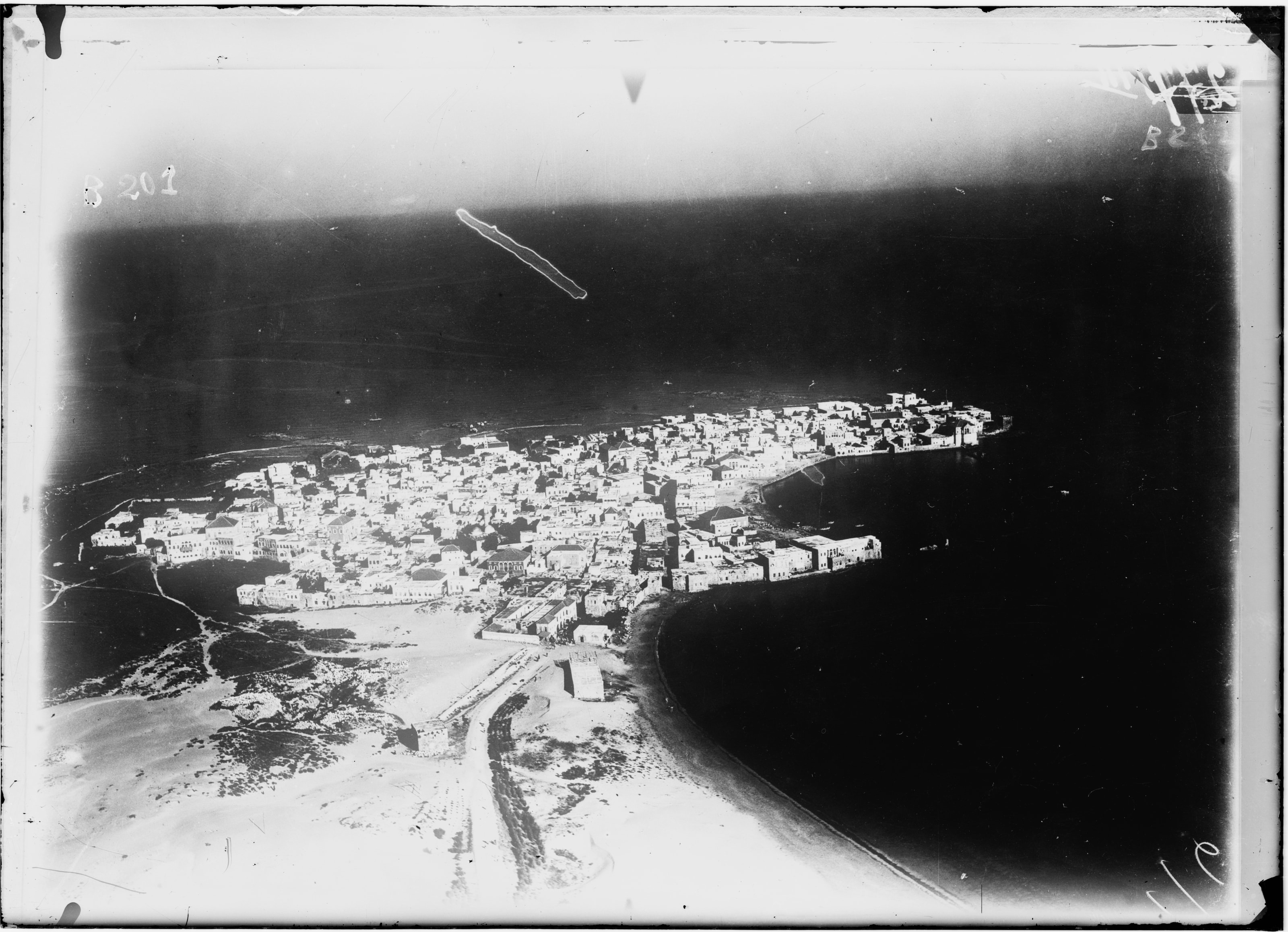
Aerial view of Tyre (Sur), Lebanon, between 1900 and 1920. The old town stands on what was the island city; the broad sandy neck joining it to the mainland grew up around the causeway Alexander built in 332 BC. Photo: American Colony (Jerusalem) Photo Department, G. Eric and Edith Matson Photograph Collection, Library of Congress, public domain, via Wikimedia Commons, resized.

See this page's graph and discover linked topics
In full
The Tyre Prophecy Argument is an abductive argument from fulfilled prediction. Its data are the oracle of Ezekiel 26:1-21, dated by its own superscription to the eleventh year of Jehoiachin's exile (c. 587/586 BC), the lament and oracles of chapters 27-28, and the dated appendix of Ezekiel 29:17-20 (571 BC). Its claim is that the oracle's distinctive structure and details are better explained by genuine foreknowledge than by chance or by later editing.
The structure is a succession of agents: Yahweh raises "many nations" (goyim rabbim) against Tyre "as the sea causeth its waves to come up" (26:3); one named agent, Nebuchadrezzar, comes "from the north" with siege works against the mainland (26:7-11); a plural "they" then plunders the city and lays "thy stones and thy timber and thy dust in the midst of the waters" (26:12). The distinctive details are the sea-disposal of the city's building material, the bare rock, and the net-drying ground (26:4-5, 14).
The historical record supplies a thirteen-year Babylonian siege under Ithobaal III (Josephus, Against Apion 1.21, citing Phoenician annals), a seven-month Macedonian siege in 332 BC in which Alexander's mole was built from the stones of mainland "Old Tyre" (Curtius Rufus 4.2.18; Diodorus 17.40.5), and a city that by 1697 an English traveller could describe as broken walls inhabited by "a few poor wretches... subsisting chiefly upon fishing" (Maundrell). Against this stand two serious objections, pressed by Farrell Till and, in a careful academic form, by Kris J. Udd (Tyndale Bulletin 56.1, 2005): that verses 7-14 assign the whole destruction to Nebuchadnezzar, who failed, and that "thou shalt be built no more" (26:14) is falsified by the continuous later history of Tyre. The point-by-point rebuttal of the failure charge lives on Failed Prophecy of Tyre Objection Defeater; this page builds the positive case and treats the 26:14 problem in its own section.
Argument structure
| # | Premise | Load-bearing claim |
|---|---|---|
| P1 | The oracle predates both sieges and is structured as successive waves | Ezek 26:1 dates it c. 587/586 BC; 26:3 announces many nations "as the sea causeth its waves to come up" |
| P2 | Nebuchadnezzar's siege fulfilled the first wave, and the text admits its limits | Josephus, Against Apion 1.21; Ezek 29:17-20 |
| P3 | Alexander's causeway fulfilled the sea-and-stone details | Arrian 2.18-24; Diodorus 17.40-46; Curtius 4.2-4; Ezek 26:4, 12 |
| P4 | The oracle's desolation language is best read as a sentence on the Phoenician sea-power, with the mainland site and the later ruin as its visible marks | Ezek 26:5, 14, 21; 27-28; Maundrell (1697) |
| C | The specificity and sequence of the oracle are better explained by foreknowledge than by chance or retrojection | Abductive inference |
Form
The argument is abductive and cumulative. No single detail carries it. The inference rests on the conjunction: a stated plurality of attackers, a named first attacker who partly succeeds, a later attacker who uses the city's own stones, timber and dust to fill the sea, and a city whose independent maritime power ended. P1 to P3 are well supported. P4 is the contested premise, and the conclusion is calibrated to it: a reader who rejects every reading of 26:14 offered below can still grant P1 to P3 and owe an explanation for them.
P1, The oracle predates both sieges and is structured as successive waves
Affirmative case
- The oracle carries its own date. Ezekiel 26:1 places it "in the eleventh year," counted from Jehoiachin's exile, which is 587/586 BC, the year Jerusalem fell. Ezekiel's dated oracles are generally accepted by critical scholars as close to their dates, and no scholar dates chapter 26 as late as 332 BC. The prediction of Alexander's stage is therefore a prediction on any dating.
- The opening verse sets the scope. "Behold, I am against thee, O Tyre, and will cause many nations to come up against thee, as the sea causeth its waves to come up" (Ezekiel 26:3, ASV). The agents are plural, and the simile is serial: waves arrive one after another.
- One named wave follows. Verses 7-11 introduce "Nebuchadrezzar king of Babylon, king of kings, from the north," with horses, chariots, forts, a mound and battering engines. These are the tools of a land siege, aimed at the mainland city and its suburbs, called "thy daughters that are in the field" (26:6, 8).
- The grammatical subject then changes. Verses 7-11 run in the third person singular ("he shall slay," "he shall set," "he shall break down"). Verse 12 switches to the plural: "they shall make a spoil of thy riches... and they shall lay thy stones and thy timber and thy dust in the midst of the waters." Defenders read the plural as the "many nations" of verse 3 returning after the first wave.
Anticipated objections
- "The 'they' of verse 12 is simply Nebuchadnezzar's army." This is Udd's and Till's reading: an army is naturally plural, so the shift need not mark a new agent.
- "Ezekiel 26:3 is generic oracle language, not a timetable of different empires."
- "Prophets regularly predicted the fall of enemy cities; a general prediction against a rich port is cheap."
Rebuttals
- The army reading is grammatically possible, and the argument does not depend on denying it. The point is cumulative: the oracle names many nations before it names Nebuchadnezzar, uses a serial simile, and then attributes to a plural subject the specific act (stones into the sea) that history attaches to Alexander. Even if "they" in verse 12 is read as Babylonian troops, the oracle as a whole still announces more than one assailant, and the sea-disposal detail still fits the second wave and not the first.
- Generic or not, it is the frame the prophet chose. An oracle that said "Nebuchadnezzar will destroy Tyre" and stopped would be a single-event prediction. Ezekiel 26 does not read that way, and the burden is on the critic to explain why a prophet confident in one agent would open with many.
- The prediction is specific in its details. Cities fell often; cities whose rubble was thrown into the sea to build a siege mole were rare. The sea-disposal of "stones," "timber" and "dust" (26:12) is the detail that lifts the oracle above a general curse.
Live-cite kit
- Scripture: Ezekiel 26:1 (date), 26:3 (many nations, waves), 26:7-11 (Nebuchadnezzar, singular), 26:12 (plural, stones into the sea)
- Scholarly: Daniel I. Block, The Book of Ezekiel, Chapters 25-48 (Eerdmans, 1998), the standard evangelical commentary on these chapters; Kris J. Udd, "Prediction and Foreknowledge in Ezekiel's Prophecy against Tyre," Tyndale Bulletin 56.1 (2005), the strongest critical treatment
- Aphorism: "The oracle names its waves before it names its first one."
Tactical notes
- Lead with the date. It disarms the retrojection charge for Alexander before it is raised.
- Concede that "they" can be read as an army. Then show the argument survives the concession.
P2, Nebuchadnezzar's siege fulfilled the first wave, and the text admits its limits
Affirmative case
- A long Babylonian siege is independently reported. Josephus quotes Phoenician records: "Nabuchodonosor besieged Tyre for thirteen years in the days of Ithobal, their king" (Against Apion 1.21, Whiston). The usual reconstruction runs from about 586/585 to 573/572 BC. Josephus also cites Philostratus for the siege (Antiquities 10.11.1).
- The mainland city bore the brunt. Nebuchadnezzar had no fleet able to take the island, which lay roughly half a mile offshore. His siege works, mound and engines (Ezekiel 26:8-9) fit a land operation against the mainland settlement and a blockade of the island.
- Ezekiel admits the limited result. Sixteen years after chapter 26, in an oracle dated "in the seven and twentieth year" (571 BC), Ezekiel writes: "Nebuchadrezzar king of Babylon caused his army to serve a great service against Tyre: every head was made bald, and every shoulder was worn; yet had he no wages, nor his army, from Tyre" (Ezekiel 29:18, ASV). Egypt is then given to him as his wages (29:19-20).
- The admission is evidence of honesty. A prophet or editor trying to hide a failed prediction would delete 29:17-20. Its survival in the canon shows the community did not read chapter 26 as a promise that Nebuchadnezzar would personally finish Tyre.
Anticipated objections
- "Ezekiel 29:17-20 is the prophet admitting his own prophecy failed." This is Till's central point and Udd's.
- "The thirteen-year siege rests on a source written seven centuries later."
- "Tyre submitted to Babylon on terms; the city was never destroyed."
Rebuttals
- It admits that Nebuchadnezzar got no plunder, which is a narrower claim. Verse 18 says the Babylonian army had "no wages," that is, no loot to pay for the effort. It does not say the oracle of chapter 26 has failed, and the prophet who wrote it kept chapter 26 in his book beside it. The fuller reply is on Failed Prophecy of Tyre Objection Defeater.
- Josephus is quoting older Phoenician archives, and Ezekiel is contemporary. The siege itself is not in doubt among historians; its length has been questioned, for example by scholars who suspect a long blockade with intermittent fighting rather than continuous assault. The calibrated claim is that a long Babylonian siege happened and did not take the island, which is exactly what Ezekiel 29 concedes.
- Agreed, and that is the point of the many nations. Tyre's submission to Babylon ended the first wave. The oracle's scope was never exhausted by it.
Live-cite kit
- Scripture: Ezekiel 29:17-20; Jeremiah 27:3 (Tyre among the kings told to submit to Babylon)
- Ancient: Josephus, Against Apion 1.21; Antiquities 10.11.1
- Aphorism: "The book that predicts the siege also keeps the receipt."
Tactical notes
- Quote 29:18 yourself, before the critic does. Owning the text is the strongest move on this premise.
P3, Alexander's causeway fulfilled the sea-and-stone details
Affirmative case
- The siege of 332 BC is richly documented. Arrian (Anabasis 2.15-24), Diodorus Siculus (17.40-46), Quintus Curtius Rufus (4.2-4) and Plutarch (Alexander 24-25) all describe it. Arrian dates the capture to the month Hekatombaion, when Anicetus was archon at Athens, that is, July or August 332 BC (2.24.6).
- Alexander built a mole across the strait. Arrian says "there was an abundant supply of stones and wood" for it (2.18). Diodorus writes that he "demolished what was called Old Tyre" and set many tens of thousands of men to carry stones for the mole (17.40.5). Curtius is the most explicit: "a great quantity of stones was at hand, Old Tyre supplying them" (magna vis saxorum ad manum erat, Tyro vetere praebente), with timber brought from Mount Lebanon (4.2.18).
- This matches Ezekiel 26:12 closely. "They shall lay thy stones and thy timber and thy dust in the midst of the waters." Stones, timber and fill went into the sea to build the causeway. Combined with 26:4, "I will also scrape her dust from her, and make her a bare rock," the picture is of the old city's material being stripped away and dumped in the water, which is what the historians describe.
- The island city fell to a land attack. The causeway turned the island into a peninsula, which it remains; sediment built up along it over the following centuries. The aerial photograph above shows the result. Arrian reports about 8,000 Tyrians killed and about 30,000 sold (2.24.5); Diodorus adds that some 2,000 men of military age were crucified (17.46.4).
Anticipated objections
- "Alexander's mole is a coincidence. Besiegers used whatever material was nearby."
- "Arrian does not say the stones came from Old Tyre."
- "If the prophecy meant Alexander, why does it name only Nebuchadnezzar?"
Rebuttals
- It was nearby because it had been a city. That is the force of the match. The prophecy did not say Tyre would be destroyed in some general way; it said its stones, timber and dust would go into the sea. That is an unusual fate for a conquered city, and it is the fate Old Tyre met.
- Correct, and the page says so. Arrian mentions stones and wood without naming their source. Diodorus links the demolition of Old Tyre to the carrying of stones, and Curtius states it directly. Two of the four main sources make the link, and none contradicts it.
- Prophets name the agent on their own horizon. Nebuchadnezzar was the threat of Ezekiel's day; Alexander lay two and a half centuries away. The oracle names the near agent and frames the whole as many nations. Other oracles do the same, and P1 covers why the frame matters.
Live-cite kit
- Scripture: Ezekiel 26:4, 26:12; Zechariah 9:3-4 (a later oracle that Tyre's power would be smitten "in the sea," also read of Alexander)
- Ancient: Arrian, Anabasis 2.18, 2.24; Diodorus 17.40.5, 17.46; Curtius 4.2.18
- Aphorism: "Ezekiel said the city would go into the sea. Alexander needed a road through the sea and paved it with the city."
Tactical notes
- Cite Curtius by section. It is the line most critics have not read.
- Do not overstate: say "two of the main sources name Old Tyre as the quarry," not "all four."
P4, The desolation language is a sentence on the Phoenician sea-power
This is the contested premise, and it needs the most care.
The problem stated fairly
Ezekiel 26:14 says, "I will make thee a bare rock; thou shalt be a place for the spreading of nets; thou shalt be built no more." Verse 21 adds, "thou shalt no more have any being; though thou be sought for, yet shalt thou never be found again." Yet Tyre was rebuilt within a few years of Alexander. In 315-314 BC Antigonus besieged it for "a year and three months" before it capitulated (Diodorus 19.61.5). Under Rome it was a major city; Paul's ship unloaded there and he stayed seven days with disciples in the city (Acts 21:3-4). Around AD 315 Eusebius preached the consecration sermon for the new cathedral of Tyre (Church History 10.4). The old town of modern Sur, a city of tens of thousands, stands on the former island. Any defence of the prophecy that says the site was never reoccupied is factually wrong, and this codex does not make it.
Four readings of "built no more"
- The mainland-site reading. The oracle's "bare rock" and "built no more" apply to the mainland city whose stones went into the sea. Old Tyre (Ushu, Greek Palaetyrus) was never rebuilt as a city; its exact location is not securely identified, which itself suits verse 21. Strength: it fits the causeway history exactly. Weakness: the oracle addresses Tyre as a whole, and verse 5 places the net-drying ground "in the midst of the sea," which sounds like the island.
- The sea-power reading. Chapters 26-28 address Tyre as a merchant empire and its king as a proud ruler of the seas (27:3-9, 28:2). After 332 BC Tyre was never again an independent Phoenician kingdom; it lived under Ptolemies, Seleucids, Romans and every power since. On this reading, "built no more" means the Tyre that the oracle addresses, the sovereign maritime city, was not restored. Strength: it reads the oracle as a political lament, which chapter 27's shipwreck image supports. Weakness: Roman Tyre was wealthy and influential, so the reading must distinguish prosperity from sovereignty.
- The oracle-genre reading. Oracles against the nations use stereotyped absolute language. Babylon "shall never be inhabited" (Isaiah 13:20) and Edom will have no "son of man" sojourning there (Jeremiah 49:18). These formulas announce total and final judgement on the power addressed and are fulfilled in that power's end, sometimes over centuries. Weakness: critics answer that genre cannot be invoked only when a detail fails.
- The long-run reading. Tyre's medieval history ended in ruin when the Mamluks took it in 1291 after the fall of Acre. Henry Maundrell, visiting in 1697, wrote that "you see nothing here but a mere Babel of broken walls, pillars, vaults, &c., there being not so much as one entire house left. Its present inhabitants are only a few poor wretches, harbouring themselves in the vaults, and subsisting chiefly upon fishing," and he read the scene as Ezekiel's fishers drying their nets (Thomas Wright, ed., Early Travels in Palestine, 1848, p. 423). Weakness: the town was later rebuilt and is a living city today, so this reading cannot rest on 1697 alone.
Anticipated objections
- "Tyre exists. Verse 14 failed. Everything else is excuse-making." This is Till's conclusion.
- "You are choosing whichever reading survives the facts."
- "If prophets used hyperbole, how can a fulfilled detail count as evidence?"
Rebuttals
- The objection is strongest here, and the defender should say so. A wooden reading of verse 14 conflicts with the later history of the island city. The question is whether a wooden reading is the right one. Readings 1 to 3 each have textual grounds inside chapters 26-28, and the fuller treatment of "never rebuilt" is on Failed Prophecy of Tyre Objection Defeater.
- The readings are older than the controversy. The sea-power reading follows chapter 27 itself; the genre reading follows from comparing the stock formulas used against Babylon and Edom (see Prophecies Against the Nations). Defenders should commit to one reading in advance and argue for it, rather than switch between them.
- Hyperbole governs scale; specifics govern evidence. The weight of the argument rests on the specific details of P1 to P3: the many nations, the named first attacker who gets no wages, the city's stones and timber in the sea. Calibrated, the case is that those details fit history remarkably well, and that 26:14 is a real interpretive difficulty whose best readings are consistent with that history.
Live-cite kit
- Scripture: Ezekiel 26:5, 14, 21; Ezekiel 27:26-36 (the shipwreck lament); Ezekiel 28:2; Acts 21:3-4
- Ancient and early modern: Diodorus 19.61.5; Eusebius, Church History 10.4; Maundrell (1697), in Wright, Early Travels in Palestine, p. 423
- Aphorism: "The merchant queen of the seas never sailed again under her own flag."
Tactical notes
- Never claim that modern Sur stands somewhere else. It stands on the island. Credibility on this premise is worth more than the premise.
- Pick the sea-power reading or the mainland reading before the debate and defend it consistently.
Grammar and hermeneutics
- The number of the verbs. Verses 7-11 use singular verbs with Nebuchadrezzar as subject; verse 12 opens a sequence of plural verbs ("they shall make a spoil... they shall lay thy stones"). Verse 4 also mixes a plural "they shall destroy the walls" with the divine first person "I will also scrape her dust." The text keeps the roles distinct: God is the ultimate actor, the nations are the instruments, and one named king is one instrument among them.
- The addressee stays fixed. Tyre is addressed throughout as "thou" (feminine singular), a city personified. What is announced is the fate of that personified city, and chapter 27 makes the personification explicit by picturing Tyre as a great merchant ship that sinks.
- The simile carries the timetable. "As the sea causeth its waves to come up" (26:3) describes repeated assaults. Nothing in the oracle sets a single date for the whole.
- Dated appendix. Ezekiel 29:17 opens with its own date formula. It is a separate oracle, written later, and it comments on what had happened. A hermeneutic that ignores it reads chapter 26 in isolation from the prophet's own later word on it.
Conclusion
The oracle predates both sieges, frames Tyre's judgement as a series of waves, names Nebuchadnezzar as the first, honestly records that he got no wages, and specifies that the city's stones, timber and dust would be laid in the sea, which is what Alexander's engineers did with Old Tyre in 332 BC. The line "thou shalt be built no more" is a genuine difficulty, and the island city's continued life must be granted. On balance, the specificity and sequence of the oracle are hard to explain as chance or as editing after the fact, and they fit the claim that Ezekiel spoke with knowledge beyond his horizon.
Master objections to the argument as a whole
- "Selection bias: apologists count the hits and ignore the misses." The codex's prophecy catalogue grades each case and lists hard cases it leaves out (see Biblical Prophecy). This page states its own miss-candidate, verse 14, at length.
- "The text was edited after Alexander." No manuscript evidence supports a post-332 BC insertion of verse 3 or verse 12, and the critical consensus dates the oracle to the sixth century BC.
- "Prophecy is unfalsifiable if fulfilments can be spread over centuries." The oracle itself states the plurality of attackers. A prediction that says "many nations, like waves" is falsifiable by a city that faces no further conquest; Tyre faced several.
Tactical opening / closing
Opening line: "Before we argue about whether Ezekiel failed, read me verse 3 and then read me verse 12, and tell me where the stones of the old city ended up."
Closing landing strip: "Ezekiel named many nations, named the first, admitted the first got nothing, and said the city's stones would end up in the sea. Alexander put them there. We can debate what 'built no more' means. The stones are still under the sand."
Scholarship
Published academic works this page draws on, each matched to a publisher, index or library catalog record.
- Daniel I. Block, The Book of Ezekiel: Chapters 25-48 (Wm. B. Eerdmans Publishing Co, 1998). doi:10.5040/bci-008x
- Kris J. Udd, "Prediction and Foreknowledge in Ezekiel’s Prophecy against Tyre," Tyndale Bulletin 56 (2005). doi:10.53751/001c.29192 open access
- Thomas Wright, Early travels in Palestine (1848). Open Library
See also
- Failed Prophecy of Tyre Objection Defeater, the point-by-point reply to the failed-prophecy charge
- Prophecies Against the Nations, Babylon, Nineveh, Edom and Egypt in the same genre
- Biblical Prophecy, the graded catalogue of fulfilled prophecy
- Argument from Prophecy Fulfillment, the broader argument this case feeds
- Nebuchadrezzar, the first named wave against Tyre
- Josephus, the source of the Phoenician siege record
- Old Testament Difficult Texts, the category of hard passages
- Hiram of Tyre, the king of Tyre in Solomon's day
Common questions this page answers
Q: What did Ezekiel prophesy about Tyre?
In Ezekiel 26, dated about 587 BC, Ezekiel said God would bring many nations against Tyre like waves of the sea, that Nebuchadnezzar would besiege it, that its stones, timber and dust would be thrown into the water, and that it would become a bare rock where fishermen spread their nets.
Q: How did Alexander the Great fulfill Ezekiel 26?
In 332 BC Alexander besieged the island city of Tyre and built a causeway across the strait to reach it. Diodorus says he demolished Old Tyre on the mainland and carried stones for the mole, and Curtius Rufus says the stones came from Old Tyre. That matches Ezekiel 26:12, "they shall lay thy stones and thy timber and thy dust in the midst of the waters."
Q: Did Nebuchadnezzar destroy Tyre?
He besieged it for thirteen years, according to Phoenician records quoted by Josephus, but he did not take the island city. Ezekiel 29:18 openly says Nebuchadnezzar and his army got "no wages" from Tyre, and Egypt was given to him instead.
Q: Isn't modern Tyre still standing, so the prophecy failed?
Modern Sur stands on the former island, and Tyre was rebuilt after Alexander. That makes "thou shalt be built no more" (Ezekiel 26:14) a real difficulty. Defenders read it as referring to the mainland city whose stones went into the sea, or to Tyre as an independent Phoenician sea-power, which never returned; critics such as Farrell Till read it literally and count it a failure.
Q: Who are the main critics of the Tyre prophecy?
Farrell Till, editor of The Skeptical Review, argued in the 1990s that the prophecy failed. The most careful academic version is Kris J. Udd's 2005 article in the Tyndale Bulletin, which concludes that the prophecy was not fulfilled in the manner Ezekiel predicted.