Concept
Twenty Conundrums the Trinity Resolves
20 conundrums the Trinity solves, twenty conundrums of reality, conundrums the triune God solves, problems only the Trinity solves, what does the Trinity explain, why the Trinity matters philosophically, Trinity solves philosophical problemsIntro
Some questions sit underneath everything else. Why is there anything at all? Why does logic work everywhere? Why should a person be worth something even when they are weak or useless to others? How can a judge be fair and still forgive? Every worldview has to answer these, or admit it has no answer.
Christians believe God is one God in three Persons: the Father, the Son and the Holy Spirit. This page walks through twenty of these deep questions and shows how that belief answers each one. It also does something many lists like this skip. It grades every answer honestly. Some of the twenty are answered by belief in any God at all. Some are answered only by a God who is three Persons, because they need love, relationship and communion that existed before the world did. And some need the full Christian story of the Son becoming human, dying and rising.
That honesty is the strength of the case. The claim is not that each puzzle on its own proves the Trinity. The claim is that one view answers all twenty together, and no rival does.
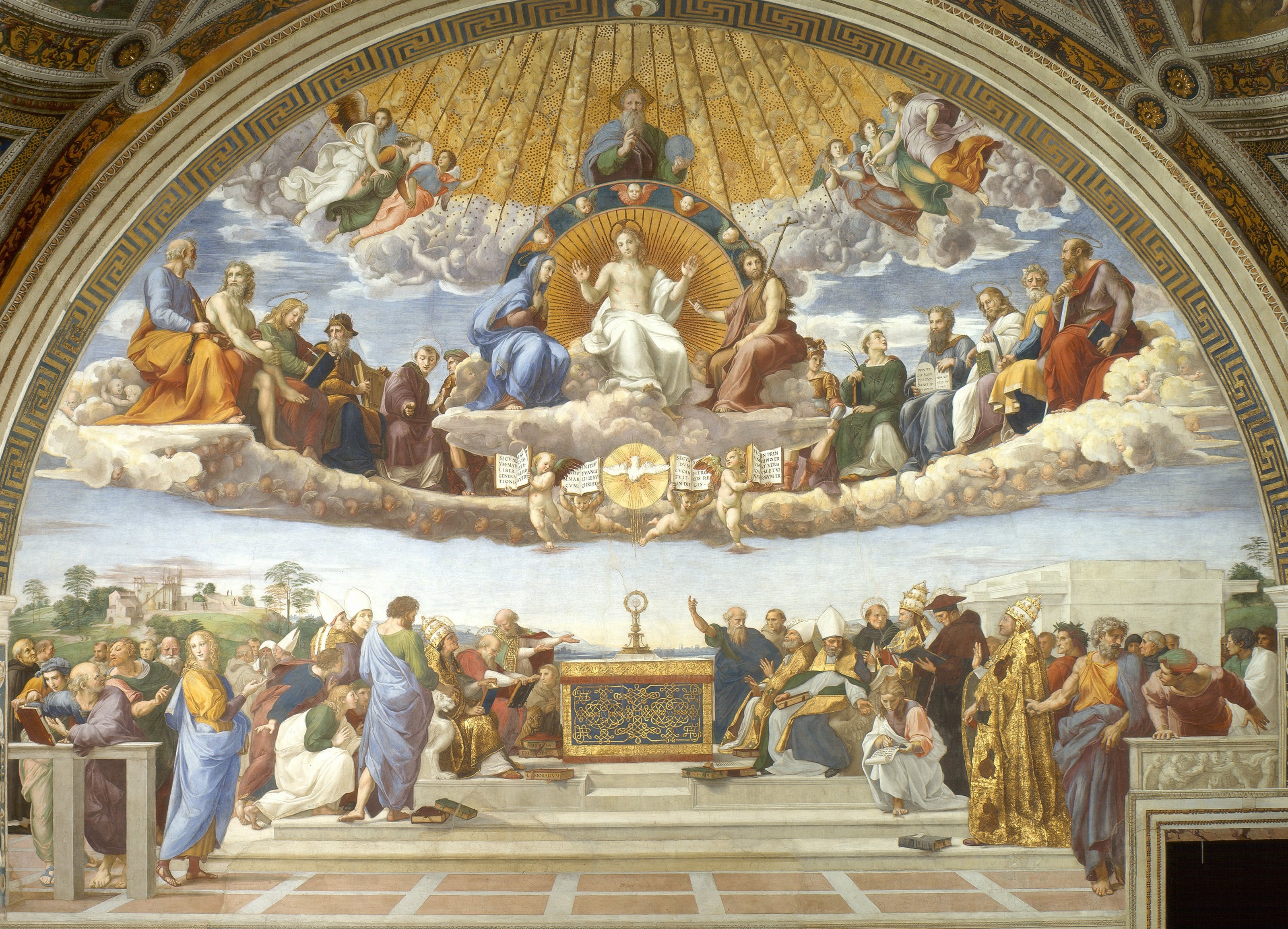
Raphael, The Disputation of the Holy Sacrament (1509 to 1510), Stanza della Segnatura, Vatican. The Father, the Son and the Spirit stand on one vertical axis above the Church's thinkers. Image: public domain, via Wikimedia Commons.
See this page's graph and discover linked topics
In full
A transcendental or abductive argument for the Trinity asks what ultimate reality must be like for certain pervasive features of the world to be real and intelligible: existence itself, causal dependence, necessary truth, logic, knowledge, the uniformity of nature, consciousness, rational inference, moral obligation, human dignity, personal identity, the coexistence of unity and plurality, love, community, the applicability of mathematics, creaturely freedom, evil, meaning, forgiveness and final restoration. This page treats twenty such conundrums. For each it states the problem, steel-mans the strongest non-Christian answers (naturalism, abstract-object Platonism, unitarian theism as in Judaism and Islam, pantheist monism, Neoplatonism), gives the theistic resolution, and then asks the sharper question: what does the Trinity add? The answers fall into three grades. G (general theism): any classical theism resolves it, and the Trinity inherits that resolution without loss. T (Trinitarian): a unipersonal God lacks a resource the triune God has, namely eternal, actual, interpersonal relation within the divine life. C (Christian-redemptive): the resolution runs through the Incarnation, the atonement and the resurrection, which presuppose distinct divine Persons. The grading follows the house rule of calibrated confidence. The specifically Trinitarian claims are strongest for the one and the many, eternal love and the reality of persons-in-communion; for the rest, the force of the case is the conjunction test of The Twenty Conundrums Argument: Trinitarian theism is the one hypothesis on the table that resolves every item, and no datum favors a unipersonal God over a triune one.
How the grading works
- G, general theism. Belief in one personal, necessary, good Creator is enough. Jews, Muslims and Christians share the answer. The Trinity does not weaken it.
- G+, theism with a Trinitarian increment. Theism answers the core of it, and the Trinity adds a real but secondary strength, usually through the Son as the eternal Word or through the Incarnation.
- T, specifically Trinitarian. The answer needs relation inside God before creation. A God who is one Person has no one to love, know or be with until the world exists.
- C, Christian-redemptive. The answer runs through the Son's becoming human, His death and resurrection, and the Spirit's renewing work. These presuppose that Father, Son and Spirit are distinct.
| Grade | Conundrums |
|---|---|
| G | 1 existence, 4 causation, 7 knowledge, 8 uniformity of nature, 9 consciousness, 10 reason, 14 personal identity, 16 mathematics |
| G+ | 5 necessary truth, 6 logic, 11 morality, 12 dignity, 17 freedom, 19 meaning |
| T | 2 the one and the many, 3 eternal love, 15 individuality and community |
| C | 13 justice and mercy, 18 evil, 20 final reconciliation |
I. Existence and metaphysics
1. Why is there something rather than nothing?
- The problem. Everything we observe could have failed to exist. A universe made only of things that might not have been seems to need an explanation outside itself. Leibniz put the question in its classic form in Principles of Nature and Grace (1714).
- Best rival answers. The universe is a brute fact with no explanation (Bertrand Russell in his 1948 BBC debate with Frederick Copleston). Or the universe, or a multiverse, exists necessarily. Or some physical state ("nothing" as a quantum vacuum) produced it.
- The theistic resolution. A necessary being, one that cannot fail to exist, explains the contingent ones, and is not itself in need of explanation by another. See Contingency Argument and Principle of Sufficient Reason. Alexander Pruss's The Principle of Sufficient Reason (2006) is the strongest modern defense of the premise. A quantum vacuum is something, with laws and fields, so it relocates the question.
- What the Trinity adds. Little at this level. A necessary Creator is shared ground. One point does follow: on the Christian view God's being is already full and active in the life of Father, Son and Spirit, so creation is a free gift, not something God needed in order to be God.
- Grade. G.
- Scripture. John 1:3; Colossians 1:16-17; Romans 11:36.
2. The one and the many
- The problem. Reality shows real unity (one world, kinds, laws) and real plurality (many distinct things). Philosophy since Parmenides and Heraclitus has tended to make one of them basic and the other derived or illusory.
- Best rival answers. Monism makes the One basic and the many appearance (Parmenides, Advaita Vedanta, Spinoza). Pluralism makes the many basic and unity a mental grouping (atomism, nominalism). Neoplatonism derives the many from a One beyond all distinction (Plotinus).
- The theistic resolution. A unipersonal God is ultimately one, so plurality first appears with creation. That still ranks unity above plurality at the root of things.
- What the Trinity adds. Everything. God is one in essence and three in Persons, so unity and distinction are equally ultimate in God. Cornelius Van Til called this the "equal ultimacy" of the one and the many. R. J. Rushdoony's The One and the Many (1971) and Colin Gunton's Bampton Lectures, The One, the Three and the Many (1993), develop it. The Persons are not parts of God, and God is not a fourth thing behind them. See Perichoresis for how the Persons are distinct without being divided.
- Grade. T.
- Scripture. Matthew 28:19 ("the name", singular, of three); John 10:30; John 17:21.
- Go deeper. One and the Many Problem, Argument from the One-and-the-Many Convergence.
3. Eternal love
- The problem. Scripture says "God is love" (1 John 4:8). Love in its full sense gives itself to another. If God is one Person, whom did He love before there was a world?
- Best rival answers. Islamic and Jewish theologians answer that love is an eternal attribute of God that was always real as a disposition, and was directed at creatures God eternally knew. Al-Wadud, "the Loving," is a divine name in the Quran (Surah 85:14).
- The theistic resolution. Any theism can say God was eternally able to love.
- What the Trinity adds. Actual, interpersonal love before creation. "Thou lovedst me before the foundation of the world" (John 17:24, ASV). Richard of St. Victor argued in De Trinitate, book 3 (twelfth century), that perfect charity needs another person to love, and that perfect love also wants a third who shares the love. Richard Swinburne restates the argument in The Christian God (1994), chapter 8. The rival answer leaves God's love either unactualized until creation, which makes creation necessary for God to be fully what He is, or aimed at ideas of creatures, which is not love between persons.
- Grade. T.
- Scripture. John 17:24; John 3:35; John 15:9; 1 John 4:8, 16.
- Go deeper. Argument from Love, Trinity Love-Overflow Argument, Aseity.
4. Ultimate causation
- The problem. A watch hand moves because a gear turns because a spring unwinds. In a chain like this, each link has its causal power only while it receives it. A chain made entirely of borrowed power explains nothing, however long it is.
- Best rival answers. An infinite regress of causes needs no first member (Hume, Dialogues Concerning Natural Religion, 1779). Or the fundamental laws themselves are the end of explanation.
- The theistic resolution. Aquinas distinguished chains ordered per accidens (a father begets a son who begets a son, each able to act after the earlier ones are gone) from chains ordered per se, where every member acts only while the first acts. A per se chain needs a first cause that has causal power of itself (Summa Theologiae I, q. 2, a. 3; Edward Feser, Five Proofs of the Existence of God, 2017). Laws describe how things act; they do not supply the being by which they act.
- What the Trinity adds. Not the existence of a first cause. The Christian account adds that creation is the shared work of the three: of the Father, through the Son, in the Spirit (Romans 11:36), without three separate causes.
- Grade. G.
- Scripture. Romans 11:36; Hebrews 1:3; Acts 17:28.
- Go deeper. Per Se vs Per Accidens Causation, Second Way - Efficient Causality, Argument from the Continuance of Being.
5. Unchanging truth in a changing world
- The problem. "Two plus two is four" and "nothing is both red and not red all over" are true always and everywhere, and could not have been false. Physical things all change and could all have been otherwise. What kind of thing is a necessary truth, and where is it?
- Best rival answers. Platonism: necessary truths are abstract objects that exist on their own, outside space and time. Nominalism and fictionalism: there are no such objects, only useful ways of talking (Hartry Field, Science Without Numbers, 1980).
- The theistic resolution. Necessary truths are the contents of God's eternal thought. Augustine held this (On Free Choice of the Will, book 2), and Alvin Plantinga defended it in "How to Be an Anti-Realist" (1982). It explains three things Platonism leaves loose: why abstract truths are about anything, how they relate to minds, and how minds like ours can know them.
- What the Trinity adds. The Son is the Word, the Father's own eternal self-expression (John 1:1). On this view the "place" of truth is not an impersonal realm but a Person who is the Father's Wisdom (Proverbs 8:30, read Christologically since the early Church).
- Grade. G+.
- Scripture. John 1:1; Malachi 3:6; Psalm 119:89.
- Go deeper. Argument from Mathematical Truth, Logos Christology.
II. Knowledge, reason and intelligibility
6. The laws of logic
- The problem. The law of non-contradiction binds every thought in every place. Aristotle stated it in Metaphysics IV.3 (1005b19-20): the same attribute cannot at the same time belong and not belong to the same subject in the same respect. It is not a habit of our brains, because a brain that broke it would just be wrong.
- Best rival answers. Logic is conventional, a set of rules we chose. Or it describes the most general features of physical reality. Or it is a brute necessity needing no ground.
- The theistic resolution. Logical laws are true propositions, propositions are thoughts, and necessary thoughts need a necessary thinker. James N. Anderson and Greg Welty make this argument in "The Lord of Non-Contradiction," Philosophia Christi 13.2 (2011). Conventionalism cannot explain why the convention is binding on reasoning that has not agreed to it.
- What the Trinity adds. Once more, the Word: reason is personal at its source (logos is both "word" and "reason"). A careful point also belongs here. The doctrine of the Trinity obeys non-contradiction. It does not say God is one Person and three Persons, or one essence and three essences. It says one essence and three Persons, which are different respects. See Trinity Coherence Defense (Latin-Thomist).
- Grade. G+.
- Scripture. John 1:1-3; 2 Timothy 2:13 ("he cannot deny himself").
- Go deeper. Laws of Logic, Transcendental Argument for God.
7. Human knowledge
- The problem. Small, fallible minds discover truths about galaxies, cells and numbers they never evolved to handle. Why should our thinking line up with reality at all?
- Best rival answers. Natural selection made our cognitive faculties reliable, because true beliefs help survival.
- The theistic resolution. A knowing Creator made both the world and the mind to fit each other. Alvin Plantinga's Evolutionary Argument Against Naturalism (Where the Conflict Really Lies, 2011) presses the rival: selection rewards adaptive behavior, not true belief as such, so naturalism plus evolution gives a naturalist a reason to doubt his own faculties, including the faculty that produced naturalism. The argument is debated, but it shows the rival answer is not free.
- What the Trinity adds. Augustine found an image of the Trinity in the mind's knowing itself (mind, its knowledge of itself, and its love of that knowledge; De Trinitate, books 9 and 10). He offered it as an analogy, not a proof. The core answer is shared theism.
- Grade. G.
- Scripture. Proverbs 2:6; Colossians 2:3.
- Go deeper. Evolutionary Argument Against Naturalism, Argument from Intelligibility.
8. The uniformity of nature
- The problem. All science assumes the future will resemble the past. David Hume showed in 1748 that this cannot be proved from past experience without arguing in a circle.
- Best rival answers. Laws of nature necessitate regularity (David Armstrong). Or induction is justified pragmatically: if any method works, induction does (Hans Reichenbach).
- The theistic resolution. Nature is regular because a faithful Creator sustains it by a constant will. "While the earth remaineth, seedtime and harvest, and cold and heat, and summer and winter, and day and night shall not cease" (Genesis 8:22, ASV). John Foster develops this in The Divine Lawmaker (2004).
- What the Trinity adds. The Son "upholding all things by the word of his power" (Hebrews 1:3, ASV) names the sustainer, but the grounding is shared theism. Divine faithfulness makes regularity expected; it does not guarantee that every observed regularity continues unchanged, since God can act in miracles.
- Grade. G.
- Scripture. Genesis 8:22; Jeremiah 33:25; Hebrews 1:3.
- Go deeper. The Seedtime Argument, David Hume.
9. Consciousness
- The problem. Why does any physical process feel like something from the inside? David Chalmers named this the "hard problem" in 1995. A full map of the brain's workings does not by itself say why there is experience.
- Best rival answers. Consciousness is identical to brain activity (identity theory) or to its functional role (functionalism). Or it is an illusion (Daniel Dennett, Keith Frankish). Or mind is a basic feature of matter everywhere (panpsychism, Philip Goff).
- The theistic resolution. If the ultimate reality is a conscious, knowing Person, then minds are not strangers in the universe. They come from Mind. Thomas Nagel, an atheist, concedes in Mind and Cosmos (2012) that materialism has no good account of consciousness.
- What the Trinity adds. The source of all minds is itself personal life, knowing and known, from eternity. Strictly the core answer is shared theism.
- Grade. G.
- Scripture. Genesis 1:26-27; Psalm 139:1-4.
- Go deeper. Argument from Consciousness, The Riddle of Consciousness, God Cannot Be Conscious Without a Brain Objection Defeater.
10. Reason and physical causation
- The problem. If every thought is fully caused by prior physical events, what makes any thought rational, that is, held because the evidence supports it rather than because neurons fired?
- Best rival answers. There is no conflict: some physical processes just are reasoning, the way a calculator's circuits just are adding.
- The theistic resolution. Reasoning is responsive to grounds, and a world made by Reason can contain beings whose physical processes are also truly guided by reasons. C. S. Lewis made the argument in Miracles (1947, revised chapter 3 in 1960), and Victor Reppert developed it in C. S. Lewis's Dangerous Idea (2003). The calculator reply borrows its rationality from the minds that designed and interpret it.
- What the Trinity adds. Nothing beyond shared theism.
- Grade. G.
- Scripture. Isaiah 1:18 ("let us reason together"); Romans 12:2.
- Go deeper. Argument from Reason, The Designed Mind.
III. Morality, value and personhood
11. Objective morality
- The problem. Some things are wrong even when a whole society approves of them. What makes a moral duty binding on everyone?
- Best rival answers. Secular moral realism: moral facts are necessary truths needing no ground (Erik Wielenberg, Robust Ethics, 2014). Or morality is evolved instinct and social agreement, real for us but not objective.
- The theistic resolution. Goodness is grounded in God's own nature, and duties in His commands, which flow from that nature. This answers the Euthyphro dilemma: good is neither arbitrary (God could not command cruelty against His own character) nor independent of God.
- What the Trinity adds. The highest moral goods are other-regarding: love, faithfulness, giving, honoring another. If goodness is grounded in God's nature, a God whose nature includes eternal self-giving between Persons grounds these goods in something actual, not just possible. A solitary God had no one to be faithful or generous toward before creation.
- Grade. G+.
- Scripture. Romans 2:14-15; 1 John 1:5.
- Go deeper. Moral Argument, Euthyphro Dilemma Objection Defeater, The Felt Ought Argument.
12. Human dignity
- The problem. Why should every person have equal, intrinsic worth, whether gifted or disabled, useful or not, wanted or not? Most measurable traits come in degrees, but worth is supposed to be equal.
- Best rival answers. Worth comes from rational capacity (Kant), which comes in degrees and is absent in some humans. Or worth is granted by society, which can withdraw it.
- The theistic resolution. Every human bears God's image (Genesis 1:27) and is loved by God. Nicholas Wolterstorff argues in Justice: Rights and Wrongs (2008) that only a worth bestowed by God's equal love is both inherent and equal for all.
- What the Trinity adds. In the Incarnation the Son took human nature permanently. Human nature is now forever joined to a divine Person, which is the highest dignity a nature can have.
- Grade. G+.
- Scripture. Genesis 1:26-27; James 3:9.
- Go deeper. Imago Dei, Biblical Dignity, The Inalienable Argument.
13. Justice and mercy
- The problem. A good judge does not wave away crimes. A loving father forgives. How can God do both without one cancelling the other?
- Best rival answers. God simply forgives the repentant, and justice is satisfied by repentance itself (a common Jewish and Islamic answer). Or justice is only restorative and never retributive.
- The theistic resolution. Theism alone can say God forgives, but must then explain why forgiving the guilty is not simply injustice to their victims.
- What the Trinity adds. The Father sends, the Son freely gives Himself, and the Spirit applies the work (Hebrews 9:14: Christ "through the eternal Spirit offered himself"). The judge does not punish a third party against his will; God Himself, in the Person of the Son, bears the cost. That is why Paul can say God is "just, and the justifier of him that hath faith in Jesus" (Romans 3:26, ASV). Anselm's Cur Deus Homo (1098) is the classic statement. Christian traditions disagree on the exact mechanism; see Atonement Theory Spread.
- Grade. C.
- Scripture. Romans 3:25-26; Hebrews 9:14; Isaiah 53:5.
- Go deeper. The Justice and Mercy Argument, Penal Substitutionary Atonement, Atonement.
14. Personal identity
- The problem. Every cell in your body is replaced over time, your memories fade, your personality changes. What makes you the same person as the child in your old photos?
- Best rival answers. Psychological continuity: overlapping chains of memory and character (John Locke, Derek Parfit's Reasons and Persons, 1984, which concludes identity is not what matters). Or bodily continuity.
- The theistic resolution. A person is a substantial self, a soul, not a bundle of states, and its identity rests in what it is, held in being by God (Richard Swinburne in Personal Identity, with Sydney Shoemaker, 1984). God knows and calls each person by name across every change (Luke 12:7).
- What the Trinity adds. Persons are not latecomers in the universe: personhood is basic in God. The answer to human persistence is shared theism.
- Grade. G.
- Scripture. Psalm 139:13-16; Luke 12:7.
- Go deeper. Argument from Personal Identity, Argument from the Memory-Continuity Convergence.
15. Individuality and community
- The problem. Individualism treats the self as complete on its own; collectivism treats the self as a part of the group. Each tends to crush what the other protects. Is either the truth about persons?
- Best rival answers. Liberal individualism (persons are prior to relations). Collectivist and communitarian views (persons are constituted by the group).
- The theistic resolution. A unipersonal God is the model of a self complete on its own, which leans toward individualism as the image of the highest being.
- What the Trinity adds. The highest being is three Persons, fully distinct and never divided, each wholly given to the others (Perichoresis). The Father is Father only in relation to the Son. Persons are neither swallowed by the whole nor complete in isolation. Jesus prayed that His people would be one "even as thou, Father, art in me, and I in thee" (John 17:21, ASV). The analogy has limits: human persons are separate beings and the divine Persons are not. Social Trinitarians press the analogy hard; classical theologians keep it modest (Social Trinitarianism).
- Grade. T.
- Scripture. John 17:20-23; 1 Corinthians 12:12-27.
- Go deeper. Social Trinitarianism, The Common Room Argument.
IV. Creation, meaning and destiny
16. Why mathematics describes nature
- The problem. Mathematics worked out on paper, often for its own beauty, later turns out to describe the physical world with uncanny precision. Eugene Wigner called this "the unreasonable effectiveness of mathematics in the natural sciences" (1960).
- Best rival answers. We notice the cases that work and forget the rest. Or mathematics is abstracted from physical experience, so it fits because it came from there. Mark Steiner's The Applicability of Mathematics as a Philosophical Problem (1998) argues neither answer covers how physicists actually discover laws.
- The theistic resolution. The same Mind that thinks mathematical truths made the world and made human minds, so the three fit.
- What the Trinity adds. The Word through whom all things were made (John 1:3) is the same Reason that grounds mathematical truth (conundrum 5). The core answer is shared theism.
- Grade. G.
- Scripture. Jeremiah 33:25; Colossians 1:16-17.
- Go deeper. Mathematical Intelligibility of Nature, Mathematics Requires Christian Theism, Argument from the Beauty-Mathematics Convergence.
17. Freedom and dependence
- The problem. If God holds every creature in being at every moment, how can a creature really act for itself? If creatures act for themselves, how is God sovereign?
- Best rival answers. Occasionalism: God is the only real cause and creatures only seem to act (al-Ghazali, Malebranche). Deism: God made the world and lets it run, so creatures are free because God is absent.
- The theistic resolution. Divine and creaturely causes are not rivals on the same level. God is the primary cause who gives being to the act; the creature is the real secondary cause of it (Aquinas, Summa Theologiae I, q. 105, a. 5). Kathryn Tanner calls this a "non-competitive" relation in God and Creation in Christian Theology (1988). See Concurrentism.
- What the Trinity adds. The Incarnation is the test case. The Third Council of Constantinople (681) affirmed that Christ has a fully divine will and a fully human will that act in harmony. If divine and human agency can coexist in one Person without either being absorbed, they can coexist in God's relation to every creature. Christians still disagree on how this fits with libertarian freedom (Free Will and Determinism, Molinism).
- Grade. G+.
- Scripture. Acts 17:28; Philippians 2:12-13.
- Go deeper. Concurrentism, Occasionalism, Agent Causation.
18. Evil in a good creation
- The problem. If a perfectly good, all-powerful God made the world, why does it contain cruelty, disease and grief? J. L. Mackie pressed the logical form in "Evil and Omnipotence" (1955), William Rowe the evidential form in 1979.
- Best rival answers. There is no God, so evil needs no reconciling (though naturalism then struggles to call anything objectively evil; see conundrum 11). Or evil is an illusion (some Eastern monism). Or good and evil are two eternal powers (dualism).
- The theistic resolution. Evil is not a thing God made but a corruption of good things, a privation (Augustine, Enchiridion 11; Aquinas, Summa Theologiae I, q. 48). Alvin Plantinga's free will defense (God, Freedom, and Evil, 1974) is widely credited, including by many atheist philosophers, with answering the logical problem. The evidential problem remains serious and is argued case by case.
- What the Trinity adds. God does not answer evil from a distance. The Son enters suffering and death in His own human nature, the Father gives the Son, and the Spirit raises Him and will give life to our mortal bodies (Romans 8:11). The cross does not explain every evil, but it shows that God is not indifferent to it, and the resurrection shows what He will do with it.
- Grade. C.
- Scripture. Romans 8:20-23; Revelation 21:4.
- Go deeper. Problem of Evil, Evil as Privation of Good, Argument from Meaningful Suffering.
19. Ultimate meaning
- The problem. If every life ends in death and the universe ends in cold, can anything we do matter in more than a passing way?
- Best rival answers. Meaning is made, not found: a life is meaningful when it is subjectively fulfilling and engaged with things of objective worth (Susan Wolf, Meaning in Life and Why It Matters, 2010). Or life is absurd and we should face it with defiance (Albert Camus).
- The theistic resolution. We exist because God intended us, for an end that outlasts death. Our purpose is found in Him, not merely invented.
- What the Trinity adds. The end is not only serving God but sharing in the communion of Father, Son and Spirit: "that they also may be in us" (John 17:21, ASV). Meaning is a relationship that was already there before we were born.
- Grade. G+.
- Scripture. Colossians 1:16; Ephesians 1:9-10; John 17:21-24.
- Go deeper. Argument from Purpose Meaning and Hope, I Create My Own Meaning Objection Defeater, The Heat Death Argument.
20. Final reconciliation
- The problem. Can justice, love, persons and the world all be restored together, so that evil is defeated without wiping out the people it touched or pretending it did not matter?
- Best rival answers. Naturalism: there is no final restoration; the universe ends in heat death. Many Eastern traditions: release means the dissolving of the individual self.
- The theistic resolution. Judaism and Islam both hope for a resurrection and a final judgment.
- What the Trinity adds. Christianity grounds the hope in an event already begun: the Son's bodily resurrection as the firstfruits, His reign until all enemies are subjected, the Spirit as the down payment, and God finally "all in all" (1 Corinthians 15:28, ASV). Persons are raised, not dissolved; justice is done, not ignored. Its truth stands or falls with the resurrection of Jesus, which is a historical question argued elsewhere in the codex.
- Grade. C.
- Scripture. 1 Corinthians 15:20-28; Revelation 21:1-5; Romans 8:21.
- Go deeper. Resurrection of Jesus, New Heavens and New Earth, Eschatology.
The conjunction test
The word "alone" in the claim that the Trinity alone resolves these puzzles is best tested on the whole set, not one item at a time. The table compares how well each major worldview handles the six clusters (see The Twenty Conundrums Argument for why they are counted as six, not twenty). It reports the case made on this page; defenders of each rival dispute particular cells.
| Cluster | Naturalism | Platonism plus naturalism | Unitarian theism | Pantheist monism | Trinitarian theism |
|---|---|---|---|---|---|
| Existence and causation (1, 4, 17) | brute fact | brute fact | resolves | resolves in part (the world is the One) | resolves |
| Intelligibility (5, 6, 7, 8, 10, 16) | strained | resolves 5, 6, 16 in part | resolves | resolves in part | resolves |
| Mind and person (9, 14) | strained | not addressed | resolves | mind basic, persons not | resolves |
| Value (11, 12, 19) | strained or anti-realist | moral facts as brute | resolves | good and evil relativized | resolves |
| Unity, love, community (2, 3, 15) | not addressed | not addressed | unity over plurality; love dispositional | unity over plurality | resolves |
| Redemption (13, 18, 20) | none needed, none offered | none | forgiveness without cost-bearing | release, not restoration | resolves |
What the table shows. Unitarian theism matches Trinitarian theism on four clusters. It falls short on the two that turn on relation within God and on God bearing the cost of evil Himself. No row favors a unipersonal God over a triune one. That asymmetry, not any single conundrum, is what the cumulative argument rests on.
What this does not claim
- It does not claim atheists cannot reason, love, do science or act morally. They plainly can. The question is what makes those things real and binding.
- It does not claim each conundrum proves the Trinity on its own. Eight of the twenty are graded G, answered by any theism.
- It does not claim to replace the historical case. The redemptive cluster (13, 18, 20) is only as strong as the evidence that Jesus rose.
- It does not claim the Trinity is fully understood. Augustine said his analogies clarify the doctrine without capturing God (De Trinitate, book 15).
Why the Trinity was not invented to solve these
A fair objection: any doctrine can be dressed up to fit any problem after the fact. The history cuts against that here. The doctrine was formulated at the Council of Nicaea (325) and the First Council of Constantinople (381) to state what Scripture says about the Father, the Son and the Spirit, against Arius and the Pneumatomachians, not to solve the one and the many or the grounding of love. The philosophical fit was noticed later, by Augustine, Richard of St. Victor, and in modern times Van Til, Gunton and Swinburne. A doctrine adopted for exegetical reasons that then turns out to answer old philosophical puzzles is a modest kind of confirmation. See Trinity Invented at Nicaea Objection Defeater for the textual roots before 325.
Connection to Scripture
- John 17:24, love between Father and Son before creation
- Matthew 28:19, one name, three Persons
- John 1:1, the Word with God and the Word God
- Colossians 1:16-17, all things made through and held together in the Son
- Genesis 8:22, the covenant regularity of nature
- Romans 3:26, just and the justifier
- 1 Corinthians 15:28, God all in all
Scholarship
Published academic works this page draws on, each matched to a publisher, index or library catalog record.
- James N. Anderson, Greg Welty and Evangelical Philosophical Society, "The Lord of Noncontradiction: An Argument for God from Logic," Philosophia Christi 13 (2011). doi:10.5840/pc201113229
- Edward Feser, Five Proofs of the Existence of God (2017). Open Library
- Hartry H. Field, Science without numbers (1980). Open Library
- John Foster, The Divine Lawmaker: Lectures on Induction, Laws of Nature, and the Existence of God (Oxford University Press, 2004). doi:10.1093/0199250596.001.0001
- Colin E. Gunton, The One, the Three and the Many (Cambridge University Press, 1993). doi:10.1017/cbo9781139166546
- David Hume, Dialogues Concerning Natural Religion (1779). Open Library
- Thomas Nagel, Mind and Cosmos: Why the Materialist Neo-Darwinian Conception of Nature is Almost Certainly False (Oxford University Press, 2012). doi:10.1093/acprof:oso/9780199919758.001.0001
- Derek Parfit, Reasons and Persons (Oxford University Press, 1984). Open Library
- Alvin Plantinga, God, freedom, and evil (1974). Open Library
- Alvin Plantinga, "How to be an Anti-Realist," Proceedings and Addresses of the American Philosophical Association 56 (1982). doi:10.2307/3131293
- Alvin Plantinga, Where the Conflict Really Lies (2011). Open Library
- Alexander R. Pruss, The Principle of Sufficient Reason: A Reassessment (Cambridge University Press, 2006). doi:10.1017/cbo9780511498992
- Victor Reppert, C.S. Lewis's dangerous idea (2003). Open Library
- Mark Steiner, The Applicability of Mathematics as a Philosophical Problem (Harvard University Press, 1998). doi:10.4159/9780674043985
- Richard Swinburne, The Christian God (Oxford University Press, 1994). doi:10.1093/0198235127.001.0001
- Kathryn Tanner, God and creation in Christian theology (Blackwell, 1988). Open Library
- Cornelius Van Til, The defense of the faith (1955). Open Library
- Erik J. Wielenberg, Robust Ethics: The Metaphysics and Epistemology of Godless Normative Realism (Oxford University Press, 2014). doi:10.1093/acprof:oso/9780198714323.001.0001
- Eugene P. Wigner, "The unreasonable effectiveness of mathematics in the natural sciences. Richard courant lecture in mathematical sciences delivered at New York University, May 11, 1959," Communications on Pure and Applied Mathematics 13 (1960). doi:10.1002/cpa.3160130102
- Nicholas Wolterstorff, Justice: Rights and Wrongs (Princeton University Press, 2008). doi:10.1515/9781400828715
See also
- The Twenty Conundrums Argument, the formal cumulative case built on this page
- Trinity, the doctrine itself
- Perichoresis, how the three Persons are in one another
- Trinity Coherence Defense (Latin-Thomist), why one essence in three Persons is not a contradiction
- Trinitarian Models Compared, social, Latin and monarchical models
- Transcendental Argument for God and Presuppositionalism, the method behind several conundrums
- Cornelius Van Til and Greg Bahnsen, who argued from the one and the many
- The Speaker-Word-Breath Argument and The Three Persons of Grammar Argument, two more arguments from the triune shape of reality
- Tawhid, the Islamic doctrine of divine oneness this page compares with
- Cumulative Case for Christian Theism, where this page contributes
Common questions this page answers
Q: What problems does the Trinity solve that other views of God cannot?
Three stand out. The Trinity makes unity and plurality equally basic in reality, it gives God actual love between Persons before the world existed, and it makes persons-in-communion the deepest pattern of being. A God who is one Person can be loving only toward creatures or in potential before creation.
Q: Does the Trinity solve every philosophical problem on its own?
No, and this page says so. Eight of the twenty conundrums are answered by belief in any personal Creator. The Trinitarian claim is that one view answers all twenty together, and that no conundrum is better answered by a God who is a single Person.
Q: How can God be love if He is only one Person?
Jewish and Muslim theologians answer that love was always an eternal attribute of God. Christians reply that a love with no one to love until creation is only a capacity, and that it makes creation necessary for God to be fully loving. On the Trinitarian view the Father loved the Son "before the foundation of the world" (John 17:24).
Q: What is the problem of the one and the many?
It is the old question of whether unity or diversity is more basic in reality. Most philosophies make one of them fundamental and the other derived. Christian thinkers from Van Til to Colin Gunton argue that the Trinity, one God in three Persons, makes both equally ultimate.
Q: Is the Trinity a contradiction?
No. A contradiction says something is and is not the same thing in the same respect. The doctrine says God is one in essence and three in Persons, which are two different respects. It never says God is one Person and three Persons.
Q: Wasn't the Trinity invented later to make Christianity look philosophical?
The councils of 325 and 381 formulated the doctrine to state what Scripture teaches about the Father, the Son and the Spirit, not to answer philosophical puzzles. The philosophical fit was noticed later, which is why it counts as a modest confirmation rather than a retrofit.