Concept
Trinity
Trinity, Doctrine of the Trinity, Triune God, Tri-unity, Holy Trinity, doctrine of the Trinity, trinitarianism, three persons one God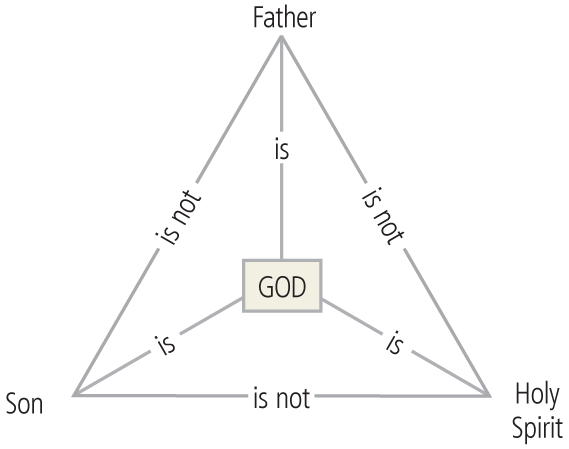
The cross-domain master hub for the doctrine of God as Father, Son, and Holy Spirit, three distinct Persons sharing one divine essence. The Trinity is the central distinctive of Christian theology and the doctrinal frame within which the Christology hub operates. This page is the teaching scaffold; the deep treatments live on companion sub-pages.
Intro
Christians say there is only one God. They also say the Father is God, Jesus is God, and the Holy Spirit is God. And they say the Father is not Jesus, Jesus is not the Spirit, and the Spirit is not the Father. That sounds like a riddle. The Trinity is the answer the church gave to it.
The short form: one God, three Persons. "God" names what He is. "Persons" names the three real, distinct whos inside the one God. The Father, the Son, and the Spirit are not three different gods, and they are not three masks worn by the same person at different times. They are three who share one life.
A common confusion is to picture three separate beings, like three people in a team. That is closer to having three gods. Another common confusion is to picture one person who plays three roles, like an actor switching costumes. That is closer to one god with three disguises. The Bible's picture is neither. At Jesus's baptism the Father speaks from heaven, the Son stands in the water, and the Spirit comes down like a dove, all at the same time, all doing different things. Three real Persons. One real God.
Why does this matter? Because if God has always been Father, Son, and Spirit, then love was not something God had to learn or wait for. The Father has loved the Son forever. Love was already happening inside God before the world existed. Creation is the overflow of a love that was already full. A lone, single-Person God could not say that. (See Trinity Love-Overflow Argument for the full case.)
See this page's graph and discover linked topics
In full
The Christian doctrine that the one God exists eternally as three coequal and consubstantial Persons (Father, Son, and Holy Spirit), each fully and equally God, distinct from one another in their personal relations but undivided in essence. The doctrine is the central distinctive of Christian theology, the framework within which Christology, pneumatology, and the doctrine of God operate. The classical formula was promulgated at the First Council of Nicaea (AD 325), refined at the First Council of Constantinople (AD 381), and confessed in the Nicene-Constantinopolitan Creed used across Catholic, Eastern Orthodox, Reformed, Lutheran, Anglican, Methodist, and evangelical traditions. This page treats the doctrine as a teaching scaffold: the technical apparatus, the biblical case, the heresy spread, and the apologetic deployments live on linked companion pages.
The classical formula
One God in three Persons, three distinct hypostaseis (Persons) sharing one ousia (substance / essence). Each Person is fully God; the Persons are not three gods (against tritheism) and not three modes of one Person (against modalism).
The Cappadocian formulation (Basil the Great, Gregory of Nazianzus, Gregory of Nyssa, c. AD 360-381):
- mia ousia, treis hypostaseis, one essence, three Persons.
- The Persons are distinguished by their eternal relations of origin:
- the Father is unbegotten (without source within the Godhead);
- the Son is eternally begotten of the Father (not created, gennēthenta ou poiēthenta);
- the Holy Spirit eternally proceeds (from the Father; the Western tradition adds and the Son, Filioque; see Filioque).
The two technical words
| Word | Greek / Latin | What it names | Plain meaning |
|---|---|---|---|
| Essence | ousia / substantia | what God IS | the one divine nature, shared completely by all three |
| Person | hypostasis / persona | who God IS | the three distinct subjects (Father, Son, Spirit), each fully sharing the one essence |
Different categories. "One essence, three Persons" is not "one Person, three Persons"; the formula is asserting unity at the level of what and trinity at the level of who.
Three things the Trinity is NOT (the teaching moment)
The classical heresies are the easiest way to learn the doctrine, because each one denies a different part of it. Hold the three together and the doctrine comes into focus.
| Confusion | What it claims | What it gets wrong | What corrects it |
|---|---|---|---|
| Tritheism | three Gods cooperating | denies one essence | Shema (Deut 6:4, echad); "there is no other God" (Isaiah 45.5) |
| Modalism / Sabellianism | one God playing three roles | denies three Persons (the Persons are real, distinct subjects) | baptism (Matthew 3.16-17, all three present at once); Son prays to Father (John 17); Father sends Son (John 3.16) |
| Arianism | the Father is God; the Son and Spirit are creatures | denies each Person is fully God | John 1.1 ("the Word was God", logos); Colossians 2.9 ("all the fullness of Deity", plērōma / theotēs); Hebrews 1.8 ("of the Son He says, 'Your throne, O God'") |
The doctrine threads between all three: against tritheism, the essence is one; against modalism, the Persons are three distinct subjects; against Arianism, each Person fully shares the one divine essence.
For the comparative-position table mapping these and other historical positions, see Spread of positions below. For each heresy treated in detail, see Modalism, Arianism, and Oneness Pentecostalism.
The biblical case, three converging lines
The doctrine is grounded in three lines of biblical evidence that must be held simultaneously. Drop any one and the doctrine collapses into one of the heresies above.
Line 1: strict monotheism (against tritheism)
Christianity inherits from Judaism the strict-monotheistic affirmation:
- Deuteronomy 6:4, the Shema: Sh'ma Yisrael, YHWH Eloheinu, YHWH echad, "Hear, O Israel, the LORD is our God, the LORD is one."
- Isaiah 45.22-23; 44:6, 8; 45:5; 46:9, "I am God, and there is no other."
- 1 Corinthians 8:4, "there is no God but one" (heis, the Greek numeral Paul carries over from the Shema).
- 1 Timothy 2:5, "there is one God."
- James 2:19, "you believe that God is one; you do well."
The Trinity is not tritheism. Christianity affirms one God absolutely.
A lexical note on the Shema, stated carefully. Echad is a numeral of unity that admits internal composition: evening and morning are one day (Genesis 1.5), and man and wife become one flesh (Genesis 2.24). The Hebrew word for a solitary, uncompounded singularity is yachid, and the Shema does not use it. This does not prove the Trinity from Deuteronomy 6:4; echad is the ordinary word for "one" and carries no plural implication by itself. What it does is remove the claim that the Shema's vocabulary excludes the Trinity.
Line 2: three distinct divine Persons (against subordinationism)
Each Person is presented as fully divine.
The Father (patēr), universally acknowledged as God (Rom 1:7; Eph 4:6; many more).
The Son (huios), see Christology for the eight-line case; key texts: John 1.1, John 20.28, Romans 10.13, Colossians 2.9, Titus 2.13, Heb 1:8.
The Holy Spirit (pneuma), divine attributes and works:
- Eternal (Heb 9:14).
- Omniscient (1 Cor 2:10-11).
- Omnipresent (Ps 139:7-10).
- Creator-agent (Gen 1:2; Job 33:4; Ps 104:30).
- Speaker of inspired Scripture (2 Pet 1:21).
- Identified as "God", Acts 5:3-4 (Ananias lied to "the Holy Spirit" / "you have not lied to men but to God").
The Spirit is also personal, not just an impersonal divine force:
- Has intellect (Rom 8:27, "the mind of the Spirit"), emotion (Eph 4:30, "do not grieve the Holy Spirit"), and will (1 Cor 12:11, "distributing to each one individually as He wills").
- Speaks (Acts 13:2; 1 Tim 4:1).
- Teaches (Jn 14:26; 1 Cor 2:13).
- Convicts (Jn 16:8).
- Intercedes (Rom 8:26).
- Can be lied to (Acts 5.3), grieved (Eph 4:30), blasphemed (Mt 12:31).
Line 3: the Persons are distinct from each other (against modalism)
The Persons act on and interact with each other; they cannot be one Person playing three roles.
- The baptism of Jesus (Matthew 3.16-17 / Mark 1.9-11 / Luke 3.21-22): Father's voice from heaven + Son in the water + Spirit descending as a dove. Three Persons present, three different actions, simultaneously.
- Jesus prays to the Father (Matthew 26.39-42; John 17, the extended high-priestly prayer).
- The Father sends the Son (John 3.16; Galatians 4.4).
- The Father and Son together send the Spirit, the paraklētos (John 14.26; 15:26, the Spirit who proceeds from the Father; 16:7).
- The Spirit speaks of / glorifies the Son (John 16.13-15).
- The Son intercedes with the Father (Romans 8.34; Hebrews 7.25).
Trinitarian formulas in the New Testament
NT passages naming all three Persons in coordinate structure:
| Passage | Form | Note |
|---|---|---|
| Matthew 28.19 | eis to onoma tou Patros kai tou Huiou kai tou Hagiou Pneumatos | Singular name governing three coordinated genitives (Father, Son, Spirit); the Trinitarian baptismal formula |
| 2 Corinthians 13.14 | Trinitarian benediction | "The grace of the Lord Jesus Christ, and the love of God, and the fellowship of the Holy Spirit" |
| 1 Corinthians 12.4-6 | Triadic gifting | "same Spirit / same Lord / same God" |
| Ephesians 4.4-6 | Triadic unity | "one Spirit / one Lord / one God and Father" |
| 1 Peter 1.2 | Triadic salvation | foreknowledge of Father; sanctification by Spirit; obedience to Jesus Christ |
| Jude 20-21 | Triadic prayer-and-keeping | praying in Spirit; love of God; mercy of Jesus Christ |
| Revelation 1.4-5 | Triadic greeting | Father ("Him who is and was and is to come") + Spirit ("seven Spirits") + Son (Jesus Christ) |
These are first-century formulas, predating the AD 325 Nicene Council by roughly 250 years. The Trinity is biblical-apostolic, not a later ecclesiastical invention.
Old Testament seeds
The OT does not fully reveal the Trinity but anticipates it. Brief survey:
- Plural divine speech, "Let Us make man" (Genesis 1.26); "the man has become like one of Us" (Genesis 3.22); "let Us go down" (Genesis 11.7); Isa 6:8 ("Whom shall I send, and who will go for Us?").
- Distinct divine figures, YHWH and the angel of YHWH (Genesis 16, 22, 31; Exodus 3); the messenger of the covenant (Malachi 3.1).
- The Spirit of God (H7307 - ruach), distinguishable from God's speaking, present from creation (Genesis 1.2).
- The Word of God (dabar) as quasi-personal hypostasis (Psalms 33.6; 107:20; the memra tradition in the Targums).
- YHWH speaks to Adoni (Psalms 110.1, David's adoni enthroned at YHWH's right hand).
- Plural participial nouns, "my Makers" (Job 35.10, osay, from asah); "his Makers" (Psalms 149.2); "your Creators" (Ecclesiastes 12.1, bore'eykha, from bara).
- Two YHWHs at Sodom, Genesis 19.24, YHWH on earth raining fire from a second YHWH in heaven.
For the live-debate deployment of OT material, see two companion stacks:
- Trinity OT Stack (Five Texts), a five-text cumulative stack ordered for street-debate use against the "Trinity invented at Nicaea" / "no OT root" objection. Strongest single text: Isaiah 48.16 (three divine referents in one verse).
- Trinity Plural-Hebrew-Noun Stack, a three-text stack focused on the plural participial nouns, sharpened specifically for LDS / Mormon engagement against the Godhead-as-three-beings model.
Why the doctrine matters, the love-overflow argument (brief)
A common objection to single-Person monotheism: "If God is one Person and was alone for eternity until He created, who was He loving? Either He was lonely (denies divine self-sufficiency), or love is not eternally part of who He is (empties God is love)." The Trinitarian reply: the Father has eternally loved the Son in the Spirit. Love did not begin with creation; love is the eternal shape of God's inner life. Creation is the overflow of a love already full.
This is one of the most important Christian apologetic resources, and it is one the Islamic, Jewish, Oneness Pentecostal, and atheist pictures of God cannot match. The full treatment lives at Trinity Love-Overflow Argument, including Augustine's amans-amatus-amor structure, Richard of St. Victor's condilectus argument, Aquinas's procession framework, and modern engagement (Edwards, Rahner, Swinburne, Hart, LaCugna, Letham).
Spread of positions (the heresy map)
The doctrine of God is one of the highest-stakes loci in Christian theology, and several incompatible positions have been held historically. A neutral mapping:
| Position | One in… | Distinct as… | Key claim about Jesus |
|---|---|---|---|
| Nicene Trinitarianism (orthodox) | one essence (ousia) | three coeternal Persons | Son is homoousios with the Father; eternally begotten |
| Oneness Pentecostalism (Oneness Pentecostalism) | one Person (the Father / Spirit) | manifestations / offices of the one God | Jesus is the Father incarnate; the Son is the human body in which the Father dwells |
| Modalism / Sabellianism (Modalism) | one Person | three successive modes (Father in OT, Son in incarnation, Spirit in church) | Jesus is one mode of the one God |
| Arianism (Arianism) | one Person (the Father) | Father uncreated; Son and Spirit created | Son is the highest creature, not God in the strict sense |
| Subordinationism (eternal) | one essence | three Persons; Son and Spirit ontologically subordinate | Son is divine but lesser in being than the Father |
| Tritheism | three Gods cooperating | three Persons = three Gods | three deities sharing common purpose |
| Unitarianism | one Person (the Father) | none; only the Father is God | Jesus is a uniquely inspired human (or angel) |
| LDS / Mormon Godhead | one purpose | three distinct beings of one divine kind | Jesus is a distinct exalted being from the Father |
Mainstream Christian tradition (Catholic, Orthodox, classical Protestant) treats Nicene Trinitarianism as orthodox and the others as departures. For the comparative-position synthesis, see Trinity vs Oneness vs Modalism vs Arianism.
Major Trinitarian heresies (historic)
| Heresy | What it denies | Refuted by |
|---|---|---|
| Tritheism | one essence | strict monotheism (Deut 6:4); the one essence shared |
| Modalism / Sabellianism | personal distinction | Mt 3:16-17 (baptism); Jn 17 (Son prays to Father); 14:26 (Father sends Spirit) |
| Arianism | Son's full deity | John 1.1; Colossians 2.9; Hebrews 1.8; Council of Nicaea AD 325 (homoousios) |
| Pneumatomachianism / Macedonianism | Spirit's full deity | Acts 5.3-4; 1 Corinthians 2.10-11; Council of Constantinople AD 381 |
| Subordinationism (extreme) | coequality of Persons | Philippians 2.6 (isa theō); John 5.18; John 10.30 |
Internal Trinitarian models (within Nicene orthodoxy)
Within Nicene orthodoxy ("one essence, three Persons"), four models operate in contemporary Christian theology. All four affirm the shared confession; they differ on how best to think it through.
| Model | Starts with | Distinctive | Where the load sits |
|---|---|---|---|
| Latin / Psychological (Augustine, Aquinas) | one essence | persons as subsistent real relations | unity in numerically one essence |
| Eastern / Cappadocian (Basil, the Gregorys) | three hypostases + Father as aitia | personal monarchia of the Father | unity in the Father personally |
| Social Trinitarianism (Plantinga, Swinburne, Craig, Moltmann) | three Persons in perichoresis | centers of self-consciousness sharing divine kind | unity in shared kind + mutual indwelling |
| Eternal Functional Subordinationism (EFS) (Grudem, Ware) | three coequal Persons | eternal taxis of authority | ontological equality + functional role-asymmetry |
The Latin and Eastern models are both classically orthodox; social trinitarianism is the live internal Western variant; EFS is a contested boundary case heatedly debated within American evangelicalism. For the comparative treatment with strengths, critiques, and the live-disagreement structure: Trinitarian Models Compared.
For each model in full: Relation (Thomist Metaphysics) + Trinity Coherence Defense (Latin-Thomist) (Latin); Monarchical Trinitarianism + Filioque (Eastern); Social Trinitarianism (modern Anglophone-analytic); Father-Son Authority Asymmetry (EFS).
Common objections (brief)
The most-recurring objections with one-line replies; for the full engagement, see Trinity Common Objections.
| Objection | Brief reply | Full treatment |
|---|---|---|
| "The word Trinity isn't in the Bible" | True; the concept is. Neither is omniscience or Bible. | Trinity Common Objections §Terminology |
| "It's a contradiction (1 = 3)" | One essence + three Persons are different categories. | Trinity Coherence Defense (Latin-Thomist) |
| "The Father is greater than I" (John 14.28) | Incarnate role-submission, not ontological inequality. | Father-Son Authority Asymmetry |
| "Jesus prayed to the Father; can't be same God" | Same God, different Person; prayer is anti-modalist evidence. | Trinity Common Objections §Christological |
| "Modalism is simpler" | Cannot account for the simultaneous baptism, the sending, the prayer. | Modalism; Oneness Pentecostalism |
| "Polytheism with one face" | Polytheism multiplies essence; Trinity multiplies Persons within one essence. | Trinity Common Objections §Biblical-shape |
| "Invented at Nicaea" | Vocabulary was Nicene; substance is pre-Pauline. | Trinity Invented at Nicaea Objection Defeater |
| "Constantine forced it" | Bishops voted 300 to 2; later emperors were often Arian. | Trinity Common Objections §Historical |
Live-cite anchors
Key NT passages. Matthew 28.19, John 1.1, John 14.26, John 17.5, John 20.28, 2 Corinthians 13.14, Ephesians 4.4-6, Hebrews 1.8, 1 Peter 1.2, 1 John 5.7-8 (with the Comma Johanneum caveat).
Key OT seeds. Genesis 1.26, Genesis 19.24, Isaiah 48.16, Psalms 33.6, Job 35.10, Psalms 149.2, Ecclesiastes 12.1.
Key lexicon entries. Hebrew: H3068 - YHWH (divine name); H0430 - elohim (God / gods, plural form, singular reference); H0259 - echad (one, the Shema numeral); H3173 - yachid (solitary one, the word the Shema does not use); H7307 - ruach (Spirit / wind / breath); H1697 - dabar (word); H0113 - adon (lord, the adoni of Ps 110:1).
Greek: G2316 - theos (God); G3776 - ousia (essence, the homoousios term); G5287 - hypostasis (person / subsistence); G1080 - gennao (to beget, begotten not made); G1607 - ekporeuomai (to proceed, the Filioque verb); G3962 - pater (Father); G5207 - huios (Son); G4151 - pneuma (Spirit); G3056 - logos (Word); G2962 - kyrios (Lord); G3439 - monogenes (only-begotten); G1520 - heis (one); G2320 - theotes (Deity); G4138 - pleroma (fullness); G3875 - parakletos (Helper); G3686 - onoma (name).
Key scholarly works
Patristic. Athanasius (Letters to Serapion on the Holy Spirit); Basil of Caesarea (On the Holy Spirit); Gregory of Nazianzus (Theological Orations); Augustine (De Trinitate).
Medieval and Reformation. Anselm (Monologion); Aquinas (Summa Theologiae I qq. 27-43); Calvin (Institutes I.13).
Modern conservative. Robert Letham (The Holy Trinity, 2004; 2nd ed. 2019, comprehensive); Bruce Ware (Father, Son, and Holy Spirit, 2005); Wayne Grudem (Systematic Theology, ch. 14); James White (The Forgotten Trinity, 1998, popular-level).
Patristic recovery / divine-identity. Khaled Anatolios (Retrieving Nicaea, 2011); John Behr (The Way to Nicaea, 2001; The Nicene Faith, 2004); Richard Bauckham (God Crucified, 1998); Lewis Ayres (Nicaea and Its Legacy, 2004).
Pastoral / accessible. Fred Sanders (The Deep Things of God, 2010; The Triune God, 2016); Gerald Bray (The Doctrine of God, 1993).
See also
- Trinity Love-Overflow Argument, the eternal-relations-of-love positive case
- Trinity OT Stack (Five Texts), the live-debate Old Testament deployment stack
- Trinity Plural-Hebrew-Noun Stack, the LDS-context plural-Hebrew-noun stack
- Trinitarian Models Compared, the four internal Trinitarian models compared
- Trinity Common Objections, the structured objections-and-replies cheatsheet
- Trinity Invented at Nicaea Objection Defeater, the structured defeater for the "fourth-century invention" objection
- Trinity Coherence Defense (Latin-Thomist), the philosophical-coherence defense
- Trinity vs Oneness vs Modalism vs Arianism, comparative-position synthesis
- Christology, the doctrine of the Son
- Monarchical Trinitarianism, the Cappadocian / Eastern grammar of Trinitarian unity
- Relation (Thomist Metaphysics), the Latin metaphysical framework
- Filioque, the East-West dispute on the Spirit's procession
- Social Trinitarianism, the modern Anglophone-analytic variant
- Father-Son Authority Asymmetry, the EFS debate and the authority-conveyance puzzle
- Divine Simplicity, the foundational classical-theistic doctrine that grounds the Trinity's coherence
- Hypostatic Union, the Christological corollary at Chalcedon
- Oneness Pentecostalism, the modern modalistic-monarchian alternative
- Modalism, the historic Sabellian heresy
- Arianism, the fourth-century Son-as-creature heresy and its modern descendants
- Comma Johanneum, the disputed Trinitarian proof text
- Logos Christology, the Johannine and patristic vocabulary in which the doctrine took shape
- Angel of the LORD, OT Christophany and divine-plurality data
- Names of Jehovah, divine names within which Trinitarian and Oneness debates take place
- Aseity, the divine attribute the love-overflow argument preserves
- Divine Impassibility, the divine attribute the love-overflow argument also preserves
- Can God Have Lackful Emotions, the per-emotion treatment of "could God be lonely / bored"
- Tawhid, the Islamic strict-unitarian counter-position
- John, the most-Trinitarian Gospel (Father, Son, Spirit prominent in 14-17)
- Bible Verses, master scripture index
- Arguments, the structured-argument master index
- Augustine, Thomas Aquinas, Boethius, Basil the Great, Gregory of Nazianzus, Gregory of Nyssa, Cyril of Alexandria, the architects of the doctrine
- William Lane Craig, leading contemporary social trinitarian
- Avery Austin (God Logic), contemporary street-deployment source for the OT stacks
Common questions this page answers
Q: What is the Trinity in one sentence?
One God in three Persons, Father, Son, and Holy Spirit; the three Persons are distinct (not three modes of one Person) and consubstantial (not three gods); the Persons share the one divine essence completely, eternally, and without division. The historic Christian doctrine confessed at Nicaea (325), Constantinople (381), and Chalcedon (451).
Q: What is the difference between Person and essence in Trinitarian language?
Essence (Greek ousia) names what God is, the one divine nature. Person (Greek hypostasis) names who God is, three distinct subjects. Different categories. The doctrine asserts unity at the level of what and trinity at the level of who; this is not a contradiction because the same thing is not being affirmed and denied in the same respect.
Q: Is the Holy Spirit really God?
Yes. The Spirit is named God explicitly (Acts 5.3-4, lying to the Spirit equals lying to God); has divine attributes (eternal, Hebrews 9.14; omnipresent, Psalms 139.7; omniscient, 1 Corinthians 2.10-11); acts as God (creates Genesis 1.2, regenerates John 3.5-8, inspires Scripture 2 Peter 1.21); and is paired with Father and Son in the baptismal formula (Matthew 28.19) and apostolic benedictions (2 Corinthians 13.14).
Q: Where is the Trinity in the Old Testament?
Not fully revealed, but anticipated. Plural divine speech (Genesis 1.26, 3:22, 11:7); two YHWHs at Sodom (Genesis 19.24); three divine referents in one verse (Isaiah 48.16); Word and Spirit as co-agents of creation (Psalms 33.6); plural participial nouns (Job 35.10, Psalms 149.2, Ecclesiastes 12.1); Angel-of-YHWH theophanies; YHWH speaks to Adoni (Psalms 110.1). See Trinity OT Stack (Five Texts) and Trinity Plural-Hebrew-Noun Stack for the deployment stacks.
Q: Does echad in the Shema mean a compound unity?
Not by itself. Echad is the ordinary Hebrew numeral "one", and it is used of plainly single things as often as of composite ones. What is true, and what the popular argument overstates, is that echad does not exclude internal composition: one day is evening plus morning (Genesis 1.5), one flesh is husband plus wife (Genesis 2.24). The Hebrew word for a solitary, uncompounded singularity, yachid, is not the word the Shema uses. So Deuteronomy 6:4 does not prove the Trinity, and it does not rule it out either. Claiming more than that hands an informed objector an easy correction.
Q: What is the difference between begotten and made?
Made (poieō, in the creed's ou poiēthenta) names an act of will that produces something of a different nature out of nothing. Begotten (gennaō) names an act according to nature that yields one of the same nature. A carpenter makes a table; he begets a son. The Nicene phrase gennēthenta ou poiēthenta, "begotten, not made", uses that contrast to deny that the Son is a creature. The Arian objection that "begotten" implies a beginning imports the temporal features of human fathering into a relation the creed defines by contrast with making; the generation is eternal and necessary, not temporal and voluntary.
Q: Was the Trinity invented at the Council of Nicaea?
The vocabulary (homoousios, consubstantial) was Nicene; the substance is pre-Pauline. The Trinitarian baptismal formula at Matthew 28.19 is first-century. The pre-Pauline creed at 1 Corinthians 15.3-7 dates within five years of the crucifixion. Tertullian coined trinitas around AD 213, almost a century before Nicaea. Justin Martyr's two-YHWHs reading of Genesis 18-19 (c. AD 155) is pre-Nicene. The structured defeater: Trinity Invented at Nicaea Objection Defeater.
Q: Why does the Trinity matter for everyday Christian life?
Because if God has always been Father, Son, and Spirit in love, then love is the eternal shape of God's own life, not something He picked up later. Creation is the overflow of a love already full, not the source of a love that would otherwise be missing. The single-Person God cannot say this; the Triune God can. This bears on prayer, on suffering, on the nature of human personhood (made in the image of relational God), and on the question whether God can be lonely or bored. See Trinity Love-Overflow Argument for the full treatment.
Q: How do I think about the Trinity without falling into one of the heresies?
Hold three things together: (1) one essence (against tritheism); (2) three distinct Persons (against modalism); (3) each Person fully God (against Arianism). The doctrine threads between all three. Most analogies fail because they overemphasize one and lose another. The safest pictures are the biblical narratives themselves, especially Jesus's baptism (all three present at once) and John 17 (the Father-Son-Spirit communion in the high-priestly prayer).
Q: Which internal Trinitarian model is right?
The shared confession is the dogma; the models are conceptual tools. The Latin / psychological model (Augustine, Aquinas), the Eastern / Cappadocian model (Basil, the Gregorys), and social trinitarianism (Plantinga, Swinburne, Craig) are all classically orthodox within their own traditions. EFS (Grudem, Ware) is a contested boundary case. The pastorally fruitful approach is to hold the confession and draw on each model's distinctive accent without pressing any past safe boundaries. See Trinitarian Models Compared.
Q: How is the Trinity not three gods or one God with three masks?
Three gods would mean three separate essences (polytheism); the Trinity affirms one essence shared completely by all three Persons. One God with three masks would mean one Person playing three roles (modalism); the Trinity affirms three distinct Persons who interact with one another (Father speaks to Son; Son prays to Father; Spirit is sent by both). The doctrine is irreducible to either. Father, Son, and Spirit are not three different gods, and they are not three masks worn by the same person. They are three who share one life.