Concept
Triadic Meta-Ontological Realism
TMOR, Triadic Metaphysical Realism, triadic meta-ontological realism, CAT'S Theory, CATS Theory, CAT'S Law, Pattern Intent Presence, Pattern x Intent x Presence, triadic invariantIntro
Triadic Meta-Ontological Realism, often shortened to TMOR, is an argument for God built by the independent researcher Coty Austin Trout. It starts with one claim: anything that exists needs three things at the same time. It needs Pattern (a definite shape or structure), Intent (something that settled on this arrangement instead of another), and Presence (it is actually real, not just possible). Take away any one of the three and, Trout says, you do not get a weaker thing. You get nothing.
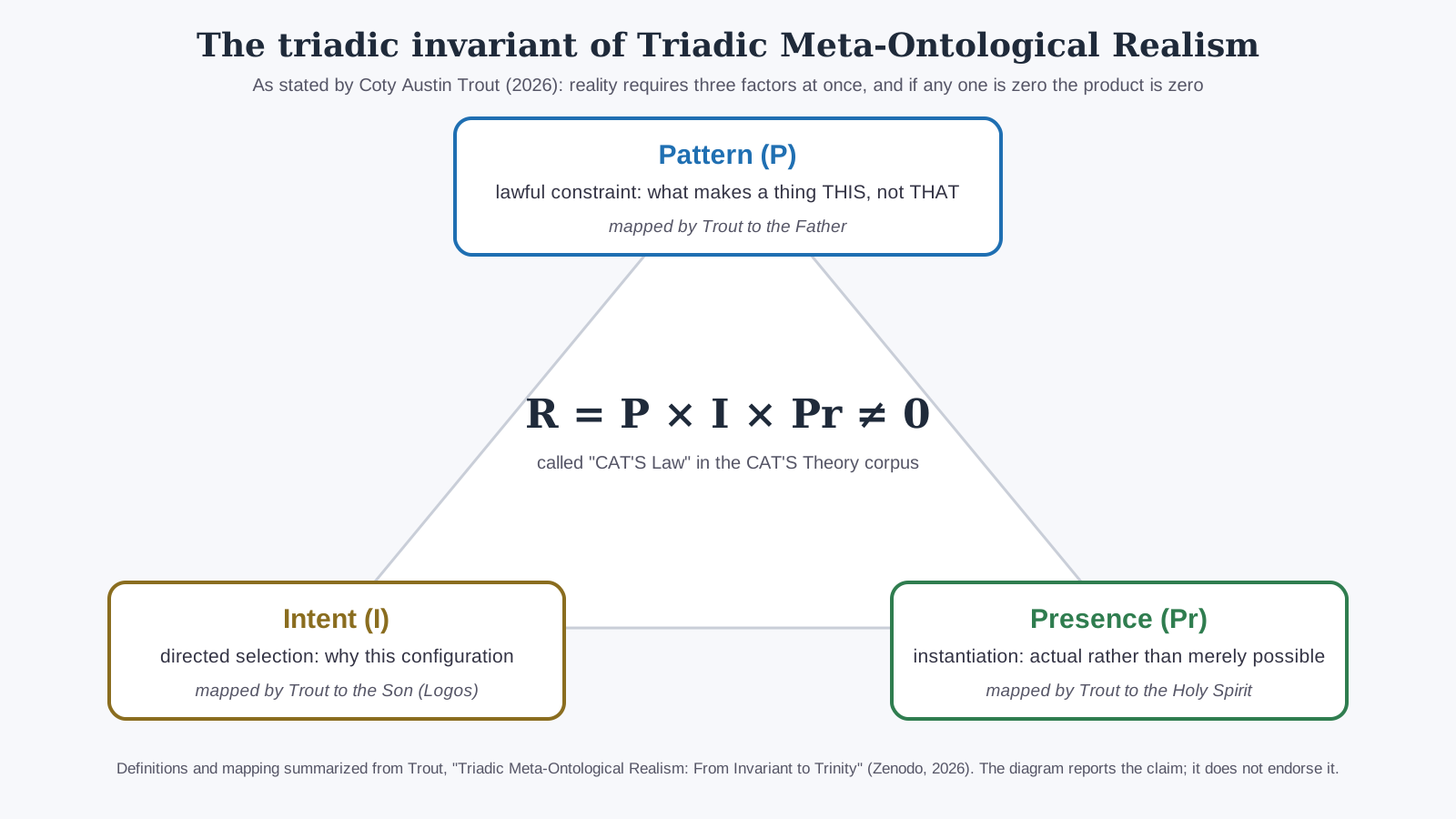
The triad as Trout states it, with his Trinity mapping. Codex diagram drawn from the definitions in his 2026 paper.
From there the argument climbs. Trout says nobody can deny the three without using all three to make the denial. He argues the three must rest on a ground that simply is all three. He argues that this ground must know itself, which makes it a person. And he concludes that a person who is three co-equal factors of one reality is what the Nicene Creed calls the Trinity.
This page sets out the argument fairly and then weighs it. Parts of it echo arguments Christians have made for centuries. Other parts lean on claims about physics and biology that the cited science does not support, and on definitions that shift partway through.
See this page's graph and discover linked topics
In full
Triadic Meta-Ontological Realism is the philosophical position formalized by Coty Austin Trout in "Triadic Meta-Ontological Realism: From Invariant to Trinity, A Complete Argument for God" (preprint, Zenodo, 2026; DOI 10.5281/zenodo.22769193). It is the philosophical core of a larger self-published research program Trout calls CAT'S Theory, whose central formula he names CAT'S Law:
R = P × I × Pr ≠ 0 (Reality equals Pattern times Intent times Presence, and is never zero.)
The multiplication is deliberate: in a product, any factor at zero makes the whole zero, so the three are presented as co-necessary rather than additive. Trout calls the position:
- Triadic, because exactly three factors are claimed to be required, no fewer and no more.
- Meta-ontological, because it is offered not as one theory of what exists (materialism, idealism, dualism) but as a test every such theory must pass. Each rival is "diagnosed" by which factor it sets to zero.
- Realist, because the triad is held to be a discovered feature of reality, not a useful model.
Its inference rule is retorsion, the classical move of showing that a denial undermines itself in the act of being made. The paper is written as a debate manual, with a closing section of twelve objections and scripted replies.
None of the CAT'S Theory papers has appeared in a peer-reviewed journal as of October 2026. They are preprints on Zenodo, plus a self-published book.
The three factors
Trout defines each factor more broadly than its everyday meaning:
| Factor | Trout's definition | Everyday sense it extends |
|---|---|---|
| Pattern (P) | Lawful constraint: what makes a thing this and not that | Structure, form |
| Intent (I) | Directed selection: whatever narrows many possible configurations to one | A person's intention |
| Presence (Pr) | Instantiation: being actual rather than merely possible | Being present in a room |
Trout insists that Intent does not mean a mind. Gravity "selects" one trajectory and crystallization "selects" one lattice, so Intent is present wherever anything settles into one state rather than another. He traces the idea to Franz Brentano's account of Intentionality (1874), "stripped of its psychological framing."
The argument, step by step
The paper closes with an 18-step summary. Condensed, the chain runs:
- Retorsion. Any denial of Pattern, Intent or Presence has structure, is aimed at a conclusion, and is actually made, so it uses all three. The triad "survives its own negation."
- The Intent Trilemma. Basic directedness is either borrowed (an infinite regress), random (ruled out by step 1 and by entropy), or self-grounding. Only the third survives.
- The entropy motivation. Structure decays without directed input under the second law of thermodynamics, so something must oppose the decay.
- Biological confirmation. Trout cites Michael Levin's experiments on bioelectric patterning, in which cells rebuild a target body plan without a brain, as evidence that directed selection works without minds.
- Precondition, not property. A universal property (imagine everything were blue) can be thought away. The triad cannot, so it is a precondition of existence.
- Self-grounding. Each factor exemplifies itself (structure is structured, selection was selected, actuality is actual), which is said to stop the regress.
- The Distinguishability Lemma. Telling X from Y needs criteria (P), a choice of which features matter (I) and an actual act of comparing (Pr). Trout argues this also shows three is the minimum: two factors could not be told apart without a third.
- Modal blindness. Standard modal logic has axes for necessity and actuality but none for selection.
- The Zero Test. The view is falsifiable: show one thing that exists with any factor at zero.
- Closures. Emergentism cannot produce Presence from a base without it; Landauer's principle (erasing a bit costs energy) is used to argue that any "mind-free" framework that selects must be physically real; "radically unintelligible reality" would be indistinguishable from nothing.
- Framework elimination. Naturalism zeroes Intent; materialism and eliminativism zero Presence; pantheism zeroes Pattern; priority monism and Neoplatonism make factors derivative; process theology has only two poles.
- The grounding trilemma. The three are either brute facts (no selection behind them, so Intent is zero), contingently grounded (incoherent for preconditions), or grounded in something that is all three necessarily. Only the last survives, "and it is not an atheist conclusion."
- The Self-Knowledge Theorem. A self-directed ground must track its own aim; at the ground, knower and known are identical, so there is no gap through which ignorance could enter. The ground knows itself, which makes it personal.
- The Trinity mapping. Pattern to the Father (Genesis 1:1), Intent to the Son as Logos (John 1:3), Presence to the Holy Spirit (Genesis 1:2). Each person has all three factors while being identified with one: "three wholes, not three thirds."
- Why Nicaea specifically. The Hindu Trimurti, the Neoplatonic triad and process theology each fail co-equality or irreducibility; only the Nicene doctrine of one substance in three co-equal persons fits.
Where it echoes older Christian thought
The family resemblance to established arguments is real, and it is the strongest thing about TMOR.
- Retorsion is a respected classical tool. It is the same move behind arguments that the denial of logic uses logic, and it underlies the case that "believe only what can be proved" fails its own test (see Self-refutation and Agrippa's Trilemma).
- The ground that "is" its attributes echoes Divine Simplicity and Classical Theism, where God does not have goodness or existence but is them.
- Triads in creation as pointers to the Trinity go back to Augustine, who explored the mind's memory, understanding and will as an image of the Trinity in De Trinitate (books IX to XV), and to the medieval tradition of tracing "vestiges of the Trinity" in creatures.
- Arguing from the preconditions of thought and existence to God is the shape of the Transcendental Argument for God, and the claim that something grounds why reality is this way resembles contingency arguments.
Assessment
The argument is ambitious, and its problems are mostly the kind a trained opponent will find fast. A debater who relies on it should know them first.
1. Intent changes meaning partway through
At the start, Intent is defined so that it requires no mind: gravity and cooling rock have it. At the end, the Self-Knowledge Theorem concludes that the ground's Intent involves tracking an aim and knowing itself, which is mind in the full sense. The early, mindless sense is what makes the premise hard to deny; the late, mental sense is what delivers a personal God. An argument that needs both senses of one word to reach its conclusion is open to the charge of equivocation, which the paper itself anticipates as the most common objection.
2. From "every assertion" to "every existent"
Retorsion shows that every act of denying has structure, aim and actuality. That is true of denials. It does not by itself show that every thing has all three. The bridge is the Distinguishability Lemma, which says anything distinguishable from nothing must have the triad. But "distinguishable" quietly brings in someone doing the distinguishing (criteria chosen, an act performed). Whether something exists and whether it can be told apart by a knower are different questions, and the lemma moves from the second to the first.
3. The "three is forced" step proves too much
Trout argues two factors cannot be distinguished without a third factor to do the distinguishing. If that reasoning holds, it seems to apply to three as well: telling Pattern, Intent and Presence apart would need a fourth, and so on. If the triad can distinguish itself from within, it is unclear why a pair could not.
4. The physics and biology do not say what the argument needs
- Entropy. The second law forbids entropy from decreasing in an isolated system. Stars, snowflakes and living cells build local order in open systems by exporting entropy to their surroundings, and physics explains this without any further "directed input." The claim that physics "does not explain what opposes the gradient" is not accurate as stated.
- Levin's research. Michael Levin's work on bioelectric patterning is real and striking, and he does use the words "cognition" and "goal-directed" in a deliberately broad, brain-free sense. But his published work does not argue for theism, and using it to confirm a triadic metaphysics goes beyond what the experiments claim.
- The "five independent programs." The paper lists five convergent research programs; most are given without publication details, and one (Neppe and Close's TDVP) sits outside mainstream peer-reviewed science. Convergence among non-peer-reviewed frameworks does not carry the evidential weight the paper assigns it.
5. The Zero Test is not a real falsification test
Because the three factors are defined so broadly, any proposed counterexample can be redescribed as having all three, and the paper reports that every challenger's example "turns out to instantiate all three factors." A test that no possible case could fail is not falsifiability in the scientific sense.
6. TAG is misdescribed
The paper says the Transcendental Argument for God "assumes its conclusion." In the form Greg Bahnsen and Cornelius Van Til gave it, TAG is an argument from the impossibility of the contrary: it argues that denying God's existence leaves logic, science and morality without a foundation. One can reject TAG, but it is not simply a presupposition, and contrasting TMOR against a weaker version of TAG overstates the novelty.
7. The Trinity mapping strains Nicene doctrine
- Persons are not factors. In Nicene theology the Father, Son and Spirit are distinguished only by their relations of origin (the Father unbegotten, the Son begotten, the Spirit proceeding), not by each supplying a different ingredient of reality. Assigning Pattern, Intent and Presence to one person each looks like the medieval doctrine of appropriations (Aquinas, Summa Theologiae I, q. 39, a. 7-8), which allows associating attributes with persons only as a way of speaking, because the persons act inseparably in creation.
- The "three wholes" fix. Trout's answer, that each person has all three factors, protects orthodoxy against Modalism and against making each person a third of God. But it also means the factors no longer distinguish the persons, so the mapping that was supposed to derive the Trinity ends up only illustrating it.
- Augustine's own caution. Augustine, who did more with triadic analogies than anyone, ends De Trinitate (book XV) warning that every image of the Trinity in creatures falls short.
8. The wider corpus
TMOR is one paper among the more than 90 works listed on Trout's ORCID profile, most of them under the CAT'S Theory name. Others claim to derive particle masses and physical constants from torus-knot topology. Two 2026 papers defend a flat-surface cosmology against the Antarctic midnight sun and Polaris objections, and treat the Moon as a local "crystalline luminary" about 2.38 km across rather than a distant body. TMOR's philosophical argument does not depend on those papers. But readers weighing the program's physics claims should know they come from the same framework, and none has been tested in the scientific literature.
Using it in apologetics
- What transfers well. The retorsion move, the challenge to explain why reality is this way, and the point that every worldview rests on something it does not argue for are all sound and well established. They are stated more carefully in the Transcendental Argument for God, Agrippa's Trilemma, Divine Simplicity and the classical cosmological arguments.
- What to avoid. Claims that thermodynamics requires directed input, that mainstream biology "confirms" Intent, or that the Trinity is derived rather than illustrated will be challenged quickly by a prepared opponent. Leaning on them risks the credibility of the sound points.
- Tone. Trout presents the work in good faith as a convert seeking to defend the faith, and his critique of materialism and eliminativism lands on real weaknesses in those views. Disagreement with the framework is disagreement with an argument, not with the person.
Scholarship
Published academic works this page draws on, each matched to a publisher, index or library catalog record.
- R. Landauer, "Irreversibility and Heat Generation in the Computing Process," IBM Journal of Research and Development 5 (1961). doi:10.1147/rd.53.0183
- Coty Austin Trout, "Triadic Meta-Ontological Realism: From Invariant to Trinity, A Complete Argument for God," Zenodo (CERN European Organization for Nuclear Research) (2026). doi:10.5281/zenodo.22761702
See also
- Coty Austin Trout, the author of TMOR and CAT'S Theory
- Transcendental Argument for God, the established argument from the preconditions of thought
- Trinity, the doctrine the argument aims to reach
- Divine Simplicity, the classical teaching that God is identical to his attributes
- Self-refutation, the logic behind retorsion
- Agrippa's Trilemma, why every worldview stops at an unargued starting point
- Modalism, the error the "three wholes" clause is meant to avoid
- Augustine, whose triadic analogies are the closest classical precedent
- Second Law of Thermodynamics, what the second law does and does not say
Common questions this page answers
Q: What is Triadic Meta-Ontological Realism?
It is an argument for God by independent researcher Coty Austin Trout. It claims that anything that exists needs three factors at once, Pattern, Intent and Presence, written R = P × I × Pr ≠ 0. It argues that these three must be grounded in a self-knowing being that is all three, and identifies that being with the Christian Trinity.
Q: What is CAT'S Theory?
CAT'S Theory is Coty Austin Trout's self-published research program, built on the formula Reality = Pattern × Intent × Presence, which he calls CAT'S Law. It spans philosophy, theology and claims in physics and cosmology, and is published as preprints on Zenodo and in the book The Structure of Reality: CAT'S Theory of Everything.
Q: Is Triadic Meta-Ontological Realism peer reviewed?
No. As of October 2026 the paper and the rest of the CAT'S Theory corpus are self-published preprints on Zenodo. None has appeared in a peer-reviewed journal, and no published scholarship engages it yet.
Q: Does Triadic Meta-Ontological Realism prove the Trinity?
It argues so, by mapping Pattern to the Father, Intent to the Son and Presence to the Spirit. The mapping works better as an illustration than a proof. Nicene theology distinguishes the persons by their relations of origin rather than by separate functions, and Trout's own qualification that each person has all three factors means the factors cannot be what distinguishes them.
Q: What are the main criticisms of Trout's triadic argument?
The main ones are these. "Intent" is defined as mindless selection at the start but carries a self-knowing mind at the end. The move from what every denial has to what every existing thing has is not justified. The appeals to thermodynamics and to Michael Levin's biology claim more than that science supports. And the "Zero Test" cannot actually fail.
Q: Is it a good argument to use in debate?
Its strongest parts, retorsion and the question of why reality is this way rather than another, are sound but are made more carefully by the transcendental argument and classical cosmological arguments. Its claims about entropy, biology and deriving the Trinity are likely to be challenged quickly, so most apologists would do better to use the established forms.