Person
Tiglath-Pileser III
Pul, Tiglath-pileser, Tilgath-pilneser, Tiglath-pileser III, Tukulti-apil-Esharra III, Pulu, Pul king of Assyria, Tiglath-PileserIntro
Tiglath-Pileser III was king of Assyria from 745 to 727 BC. He turned Assyria from a raiding power into a standing empire, and the kingdoms of Israel and Judah felt the change first. The Bible names him six times, sometimes by his throne name and sometimes as "Pul." Menahem of Israel paid him a thousand talents of silver; he stripped Galilee from Pekah and deported its people; Ahaz of Judah sent him the temple treasures and called himself his servant.
His own inscriptions name the same kings: Menahem, Pekah, Hoshea and "Jehoahaz of Judah," which is Ahaz's full name.
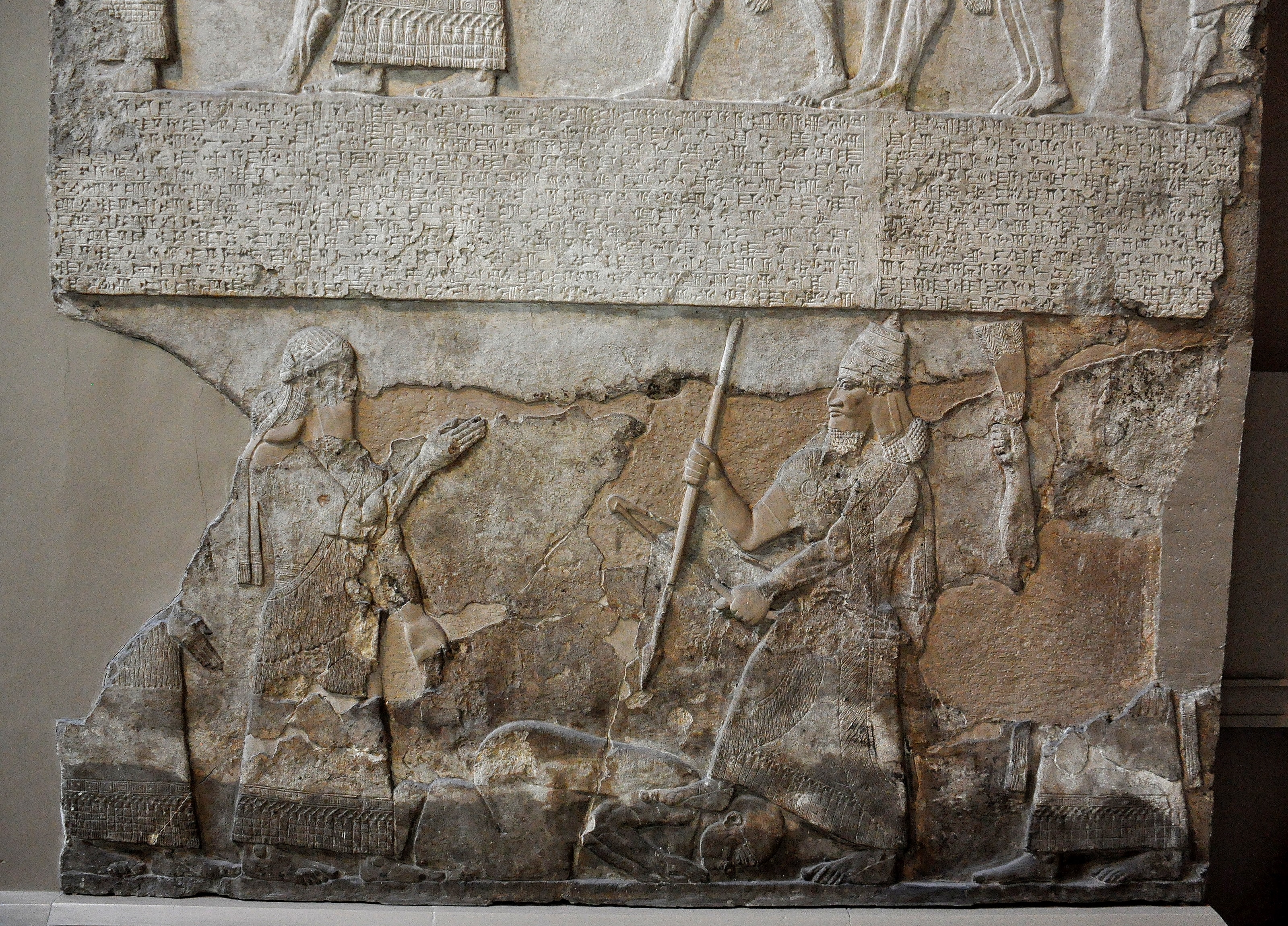 Tiglath-Pileser III standing over a defeated enemy, alabaster relief from his Central Palace at Nimrud, British Museum. Photo: Osama Shukir Muhammed Amin FRCP(Glasg), CC BY-SA 4.0, via Wikimedia Commons, resized.

The 30-second version:
Tiglath-Pileser III, also called Pul, ruled Assyria from 745 to 727 BC and built it into an empire. The Bible says Menahem paid him tribute, that he took Galilee from Pekah and deported its people, and that Ahaz of Judah bought his help with temple silver. His own annals and summary inscriptions name Menahem of Samaria, Pekah, Hoshea, whom he says he set on Israel's throne, and Jehoahaz (Ahaz) of Judah. Babylonian king lists confirm that he also ruled Babylon under the name Pulu.
See this page's graph and discover linked topics
In full
Tiglath-Pileser III (Akkadian Tukultī-apil-Ešarra, "my trust is in the son of Esharra") seized the throne in 745 BC during a revolt at Kalhu. He reorganized the army into a standing force, turned conquered kingdoms into provinces ruled by Assyrian governors, and used mass two-way deportation as policy. From 743 he campaigned in the west: Arpad fell in 740, Menahem of Israel and Rezin of Damascus paid tribute in 738, and in 734 to 732 he marched down the coast to Gaza, broke the anti-Assyrian alliance of Rezin and Pekah, annexed Galilee and Gilead, took Damascus, and executed Rezin. In 729 he took the throne of Babylon himself, where king lists record him as Pulu. He died in 727 and was succeeded by his son Shalmaneser V.
In the Bible
- 2 Kings 15:19-20. "There came against the land Pul the king of Assyria; and Menahem gave Pul a thousand talents of silver, that his hand might be with him to confirm the kingdom in his hand" (2 Kings 15:19, ASV). Menahem raised it by a tax of fifty shekels on each man of wealth.
- 2 Kings 15:29. "In the days of Pekah king of Israel came Tiglath-pileser king of Assyria, and took Ijon, and Abel-beth-maacah, and Janoah, and Kedesh, and Hazor, and Gilead, and Galilee, all the land of Naphtali; and he carried them captive to Assyria" (ASV).
- 2 Kings 16:7-10. Ahaz, attacked by Rezin and Pekah, sends word: "I am thy servant and thy son: come up, and save me" (2 Kings 16:7, ASV). He pays with the silver and gold of the temple; Tiglath-Pileser takes Damascus, deports its people to Kir and kills Rezin. Ahaz goes to Damascus to meet him and copies the altar he sees there.
- 1 Chronicles 5:6, 26. Beerah, prince of the Reubenites, is carried off by "Tilgath-pilneser." In 5:26 "God of Israel stirred up the spirit of Pul king of Assyria, and the spirit of Tilgath-pilneser king of Assyria, and he carried them away" (ASV), taking Reuben, Gad and half of Manasseh east of the Jordan.
- 2 Chronicles 28:20. "Tilgath-pilneser king of Assyria came unto him, and distressed him, but strengthened him not" (ASV).
- Background to Isaiah 7-10. The Syro-Ephraimite war, Isaiah's Immanuel sign to Ahaz, and the oracle of Assyria as "the rod of mine anger" (Isaiah 10:5, ASV) are set in his reign.
Family and lineage
- Origins: ancient sources disagree about his father, and many historians think he was a usurper who came to power in the revolt of 745 BC, possibly from a collateral branch of the royal family.
- Son and successor: Shalmaneser V (reigned 727-722 BC).
- Successors in the same empire: Sargon II, Sennacherib, Esarhaddon and Ashurbanipal.
Historical and archaeological evidence
| Source | What it says | Date | Findspot and current home | Grade |
|---|---|---|---|---|
| Calah Annals | Year-by-year account carved on palace reliefs; lists Menahem of Samaria among tributaries | 730s BC | Central Palace, Nimrud; many slabs later reused by Esarhaddon; British Museum and other collections | Direct |
| Iran Stele | Lists tributaries of 738 BC including "Menahem of Samaria" and Rezin of Damascus | about 737 BC | Found in western Iran; Israel Museum, Jerusalem | Direct |
| Summary Inscription 4 | Says the people of Israel overthrew Pekah and that he installed Hoshea as king, receiving tribute | after 732 BC | Nimrud; known from a tablet copy | Direct |
| Summary Inscription 7 | Lists "Jehoahaz (Ia-ú-ḫa-zi) of Judah" among tributaries | about 729 BC | Nimrud; British Museum tablet K 3751 | Direct |
| Panamuwa II and Bar-Rakib inscriptions | Aramaic inscriptions from Sam'al (Zincirli) naming "Tiglath-pileser, king of Assyria" as overlord; Panamuwa died "in the camp of his lord" at the siege of Damascus | about 730 BC | Zincirli (ancient Sam'al), Turkey | Direct, independent of Assyria |
| Babylonian King List A and Ptolemy's Canon | Record him as king of Babylon under the names Pulu and Poros | compiled later from records | British Museum; Ptolemy's Almagest tradition | Direct for the identification of Pul |
Grade: direct. Lawrence Mykytiuk lists "Tiglath-pileser III or Pul" among his 53 confirmed Hebrew Bible figures, attested in many inscriptions of his own and in Aramaic inscriptions of Panamu II and Bar-Rakib. The standard edition of his texts is Hayim Tadmor and Shigeo Yamada, The Royal Inscriptions of Tiglath-pileser III and Shalmaneser V (RINAP 1, Eisenbrauns 2011). See Biblical Figures Confirmed by Archaeology.
Scholarly consensus
- Pul is Tiglath-Pileser. Before the Babylonian king lists were read, some commentators took Pul and Tiglath-pileser as two kings, partly because of 1 Chronicles 5:26. The king lists settled it: Pulu was his name as king of Babylon. In 1 Chronicles 5:26 the following verb, "he carried them away," is singular, which fits one king named twice.
- The tribute of Menahem. His annals and the Iran Stele place Menahem's tribute in 738 BC. A thousand talents in 2 Kings 15:19 is a large sum, and the Bible's detail that it was raised by a fifty-shekel levy on about 60,000 landowners is usually taken as realistic.
- Pekah and Hoshea. His Summary Inscription 4 says Israel overthrew Pekah and he placed Hoshea on the throne. 2 Kings 15:30 says Hoshea conspired against Pekah and killed him. Historians read the two as complementary: an internal coup with Assyrian approval.
- Ahaz as Jehoahaz. The Assyrian list gives Ahaz's longer name, with the divine element Yah. The biblical writers use the shortened form Ahaz.
- Chronology. Assyrian eponym lists date his campaigns exactly. Fitting Menahem's tribute in 738 with the biblical reign lengths of Menahem and Pekah is one of the hard problems of Israelite chronology; Edwin Thiele and others solved it with overlapping reigns, while other scholars propose textual error in the regnal figures.
Theological significance
- The rod of God's anger. Isaiah interprets Assyria as an instrument in God's hand that does not know it is one: "Howbeit he meaneth not so, neither doth his heart think so" (Isaiah 10:7, ASV). Tiglath-Pileser's campaigns are the first act in that drama.
- The first exile. The deportation of Galilee and the Transjordan tribes (2 Kings 15:29; 1 Chronicles 5:26) begins the scattering of the northern tribes, completed at the fall of Samaria in 722 BC.
- Galilee of the nations. Isaiah 9:1-2 promises that the land of Zebulun and Naphtali, first humbled, will see a great light. Matthew 4:13-16 applies that promise to Jesus' ministry in Galilee, the very region Tiglath-Pileser stripped from Israel.
- Trust or alliance. Ahaz's appeal to Assyria, against Isaiah's call to trust God (Isaiah 7:4-9), is a recurring biblical lesson: the ally he bought "distressed him, but strengthened him not" (2 Chronicles 28:20, ASV).
Church Fathers
No verified patristic comment on Tiglath-Pileser as a historical figure is cited here; the Fathers discuss him only as part of the Isaiah and Kings narratives.
See also
- People of the Bible, every person in this series grouped by the book of first mention
- Biblical Figures Confirmed by Archaeology, Mykytiuk's list of confirmed persons
- Shalmaneser III, the earlier Assyrian king whose inscriptions name Ahab and Jehu
- Shalmaneser V, his son, who besieged Samaria
- Menahem, Pekah and Hoshea, the kings of Israel his inscriptions name
- Ahaz, the king of Judah who called himself his servant
- Rezin, the king of Damascus he executed in 732 BC
- Isaiah the Prophet, whose ministry began in the years of Tiglath-Pileser's campaigns
- Isaiah 7-14 Was Mistranslated Objection Defeater, the Immanuel oracle given in the crisis his campaigns provoked
- Nineveh Discovery, the recovery of the Assyrian archives
Common questions this page answers
Q: Who was Pul in the Bible?
Pul is Tiglath-Pileser III, king of Assyria from 745 to 727 BC. Babylonian king lists record that he ruled Babylon under the name Pulu, which is why 2 Kings 15:19 can call him Pul.
Q: Is Tiglath-Pileser III mentioned outside the Bible?
Yes, extensively. His own annals, summary inscriptions and the Iran Stele survive, along with Aramaic inscriptions of his vassals at Sam'al. They name Menahem, Pekah, Hoshea and Ahaz of Judah.
Q: Did Tiglath-Pileser III deport the Israelites?
Yes. 2 Kings 15:29 and 1 Chronicles 5:26 say he carried off the people of Galilee and the tribes east of the Jordan. His inscriptions describe the same campaigns of 734 to 732 BC and his policy of mass deportation.
Q: Which kings of Israel and Judah does Tiglath-Pileser III name?
Menahem of Samaria, Pekah, Hoshea, whom he claims to have placed on the throne, and Jehoahaz of Judah, the full form of the name Ahaz.
Q: Why did Ahaz ask Tiglath-Pileser for help?
Rezin of Damascus and Pekah of Israel attacked Judah to force it into their anti-Assyrian alliance. Ahaz sent temple silver and gold to Tiglath-Pileser, who crushed Damascus. Isaiah had urged Ahaz to trust God instead.