Argument
Theistic Abiogenesis Objection Defeater
theistic abiogenesis, God used abiogenesis, let the earth bring forth, let the earth bring forth living creatures, Genesis 1:24 abiogenesis, did God give matter the power to create life, God caused matter to evolve life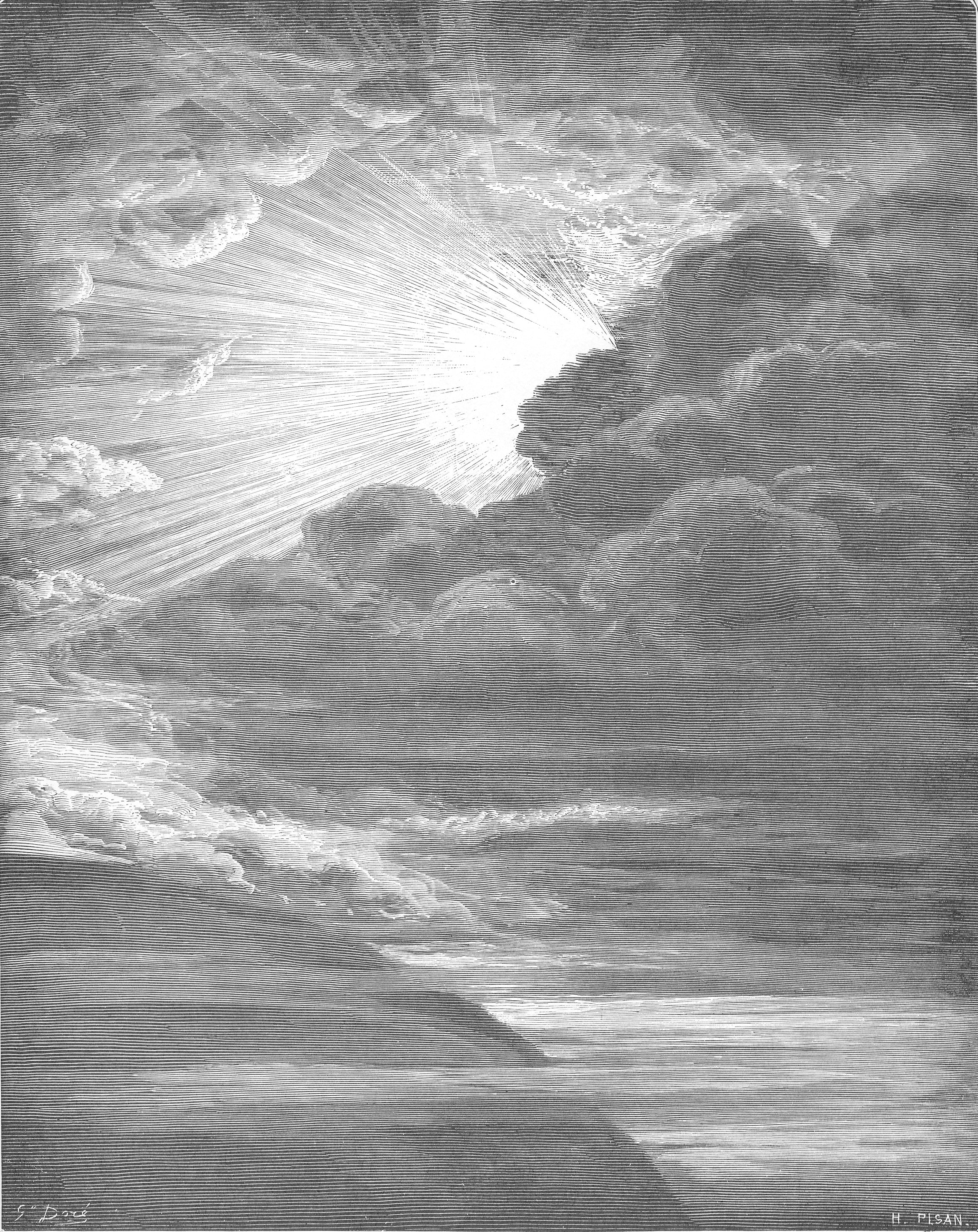
Gustave Doré, The Creation of Light ("And God said, Let there be light," Genesis 1:3), engraved by Héliodore Pisan for La Grande Bible de Tours (1866). Image: public domain, via Wikimedia Commons.
Intro
Some Christians say that God did not give life to the first plants and animals directly. Instead, they say, He made matter with the power to produce life on its own through chemistry, and then let it happen. They point to Genesis 1:24, where God says, "Let the earth bring forth living creatures," and to Genesis 1:20, where the waters "teem" with life. If the earth brought the creatures forth, the argument goes, then the earth had the power to make life, and that power is what scientists call abiogenesis: life arising from nonliving chemistry.
The verses are real, and the observation behind them is fair. God does speak to the earth and the waters, and they do have a part in what happens. But read one verse further. Right after "Let the earth bring forth," Genesis 1:25 says "God made the beasts of the earth." Right after the waters teem, Genesis 1:21 says "God created" the sea creatures. The text gives the earth a role and gives God the credit, every time.
So the question is not whether the earth was involved. It is whether the text says the earth had its own built-in power to make life without God's direct action. It never says that. That idea is an extra step added to the text, and science has not supplied it either, since no one has shown a complete chemical path from nonliving matter to a living cell. The word abiogenesis itself was coined by the biologist Thomas Henry Huxley in 1870, and he called his own hope that it happened in the distant past "an act of philosophical faith."
This page shows how to answer the claim in a friendly but firm way. Grant what the text grants, show what it does not say, and ask what actually supports the extra step.
See this page's graph and discover linked topics
In full
The objection, at full strength, is a claim about how Genesis 1 describes the origin of life:
- In Genesis 1:11, 1:20 and 1:24, God commands the earth and the waters to produce living things.
- A command addressed to matter implies that matter receives a real causal role in producing life.
- The most natural modern name for matter producing life is abiogenesis.
- Therefore Genesis teaches, or at least invites, the view that God endowed matter with the capacity to generate life, and Christians should be comfortable with theistic abiogenesis.
Its strongest historical ally is Augustine, who in The Literal Meaning of Genesis (books 5 and 6) taught that God planted "causal reasons" (rationes seminales) in creation, so that some things unfolded later from potencies God placed in the world at the beginning. Theistic abiogenesis can present itself as a modern form of that idea.
The defeater does not argue that abiogenesis is impossible, and it does not judge the motives of Christians who hold it. It argues three narrower things:
- Textually, Genesis gives created matter an instrumental role but consistently names God as the agent who makes and creates living things. An intrinsic, self-sufficient life-generating capacity in matter is a further premise the text does not state.
- Scientifically, no complete pathway from nonliving chemistry to the first living organism has been demonstrated, so the premise cannot be borrowed from science either.
- Logically, the fact that some Christians hold the view adds nothing to its truth.
The conclusion is that theistic abiogenesis is, at most, a speculative proposal about mechanism. It may be held, but it cannot be presented as what Genesis teaches or as something Christians are obliged to accept.
Argument structure
| # | Premise | Status | Support |
|---|---|---|---|
| P1 | Genesis 1 gives the earth and waters an instrumental role in producing life, but names God as the one who creates and makes the creatures. | Textual | Genesis 1:21, 1:25, 2:7, 2:19 |
| P2 | "Matter received an intrinsic power to originate life by chemistry" is an additional premise the text never supplies. | Hermeneutical | Material cause is distinct from efficient cause |
| P3 | Science has not supplied that premise either: no complete abiogenetic pathway has been demonstrated. | Empirical | Abiogenesis, Law of Biogenesis |
| P4 | That some Christians hold the view adds nothing to its truth. | Logical | Appeal to Popularity |
| C | Theistic abiogenesis is at most a speculative proposal; it is neither biblical teaching nor a Christian obligation. | Follows | P1 to P4 |
Form
Defensive. The defeater does not need to prove that God created life by immediate action. It needs only to show that the objection's key step, from "the earth brought forth" to "matter has its own power to originate life," is unsupported by the text, by science, and by the appeal to Christian agreement.
Cheatsheet
30-second reply. "Genesis 1:24 says, 'Let the earth bring forth living creatures,' and I agree the earth has a role. But the very next verse says God made them, and Genesis 2:7 says Adam became a living being when God breathed into him. The earth is the material; God is the cause. Where does the text say matter received the power to make life on its own? And where has science shown that it can?"
Fast facts
- Genesis 1:21 uses bara, "created," with God as the subject, right after the waters teem (1:20).
- Genesis 1:25 says "God made" the land animals, right after "let the earth bring forth" (1:24).
- Genesis 2:19: "out of the ground the LORD God formed every beast of the field." The ground is the source material; God is the one forming.
- Genesis 2:7: man is formed from dust, but becomes a living being only when God breathes into him.
- Thomas Henry Huxley coined both "biogenesis" and "abiogenesis" in his 1870 presidential address to the British Association. He granted that experiment favored biogenesis and called his expectation of ancient abiogenesis "an act of philosophical faith."
- Origin-of-life research has produced some building blocks under lab conditions, but not a complete pathway to a living cell. See Lab-vs-Wild Defeater for Origin-of-Life Demonstrations.
Counter-moves
- If they say "bring forth means the earth did it": ask why the next verse says God made them.
- If they cite Augustine: Augustine's causal reasons were planted by God at creation and unfolded under His governance; they were not autonomous chemistry, and Augustine did not derive them from a lab result.
- If they say "lots of Christians believe this": the number of believers tells you nothing about whether it is true (see the reductio below).
- If they say "you just reject science": the objection is about what the science has shown, and it has not shown the pathway.
Concessions (grant freely)
- The earth and waters do have a real, instrumental role in Genesis 1. "Let the earth bring forth" is not empty wording.
- Scripture does not spell out the physical mechanism of creation, so a Christian can explore mechanism without denying God.
- God often works through secondary causes in providence (Divine Providence), so a mediated account is not unthinkable in principle.
- A Christian can hold theistic abiogenesis sincerely, without compromise of faith.
What NOT to defend
- Do not claim abiogenesis is proven impossible. The case is that it is undemonstrated and that Scripture does not teach it.
- Do not argue that "if God used chemistry, then humans could create life too." That does not follow: God could use conditions or direction no human can reproduce.
- Do not accuse the other person of seeking the world's approval. Judge the argument; leave motives to God.
Closing line. "The earth gave the material. God gave the life. If you want to add that matter did it on its own, you will need a verse or an experiment, and so far there is neither."
Grammar and hermeneutics
The objection turns on the wording of Genesis 1, so the grammar settles much of it before any science is needed.
-
The verbs of command are jussives spoken by God. "Let the earth sprout" (1:11, tadshe, a Hiphil jussive of dasha), "let the waters swarm" (1:20, yishretsu, a jussive of sharats), and "let the earth bring forth" (1:24, totse, a Hiphil jussive of yatsa, "cause to go out"). A jussive expresses a command or wish. Here the speaker is God, so the grammatical subject (the earth) is acting under the speech act of another (God's command). The form describes what happens at God's word; it does not describe a power the earth holds on its own.
-
Every command is followed by a fulfilment report that names God. Genesis 1 follows a steady pattern: God said, "Let...," "and it was so," then a report of the result. In 1:20 to 21, the waters are told to swarm, and the report is "God created (wayyibra) the great sea monsters and every living creature that moves." In 1:24 to 25, the earth is told to bring forth, and the report is "God made (wayyaas) the beasts of the earth." The narrator himself interprets the command. Reading 1:24 as matter acting autonomously makes the text contradict its own next verse.
-
Bara has God as its subject. In its basic (Qal) stem, bara, "create," always has God as its subject in the Hebrew Bible. The writer uses it at the first appearance of animal life (1:21), the creation of humanity (1:27), and the heavens and the earth (1:1). Its use in 1:21 marks the arrival of the sea creatures as God's own act.
-
Genesis 2 separates the material from the life. Genesis 2:7 says the LORD God "formed" (yatsar, a potter's word) man from dust and "breathed" (naphach) into his nostrils the breath of life, and only then did man become a living being (nephesh chayyah). Genesis 2:19 uses the same verb, yatsar, for the animals: God formed them "out of the ground." The ground is the material; the forming is God's.
-
Genre and the vision in Ezekiel. Ezekiel 37:9 to 10, where breath enters slain bodies at God's command and they live, is a prophetic vision of Israel's restoration, so it should not be pressed as a description of biology. It does show a consistent biblical picture: physical structure without life, and life given by God's breath.
-
Descriptive, not mechanistic. Genesis 1 tells who caused life and in what order; it does not describe chemistry. That cuts both ways. It means immediate creation is not spelled out in lab terms either. But it also means the text cannot be cited as teaching a chemical mechanism it never describes.
Logical fallacies in the objection
Equivocation on "bring forth"
- What it is: using one word in two different senses within one argument, so that a conclusion seems to follow when it does not. See Equivocation.
- Where the objection commits it: "bring forth" in Genesis 1:24 means the creatures come out of the earth at God's command (material source). The objection quietly shifts it to mean the earth generated life by its own power (efficient cause).
- Reductio: By the same reasoning, Genesis 2:7 would teach that dust has the power to produce human beings, since Adam came from dust. But the verse says Adam lived only when God breathed into him. If "came from the ground" does not mean "the ground made him alive" in 2:7, it does not mean that in 1:24 either.
Appeal to popularity
- What it is: treating the number or standing of people who believe something as evidence that it is true. See Appeal to Popularity.
- Where the objection commits it: "Many Christians, including scientists, accept that God used abiogenesis, so it must be compatible with Scripture."
- Reductio: Some people who call themselves Christians also deny the bodily resurrection, the virgin birth, the soul, or any effect of prayer, often on scientific grounds. If Christian agreement made a view biblical, those denials would become biblical too. But Paul says that if Christ has not been raised, faith is worthless (1 Corinthians 15:14 to 17). So agreement among Christians cannot be the test. Each view must be judged on its evidence.
Reading modern science into an ancient text
- What it is: a form of presentism, interpreting an ancient text through the science or concerns of the reader's own day, so that the text appears to teach what the reader already believes.
- Where the objection commits it: treating "let the waters swarm" or "let the earth bring forth" as a description of prebiotic chemistry, hydrothermal vents or an RNA world.
- Reductio: Some earlier readers found the spontaneous generation of insects and small animals from mud and decay in these same verses, because that was the science of their day. Louis Pasteur and others later overturned spontaneous generation. If the verses could be made to support that theory and then this one, they are being used as a mirror for each age's science, not read for what they say.
P1, The earth has a role, and God is the agent
Second-order arguments
- The command-and-fulfilment pattern in Genesis 1 always ends by naming God as the actor (1:21, 1:25).
- Bara in 1:21 marks the first animal life as God's own creative act.
- Genesis 2:19 repeats the point for the land animals: God formed them out of the ground.
- Scripture elsewhere names God as the giver of life to all: "He Himself gives to all people life and breath and all things" (Acts 17:25, NASB95).
Objections (steel-manned)
- "The fulfilment reports are summaries; the real action is the earth bringing forth."
- "Augustine read these verses as God planting causal powers in creation."
- "God works through secondary causes all the time, as in rain and growth."
Rebuttals
- The text itself chooses to report the result as God's act. A summary that names God as the maker cannot be used to remove God from the making.
- Augustine's causal reasons were planted by God and unfolded under His governance. They are a theological proposal, not a claim that matter has an independent power to originate life, and not a finding of chemistry.
- Agreed, and the concession is real. But providence through secondary causes is the ordinary governance of an existing creation. The origin of the first life is the very thing in dispute, and the text names God as its maker.
P2, The extra premise
Second-order arguments
- Material cause (what something is made from) differs from efficient cause (what makes it). The earth can be the first without being the second.
- The text never says God transferred a power to matter, never says matter acted without Him, and never describes a chemical process.
- The objection therefore needs an added premise: "matter received an intrinsic capacity to originate life." That premise has to come from somewhere other than the verse.
Objections (steel-manned)
- "The text doesn't rule it out."
- "You are adding a premise too, that God acted immediately."
Rebuttals
- Agreed. Silence permits a proposal; it does not establish one. The objection claims more than permission: it claims Genesis teaches or invites the view.
- Fair, and the defeater does not need immediate creation. It needs only the text's own claim, that God made the creatures. Whether by immediate or mediated action, the life is credited to God, not to matter's own power.
P3, Science has not supplied it
Second-order arguments
- Huxley's 1870 address granted that the experimental evidence favored biogenesis, life from life, and called his expectation of ancient abiogenesis "an act of philosophical faith." See Law of Biogenesis.
- Modern research has produced some building blocks under controlled conditions (the line that runs from Miller and Urey), but not a complete, demonstrated pathway to a self-replicating living cell. See Abiogenesis and Argument from Origin of Life.
- The fact that living things are made of chemicals shows that life involves chemistry. It does not show that life began from unguided chemistry.
Objections (steel-manned)
- "Science is young; the gap will close."
- "The absence of a demonstration does not prove impossibility."
Rebuttals
- It may or may not. A theological interpretation should not be built on a pathway that has not yet been found.
- Correct, and the defeater does not claim impossibility. It claims that the premise is undemonstrated, so it cannot be imported into Genesis as established fact.
P4, Agreement is not evidence
See the appeal-to-popularity reductio above. The useful question to ask is simple: "What makes this view true, beyond the fact that some Christians believe it?" Paul's standard is to "examine everything carefully; hold fast to that which is good" (1 Thessalonians 5:21, NASB95). That applies equally to views that are popular in secular culture and to views that are popular in the church.
Master objections to the defeater as a whole
- "This is anti-science." It is not. The defeater accepts every demonstrated result. It declines only to treat an undemonstrated pathway as established, and to read it into Genesis.
- "You are setting God against natural processes." It does not. God governs natural processes. The question is whether Scripture or science shows that the first life arose from matter's own power, and neither does.
- "Isn't this just a God-of-the-gaps argument?" No. The defeater's main point is textual: Genesis names God as the maker. The scientific point only blocks the claim that science has already filled in the mechanism.
On worldly approval
Some critics of theistic abiogenesis go further and say that Christians who hold it are seeking the world's approval, citing James 4:4, Romans 12:2 and Galatians 1:10. Those passages do warn against reshaping faith to win human approval: "If I were still trying to please men, I would not be a bond-servant of Christ" (Galatians 1:10, NASB95). Used well, they are a call to self-examination. Used against a person, they become a judgment of motive that the evidence rarely supports. The stronger and fairer argument is the one on this page: test the claim, not the heart. God's creative authority does not depend on scientific approval (Hebrews 11:3), and a Christian need not reshape Genesis to fit a hypothesis that has not been established.
Tactical opening / closing
Opening. "I agree with you that the earth has a role in Genesis 1. Let's read the next verse together and see who the text says made the animals."
Closing. "The earth gave the material; God gave the life. If matter did it on its own, show me the verse or the experiment. Until then, I'll take Genesis at its word: God is the giver of life."
Live-cite kit
Scripture
- Genesis 1:24 to 25: the earth brings forth, and "God made" the beasts.
- Genesis 1:20 to 21: the waters swarm, and "God created" the sea creatures.
- Genesis 2:7: formed from dust, alive by God's breath.
- Genesis 2:19: God formed the animals out of the ground.
- Acts 17:25: God gives to all life and breath and all things.
- Hebrews 11:3: the worlds were prepared by the word of God.
Scholarly
- Thomas Henry Huxley, "Biogenesis and Abiogenesis" (presidential address, British Association, Liverpool, 1870).
- Augustine, The Literal Meaning of Genesis, books 5 and 6, on causal reasons.
Aphorism
- "The material source of a creature is not the cause of its life."
Scholarship
Published academic works this page draws on, each matched to a publisher, index or library catalog record.
- John Farley, The spontaneous generation controversy from Descartes to Oparin (Johns Hopkins University Press, 1977). Open Library
- John H. Walton, The lost world of Genesis One (IVP Academic, 2009). Open Library
- Gordon J. Wenham, Genesis 1-15 (Word, 1987). Open Library
See also
- Abiogenesis, the scientific scenarios and their current state
- Law of Biogenesis, life from life, and Huxley's naming of the terms
- Biogenesis Argument, the positive argument from life's origin
- Argument from Origin of Life, the design case at the origin of life
- Theistic Evolution, the broader view this objection usually belongs to
- Lab-vs-Wild Defeater for Origin-of-Life Demonstrations, why lab synthesis is not a natural pathway
- Abiogenesis Under the Microscope, ris3n's paper on the origin-of-life problem
- Cambrian Explosion, the parallel question of new body plans
- Divine Providence, how God works through secondary causes
Common questions this page answers
Q: Does "Let the earth bring forth living creatures" mean God gave matter the power to create life?
No. Genesis 1:24 gives the earth a role, but the next verse says "God made the beasts of the earth." The earth is the material source; God is named as the maker. The text never says matter received its own power to originate life.
Q: Can a Christian believe God used abiogenesis?
A Christian can hold it as a speculative proposal, and many do in good faith. But Scripture does not teach it, and science has not demonstrated a complete pathway from nonliving chemistry to the first living cell, so it cannot be presented as biblical teaching or as an obligation.
Q: Who coined the word abiogenesis?
Thomas Henry Huxley introduced the terms biogenesis and abiogenesis in his 1870 presidential address to the British Association in Liverpool. He granted that experiment favored biogenesis and called his expectation that life arose from nonliving matter in the distant past "an act of philosophical faith."
Q: Does Genesis 1:20 say the oceans produced life?
Genesis 1:20 says God commanded the waters to swarm with living creatures, and Genesis 1:21 immediately reports that "God created" the sea creatures. The waters are the setting and the material; the creating is credited to God.
Q: Is it a fallacy to say a view is biblical because many Christians hold it?
Yes. That is an appeal to popularity. Some people who call themselves Christians deny the bodily resurrection or the virgin birth; their agreement does not make those denials biblical. Every view has to be tested on its own evidence.
Scripture quotations taken from the New American Standard Bible® (NASB), Copyright © 1960, 1971, 1977, 1995 by The Lockman Foundation. Used by permission. All rights reserved. www.lockman.org