Concept
The Will of God
Will of God, God's will, Gods will, What is God's will, Sovereign will of God, Moral will of God, Decretive will, Preceptive will, Two wills in God, Knowing God's will, Finding God's willIntro
When Christians ask "What is God's will?" they usually mean one of three different things, and mixing them up causes a lot of confusion.
- What God has decided will happen. Scripture says God "worketh all things after the counsel of his will" (Ephesians 1:11). Nothing catches Him by surprise and nothing finally defeats His plan.
- What God tells people to do. "This is the will of God, even your sanctification" (1 Thessalonians 4:3). This is the will people can disobey, and often do.
- What God wants for my particular life. Which job, which city, whom to marry. Here Christians disagree about how much God has a specific plan to be discovered and how much He gives wisdom and freedom to choose well.
The first two have to be kept apart. If "God's will" only meant "whatever happens," then every sin would be God's will, which Scripture flatly denies. If it only meant "what God commands," then God's plan would fail every time someone disobeyed, which Scripture also denies. The Bible holds both: people really do evil, and God still accomplishes His purpose through it. Joseph said it to the brothers who sold him: "ye meant evil against me; but God meant it for good" (Genesis 50:20, ASV).
The parts of God's will that Scripture states plainly are not mysterious. God wills that people be saved and come to know the truth (1 Timothy 2:4), that they believe in His Son (John 6:40), that they be made holy, that they give thanks in everything (1 Thessalonians 5:18) and that they do good (1 Peter 2:15). Most of God's will for a person's life is already written down.
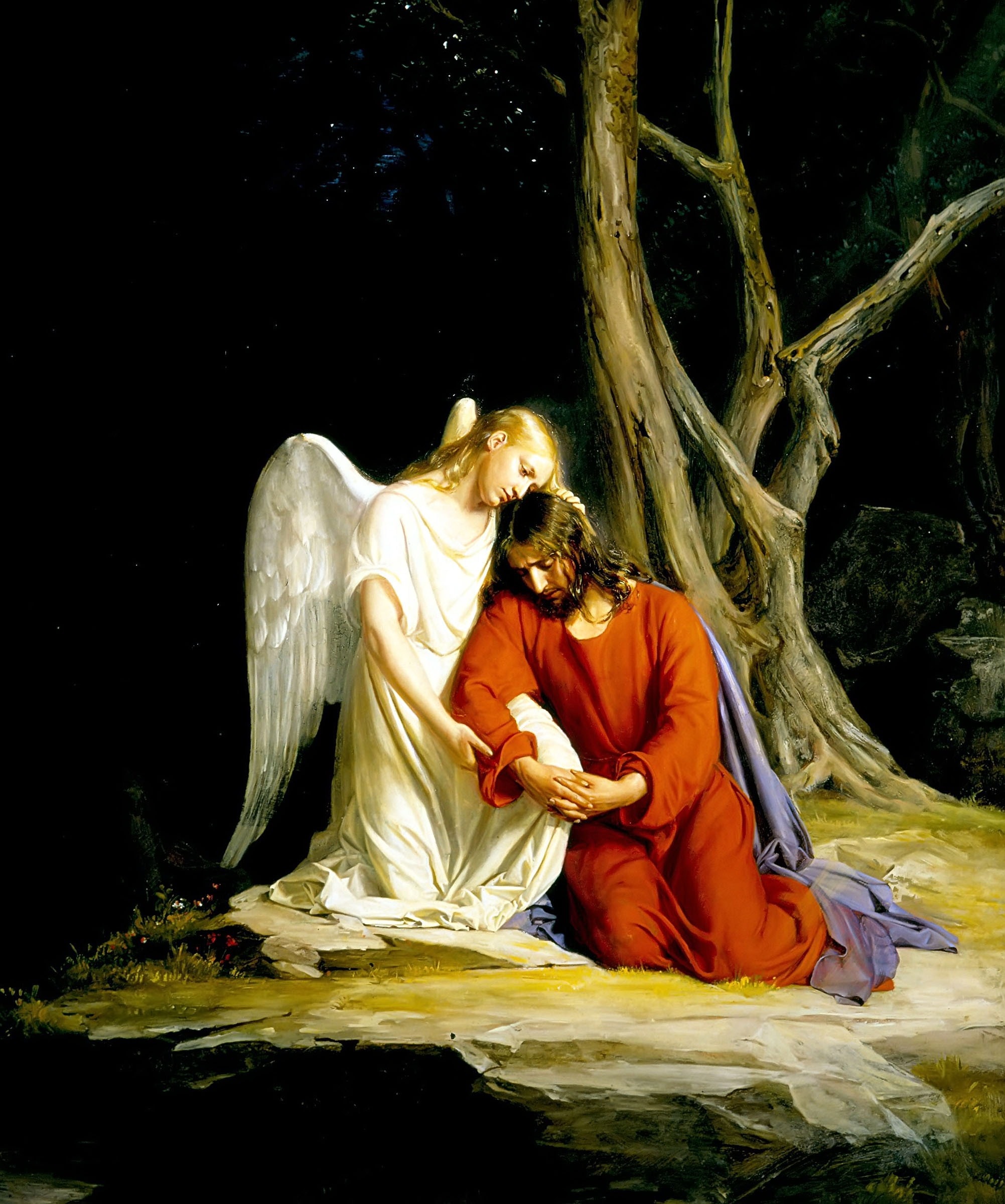
After praying "not my will, but thine, be done," Jesus is strengthened by an angel (Luke 22:42-43). Carl Bloch, Gethsemane, 1873. Public domain, via Wikimedia Commons.
See this page's graph and discover linked topics
In full
The will of God (Greek thelēma, boulē; Hebrew ratson, chefets, etsah) is the divine willing that Scripture presents both as the sovereign cause of all that happens and as the moral standard to which creatures are bound. Christian theology has consistently found it necessary to distinguish senses of the term, because the biblical data includes both statements that God's will cannot be resisted (Daniel 4:35; Ephesians 1:11) and statements that it is regularly resisted (Matthew 23:37; Matthew 7:21).
The standard distinctions, under several names:
| Sense | Also called | What it covers | Can it be resisted? | Key texts |
|---|---|---|---|---|
| Sovereign | Decretive, hidden, secret, will of good pleasure (voluntas beneplaciti) | What God has determined will occur, including His permission of evil | No | Ephesians 1:11; Daniel 4:35; Proverbs 16:33; Acts 4:27-28 |
| Moral | Preceptive, revealed, will of the sign (voluntas signi) | What God commands, forbids and approves | Yes | 1 Thessalonians 4:3; Romans 12:2; Matthew 7:21 |
| Desiderative | Will of disposition, antecedent will | What God delights in and desires, even where He does not bring it about | Yes, in the sense that its object may not occur | 1 Timothy 2:4; 2 Peter 3:9; Ezekiel 18:23 |
| Individual guidance | Specific or personal will | God's leading in particular decisions not settled by Scripture | Disputed (see below) | James 1:5; Proverbs 3:5-6; Colossians 1:9 |
The decretive and preceptive distinction is anchored in Deuteronomy 29:29: "The secret things belong unto Jehovah our God; but the things that are revealed belong unto us and to our children for ever, that we may do all the words of this law" (ASV). The verse assigns the hidden counsel to God and the revealed command to human obedience, and it makes the revealed will, not the hidden one, the rule of life.
The most important single text for the relation between the senses is Acts 2:23, where Peter says Jesus was "delivered up by the determinate counsel and foreknowledge of God" and in the same breath that "ye by the hand of lawless men did crucify and slay" him (ASV). The crucifixion was within God's determinate counsel (boulē) and was at the same time a crime against His moral will. Neither truth cancels the other. Any account of God's will that cannot hold both clauses of that sentence has failed the central test case.
The vocabulary
θέλημα (thelēma), noun, from thelō, "to will, wish, desire." The common New Testament word for will, used more than sixty times. It covers God's saving purpose (John 6:40), His commands (1 Thessalonians 4:3), and the will Christ submits to in Gethsemane (Matthew 26:39). See G2307 - thelema.
βουλή (boulē), noun, "counsel, deliberate purpose, decision." Used especially for God's settled plan: "the determinate counsel" of Acts 2:23, "thy counsel foreordained" in Acts 4:28, "the counsel of his will" in Ephesians 1:11.
A caution on the distinction. It is sometimes said that boulē always names God's fixed decree and thelēma His desire. The vocabulary will not carry that much weight. Ephesians 1:11 joins the two ("the counsel of his will," tēn boulēn tou thelēmatos autou), and the desire that none should perish in 2 Peter 3:9 uses the verb boulomai, from the boulē family. The theological distinctions above rest on what the texts say God does and wants, not on which word they use.
Hebrew. Ratson (favor, delight, what pleases) is the word of Psalm 40:8, "I delight to do thy will, O my God." Chefets (delight, pleasure) appears in God's statement "Have I any pleasure in the death of the wicked?" (Ezekiel 18:23). Etsah (counsel, plan) is the word of Isaiah 46:10, "My counsel shall stand."
What God's revealed will plainly includes
Scripture states the following explicitly as God's will. None of them requires a sign to discover.
- Salvation through knowing the truth. God "would have all men to be saved, and come to the knowledge of the truth" (1 Timothy 2:4, ASV). See also 2 Peter 3:9.
- Faith in the Son. "This is the will of my Father, that every one that beholdeth the Son, and believeth on him, should have eternal life" (John 6:40, ASV).
- Sanctification. "This is the will of God, even your sanctification, that ye abstain from fornication" (1 Thessalonians 4:3, ASV). See Sanctification.
- Thanksgiving. "In everything give thanks: for this is the will of God in Christ Jesus to you-ward" (1 Thessalonians 5:18, ASV). The text says in everything, not for everything. Thanksgiving in suffering does not require calling evil good.
- Doing good. "So is the will of God, that by well-doing ye should put to silence the ignorance of foolish men" (1 Peter 2:15, ASV).
- A renewed mind. "Be ye transformed by the renewing of your mind, that ye may prove what is the good and acceptable and perfect will of God" (Romans 12:2, ASV). Discernment of God's will is the fruit of transformation, not a substitute for it.
- Submission when obedience costs. "Father, if thou be willing, remove this cup from me: nevertheless not my will, but thine, be done" (Luke 22:42, ASV). Christ's prayer in Gethsemane is the model of a human will aligned with the Father's.
How the traditions relate the senses
The distinctions are shared widely. What divides the traditions is how the desiderative will (God wants all to be saved) relates to the sovereign will (not all are saved).
- Augustine. In the Enchiridion (chs. 95-103), Augustine argues that God's will is never defeated, and that even what is done against His commands does not happen apart from His will, because He permits it and brings good out of it. He reads 1 Timothy 2:4 as referring to all kinds of people rather than every individual, a reading later Reformed writers often follow.
- Thomas Aquinas. In Summa Theologiae I, q. 19, Thomas Aquinas distinguishes God's will of good pleasure from the "will of the sign" (precept, prohibition, counsel, permission, operation; a. 12) and, following John of Damascus, an antecedent will, by which God wills all to be saved considered in itself, from a consequent will that takes all circumstances into account, including justice toward the unrepentant (a. 6). God's antecedent will is a real willing, not a pretense, but it is not the final word.
- Reformed. The Westminster Confession (1646) states that "God from all eternity did, by the most wise and holy counsel of His own will, freely, and unchangeably ordain whatsoever comes to pass; yet so, as thereby neither is God the author of sin, nor is violence offered to the will of the creatures" (WCF 3.1). John Piper's essay "Are There Two Wills in God?" (in Still Sovereign, 2000) defends the view that God genuinely desires the salvation of all in one sense while decreeing to save some, because He values the display of the full range of His glory more. See Calvinism and Compatibilism.
- Arminian. Arminians read 1 Timothy 2:4 and 2 Peter 3:9 as God's universal saving desire, and locate the gap between that desire and its outcome in God's decision to give creatures a resistible grace and real freedom. God's sovereign will includes His sovereign choice to permit libertarian freedom. See Arminianism and Libertarian Free Will.
- Molinist. Molinists hold that God, knowing what every possible free creature would freely do in every circumstance, chose to actualize a world in which His purposes are achieved through genuinely free choices. See Molinism and Counterfactuals of Freedom.
All five agree on the two points that matter most for ordinary Christian life: God's purpose will stand, and God's commands are binding and are often broken.
The question of individual guidance
The fourth sense is where evangelical teaching has most changed in the last fifty years.
- The traditional view. God has an ideal, detailed plan for each believer's life, covering choices such as career and marriage, and the believer's task is to discover it through Scripture, prayer, circumstances, inner peace and counsel. Missing it means living in "God's second best."
- The wisdom view. Garry Friesen's Decision Making and the Will of God (1980) argued that Scripture teaches God's sovereign will and His moral will but nowhere teaches an individual blueprint to be found. Within the moral will the believer is free and responsible to choose wisely. Kevin DeYoung's Just Do Something (2009) popularized a version of this view.
- The relational middle. Many writers hold that God does lead individuals, sometimes very specifically, as Acts shows (Acts 16:6-10), while denying that the ordinary believer must decode a hidden plan before acting. Bruce Waltke's Finding the Will of God: A Pagan Notion? (2002) argued that the anxious search for a secret plan resembles divination more than biblical wisdom, and that God guides through Scripture, a renewed heart, wise counsel and providence.
What all three share is the priority of what is already revealed. A decision that requires disobeying Scripture is not God's will however strong the inner sense of leading. A choice within Scripture's bounds, made in prayer and with wise counsel, is not a gamble against a hidden plan.
The will of God and the problem of evil
The distinctions are not hair-splitting. They are how Christian theology answers the charge that if God is sovereign, He must approve of evil.
- Objection. "If God works all things after the counsel of His will, then the Holocaust, child abuse and every sin are God's will. Either God is evil or He is not sovereign."
- Reply. The objection equivocates on "will." Evil is not God's moral will; Scripture condemns it in God's name. Evil occurs within God's sovereign will only in the sense that God permits it and does not allow it to defeat His purposes. Joseph's brothers "meant evil," and the guilt is theirs; God "meant it for good" (Genesis 50:20). The crucifixion is the decisive case: wicked by the will of those who did it, redemptive by the counsel of God (Acts 2:23).
- What the reply does not claim. It does not claim to explain why God permits each particular evil. It claims that sovereignty and moral opposition to evil are coherent together. See Problem of Evil and Divine Providence.
Willing and knowing
One saying of Jesus connects the will of God directly to the question of how anyone comes to know whether Christianity is true: "If any man willeth to do his will, he shall know of the teaching, whether it is of God, or whether I speak from myself" (John 7:17, ASV).
The claim is that openness to obey is a condition of seeing clearly, not a reward for having seen. That is the positive side of the biblical teaching that unbelief can be motivated as well as reasoned (John 3:19-21). See Atheism as Escapism and Suppression of God Thesis.
Scholarship
Published academic works this page draws on, each matched to a publisher, index or library catalog record.
- Kevin DeYoung, Just do something (2009). Open Library
See also
- Divine Providence, God's governance of all things
- G2307 - thelema, the main Greek word for will
- Sanctification, the will of God named in 1 Thessalonians 4:3
- Christian Discernment, testing and choosing well
- Problem of Evil, where the sovereign and moral will must be distinguished
- Calvinism, decree and the two-wills position
- Arminianism, universal desire and resistible grace
- Molinism, middle knowledge and providence
- Free Will and Determinism, the philosophical frame
- Lord's Prayer, "thy will be done"
- Prayer, asking "according to his will" (1 John 5:14)
Common questions this page answers
Q: What is God's will according to the Bible?
Scripture names several things directly as God's will: that people be saved and come to know the truth (1 Timothy 2:4), believe in Jesus (John 6:40), be made holy (1 Thessalonians 4:3), give thanks in everything (1 Thessalonians 5:18) and do good (1 Peter 2:15). Beyond what He commands, God also has a sovereign plan that nothing can finally defeat (Ephesians 1:11).
Q: What is the difference between God's sovereign will and His moral will?
God's sovereign will is what He has determined will happen, and it cannot be thwarted. His moral will is what He commands, and people can and do disobey it. The crucifixion shows both: it happened "by the determinate counsel and foreknowledge of God," yet those who did it were "lawless men" (Acts 2:23).
Q: If God is sovereign, is everything that happens God's will?
Only in the sense that nothing happens outside His permission or beyond His power to bring good from it. Evil is never God's moral will, and the guilt belongs to those who do it. Joseph told his brothers, "ye meant evil against me; but God meant it for good" (Genesis 50:20).
Q: How can I know God's will for my life?
Start with what is already revealed: most of God's will for any believer is written in Scripture. Within those bounds, Scripture promises wisdom to those who ask (James 1:5) and links discernment to a renewed mind (Romans 12:2). Christians differ on whether God has a detailed individual plan to be discovered, but agree that prayer, Scripture, wise counsel and obedience are the way to walk in it.
Q: Does God want everyone to be saved?
Scripture says God "would have all men to be saved" (1 Timothy 2:4) and is "not wishing that any should perish" (2 Peter 3:9). Arminians read this as a universal saving desire that people can resist. Many Calvinists distinguish this desire from God's decree, and Augustine read "all men" as all kinds of people. All agree the desire is real and the offer of the gospel is sincere.
Q: What does "not my will, but thine, be done" mean?
It is Jesus' prayer in Gethsemane before the cross (Luke 22:42). He asked that the suffering might pass, then submitted His human will to the Father's. It is the pattern for Christian prayer: honest about what we want, surrendered to what God wills.