Argument
The Twenty Conundrums Argument
Twenty Conundrums Argument, 20 conundrums argument, the triune God solves reality's conundrums, conundrums only the Trinity solves, argument from twenty conundrums, Trinity cumulative case, transcendental cumulative case for the TrinityIntro
Every worldview has to answer some very old, very hard questions. Why does anything exist? Why does logic hold everywhere? Why can our minds know the world? Why are some things truly wrong? Why does every person matter? How can unity and variety both be real? How can God be love? How can a just God forgive?
This argument lines up twenty of those questions and asks which view of reality answers all of them. Belief in God answers most of them better than atheism does. But a few of the deepest ones, about love, relationship and the balance of unity and difference, need more than a God who is one Person alone. They need a God in whom love and relationship were already real before the world existed: the Father, the Son and the Holy Spirit. And the questions about evil and forgiveness are answered most fully by the Son becoming human, dying and rising.
The argument does not pretend that every question proves the Trinity by itself. It shows the opposite: eight of the twenty are answered by any belief in God. Its claim is stronger and more honest. One view answers all twenty, and on none of them does a God who is a single Person do better than the triune God.
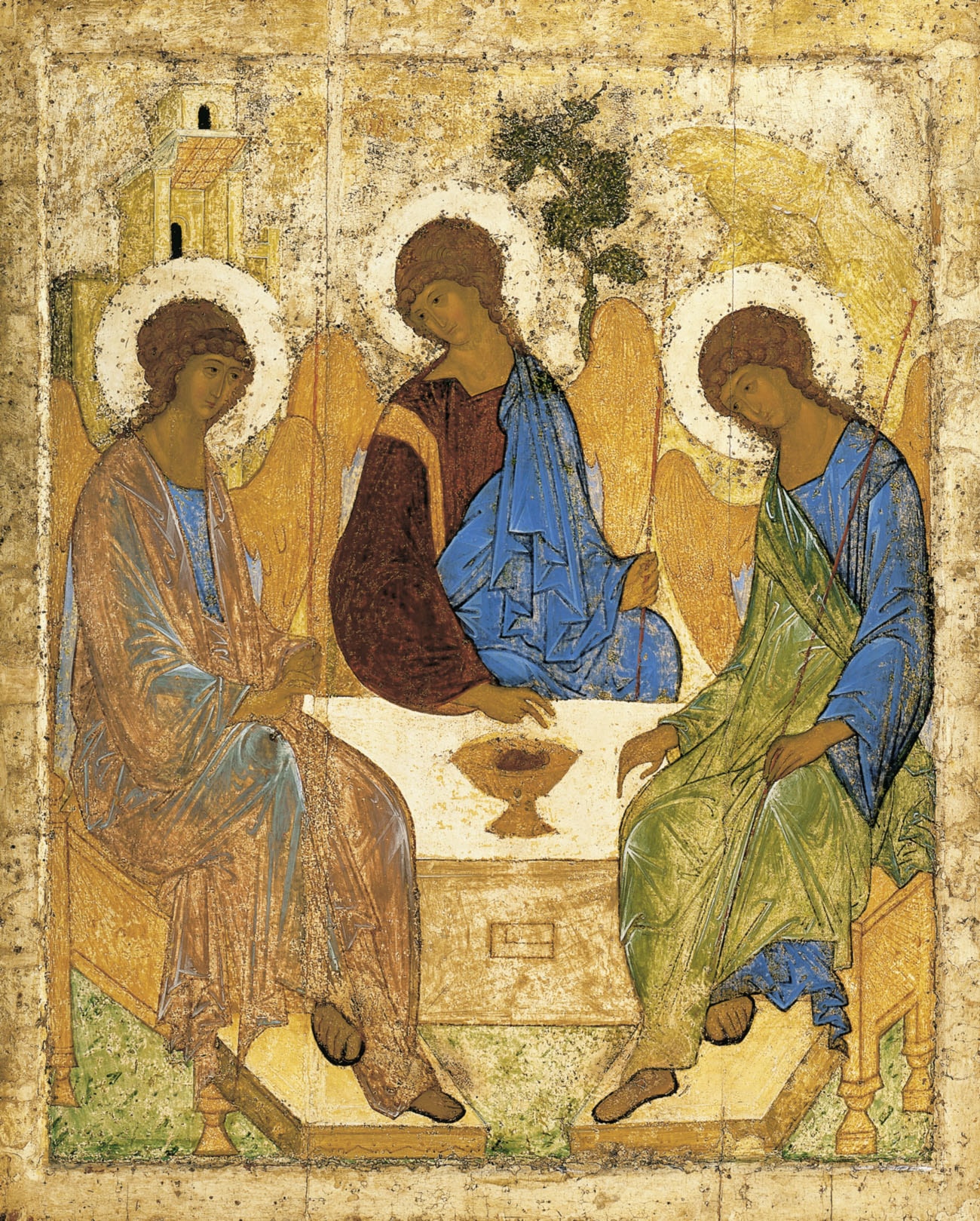
Andrei Rublev, The Trinity (also called The Hospitality of Abraham), about 1411 or 1425 to 1427, State Tretyakov Gallery, Moscow. The three visitors of Genesis 18 are painted as an image of the Father, the Son and the Spirit in communion. Image: public domain, via Wikimedia Commons.
See this page's graph and discover linked topics
In full
The Twenty Conundrums Argument is a cumulative, comparative case for Trinitarian theism built on twenty explananda: contingent existence, ultimate causation, creaturely freedom under total dependence, necessary truth, logical law, cognitive reliability, the uniformity of nature, rational inference, mathematical applicability, consciousness, personal identity, moral obligation, human dignity, meaning, the coexistence of unity and plurality, eternal love, persons-in-community, justice with mercy, evil in a good creation, and final reconciliation. The data and the rival answers to each are set out in Twenty Conundrums the Trinity Resolves. A deductive spine (P1 to P5) argues that (i) each explanandum is real and must be explained or accepted as brute; (ii) each is more expected on theism than on naturalism, by margins argued case by case; (iii) a subset of six (the one and the many, eternal love, persons-in-community, and the redemptive triad of justice with mercy, evil, and final reconciliation) is more expected on Trinitarian theism than on unitarian theism, because each turns on actual interpersonal relation within God or on God bearing the cost of evil in the Person of the Son; (iv) no explanandum is more expected on unitarian theism than on Trinitarian theism; and (v) by the likelihood principle, evidence more expected on one hypothesis than another confirms it, and independent pieces of evidence accumulate. The knot groups the twenty into six clusters, so the case counts six roughly independent lines, not twenty. The conclusion is confirmatory, not deductive: the twenty together favor Trinitarian theism over both naturalism and unitarian theism. The "alone" claim is defended in its precise form: Trinitarian theism is the only hypothesis on the table that resolves every item, and the triune increment is a strict gain over unitarian theism with no compensating loss.
Format note
A braided case runs four kinds of reasoning on one argument instead of choosing one. A deductive spine of numbered premises carries the conclusion, so the argument is valid and every disagreement is forced onto a named premise. Each premise is then held up by an inductive strand (the data that make it probable), an abductive strand (rival explanations compared on explanatory power, scope, simplicity and how ad hoc they are) and a convergence note (independent disciplines that reach the same premise). A knot checks that the strands are genuinely independent, so no datum is counted twice. A likelihood ledger states, datum by datum, how much more expected the evidence is on one hypothesis than another, as honest qualitative ranges, never invented precision. A defeater gate answers the single strongest objection to the whole argument before the cheatsheet.
The spine
| # | Premise |
|---|---|
| P1 | There are twenty pervasive features of reality (the conundrums) that any adequate worldview must explain or else accept as brute facts. |
| P2 | Each of the twenty is at least as expected on theism as on naturalism, and most are substantially more expected. |
| P3 | Six of the twenty are substantially more expected on Trinitarian theism than on unitarian theism. |
| P4 | None of the twenty is more expected on unitarian theism than on Trinitarian theism, and the Trinitarian additions cost no explanatory power elsewhere. |
| P5 | Evidence that is more expected on one hypothesis than on another confirms the first over the second, and independent pieces of such evidence accumulate. |
| C | The twenty conundrums, taken together, confirm Trinitarian theism over naturalism and over unitarian theism. |
Validity. From P2 and P5, the set confirms theism over naturalism. From P3, P4 and P5, the set confirms the Trinitarian version of theism over the unitarian version, since some items favor it and none favor its rival. Trinitarian theism is a version of theism, so it keeps theism's advantage over naturalism on every item unless something in the doctrine costs it ground; P4 rules that out. So C follows.
Strength of the conclusion. Confirmatory. The argument does not claim that each conundrum entails the Trinity. It claims the whole body of evidence is more expected on Trinitarian theism than on its two main rivals, with the size of the margin argued in the ledger.
P1, Twenty real conundrums
Inductive strand
- They are recognized across traditions. Each conundrum has a standard name and literature in secular philosophy: the question of being (Leibniz, Heidegger), the problem of induction (Hume), the hard problem of consciousness (Chalmers), the unreasonable effectiveness of mathematics (Wigner), the one and the many (from Parmenides on), personal identity (Locke, Parfit), the problem of evil (Mackie, Rowe), meaning in life (Nagel, Wolf).
- They are presupposed in practice. Science presupposes uniformity, logic and reliable cognition; law presupposes guilt, desert and human equality; everyday life presupposes persisting persons and binding obligations.
Abductive strand
| Explanation of P1's data | Explanatory power | Scope | Simplicity | Ad hoc? |
|---|---|---|---|---|
| The conundrums are real questions about reality | High: explains why they recur in every tradition | All twenty | One assumption | No |
| They are confusions of language (Wittgenstein's therapeutic view) | Low for most: the hard problem and induction survive restatement | Partial | Simple | Yes, applied selectively |
Convergence
Metaphysics, epistemology, philosophy of mind, ethics, philosophy of mathematics and theology reach the same list independently. Atheist philosophers state several of them more sharply than theists do (Nagel on mind, Wigner on mathematics, Mackie on evil).
Objections and rebuttals
- "Some of these are pseudo-problems." Rebuttal. Then the objector must say which, and why the standard secular literature treats them as real. Dismissing the hard problem or the problem of induction is itself a contested philosophical position, not a neutral starting point.
- "Brute facts are acceptable." Rebuttal. Every view has some starting point. But a worldview that must accept many unrelated brute facts is less unified, and therefore less probable on ordinary explanatory standards, than one that explains them from a single source. Accepting brute facts is allowed; it costs.
P2, Theism over naturalism
Inductive strand
- Existence and causation. A necessary being explains contingent beings; a universe of contingent things does not explain itself (Contingency Argument).
- Intelligibility. A rational Creator who made both world and mind predicts that the world is lawful, mathematical and knowable (The Seedtime Argument, Mathematical Intelligibility of Nature, Evolutionary Argument Against Naturalism).
- Mind. If the ultimate reality is mind, minds are expected; if it is mindless, they are a surprise (Nagel, Mind and Cosmos, 2012; Argument from Consciousness).
- Value. Objective obligation and equal dignity are expected if goodness is grounded in a personal, good God; on naturalism they are either brute (Wielenberg) or illusory (Moral Argument).
Abductive strand
| Explanation | Explanatory power | Scope | Simplicity | Ad hoc? |
|---|---|---|---|---|
| Theism (a necessary, rational, personal, good Creator) | High | All twenty in principle | One source | No |
| Naturalism | Moderate on causation, low on mind and value | Partial | Simple in entities, but many brute facts | Often, for consciousness and morality |
| Naturalism plus Platonism | Better on 5, 6, 16 | Partial | Adds an abstract realm with no account of how we know it | Partly |
Convergence
The argument from contingency (metaphysics), from reason (epistemology), from consciousness (philosophy of mind) and the moral argument (ethics) are independent arguments, made by different thinkers with different methods, that each reach the same personal source.
Objections and rebuttals
- "God of the gaps." Rebuttal. These are not gaps in scientific knowledge waiting for more data. They concern the preconditions of science itself: why there are laws, why minds can know them, why reasoning is valid. More physics cannot answer why physics is possible.
- "Naturalism explains some of these well, for example causation." Rebuttal. Granted, which is why P2 says "at least as expected" and the ledger rates some items as roughly even. The case does not need a theistic margin on every item.
P3, Trinitarian over unitarian theism on six items
Inductive strand
- The one and the many. A unipersonal God is ultimately one, so plurality begins with creation. A triune God is one in essence and three in Persons, so unity and plurality are equally ultimate (Van Til; Gunton, 1993; One and the Many Problem).
- Eternal love. "Thou lovedst me before the foundation of the world" (John 17:24, ASV). Love between Persons is actual in God before creation (Richard of St. Victor, De Trinitate 3; Swinburne, 1994, ch. 8; Argument from Love).
- Persons-in-community. Distinct Persons who are never separate (Perichoresis) give a model of personhood neither individualist nor collectivist.
- Justice with mercy. God the Son bears the cost of sin, so God is "just, and the justifier" (Romans 3:26, ASV); the judge does not punish an unwilling third party (The Justice and Mercy Argument).
- Evil. God enters suffering in the Son's human nature and overcomes death in the resurrection, by the Spirit (Romans 8:11).
- Final reconciliation. The Son's bodily resurrection begins the renewal of persons and creation, and God becomes "all in all" (1 Corinthians 15:28, ASV).
Abductive strand
| Item | Unitarian theism's best answer | Its cost | Trinitarian answer |
|---|---|---|---|
| One and many | Plurality derives from God's will to create | Unity outranks plurality at the root | Equal ultimacy in God |
| Eternal love | Love is an eternal attribute, aimed at creatures God foreknew | Love is potential, or creation is needed for it to be actual | Love actual between Persons |
| Community | Persons model a self complete on its own | Leans individualist | Distinction without separation |
| Justice and mercy | God forgives the penitent | Forgiveness without anyone bearing the cost | God bears the cost in the Son |
| Evil | God permits evil for greater goods | God remains untouched by it | God suffers in the Son's human nature |
| Reconciliation | Resurrection and judgment promised | No event yet in history that begins it | Already begun in Christ's resurrection |
Convergence
Patristic theology (Augustine), medieval mysticism (Richard of St. Victor), Reformed presuppositionalism (Van Til, Rushdoony), British systematic theology (Gunton) and analytic philosophy of religion (Swinburne) reach the T-items by different routes. They disagree with each other on much else, which makes the agreement here harder to dismiss.
Objections and rebuttals
- "A Muslim says God's love is eternal and needs no object." Rebuttal. A love with no actual beloved is a disposition. If God's love becomes actual only with creation, then creation completes something in God, which classical Islamic theology also denies. If it is aimed at ideas of creatures, it is not love between persons. The Trinitarian answer has no such cost.
- "Unitarian theism has its own atonement theology." Rebuttal. Jewish and Islamic theology hold that God forgives the penitent, a real and serious position. The comparison is narrow: only on the Trinitarian view does the one who forgives also bear the cost personally. The six items are claimed as better explained, not as unexplained on the rival.
P4, No item favors the unitarian view
Inductive strand
- The G-items are shared. On the eight items graded G (existence, causation, knowledge, uniformity, consciousness, reason, personal identity, mathematics), Trinitarian theism inherits the theistic answer whole. Nothing in the doctrine of three Persons weakens it.
- The usual candidate is simplicity. The main argument that unitarianism does better is that one Person is simpler than three. But classical Trinitarianism affirms divine simplicity: God is not composed of three parts, and the Persons are relations within one essence (Divine Simplicity, Trinity Coherence Defense (Latin-Thomist)).
- The other candidate is coherence. The charge that one essence in three Persons is contradictory fails, because "one" and "three" are said in different respects (Laws of Logic, conundrum 6).
Abductive strand
| Candidate advantage for unitarianism | Assessment |
|---|---|
| Fewer Persons, so simpler | Simplicity counts entities and kinds, not relations within one being; the triune God is one being |
| Easier to state without paradox | Ease of statement is not truth; the doctrine is consistent as stated |
| Fits the Shema | The Shema affirms one God, which Trinitarianism affirms; see Trinity Violates the Shema Objection Defeater |
Convergence
The coherence of the Trinity is defended by Latin (Aquinas), social (Swinburne) and relative-identity (Peter van Inwagen) models. They disagree with one another, but each provides a consistent reading.
Objections and rebuttals
- "Three Persons is just more to believe." Rebuttal. It is more content, which lowers the prior a little. The ledger shows that the content buys explanatory gains on six items. A hypothesis that says more and explains more can come out ahead.
- "You are assuming the Trinity is coherent." Rebuttal. The argument assumes only what the coherence defenses show. If the doctrine were proved incoherent, P4 would fail; nobody has proved it.
P5, The likelihood principle
Inductive strand
- The likelihood principle (Ian Hacking, Logic of Statistical Inference, 1965; Elliott Sober, Evidence and Evolution, 2008) is standard in the philosophy of science: E favors H1 over H2 when P(E given H1) is greater than P(E given H2).
- Independent pieces of evidence that each favor H1 combine, since their likelihood ratios multiply.
Abductive strand
Rival standards (pure falsificationism, strict deduction) are too strong for any worldview, including naturalism, to meet. The likelihood principle is the standard actually used in science and history.
Convergence
Bayesian epistemology, legal reasoning about cumulative evidence and historical method all use the same principle.
Objections and rebuttals
- "Likelihoods for worldviews cannot be measured." Rebuttal. Not numerically. The ledger gives ordinal judgments ("more expected," "much more expected"), which are argued, not measured. That is how cumulative cases are judged in law and history too.
The knot
The twenty are not twenty independent pieces of evidence, and the argument does not count them that way. They fall into six clusters whose members share reasoning:
| Cluster | Conundrums | Why grouped |
|---|---|---|
| A, existence and causation | 1, 4, 17 | All turn on dependence on a first cause |
| B, intelligibility | 5, 6, 7, 8, 10, 16 | All turn on a rational source of world and mind |
| C, mind and person | 9, 14 | Both turn on the reality of a first-person self |
| D, value | 11, 12, 19 | All turn on goodness grounded in a person |
| E, relation | 2, 3, 15 | All turn on relation within God |
| F, redemption | 13, 18, 20 | All turn on the Incarnation and resurrection |
The six clusters are reasonably independent: rejecting the contingency argument does not touch the argument from consciousness, and neither affects the eternal-love argument. Clusters E and F are where the Trinitarian increment lives. Cluster F also depends on the historical case for the resurrection, which is outside this argument and counted separately in the Cumulative Case for Christian Theism.
The ledger
Prior-agnostic: the ledger asks only how expected each cluster is under each hypothesis. Ranges are qualitative judgments, argued above and in Twenty Conundrums the Trinity Resolves.
| Cluster | Theism vs naturalism | Trinitarian vs unitarian theism | Why | Independent of other rows? |
|---|---|---|---|---|
| A, existence and causation | Favors theism, moderate | Even | A necessary first cause explains dependence; naturalism must end in a brute fact | Yes |
| B, intelligibility | Favors theism, moderate to strong | Even, slight Trinitarian edge through the Word | A rational source predicts a knowable, lawful, mathematical world | Yes |
| C, mind and person | Favors theism, strong | Even | Mind from Mind is expected; mind from matter is the hard problem | Yes |
| D, value | Favors theism, moderate to strong | Slight Trinitarian edge (other-regarding goods actual in God) | Obligation and equal worth need a personal good ground | Partly overlaps C |
| E, relation | Favors theism, moderate | Favors Trinitarian, strong | Actual eternal love and equal ultimacy need relation in God | Yes |
| F, redemption | Not applicable without revelation | Favors Trinitarian, strong if the resurrection is historical | Cost-bearing forgiveness and begun restoration need the Son | Depends on historical case |
Net. Against naturalism, five clusters favor theism, most by moderate or strong margins. Against unitarian theism, two clusters favor the Trinitarian view strongly, two slightly, two are even, and none favors the unitarian view. The case is strongest as a comparison: whatever one's starting probabilities, the evidence moves toward Trinitarian theism and away from both rivals.
The defeater gate
The strongest objection: retrofitting. "Any rich doctrine can be dressed up to fit any problem after the fact. Muslims say Tawhid solves these conundrums; Hindus say Brahman does. You started with the Trinity and went looking for problems it fits. This is the Texas sharpshooter fallacy: draw the target around the arrows."
Reply.
- The doctrine was not designed for these problems. Nicaea (325) and Constantinople (381) defined the Trinity to state what Scripture says about Father, Son and Spirit, against Arius and the Pneumatomachians. The philosophical fit was noticed afterward: by Augustine on love and the mind, by Richard of St. Victor on charity, by Van Til and Gunton on the one and the many. A doctrine fixed for exegetical reasons that later proves to answer independent puzzles is the opposite of a target drawn around arrows.
- The grading refuses the easy win. A sharpshooter would claim all twenty. This argument grades eight as G, answered by any theism, and claims a Trinitarian margin on only six. That restraint is what the fallacy lacks.
- The rivals are tested on the same twenty. The comparison table in Twenty Conundrums the Trinity Resolves scores Tawhid and monism on the same list. The rivals do well on several clusters and are credited for it. Their shortfall is on the clusters that need actual relation within God (E) and cost-bearing redemption (F).
- What it costs if the reply fails. If the objector shows that a unitarian account answers cluster E as well as the Trinity does, P3 weakens to four items and the Trinitarian margin shrinks. The case against naturalism (P2) is untouched.
Concessions
- Grant: most of the twenty are answered by any theism. Now collect: then the objector who says these conundrums do not point beyond the world has already lost to theism on most of them, before the Trinity is even discussed.
- Grant: the redemptive cluster depends on the resurrection being historical. Now collect: then the question is the historical evidence, which the objector must now weigh rather than wave away (Resurrection of Jesus).
- Grant: the analogy between the Trinity and human community has limits. Now collect: the analogy is not the argument. The argument is that unity and plurality are equally basic in God, which no limit on the analogy undoes.
Cheatsheet
The 30-second version (read aloud). "Every worldview has to explain why anything exists, why logic works, why minds can know the world, why some things are really wrong, why every person matters, how God can be love, and how justice and mercy can meet. Belief in God explains most of these better than atheism does. But a few, like eternal love and the balance of unity and difference, need a God who has relationship inside Himself before the world existed. That is the Trinity. One view answers all of these together, and on none of them does a God who is one Person do better. That is a strong cumulative case."
Fast facts:
- Eight of the twenty are answered by any theism; three need relation within God; three need the Incarnation and resurrection; six get a Trinitarian increment (Twenty Conundrums the Trinity Resolves).
- The Father loved the Son "before the foundation of the world" (John 17:24, ASV).
- Richard of St. Victor argued in the twelfth century that perfect love requires another and a third who shares it (De Trinitate, book 3).
- Colin Gunton's Bampton Lectures, The One, the Three and the Many (1993), argue that the Trinity alone makes unity and plurality equally basic.
- The doctrine was defined at Nicaea (325) and Constantinople (381) on scriptural grounds, centuries before these philosophical uses.
The closing line. "The question is not whether you can answer one of these without the Trinity. It is whether your view can answer all twenty together, without borrowing from mine."
Cross-examination
Round 1, Brute facts
- Q: Why is there a universe at all, on your view?
- If they say: "It just is." Then: "So existence, logic, mind and moral obligation are each brute facts? That is four unexplained starting points where I have one explained source. Which view is simpler?"
Round 2, Love
- Q: Is God's love, on the unitarian view, eternally actual or only eternally possible?
- If they say: "Actual, toward creatures God foreknew." Then: "Is loving an idea of a person the same as loving a person? And if not, was God's love completed only when He created?"
Round 3, Retrofit
- Q: Do you think the councils of 325 and 381 defined the Trinity to solve the one and the many?
- If they say: "No, but Christians use it that way now." Then: "Exactly. The fit was discovered, not designed. That is what makes it evidence."
Dodge table
| Dodge | What it concedes | Reply |
|---|---|---|
| "Science will explain it eventually" | No current explanation | These are about the preconditions of science; more data cannot supply them |
| "That's just one theory" | That it is a theory with explanatory power | Then compare it with yours on all twenty |
| "The Trinity is a contradiction" | Nothing yet; it is a claim | One essence, three Persons: two respects, no contradiction |
| "Islam solves these too" | That theism does | On most of them, yes. Show me the eternal beloved before creation |
Live-cite kit
Scripture (ASV):
- John 17:24: Father, I desire that they also whom thou hast given me be with me where I am, that they may behold my glory, which thou hast given me: for thou lovedst me before the foundation of the world. (John 17:24, ASV)
- Matthew 28:19: Go ye therefore, and make disciples of all the nations, baptizing them into the name of the Father and of the Son and of the Holy Spirit. (Matthew 28:19, ASV)
- Colossians 1:17: and he is before all things, and in him all things consist. (Colossians 1:17, ASV)
- Romans 11:36: For of him, and through him, and unto him, are all things. (Romans 11:36, ASV)
Scholarly:
- Richard of St. Victor, De Trinitate, book 3: supreme charity needs a beloved equal to the lover, and a third to share the love.
- Colin Gunton, The One, the Three and the Many (1993): modernity's crisis is the loss of a ground in which unity and plurality are equally real.
- Richard Swinburne, The Christian God (1994), ch. 8: a perfectly good God would share love, and the best love shares in loving a third.
- Thomas Nagel, Mind and Cosmos (2012): materialism cannot account for consciousness, cognition and value.
Aphorism: "Before there was a world, there was love; before there was love for us, there was love between Them."
Connection to Scripture
- John 17:24, love before creation
- John 17:21, the indwelling of Father and Son
- Matthew 28:19, one name, three Persons
- Colossians 1:16-17, all things created and held together in the Son
- Romans 3:26, just and the justifier
- 1 Corinthians 15:28, God all in all
Scholarship
Published academic works this page draws on, each matched to a publisher, index or library catalog record.
- Colin E. Gunton, The One, the Three and the Many (Cambridge University Press, 1993). doi:10.1017/cbo9781139166546
- Ian Hacking, Logic of statistical inference (Cambridge University Press, 1965). Open Library
- Thomas V. Morris, Philosophy and the Christian faith (University of Notre Dame Press, 1988). Open Library
- Thomas Nagel, Mind and Cosmos: Why the Materialist Neo-Darwinian Conception of Nature is Almost Certainly False (Oxford University Press, 2012). doi:10.1093/acprof:oso/9780199919758.001.0001
- Elliott Sober, Evidence and Evolution: The Logic Behind the Science (Cambridge University Press, 2008). doi:10.1017/cbo9780511806285
- Richard Swinburne, The Christian God (Oxford University Press, 1994). doi:10.1093/0198235127.001.0001
- Cornelius Van Til, The defense of the faith (1955). Open Library
See also
- Arguments, the master index
- Ris3n Arguments, the hub of ris3n's original arguments
- Twenty Conundrums the Trinity Resolves, the twenty conundrums expounded one by one, with rivals and grades
- Perichoresis, the mutual indwelling of the Persons
- Argument from the One-and-the-Many Convergence and One and the Many Problem, cluster E in depth
- Argument from Love and Trinity Love-Overflow Argument, eternal love in depth
- The Justice and Mercy Argument, cluster F in depth
- Transcendental Argument for God and Presuppositionalism, the method behind several conundrums
- The Speaker-Word-Breath Argument and The Three Persons of Grammar Argument, further arguments from the triune shape of reality
- Tawhid and Trinity Violates the Shema Objection Defeater, the unitarian alternative and the main objection
- Cumulative Case for Christian Theism, where this argument contributes
Common questions this page answers
Q: Is there a philosophical argument for the Trinity, not just for God?
Yes. The Twenty Conundrums Argument compares how well different views of God explain twenty deep features of reality. Most are explained by any theism, but a few, such as eternal love and the equal reality of unity and plurality, are better explained by a God who is three Persons, and none is better explained by a God who is one Person.
Q: Does the Trinity solve problems that Islam's view of God cannot?
On most of the twenty conundrums, Islamic theism and Christian theism give similar answers. The difference shows on the questions that need relationship within God before creation, such as eternal love, and on the questions answered by God bearing the cost of evil Himself in the Son.
Q: Isn't it circular to start with the Trinity and look for problems it solves?
It would be if the doctrine had been designed for these problems. It was defined in 325 and 381 to state what Scripture teaches about Father, Son and Spirit, and the philosophical fit was discovered later. The argument also grades eight of the twenty as answered by any theism, which a circular argument would not do.
Q: Why count six clusters instead of twenty separate proofs?
Because several conundrums share the same reasoning, and counting them separately would overstate the case. Grouping them into six roughly independent clusters keeps the cumulative case honest.
Q: What would weaken this argument?
Showing that a God who is one Person explains eternal love and the equal reality of unity and plurality as well as the Trinity does would shrink the Trinitarian margin. Showing the Trinity to be incoherent would defeat it. Neither has been shown.