Argument
The Speaker-Word-Breath Argument
The Speaker, Word and Breath Argument, Speaker Word and Breath Argument, language proves the Trinity, language proves a triune creator, argument that language proves the triadic creator, triadic structure of language argument, argument from the triad of communication, speaker speech breath, does language point to the Trinity, Poythress language and the TrinityIntro
Every time you say something and someone understands it, three things are happening at once. There is you, the one who means something. There is the word, what you actually say. And there is the breath that carries your word across the room and lands it in someone else's mind. Take away any one of the three and there is no communication at all. A speaker with no word says nothing. A word with no speaker is just noise, like a pattern in the waves. A word that never travels reaches no one.
The Bible describes God's own speaking with the same three parts. "By the word of Jehovah were the heavens made, And all the host of them by the breath of his mouth" (Psalm 33:6, ASV). John calls the Son "the Word" (John 1:1). The Hebrew word for the Spirit, ruach, also means breath. So Christianity says the Creator is a Speaker, a Word and a Breath: Father, Son and Holy Spirit.
This argument says the fit is not a coincidence. If the One who made everything is a speaking Father, an eternal Word and a life-giving Breath, then a world full of creatures who speak, mean and understand is exactly what you would expect. If reality is impersonal at bottom, or if God is a single person with no one to speak to before creation, that shape is much harder to explain.
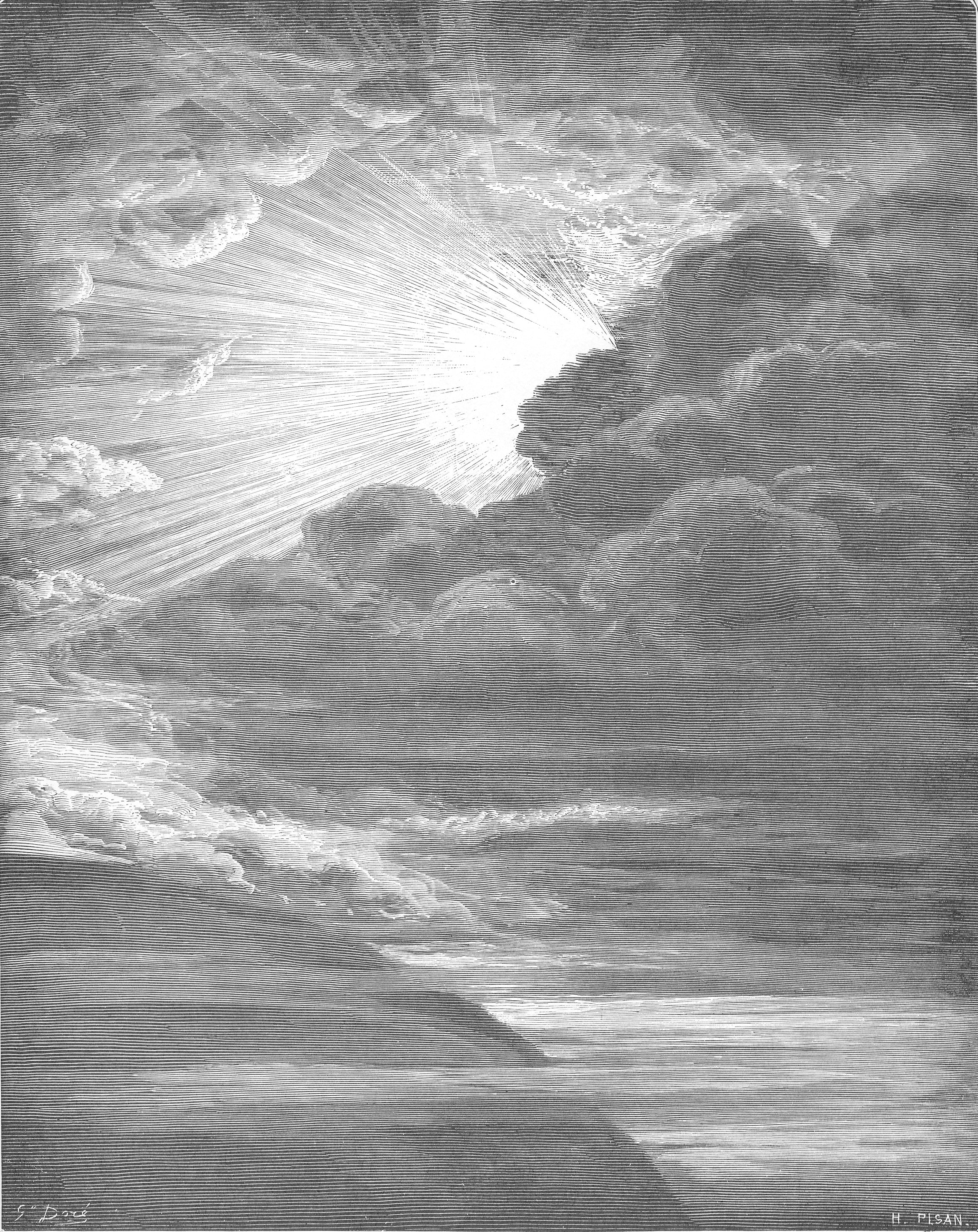
Gustave Doré, The Creation of Light ("And God said, Let there be light," Genesis 1:3), engraved by Héliodore Pisan for La Grande Bible de Tours (1866). Image: public domain, via Wikimedia Commons.
The 30-second version: Every act of meaning has three parts: a speaker, a word, and a breath that carries the word to a hearer. Logicians since Peirce have argued that this three-way relation cannot be broken down into two-way pieces. Scripture names the Creator in exactly those terms: the Father speaks, the Son is the Word, the Spirit is the Breath. If reality is persons in eternal communication, a world of speakers is at home. If reality is impersonal, meaning is a stranger in it. Language does not replace revelation, but it fits the triune God like a key in a lock.
See this page's graph and discover linked topics
In full
The Speaker-Word-Breath Argument is a comparative likelihood argument from the structure of meaningful communication. It has three evidential bases. First, analyses of meaning from independent traditions converge on an irreducibly triadic structure: Peirce's sign relation (sign, object, interpretant), which he held cannot be reduced to dyadic relations; Grice's analysis of speaker meaning as an utterer's intention that an audience respond through recognising that intention; Bühler's organon model, on which every sign is at once an expression of a sender, an appeal to a receiver and a representation of states of affairs; and Austin's distinction of locutionary, illocutionary and perlocutionary acts. Second, meaning does not arise from dyadic physical causation alone: a pattern of sounds produced by waves or thunder is not speech, because it has no speaker who means it (Poythress). Third, Scripture and the Christian tradition describe the Creator in the same triadic terms: the Father who speaks, the Son who is the Word (John 1:1), and the Spirit who is the breath of God (Psalm 33:6; Job 33:4), whom Augustine and Aquinas developed through the analogy of the inner word and love, and whom Poythress (2009) maps onto speaker, speech and breath, and onto speaker, discourse and hearer. The spine (P1 to P5) argues that a reality in which irreducibly triadic, personal communication is basic to every human life is much more expected if the ground of being is itself an eternal communion of Speaker, Word and Breath than on naturalism, whose fundamental level contains no speakers, and modestly more expected than on unipersonal theism, which has an eternal speaker without an eternal Word distinct from Him or an eternal hearer. The argument does not derive the Trinity from linguistics. The doctrine comes from revelation; the argument shows that the shape of language fits it, and the conclusion is confirmatory, not deductive proof. It is distinct from The Three Persons of Grammar Argument, which concerns the grammatical roles of persons (I, you, he); this page concerns the act of meaning itself (speaker, word, breath).
Format note
A braided case runs four kinds of reasoning on one argument instead of choosing one. A deductive spine of numbered premises carries the conclusion, so the argument is valid and every disagreement is forced onto a named premise. Each premise is then held up by an inductive strand (the data that make it probable), an abductive strand (rival explanations of that premise's data, compared on explanatory power, scope, simplicity and how ad hoc they are) and a convergence note (independent disciplines that reach the same premise). A knot checks that the strands are genuinely independent, so no datum is counted twice. A likelihood ledger states, datum by datum, how much more expected the evidence is on theism than on its rival, as honest qualitative ranges, never invented precision. A defeater gate answers the single strongest objection to the whole argument before the cheatsheet.
The spine
| # | Premise |
|---|---|
| P1 | Meaning is triadic. Every act of meaningful communication involves a speaker who means, a word that carries the meaning, and a reception that brings it to a hearer, and this three-place relation does not reduce to pairs of two-place relations. |
| P2 | Meaning is personal. Words mean only because someone means them. Physical cause and effect, which is two-place (this pushes that), produces signals and patterns, but not meaning, unless a mind stands behind them. |
| P3 | The Christian Creator is triadic in exactly this way. Scripture describes God's creative and revealing speech as the Father speaking, the Son as the Word, and the Spirit as the breath that carries the Word and brings it to effect and to understanding, and the persons indwell one another as speaker, word and breath do. |
| P4 | The rivals. On naturalism the fundamental level is impersonal and contains no speakers; on unipersonal theism God is a single speaker with no eternal Word distinct from Himself and no eternal hearer; on Trinitarian theism the ground of being is an eternal Speaker, Word and Breath. |
| P5 | The likelihood principle. If a body of evidence is more expected on one hypothesis than on its rivals, it confirms that hypothesis over them. |
| C | The triadic, personal structure of human language confirms Trinitarian theism over naturalism, and modestly over unipersonal theism. |
Validity. P1 and P2 fix the datum: irreducibly triadic personal communication, basic to every human life. P3 and P4 state how each hypothesis relates to that datum. P5 is the bridge principle. If the datum is more expected on Trinitarian theism (argued under P4 and in the ledger), C follows by P5.
Strength of the conclusion. Confirmatory. The argument raises the probability of Trinitarian theism relative to its rivals; it does not prove the Trinity from language. The doctrine of the Trinity rests on revelation in Christ and Scripture; this argument shows that the world's most human activity is shaped the way that revelation would lead us to expect.
P1, Meaning is triadic
Inductive strand
- Peirce's sign relation. Charles Sanders Peirce analysed every sign as a three-place relation of sign, object and interpretant: a sign stands for an object to an interpreter. He argued that genuinely triadic relations cannot be built from two-place relations, while every relation of four or more places can be built from three-place ones. This "reduction thesis" has been defended formally by Robert W. Burch, A Peircean Reduction Thesis (Texas Tech University Press, 1991), and remains debated (see the objections below).
- Grice on meaning. H. P. Grice, "Meaning," The Philosophical Review 66 (1957), analysed what it is for a speaker to mean something: the speaker intends an audience to respond, and intends the response to come about through the audience's recognising that very intention. Speaker, utterance and audience are all essential to the analysis.
- Bühler's organon model. Karl Bühler, Sprachtheorie (Jena: Gustav Fischer, 1934; English, Theory of Language, trans. Donald Fraser Goodwin, Benjamins, 1990), described every linguistic sign as having three functions at once: expression (it is a symptom of the sender), appeal (it is a signal to the receiver) and representation (it is a symbol of objects and states of affairs).
- Austin's speech acts. J. L. Austin, How to Do Things with Words (Oxford: Clarendon Press, 1962), distinguished three dimensions of every utterance: the locutionary act (saying something with a meaning), the illocutionary act (what is done in saying it, such as promising or warning) and the perlocutionary act (the effect produced in the hearer).
- Everyday experience. Nobody has ever communicated anything without a communicator, a message and a reception. Even talking to yourself divides you into speaker and hearer, as Poythress notes of soliloquy.
Abductive strand
| Explanation of P1's data | Explanatory power | Scope | Simplicity | Ad hoc? |
|---|---|---|---|---|
| Communication is triadic because its archetype, God's own speaking, is triadic | High: predicts both the threefold structure and its irreducibility | Covers speech, writing, gesture and inner thought | One source for all of it | No; the doctrine was held for other reasons long before semiotics |
| Communication is triadic because any channel needs a sender, a message and a receiver | Good for the bare count | Covers engineered signals too | Simple | No, but it explains why the parts exist, not why meaning cannot be reduced to them |
| The triads are imposed by the analyst; one can count two, six or more | Weak for the convergence of independent analyses | Narrow | Simple | Partly; it has to treat four independent traditions as coincidence |
Convergence
Four traditions reach P1 by different routes: American pragmatist logic (Peirce), German psychology of language (Bühler), Oxford ordinary-language philosophy (Austin) and analytic philosophy of mind (Grice). None was trying to support Christian doctrine. Their triads are not identical, and the knot below counts them carefully, but they agree that meaning involves an irreducible relation among one who means, what is meant or said, and one to whom it is meant.
Objections and rebuttals
- "Jakobson counted six factors of communication, not three." Rebuttal. Roman Jakobson's 1960 model added context, contact and code to Bühler's three. But those additions are conditions of the channel, not new parties to the meaning. The core relation is still one who means, what is said, and one who understands. And if Peirce's reduction thesis holds, any larger relation can be analysed into triads, while triads cannot be analysed into pairs.
- "Peirce's reduction thesis is disputed." Rebuttal. True. Some logicians argue that whether triads are irreducible depends on which logical operations you allow (Sergiy Koshkin surveys the debate in Transactions of the Charles S. Peirce Society, 2022). The argument does not need the strong mathematical thesis. It needs only the weaker point on which Peirce, Grice and Bühler agree: that meaning, unlike pushing and pulling, essentially involves three roles.
- "You can find threes anywhere if you look." Rebuttal. Yes, which is why the argument does not rest on the number three by itself. It rests on a specific triad (one who means, what is meant, one who receives) that is irreducible, personal, and named in the same terms in Scripture.
P2, Meaning is personal
Inductive strand
- The waves-and-thunder test. Vern Poythress, In the Beginning Was the Word (Crossway, 2009), ch. 4, notes that if something that sounded like a speech turned out to be produced by waves or thunder, we would conclude either that it was not speech at all, or that someone (God, or a spirit) was speaking through it. A speech without a speaker is "virtually an impossibility."
- Intentionality. Philosophers since Franz Brentano have called the "aboutness" of thoughts and words intentionality. A word is about something only because a mind takes it to be. Ink marks and air vibrations, considered only physically, are not about anything.
- Grice's two kinds of meaning. Grice distinguished "natural meaning" ("those spots mean measles") from "non-natural meaning" ("those three rings on the bell mean the bus is full"). Natural meaning is just cause and effect. Non-natural meaning, the kind language has, requires a speaker's intention.
- Physical causation is two-place. The basic relations of physics are dyadic: this body attracts that one, this particle collides with that one. Peirce himself contrasted such "brute" dyadic action with the triadic action of signs.
Abductive strand
| Explanation of P2's data | Explanatory power | Scope | Simplicity | Ad hoc? |
|---|---|---|---|---|
| Meaning is personal because the source of all things is personal and speaks | High: meaning is at home in a world made by a speaker | Covers every meaningful act | Simple | No |
| Meaning emerges from complex physical systems once they are complex enough | Moderate: describes when meaning appears, not what it is | Broad | Simple to state | Partly; it relies on a promissory note about emergence |
| Meaning is an illusion; there are only causal signals (eliminativism) | Low: the claim is itself meant to be meaningful | Total | Simple | Self-undermining |
Convergence
P2 is reached by the philosophy of mind (Brentano's intentionality), the philosophy of language (Grice's non-natural meaning), semiotics (Peirce's contrast of dyadic and triadic action) and Christian theology (Poythress). It also supports the Argument from Reason; across the codex that overlap should be counted once.
Objections and rebuttals
- "Computers and language models produce meaningful text without a speaker." Rebuttal. They produce text that is meaningful to us because human speakers wrote the data they were trained on and human readers interpret their output. Their meaning is borrowed from persons at both ends, which illustrates P2 rather than refuting it.
- "Animals signal without being persons." Rebuttal. A bee's dance or a vervet monkey's alarm call is real communication, and it is triadic in form (sender, signal, receiver). But it is closer to Grice's natural meaning: fixed, tied to the immediate situation, and without the open-ended, rule-governed meaning of human language. Animal signals show the triadic pattern runs through creation; human language shows it in its fully personal form.
P3, The Christian Creator is triadic in exactly this way
Inductive strand
- The Old Testament pattern. "By the word of Jehovah were the heavens made, And all the host of them by the breath of his mouth" (Psalm 33:6, ASV). The Hebrew has dabar (dabar, word) and ruach (ruach, breath, wind or spirit) side by side. In Genesis the Spirit of God is over the waters (Genesis 1:2) and then "God said, Let there be light" (Genesis 1:3). "The Spirit of God hath made me, And the breath of the Almighty giveth me life" (Job 33:4, ASV).
- The Son as the Word. "In the beginning was the Word, and the Word was with God, and the Word was God" (John 1:1, ASV). The Greek is logos, and the Word is "with" God, pros God: distinct from the Father yet God. Hebrews calls the Son the one who upholds all things "by the word of his power" (Hebrews 1:3).
- The Spirit as breath, hearer and bearer of the Word. Jesus breathes on the disciples and says "Receive ye the Holy Spirit" (John 20:22, ASV). The Spirit "shall not speak from himself; but what things soever he shall hear, these shall he speak" (John 16:13, ASV). Scripture itself is "inspired of God," theopneustos, literally God-breathed (2 Timothy 3:16).
- The tradition's analogy. Augustine, De Trinitate book 15, compared the Son to the inner word a mind forms when it knows, and the Spirit to love. Aquinas, Summa Theologiae I, q. 27, described the two divine processions as the procession of a word by way of intellect and of love by way of will, and in q. 34 argued that "Word" is a proper name of the Son.
- Poythress's synthesis. Poythress (2009), ch. 2 and 4, puts these together: the Father is speaker, the Son is the speech, and the Spirit is the breath carrying the speech to its destination and bringing about its effects; in another aspect, the Spirit is the hearer who receives the Word (John 16:13). Because the persons indwell one another, speaker, speech and breath indwell one another in every act of communication: the speech dwells in the speaker, the speaker is known through the speech, and the breath carries nothing unless it carries a speech.
Abductive strand
| Explanation of P3's data | Explanatory power | Scope | Simplicity | Ad hoc? |
|---|---|---|---|---|
| Scripture describes God this way because God is Father, Word and Spirit | High | Covers both Testaments and the creeds | Simple | No |
| The pattern is a later Christian reading imposed on Hebrew poetry | Moderate for Psalm 33:6 taken alone | Does not cover John's deliberate logos | Simple | Partly; John's prologue was written as theology of the Word |
| The pattern is poetic parallelism with no doctrinal weight | Moderate for the Psalms | Weak for John and Hebrews | Simple | No, but it leaves the New Testament usage unexplained |
Convergence
Hebrew poetry, the Johannine prologue, the Pauline and Petrine language of inspiration, Latin theology (Augustine, Aquinas), and a modern Reformed linguist (Poythress was a student of the linguist Kenneth L. Pike) all describe God's speech in the same three terms.
Objections and rebuttals
- "The psalmist was not thinking of the Trinity." Rebuttal. Probably not in the developed sense. The argument does not need him to have been. It needs only that the Creator Scripture describes acts through word and breath, and that the New Testament identifies the Word and the Spirit as divine persons. Progressive revelation is how the Old Testament pattern gains its full meaning.
- "Breath is just a metaphor." Rebuttal. All human language about God is analogical. The question is whether the analogy is apt, and Scripture chose it repeatedly, in Hebrew (ruach) and Greek (pneuma, pneuma), which both mean breath, wind and spirit.
P4, The rivals
Inductive strand
- Naturalism. On naturalism the fundamental entities are fields and particles interacting by physical law. There are no speakers at the base of reality, so speakers, meanings and hearers must appear late and locally.
- Unipersonal theism. In unitarian forms of theism (for example the Tawhid of classical Islam, or Oneness theology), God is one person. Before creation there is no one to whom He speaks, and no Word distinct from Him who is also God.
- A revealing concession. Classical Sunni theology (the Ash'ari school) held that God's speech (kalam) is an eternal attribute subsisting in His essence, so that the Quran as God's speech is uncreated, against the Mu'tazila, who held it was created. That debate shows how strongly unipersonal theism feels the pull toward an eternal Word, without being able to say who receives it.
- Trinitarian theism. Here communication is eternal: the Father loves the Son "before the foundation of the world" (John 17:24), the Word is eternally "with God," and the Spirit eternally receives and bears what the Father speaks in the Son.
Abductive strand
| Hypothesis | Does it contain speakers at the ground? | Does it contain an eternal Word? | Does it contain eternal reception? | Fit with P1 and P2 |
|---|---|---|---|---|
| Trinitarian theism | Yes | Yes | Yes | Close |
| Unipersonal theism | Yes | Only as an attribute, not a person | No | Partial |
| Naturalism | No | No | No | Poor |
Convergence
The contrast between naturalism and theism on P2 is drawn by secular philosophers too: Thomas Nagel, Mind and Cosmos (2012), argued that materialist naturalism cannot account for mind and meaning. The contrast between Trinitarian and unipersonal theism is drawn within the Christian tradition (Augustine, Richard of St. Victor) and is pressed in modern debate about whether God's love and speech require eternal relation.
Objections and rebuttals
- "Naturalism can let meaning emerge late." Rebuttal. It can posit that, and the argument grants it is possible. The argument is comparative: a late, local emergence of meaning from a speakerless base is less expected than meaning in a world whose source is a speaker.
- "A unipersonal God can speak to Himself." Rebuttal. Then He divides Himself into speaker and hearer, as a person does in soliloquy, which is either a real distinction in God (moving toward the Trinity) or only a manner of speaking (leaving the eternal hearer absent).
P5, The likelihood principle
Inductive strand
The principle is standard in probability theory and the philosophy of science: evidence E confirms hypothesis H1 over H2 when E is more probable given H1 than given H2. It is used throughout the sciences and in the codex's other braided cases.
Abductive strand
No serious rival principle is offered; critics usually dispute the likelihood judgments, not the principle.
Convergence
Bayesian confirmation theory and ordinary inference to the best explanation agree here.
Objections and rebuttals
- "The likelihoods are subjective." Rebuttal. They are judgments, and the ledger states them as ranges, not numbers. Anyone who disagrees must say which row is wrong and why, which moves the debate to the evidence.
The knot
The strands are independent in method and history. Peirce (logic and semiotics), Bühler (psychology of language), Austin (ordinary-language philosophy) and Grice (analytic philosophy of meaning) worked in different traditions and countries, and none argued for theism. The theological strand (Psalms, John, Augustine, Aquinas) predates all of them by many centuries. Poythress is the bridge between the two and is counted as interpretation, not as independent data. Two overlaps are counted once. First, Grice and Austin both work in the analytic tradition and their triads overlap. Second, the personal nature of meaning (P2) also supports the Argument from Reason and Argument from Consciousness; across the codex it should be counted once. The distinctive datum here is the triadic shape of meaning and its match to Speaker, Word and Breath.
The ledger
Prior-agnostic: the ledger asks only how expected each datum is under each hypothesis. The ratings are judgments argued above, not measurements.
| Datum | How expected on Trinitarian theism | How expected on naturalism | Favours | Why | Independent? |
|---|---|---|---|---|---|
| Communication requires sender, message and receiver | High | High | Neither much | Any channel needs these parts | Yes |
| Meaning is irreducibly triadic, not built from pairs | High | Moderate | Theism, slightly to modestly | Naturalism's basic relations are dyadic | Partly overlaps the row above |
| Meaning exists only where someone means | High | Low to moderate | Theism, modestly to clearly | Shared with arguments from reason; count once | Partly |
| The same triad names the Creator in Scripture | High on the Trinity | Not applicable | Trinity over unipersonal theism | Only a plurality of persons has eternal Word and reception | Comparative |
| Communication as eternal, not only after creation | High on the Trinity | Not applicable | Trinity over unipersonal theism, modestly | Unipersonal theism lacks an eternal hearer | Comparative |
Net. Against naturalism the force comes from the personal row: if meaning exists only where someone means, a speakerless ground is a poor fit. The triadic row adds a little, because naturalism can explain the bare count functionally. Against unipersonal theism the advantage is modest and rests on the eternity of communication. The argument contributes a distinct communicative strand to the Cumulative Case for Christian Theism.
The defeater gate
The numerology objection. The strongest objection is that the argument finds threes because it looks for threes. Communication engineers draw diagrams with five boxes (source, transmitter, channel, receiver, destination), Jakobson with six, and one could count two (speaker and hearer). Christians have always found trinities in nature (Augustine's memory, understanding and will; Sayers's idea, energy and power in a writer's work), and none of those analogies proves anything. Choose the right level of description and any doctrine can be found in any structure.
The reply has three parts.
- Grant the danger, then narrow the claim. Augustine himself warned that every created trinity falls short of the divine one (De Trinitate 15). The argument does not say every triad in nature reveals God. It says one specific triad (one who means, what is meant, one who receives) is irreducible and personal, and that Scripture names the Creator in those same terms, before any philosopher noticed the structure.
- The direction of discovery matters. The biblical vocabulary (word and breath in Psalm 33:6, the Word in John 1:1) came first. The semiotic analyses came eighteen centuries later and from people who were not looking for the Trinity. A prediction confirmed by independent investigators is not numerology.
- The personal row carries the weight. Even if the count of three were set aside entirely, P2 remains: meaning exists only where a person means. That fits a Creator who speaks, and the Christian claim that His speaking is eternal requires a Word and a receiver who are as eternal as He is.
What the gate concedes: someone who holds that meaning reduces to physical causation after all (rejecting P2), and that the triadic analyses are artifacts of description (rejecting P1), can resist the argument. Its strength depends on those premises, which are serious but debated.
Concessions
- Grant: any channel has a sender, a message and a receiver. Now collect: then every act of meaning is a relation of persons through a word, and that is the datum to be explained.
- Grant: the Trinity cannot be proved from linguistics. Now collect: then the only question is fit, and a world of speakers fits a speaking Creator better than a speakerless one.
- Grant: Christians have overused natural "trinities." Now collect: the Speaker, Word and Breath pattern is not a later analogy but the Bible's own vocabulary for how God creates.
Cheatsheet
The 30-second version (read aloud). Whenever you understand me, three things happen: I mean something, I say a word, and my breath carries it to you. Logicians like Peirce argued you cannot break that three-way relation into two-way pieces, and you never get meaning from mere physics: waves that happened to spell a word are not speaking. Now open the Bible: "By the word of the Lord were the heavens made, and all their host by the breath of his mouth." The Father speaks, the Son is the Word, the Spirit is the Breath. If reality is persons in eternal communication, a world of speakers is home. If reality is impersonal, meaning is an orphan.
Fast facts:
- Peirce analysed every sign as a three-place relation (sign, object, interpretant) and held that triadic relations cannot be reduced to dyadic ones.
- Bühler (1934): every sign expresses a sender, appeals to a receiver and represents something.
- Grice (1957): to mean something is to intend an audience to respond through recognising your intention.
- Psalm 33:6 puts dabar (word) and ruach (breath) side by side in creation.
- Ruach and pneuma both mean breath, wind and spirit.
- Augustine (De Trinitate 15) and Aquinas (Summa Theologiae I, q. 27 and 34) explained the Son as the Word the Father speaks.
- Poythress (2009): Father as speaker, Son as speech, Spirit as breath and hearer.
The closing line. You cannot say a single sentence without a speaker, a word and a breath; Christians think that is because you were made by one.
Cross-examination
Round 1, Is meaning just physics?
- Q: If waves on a beach happened to form the letters "HELP," would the beach be asking for help?
- If they say: No. Then: So meaning needs someone who means. Where in a wholly impersonal universe is that someone at the foundation?
- If they say: It depends on who reads it. Then: Then you have just named the third party, the hearer. Meaning still needs persons.
Round 2, Why three?
- Q: Can you describe a single act of communication without a communicator, a message, or a recipient?
- If they say: You can talk to yourself. Then: Then you are both speaker and hearer, two roles and a word, still three.
Round 3, Which God?
- Q: Before creation, to whom did a unipersonal God speak?
- If they say: No one; He spoke only after creating. Then: Then speech, the most personal thing we know, is not part of His eternal life. On the Trinity it always was.
Dodge table
| Dodge | What it concedes | Reply |
|---|---|---|
| "Language evolved, so no explanation is needed." | That language has a history | Evolution explains when speakers arose, not how meaning exists in a speakerless world |
| "You can find threes anywhere." | That the pattern is real | The argument rests on one specific triad, named in Scripture first |
| "Machines make sentences without minds." | That their output means something to us | Its meaning comes from human writers and readers, which is P2 |
Live-cite kit
Scripture (ASV):
- By the word of Jehovah were the heavens made, And all the host of them by the breath of his mouth. (Psalm 33:6, ASV)
- In the beginning was the Word, and the Word was with God, and the Word was God. (John 1:1, ASV)
- And God said, Let there be light: and there was light. (Genesis 1:3, ASV)
- The Spirit of God hath made me, And the breath of the Almighty giveth me life. (Job 33:4, ASV)
- And when he had said this, he breathed on them, and saith unto them, Receive ye the Holy Spirit. (John 20:22, ASV)
Scholarly:
- Vern S. Poythress, In the Beginning Was the Word: Language, A God-Centered Approach (Crossway, 2009), ch. 2 and 4: Father as speaker, Son as speech, Spirit as breath and hearer.
- Augustine, De Trinitate, book 15: the inner word as an image of the Son.
- Thomas Aquinas, Summa Theologiae I, q. 34, a. 1: "Word" is a proper name of the Son.
- Charles Sanders Peirce, the triadic sign relation; Robert W. Burch, A Peircean Reduction Thesis (1991).
- H. P. Grice, "Meaning," The Philosophical Review 66 (1957).
- Karl Bühler, Sprachtheorie (1934).
Aphorism: "No word without a speaker, no speech without breath, no meaning without a hearer, and no Creator without all three."
Connection to Scripture
- Psalm 33:6, creation by word and breath
- Genesis 1:2 and Genesis 1:3, the Spirit over the waters and God's first word
- Genesis 2:7, God breathes the breath of life into man, who becomes a speaking creature
- Genesis 2:19, the first human speech act, naming the animals
- John 1:1 and John 1:14, the eternal Word who became flesh
- John 16:13, the Spirit who hears and speaks
- John 20:22, the risen Son breathes the Spirit
- 2 Timothy 3:16, Scripture as God-breathed
- Hebrews 1:3, the Son upholds all things by His word
Scholarship
Published academic works this page draws on, each matched to a publisher, index or library catalog record.
- J. L. Austin, How to do things with words (Clarendon Press, 1962). Open Library
- Karl Bühler, Sprachtheorie (1934). Open Library
- Robert W. Burch, A Peircean reduction thesis (Texas Tech University Press, 1991). Open Library
- Thomas Nagel, Mind and Cosmos: Why the Materialist Neo-Darwinian Conception of Nature is Almost Certainly False (Oxford University Press, 2012). doi:10.1093/acprof:oso/9780199919758.001.0001
- Charles Sanders Peirce, Collected Papers of Charles Sanders Peirce (1931). Open Library
- Vern Sheridan Poythress, In the Beginning Was the Word (Crossway, 2009). Open Library
- Dorothy L. Sayers, The mind of the Maker (Methuen, 1941). Open Library
- Thomas A. Sebeok, Style in language (1960). Open Library
See also
- Arguments, the master index
- Ris3n Arguments, the hub of ris3n's original arguments
- The Three Persons of Grammar Argument, the sister argument from I, you and he; this page is about the act of meaning, that one about the roles of persons
- Argument from the Pre-Given Logos, Argument from the Naming Convergence and The Babel Argument, other arguments from language
- Logos Christology, the Son as the Word
- Trinity, Social Trinitarianism and Trinity Love-Overflow Argument, the doctrine and a parallel argument from love
- Argument from the One-and-the-Many Convergence, the Trinity and the problem of unity and plurality
- Argument from Reason and Information Argument for Design, where meaning and information also point to mind
- Presuppositionalism and Cornelius Van Til, the tradition Poythress writes from
- Augustine and Thomas Aquinas, who developed the Word analogy
- Unitarian Oneness Binitarian Objection Defeater, the case against unipersonal readings of God
- Cumulative Case for Christian Theism, where this argument contributes
Common questions this page answers
Q: Does language prove the Trinity?
Not by itself. The Trinity is known from revelation in Christ and Scripture. What language shows is a fit: every act of meaning needs a speaker, a word and a breath that carries it to a hearer, and Scripture names the Creator as exactly that, the Father who speaks, the Son who is the Word, and the Spirit who is the breath of God.
Q: Why is the Holy Spirit called breath?
The Hebrew ruach and the Greek pneuma both mean breath, wind and spirit. Psalm 33:6 says the heavens were made by the word of the Lord and their host by the breath of His mouth, and Jesus breathed on His disciples when He said, "Receive ye the Holy Spirit" (John 20:22).
Q: What is Peirce's triadic theory of signs?
Charles Sanders Peirce held that every sign involves three things: the sign, the object it stands for, and the interpretant, the understanding it produces in a mind. He argued that this three-place relation cannot be broken down into two-place relations, unlike physical cause and effect, which is always one thing acting on another.
Q: Why is Jesus called the Word of God?
John 1:1 calls the Son the Logos, the Word, who was with God and was God. A word expresses the mind of the one who speaks it, and the Son perfectly expresses the Father. Augustine and Aquinas developed this by comparing the Son to the inner word a mind forms when it knows.
Q: Can a computer or AI mean what it says?
Language software produces sentences that are meaningful to us, but the meaning comes from the human writers whose text it learned from and from the human readers who interpret it. That supports the argument's point that meaning exists only where persons mean and understand.
Q: How is this different from the Three Persons of Grammar Argument?
The Three Persons of Grammar Argument starts from the grammatical roles every language encodes, I, you and he. This argument starts from the act of meaning itself: someone who means, a word that carries it, and a breath or medium that brings it to a hearer. Both point to the Trinity from different features of language.
Q: Who is Vern Poythress?
Vern S. Poythress is a New Testament scholar at Westminster Theological Seminary, trained in mathematics and linguistics, who studied under the linguist Kenneth L. Pike. His book In the Beginning Was the Word (2009) argues that human language reflects the Trinity, with the Father as speaker, the Son as speech and the Spirit as breath.